
AG3 Batteries: Specifications, Installation, Applications and Equivalents
This guide explains everything you need to know about the AG3 battery, a small button cell used in watches, calculators, medical devices, and toys. It covers the battery’s size, power, and how to install it properly. You’ll also learn about other batteries that can replace the AG3, such as silver oxide and zinc-air types, and how they compare. If you need to change an AG3 battery or find a good alternative, this guide will help you make the right choice.Catalog

What is an AG3 Battery?
The AG3 battery, also known by alternative names such as LR41, 192, and GP192, is a compact alkaline button cell widely used in small electronic devices. With a diameter of 7.9mm and a height of 3.6mm, this battery is designed for low-drain applications, providing efficient and consistent energy output. It is commonly found in digital thermometers, wristwatches, calculators, laser pointers, small toys, and specialized medical instruments. Operating at a nominal voltage of 1.5V, the AG3 battery ensures reliable device performance without frequent replacements. Its ability to maintain a steady output over time enhances the lifespan and effectiveness of the devices it powers.
One of its advantages is its extended shelf life, makes it ideal for emergency equipment and backup power sources in safety devices, ensuring readiness when needed. While the AG3 primarily uses alkaline chemistry, silver oxide alternatives like the SR41 provide a more stable voltage output throughout their use, making them preferable for precision instruments. Replacing an AG3 battery is a simple process due to its standard size and compatibility with multiple devices. You can replace it effortlessly without requiring special tools or specialized skills. This ease of replacement ensures minimal downtime, allowing electronic devices to remain fully functional with little interruption.
Specifications and Features of the AG3 Battery
• Size: 7.9mm (diameter) × 3.6mm (height)
• Voltage: 1.5V
• Capacity: 40mAh
• Variants:
Alkaline (AG3) – standard version.
Silver Oxide (SR41) – longer-lasting with steady voltage output.
• Lifespan: Up to 3 years when stored in a cool, dry place.
• Usage: Common in wearables, medical instruments, and precision devices.
• Easy Replacement: Standard size ensures compatibility across devices.
Guide to Installing the AG3 Battery
Proper installation of an AG3 battery is important for maintaining reliable device performance. Follow these steps to ensure a smooth replacement process:
1. Locate the Battery Compartment
To begin, identify the battery compartment on your device, as its location may vary depending on the design. Some devices have a dedicated battery cover secured with screws, requiring a small screwdriver for access. Others feature a sliding panel that can be pushed open with minimal effort, often found in remote controls or small electronic gadgets. In certain cases, especially with compact devices like watches or hearing aids, a latch mechanism may need to be lifted to access the battery slot. Be sure to handle the device carefully to avoid damaging delicate components during this step. If you're unsure of the compartment’s exact location, refer to the manual for detailed instructions. Some devices may have small icons or labels indicating where to open the battery housing, making identification easier.
2. Remove the Old Battery
If your device already contains a battery, you must carefully remove it before inserting a new one. Begin by noting how the battery is positioned for the proper functioning of the replacement. Some batteries may have a snug fit, requiring the use of a small tool like tweezers to gently lift them out. When handling button cell batteries, avoid using excessive force, as they are delicate and can be damaged easily. Ensure your hands are dry and free of any moisture or oil, as this can affect battery performance. Dispose of the old battery properly, as these small power cells contain materials that should not be discarded in regular trash. If you notice any corrosion or residue in the battery compartment, clean it carefully with a dry cotton swab before proceeding. Taking these precautions will help maintain the integrity of the device and ensure optimal performance from the new battery.
3. Insert the New Battery
When inserting a new AG3 battery, align it correctly according to the device’s specified polarity. The positive (+) side is marked on the battery itself and should face the direction indicated in the device’s battery compartment. Failure to install the battery correctly can prevent the device from functioning or even cause damage to its internal components. If your device requires multiple AG3 batteries, ensure each one is inserted in the proper sequence, maintaining consistent polarity throughout. Some devices have metal contacts or springs that help guide battery placement, so be sure the battery sits securely within these connectors. Double-check the positioning before proceeding to avoid unnecessary troubleshooting later. A correctly placed battery will fit snugly without forcing it, ensuring a stable power connection and efficient operation of the device.
4. Secure the Battery Compartment
Once the new battery is in place, the next step is to securely close the battery compartment to prevent any movement. For devices with a screw-on cover, ensure the cover is tightened properly to maintain a firm connection between the battery and the device’s electrical contacts. If your device has a latch or sliding cover, make sure it clicks or locks into place to avoid accidental opening during use. Some models, such as the MOB MO8193 laser pointer, require multiple AG3 batteries to be stacked in a specific orientation before securing the compartment. In these cases, double-check that all batteries are properly aligned with the negative (-) side facing up before sealing the compartment. If the cover does not close easily, do not force it, as this could indicate that the battery is not seated correctly. A properly closed compartment ensures that the battery remains stable and prevents any interruptions in power. Taking a moment to verify the security of the battery housing will help maintain the longevity and functionality of your device.
5. Test the Device
After securing the battery compartment, it is important to test the device immediately to confirm that the battery is correctly installed and functioning as expected. Turn on the device or press the activation button to check for any signs of power, such as an LED light, sound, or movement, depending on the device type. If the device does not turn on, double-check the battery orientation and ensure it is making proper contact with the terminals. In some cases, removing and reinserting the battery can resolve minor connectivity issues. If the device still fails to function, inspect the battery compartment for any debris or corrosion that could be interfering with the connection. Ensure that the new battery is not defective by testing it in another compatible device if possible. Successfully testing the device after battery replacement ensures that it is ready for use and prevents unnecessary troubleshooting later on.
Zinc-Air Batteries as Alternatives to AG3
Zinc-air batteries offer a viable alternative to AG3 batteries, providing comparable voltage and dimensions while delivering enhanced performance through a unique chemical process. Unlike AG3 batteries, which use alkaline chemistry, zinc-air batteries generate power through a reaction with oxygen from the air. This process results in higher energy density, allowing them to last longer than standard alkaline batteries. Zinc-air batteries can provide up to 50% more energy than AG3 batteries, making them ideal for long-term use in low-drain devices such as hearing aids and digital watches.

Figure 2. Zinc-Air Batteries
Their ability to continuously generate energy from air contributes to prolonged operation. These batteries are mercury-free and contain fewer harmful substances compared to traditional alkaline batteries, reducing environmental impact upon disposal. Their use of oxygen as a reactant further minimizes ecological footprint. Since zinc-air batteries rely on air for power generation, they perform best in devices with adequate ventilation. For applications requiring long-lasting and eco-friendly power, zinc-air batteries serve as an efficient and sustainable alternative to AG3 batteries.
AG3 Battery Equivalents and Compatibility
AG3 batteries are widely used across various devices, leading to multiple interchangeable designations. The most common equivalent is the LR41, which shares the same dimensions, voltage, and chemistry.
LR41
The LR41 battery is a small, button-cell battery commonly used in watches, medical devices, and small electronics. It has a nominal voltage of 1.5V and is made using alkaline chemistry, providing reliable power for low-drain applications. While it is a popular choice for budget-friendly applications, its lifespan is shorter than that of silver oxide equivalents. Due to its compact size, it is often used in hearing aids, laser pointers, and small calculators. LR41 batteries are widely available and are interchangeable with other similar-sized batteries with minor voltage differences. However, they may experience voltage drops over time, affecting performance in precision devices. If a longer-lasting option is needed, silver oxide versions like the SR41 can be used instead.

Figure 3. LR41 Battery
SR41
The SR41 battery is a silver oxide button cell known for its stable voltage and long-lasting performance. It provides a nominal voltage of 1.55V, slightly higher than its alkaline counterpart, LR41. Due to its consistent power output, it is often used in precision instruments like digital thermometers, watches, and calculators. Unlike alkaline batteries, the SR41 maintains its voltage more steadily over time, making it ideal for devices requiring consistent energy levels. This battery has a longer lifespan, reducing the frequency of replacements in devices with moderate power consumption. The silver oxide chemistry also provides better resistance to leakage compared to alkaline alternatives. Because of these advantages, SR41 batteries are preferred for applications that require reliability.

Figure 4. SR41 Battery
SR41W
The SR41W battery is a high-drain silver oxide battery designed for devices that require a steady and strong power supply. It has a voltage of 1.55V, making it a suitable alternative to alkaline LR41 batteries. The "W" designation indicates that it is optimized for applications that demand higher energy output, such as cameras, hearing aids, and digital thermometers. Due to its silver oxide composition, it delivers a more stable voltage throughout its lifespan, preventing performance fluctuations in sensitive devices. It also has a longer shelf life compared to alkaline equivalents, making it a more cost-effective choice in the long run. This battery is commonly used in medical equipment with consistent power. When replacing LR41 in high-drain devices, the SR41W is a superior option.
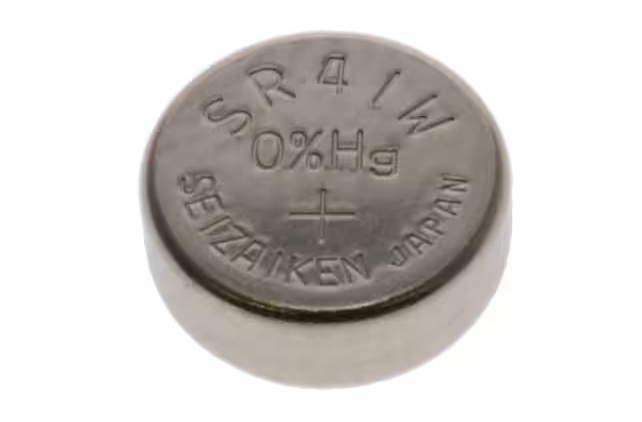
Fgure 5. SR41W Battery
SR41SW
The SR41SW is a silver oxide button cell battery designed for low-drain devices requiring long-lasting, stable voltage. With a nominal voltage of 1.55V, it is commonly used in wristwatches, analog thermometers, and small electronic gadgets. The "SW" in its name stands for "low-drain," indicating its efficiency in devices that draw minimal power over extended periods. Unlike alkaline batteries, which gradually lose voltage, the SR41SW maintains a steady energy supply until it is nearly depleted. This characteristic makes it useful for precision instruments that require accurate and consistent performance. It is less prone to leakage compared to alkaline alternatives, ensuring the safety of delicate electronic components. The SR41SW is an excellent choice who need a reliable and long-lasting power source for small devices.

Figure 6. SR41SW Battery
192
The 192 battery is an alkaline button cell equivalent to LR41 and is often used in small electronic devices. With a nominal voltage of 1.5V, it serves as a cost-effective power source for calculators, laser pointers, and some hearing aids. It is an interchangeable alternative to other batteries with similar size and specifications, though its performance may vary depending on the device. Like other alkaline button cells, the 192 battery experiences gradual voltage decline over time, which may affect performance in sensitive electronics. It is widely available and an affordable choice for low-drain applications that do not require a constant voltage supply. However, for more demanding devices, a silver oxide variant like SR41 or 384 may be a better option. Despite its limitations, the 192 battery remains a popular choice for everyday use.
384
The 384 battery is a silver oxide button cell that provides a consistent voltage of 1.5V throughout its lifespan. It is often used in wristwatches, medical devices, and small electronics that require stable and long-lasting power. Compared to alkaline alternatives like the 192 or LR41, the 384 offers superior longevity and reliability. It maintains a steady voltage output, making it ideal for precision instruments that cannot tolerate power fluctuations. Due to its silver oxide chemistry, the 384 battery is also less prone to leakage, ensuring the safety of delicate electronic components. It is a preferred choice for applications where battery longevity and consistent performance are important.
RW87
The RW87 battery is a small, round button cell commonly used in watches, calculators, and compact medical devices. It delivers a nominal voltage of 1.5V, making it a suitable replacement for LR41 and other similar batteries. This battery is available in both alkaline and silver oxide variations, with the silver oxide version offering better longevity and consistent voltage. The RW87 is known for its compatibility with a variety of electronic devices, making it a versatile choice. It provides a steady power supply, ensuring smooth operation in applications requiring low but reliable energy consumption. Due to its compact size, it is frequently used in small gadgets where space is limited. If a device requires a longer-lasting battery, the silver oxide version of RW87 is recommended over the alkaline one.
V3GA
The V3GA battery is a 1.5V alkaline button cell widely used in small electronic devices. It is interchangeable with LR41, 192, and other similar-sized batteries, making it a flexible replacement option. This battery is often found in digital thermometers, laser pointers, and small remote controls. Like other alkaline button cells, the V3GA gradually loses voltage over time, which may impact performance in sensitive devices. It is a cost-effective solution for applications that do not require a steady voltage supply. However, for high-precision or long-lasting performance, a silver oxide alternative like the SR41 or 384 battery is preferable. Despite its shorter lifespan, the V3GA remains a widely available and affordable choice for everyday use.
Advantages of the AG3 Battery
Stable Voltage Output
The AG3 battery provides a consistent 1.5V output, ensuring reliable performance in precision devices. This steady voltage supply is important for devices like digital thermometers, watches, and calculators, which require uninterrupted power to function accurately. Unlike some batteries that experience rapid voltage drops, the AG3 maintains its voltage stability until it is nearly depleted. This characteristic helps prevent malfunctions or inaccuracies in electronic devices that depend on a constant power source. It is beneficial in medical equipment, where even slight fluctuations in power can affect readings. The stable voltage also extends the efficiency of the battery, allowing devices to run smoothly for a longer period. Due to this advantage, AG3 batteries are widely used in applications that require dependable and precise energy output.
High Energy Density
Despite its small size, the AG3 battery has a high energy density, making it an efficient power source for compact devices. It stores a significant amount of energy in a tiny button cell, ensuring prolonged use in low-drain applications. This feature is beneficial for watches, hearing aids, and small remote controls, which require long-lasting performance. The high energy density also reduces the need for frequent battery replacements, saving time and effort. Compared to larger batteries, AG3 delivers a remarkable amount of power without adding bulk to the device. This makes it an ideal choice for miniature gadgets where space is limited but reliable energy is needed. Thanks to its efficiency, AG3 batteries are favored in industries for compact and lightweight power sources.
Mercury-Free Design
AG3 batteries are designed to be mercury-free, making them safer for both users and the environment. Older button-cell batteries contained mercury, which posed a risk of toxic contamination when disposed of improperly. By eliminating mercury, AG3 batteries comply with modern environmental regulations and reduce hazardous waste. This eco-friendly design allows for safer disposal and minimizes pollution in landfills and water sources. Mercury-free batteries also reduce health risks associated with accidental leakage or improper handling. Many countries have restricted the sale of mercury-containing batteries, making AG3 a compliant and responsible choice. With its environmentally friendly composition, the AG3 battery supports sustainable energy solutions while maintaining excellent performance.
Long Shelf Life
The AG3 battery has a long shelf life, remaining effective for up to three years when stored properly. This makes it a reliable option for devices that are not used frequently but require immediate functionality when needed. Proper storage conditions, such as keeping the battery in a cool, dry place, help preserve its energy capacity. Unlike some batteries that degrade quickly even when unused, AG3 batteries retain their charge well over time. This ensures that spare batteries remain functional for emergencies or replacements. Because of this advantage, AG3 batteries are an excellent choice for both household and industrial use.
Applications of AG3 Batteries
Watches and Clocks
AG3 batteries are widely used in wristwatches and small clocks because of their compact size and reliable energy output. These batteries provide a steady 1.5V power supply, ensuring accurate timekeeping over extended periods. Unlike some batteries that gradually lose voltage, AG3 batteries maintain a stable current, preventing time drift in precision watches. Their small size allows them to fit seamlessly into slim and delicate watch designs without adding unnecessary bulk. Many quartz watches rely on AG3 batteries for smooth and uninterrupted operation. With their long lifespan, you do not have to frequently replace the battery, reducing maintenance efforts. Since AG3 batteries are mercury-free, they are also a safer and more environmentally friendly choice for timepieces. Thanks to their reliability, AG3 batteries are a preferred power source for both analog and digital watches.
Calculators and Thermometers
AG3 batteries are important in devices like calculators and digital thermometers, where consistent power is required for accurate results. The stable voltage of 1.5V ensures that mathematical calculations and temperature readings remain precise. In digital thermometers, a sudden voltage drop could lead to inaccurate temperature measurements, making AG3 batteries a reliable choice. Similarly, in calculators, a steady power supply ensures smooth and uninterrupted calculations without glitches or shutdowns. The small size of AG3 batteries allows them to fit into slim, portable devices without compromising battery life. Many scientific and financial calculators use AG3 batteries because of their efficiency in low-drain applications. Since these batteries have a long shelf life, spare units can be stored for years without power loss.
Medical Devices
AG3 batteries play a role in medical devices such as glucose meters and pulse oximeters. These devices require a stable power source to deliver accurate health readings, making the AG3 battery an ideal choice. In glucose meters, a reliable battery ensures that blood sugar measurements are precise for diabetes management. Similarly, in pulse oximeters, steady power is needed to provide accurate oxygen saturation and heart rate readings. AG3 batteries are designed to maintain their voltage output over time, preventing sudden failures in health devices. Their compact size allows them to fit into portable medical tools without increasing weight or bulk. Since medical devices often require dependable and long-lasting energy, AG3 batteries are preferred due to their efficiency and reliability. With their mercury-free composition, they are also safer for use in health-related applications.
Toys and LED Accessories
AG3 batteries are commonly used in small electronic toys and LED accessories due to their compact size and stable voltage. Many miniature toys, including light-up rings, keychain gadgets, and novelty flashing items, rely on AG3 batteries for power. The battery’s consistent energy output ensures that LED accessories, such as decorative lights and illuminated pens, function efficiently. Since LED devices require a steady voltage to maintain brightness, AG3 batteries are an excellent choice for prolonged use. The lightweight and small form factor of these batteries make them ideal for compact, handheld electronic toys. In children’s toys, AG3 batteries provide long-lasting power without the risk of mercury exposure. Their ability to deliver reliable energy over time means less frequent battery replacements, reducing overall maintenance costs. With their durability and efficiency, AG3 batteries continue to be a popular power source for fun and creative electronic products.
Laser Pointers and Remote Controls
AG3 batteries are widely used in laser pointers and remote controls, where a reliable and long-lasting power source is required. Laser pointers depend on a consistent voltage supply to produce a strong, stable beam without flickering. In remote controls for small devices, AG3 batteries provide quick and reliable signal transmission. Because of their stable 1.5V output, these batteries ensure that laser pointers remain bright and functional throughout their lifespan. The compact size of AG3 batteries allows them to fit seamlessly into slim, portable remote control designs. Many presentation pointers, pet toys, and key fob remotes utilize AG3 batteries for their efficiency and longevity. Their long shelf life makes them ideal for backup batteries in remote-controlled gadgets that are used intermittently.
Conclusion
The AG3 battery is a simple and reliable power source for many small electronic devices. It lasts a long time, is easy to replace, and works well in everyday gadgets. While other batteries like SR41 and zinc-air can be used instead, the AG3 remains a great option. By understanding how it works and what to use it for, you can keep your devices running smoothly without hassle.
About us
ALLELCO LIMITED
Read more
Quick inquiry
Please send an inquiry, we will respond immediately.
Frequently Asked Questions [FAQ]
1. Are AG3 and 392 batteries the same?
AG3 and 392 batteries are similar in size and shape but have differences in composition and performance. AG3 is an alkaline button cell, while 392 is a silver oxide button cell. Silver oxide batteries like the 392 offer more stable voltage and longer lifespan, making them preferable for precision devices like watches. While AG3 can substitute for 392 in some cases, it may not last as long or provide consistent voltage.
2. What does AG mean on a battery?
"AG" stands for Alkaline Button Cell in battery labeling. It is a common designation for small, round, disposable batteries that use an alkaline electrolyte. These batteries are used in low-power devices like calculators, remote controls, and small toys.
3. What is the difference between AG3 and LR41 batteries?
AG3 and LR41 are functionally the same; both refer to an alkaline button cell with a 7.9mm diameter and 3.6mm height. The difference is in the naming convention, AG3 is a generic term, while LR41 follows the IEC (International Electrotechnical Commission) standard. Some brands may use "AG3," while others use "LR41," but they are interchangeable.
4. Is AG3 the same as 312?
No, AG3 and 312 batteries are not the same. While both are small button cells, the 312 battery is a zinc-air type, mainly used in hearing aids. Zinc-air batteries have a different voltage (typically 1.45V vs. 1.5V for AG3) and rely on air activation, making them unsuitable replacements for AG3.
5. Can I replace LR41 with LR44?
No, LR41 and LR44 are not direct replacements due to size differences. LR41 measures 7.9mm in diameter and 3.6mm in height, while LR44 is 11.6mm in diameter and 5.4mm in height, making it greatly larger and incompatible with devices designed for LR41. However, if the device has enough space, LR44 may work since both batteries provide 1.5V output, but modifications might be necessary.
XC2S15-5TQG144I FPGA: Features, Applications, Alternatives and Specifications
on March 20th

Everything You Need to Know About MAX3238CAI
on March 19th
Popular Posts
-

Complex Instruction Set Computers: How They Changed Computing?
on June 14th 148402
-

USB-C Pinout and Features
on June 14th 131612
-
Using Xilinx Unified Simulation Primitives: A Comprehensive Guide to FPGA Design and Simulation
on June 14th 111884
-

Power Supply Voltages in Electronics: Meaning of VCC, VDD, VEE, VSS, and GND
on June 14th 94454
-

RJ45 Connector Guide: Pinout, Wiring, Cable Types, and Uses
on January 1th 93984
-

The Ultimate Guide to Wire Color Codes in Modern Electrical Systems
The way our electrical systems use colors isn’t just for looks. Each wire color now indicates a specific function, making it easier to identify and handle electrical components correctly during ins...on January 1th 76891
-

Quality (Q) Factor: Equations and Applications
The quality factor, or 'Q', is important when checking how well inductors and resonators work in electronic systems that use radio frequencies (RF). 'Q' measures how well a circuit minimizes energy...on January 1th 74843
-
Purge Valve Guide: Function, Symptoms, Testing, and Replacement for Optimal Engine Performance
The purge valve is a key part of a car’s system that helps keep the air clean by managing fuel vapors before they can escape into the atmosphere. This not only helps the environment by reducing pol...on January 1th 68783
-

Understanding Capacitors and Their Symbols in Circuit Diagrams
Capacitors are small parts used in almost all electronic devices. They store and release electrical energy and are found in things like power supplies, radios, and circuits that help reduce noise. ...on June 14th 58527
-

A23 Battery Specifications and Compatibility
The A23 battery is a small, cylinder-shaped battery with high voltage. Also called 23A, 23AE, or MN21, it runs at 12 volts and much higher than AA or AAA batteries. Its special design make...on January 1th 58132
HOT Part Number
-
C2012C0G2A222K085AA
TDK Corporation
CAP CER 2200PF 100V C0G 0805
GS1559-CBE2
Semtech Corporation
IC VIDEO RECLOCKER 100BGA
SI5330A-B00202-GM
Skyworks Solutions Inc.
IC CLK BUFFER 1:4 710MHZ 24QFN
VI-200-EX
Vicor Corporation
DC DC CONVERTER 5V 75W
FAN2514S33X
onsemi
IC REG LINEAR 3.3V 200MA SOT23-5
C1608X7R2A102M080AA
TDK Corporation
CAP CER 1000PF 100V X7R 0603
LM339M
Texas Instruments
IC COMPARATOR 4 GEN PUR 14SOIC
UCC5672PWPTRG4
Texas Instruments
IC SCSI 9-LINE TERM 28-HTSSOP
SN74S1051PWR
Texas Instruments
IC 12-BIT BUS TER ARRAY16-TSSOP
62684-501100ALF
Amphenol ICC (FCI)
CONN FPC BOTTOM 50POS 0.5MM R/A
UMK105CG8R2BW-F
Taiyo Yuden
CAP CER 8.2PF 50V C0G/NP0 0402
0603N1R0B101CT
Walsin Technology Corporation
CAP CER 1PF 100V C0G/NP0 0603
LT4321HUF#PBF
Analog Devices Inc.
IC OR CTRLR BRIDGE RECT 16QFN
FQA35N40
Fairchild Semiconductor
MOSFET N-CH 400V 35A TO3P
MAX4066ACEE+
Analog Devices Inc./Maxim Integrated
IC SWITCH SPST-NOX4 45OHM 16QSOP
BQ24270RGER
Texas Instruments
IC BATT CHG LI-ION 1CELL 24VQFN
ISL84684IR-T
Renesas Electronics America Inc
IC SWITCH SPDTX2 500MOHM 10TDFN
BCX56-16
Yangjie Technology
Transistors - Bipolar (BJT) - Si -

IRLMS5703TR
Infineon Technologies
MOSFET P-CH 30V 2.3A 6-TSOP
ISL29033IROZ-T7S2722
Renesas Electronics America Inc
OPTICAL SENSOR
1812CC682MAT1A
KYOCERA AVX
CAP CER 6800PF 630V X7R 1812
STUSB4500QTR
STMicroelectronics
IC USB CONTROLLER I2C 24QFN
MIC5319-2.5YD5
Microchip Technology
IC REG LIN 2.5V 500MA TSOT23-5
XCV50E-8CS144C
AMD
IC FPGA 94 I/O 144CSBGA
74CBTLV3253QG
IDT, Integrated Device Technology Inc
IC MUX/DEMULT 2 X 4:1 16QSOP
MBR3045CT
Vishay General Semiconductor - Diodes Division
DIODE ARRAY SCHOTTKY 45V TO220AB
PS9306L-E3-AX
Renesas Electronics America Inc
OPTOISO 5KV 1CH GATE DRVR 6SDIP
QRW025A0A1
ABB Power Electronics Inc.
DC DC CONVERTER 5V 125W
STG3699BVTR
STMicroelectronics
IC SWITCH SPDT X 4 500MOHM 16QFN
FH19SC-17S-0.5SH(05)
Hirose Electric Co Ltd
CONN FFC BOTTOM 17POS 0.5MM R/A
AOZ13987DI-02
Alpha & Omega Semiconductor Inc.
23V USB IDEAL DIODE SWITCH
LTC2626CDD#TRPBF
Analog Devices Inc.
IC DAC 12BIT V-OUT 10DFN
2SC3356-T1B-A
CEL (California Eastern Laboratories)
RF TRANSISTOR NPN SOT-23
SKY87000-11-001
Skyworks Solutions Inc.
IC REG PMIC PWR AMP RF DC 9CSP
CY7C1315KV18-250BZC
Infineon Technologies
IC SRAM 18MBIT PARALLEL 165FBGA
DM74AS240N
Fairchild Semiconductor
IC BUFFER INVERT 5.5V 20DIP -

XR3080XIDTR-F
MaxLinear, Inc.
IC TRANSCEIVER FULL 1/1 14SOIC
DAC7800KUG4
Texas Instruments
IC DAC 12BIT A-OUT 16SOIC
24LC00/SN
Microchip Technology
IC EEPROM 128B I2C 400KHZ 8SOIC
V110C24C100BL
Vicor Corporation
DC DC CONVERTER 24V 100W
06035C471KAT4J
KYOCERA AVX
CAP CER 470PF 50V X7R 0603
DF11-8DP-2DS(52)
Hirose Electric Co Ltd
CONN HEADER R/A 8POS 2MM
HCPL-0730-000E
Broadcom Limited
OPTOISO 3.75KV 2CH DARLNG 8-SO
93LC86T-I/SN
Microchip Technology
IC EEPROM 16KBIT MICROWIRE 8SOIC
R3118N091C-TR-FE
Nisshinbo Micro Devices Inc.
IC SUPERVISOR 1 CHANNEL SOT23-5
PIC16F1825-E/SL
Microchip Technology
IC MCU 8BIT 14KB FLASH 14SOIC
TPS2410RMST
Texas Instruments
O-RING CONTROLLER
MMSZ5237B_R1_00001
Panjit International Inc.
SOD-123, ZENER
PT7C43390LE
Diodes Incorporated
IC RTC CLK/CALENDAR I2C 8MSOP
LTM8047IY#PBF
Analog Devices Inc.
DC DC CONVERTER 2.5-12V
18121C682KAT2A
KYOCERA AVX
CAP CER 6800PF 100V X7R 1812
74HCT86D,653
NXP USA Inc.
IC GATE XOR 4CH 2-INP 14-SO
GRM1555C1H9R5CA01D
Murata Electronics
CAP CER 9.5PF 50V C0G/NP0 0402
LT1193CS8#TRPBF
Analog Devices Inc.
IC AMP DIFFERENTIAL 8SOIC