BC556 Transistor: Complete Guide to Pinout, Specifications, Working, and Applications
The BC556 PNP transistor stands out as a versatile and reliable component in modern electronics, offering high-performance capabilities in amplification and switching applications. Its unique semiconductor structure, with an N-type layer sandwiched between two P-type layers, ensures efficient current control, making it a requisite element in circuits ranging from audio devices to power systems. This article digs into the key features, specifications, and practical applications of the BC556 transistor, providing insights into its operation, design considerations, and use cases. This guide offers valuable knowledge to help you harness the full potential of the BC556 in your projects.Catalog
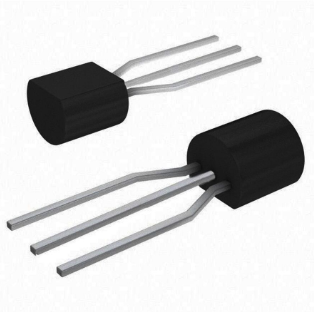
BC556 Transistor Overview
The BC556 transistor presents itself as a PNP-type semiconductor, frequently employed for signal switching and amplification within various electronic circuits. It features three terminals: the emitter, base, and collector, each contributing significantly to its functionality. The device is triggered when the base terminal is stabilized at zero volts, permitting regulation of the current flow between the collector and emitter. Once engaged, the transistor facilitates voltage across the collector-emitter pair, adeptly managing signal amplification. It maintains a base-emitter voltage of around 660 mV and showcases an amplification gain spanning from 125 to 450, highlighting its ability to boost weak signals. This trait renders it mostly suitable for compact electronic devices, notably audio amplifiers, where precision and reliability take precedence.
Mechanism of Current Regulation
Understanding the BC556's operational constraints is a must, especially its capacity to handle a peak current reaching 200mA. In full saturation, the transistor supports up to 100mA of current between the collector and emitter, reflecting its sturdiness in moderate power applications. However, exceeding this limit poses a risk to the device, demanding careful design strategies. In practical applications, you can often utilize heat sinks to alleviate potential overheating hazards, thus enhancing the device's dependability.
The BC556 operates via current regulation; halting base current transitions the transistor into the cut-off region, thereby deactivating it. Ingeniously crafted, it necessitates under 2mA of base current for activation, ensuring efficacy in scenarios with limited power availability. Circuit design performance can be optimized by adjusting the base voltage from 0.7V to 0.9V, achieving a balance between rapid activation and reduced power consumption.
Pin Configuration
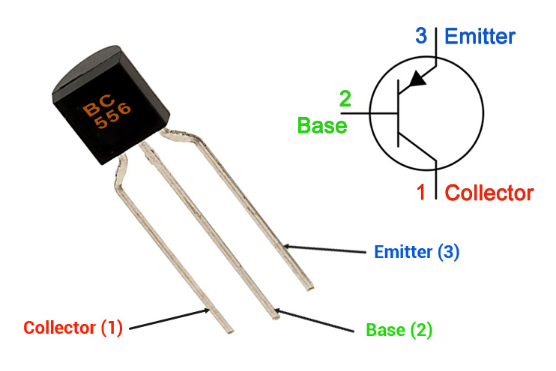
|
Pin Number |
Pin Name |
Description |
|
Pin-1 |
Collector |
This terminal collects the electrons emitted from the
emitter. |
|
Pin-2 |
Base |
This terminal helps in controlling the transistor
biasing. |
|
Pin-3 |
Emitter |
Emitted electrons from the emitter move into the primary
PN junction. |
Features and Specs
|
Feature/Specification |
Details |
|
Type |
PNP Transistor |
|
Package Types |
TO-92, SOT54 Plastic |
|
Collector to Emitter Voltage (VCEO) |
-65V |
|
Noise Level |
Low Noise |
|
Lead-Free Compliance |
Pb-Free |
|
Maximum Current (IC) |
100 mA |
|
Technology |
Advanced Process Technology |
|
Error Voltage |
Low Error Voltage |
|
Switching Speed |
Fast Switching Speed |
|
Power & Current Handling |
High |
|
Collector Power Dissipation (PC) |
0.5 W |
|
Collector to Base Voltage (VCBO) |
-80V |
|
Emitter to Base Voltage (VEBO) |
-5V |
|
Collector Capacitance |
8 pF |
|
Transition Frequency (fT) |
150 MHz |
|
Operating Junction Temperature |
150 °C |
Equivalent and Complementary Models
Equivalent
• BC558
• A1015
• S8550
• BC557
Complementary
• BC546
• BC548
• BC547
• BC549
Ideal Conditions for Using BC556 Transistor
To ensure the BC556 transistor serves you well over time, it's wise to respect its specified limits. Keeping the current below 100mA when powering a load with this transistor not only preserves its functionality but also keeps you aligned with its intended use. Being mindful of the collector-to-emitter voltage, which should remain below -36V, adds another layer of respect for its design.
The delicate relationship with temperature becomes evident when considering the junction temperature, which should not surpass 150°C. This understanding stems from various tests and speaks to the careful balance required to prevent damage to the semiconductor material.
Adding a resistor to the base of the transistor plays an active role in shielding the device. The base resistor doesn't just regulate incoming current; it acts as a silent guardian, ensuring the transistor isn't overwhelmed by excessive current. This practice highlights a blend of notional insight and practical wisdom, allowing the transistor to function smoothly and extending its life and stability.
Functional Design of a Transistor-Based Lamp Flasher Circuit
The transistor-based lamp flasher circuit, often deployed for vehicle signaling and as caution indicators at construction zones, exploits the properties of BC556 and BC549 transistors. On a compact breadboard canvas, it integrates components such as resistors, a 6V battery, a lamp, capacitors, and connecting wires, all working harmoniously towards an efficient configuration.

Mechanism of Action
The core of this circuit pulses with regenerative feedback, a process set in motion by a 6V control signal reaching the BC549 transistor's base. This thrilling interaction initiates the BC556 transistor's response, enlightening the lamp with a determined glow. Through the rapid dance of transistor switching, the lamp performs its flashing role, reaching out as a visual cue designed to capture attention and convey urgency.
Applications
The BC556 transistor integrates seamlessly into numerous functional devices and circuits, showcasing its adaptability across a diverse range of electronics fields. This component is a core element in both consumer electronics and industrial systems, supporting technologies that demand precise amplification and control.
Audio Circuit
In audio circuit design, the BC556 is dynamic for ensuring sound fidelity and quality. A basic application is the amplification of weak audio signals with minimal noise, which enables clearer sound output in various audio devices. The immersive experience of listening to high-fidelity sound often stems from meticulous audio amplification, where the BC556 transistor significantly contributes.
General-Purpose Amplification
In general-purpose amplification, the BC556 serves as an initial component in amplifier modules for signals and audio. It provides stable amplification across diverse environments and applications. Its adaptability and reliability emphasize its widespread utility.
Driver Modules
The BC556 is proficient in driver modules, especially for powering LEDs and relays. These setups benefit from the transistor's capacity to efficiently switch and amplify currents, ensuring the enduring performance and reliability of LEDs and relays. For example, the consistent operation of traffic lights under any weather conditions relies heavily on such components.
Darlington Pairs and H-Bridges
For high-current applications, the BC556 is often configured into Darlington pairs, which enhance its effective current gain and facilitate driving heavier loads up to 100mA effortlessly. Furthermore, in H-Bridges, used for motor control, the BC556 allows for precise manipulation of motor direction and speed, which is useful in automated and remotely operated vehicles.
Additional Complex Applications
The BC556 also proves useful in areas such as oscillators, current mirrors, comparators, and various linear and switching operations. In oscillators, it aids in generating consistent waveforms, dynamic for timing and control mechanisms within electronic devices. The BC556's role in current mirrors boosts circuit stability by mirroring currents used in analog signal processing.
About us
ALLELCO LIMITED
Read more
Quick inquiry
Please send an inquiry, we will respond immediately.
Understanding the IR2110 MOSFET Driver
on December 15th
A Comprehensive Guide to the LM3886 IC
on December 15th
Popular Posts
-

Complex Instruction Set Computers: How They Changed Computing?
on April 18th 147749
-

USB-C Pinout and Features
on April 18th 111920
-
Using Xilinx Unified Simulation Primitives: A Comprehensive Guide to FPGA Design and Simulation
on April 18th 111349
-

Power Supply Voltages in Electronics: Meaning of VCC, VDD, VEE, VSS, and GND
on April 18th 83714
-

RJ45 Connector Guide: Pinout, Wiring, Cable Types, and Uses
on January 1th 79502
-

The Ultimate Guide to Wire Color Codes in Modern Electrical Systems
The way our electrical systems use colors isn’t just for looks. Each wire color now indicates a specific function, making it easier to identify and handle electrical components correctly during ins...on January 1th 66872
-

Quality (Q) Factor: Equations and Applications
The quality factor, or 'Q', is important when checking how well inductors and resonators work in electronic systems that use radio frequencies (RF). 'Q' measures how well a circuit minimizes energy...on January 1th 63005
-
Purge Valve Guide: Function, Symptoms, Testing, and Replacement for Optimal Engine Performance
The purge valve is a key part of a car’s system that helps keep the air clean by managing fuel vapors before they can escape into the atmosphere. This not only helps the environment by reducing pol...on January 1th 62951
-

Achieving Peak Performance with the Maximum Power Transfer Theorem
The Maximum Power Transfer Theorem explains how energy from a source, such as a battery or generator, flows to a connected load. It shows the exact condition where the load receives the most power....on January 1th 54078
-

A23 Battery Specifications and Compatibility
The A23 battery is a small, cylinder-shaped battery with high voltage. Also called 23A, 23AE, or MN21, it runs at 12 volts and much higher than AA or AAA batteries. Its special design make...on January 1th 52092
HOT Part Number
-

BD9B100MUV-E2
Rohm Semiconductor
IC REG BUCK ADJ 1A 16VQFN
UPD70F3539AF5A9-PN7-Q-A
Renesas Electronics America Inc
IC MICROCONTROLLER
18081A621JAT2A
KYOCERA AVX
CAP CER 620PF 100V NP0 1808
FDN340P
onsemi
MOSFET P-CH 20V 2A SUPERSOT3
70231-101
Amphenol ICC (FCI)
CONN RCPT BLADE PWR 8POS EDGE MT
MPSW42RLRAG
onsemi
TRANS NPN 300V 0.5A TO92
MC7824BT
onsemi
IC REG LINEAR 24V 1A TO220AB
AD8009ARZ-REEL
Analog Devices Inc.
IC OPAMP CFA 1 CIRCUIT 8SOIC
LT1815CS5#TRPBF
Analog Devices Inc.
IC OPAMP VFB 1 CIRCUIT TSOT23-5
DG411DYZ
Renesas Electronics America Inc
IC SWITCH SPST-NCX4 35OHM 16SOIC
VFT2060C-M3/4W
Vishay General Semiconductor - Diodes Division
DIODE SCHOTTKY 20A 60V ITO-220AB
TSX562AIYST
STMicroelectronics
IC CMOS 2 CIRCUIT 8MINISO
MR256D08BMA45
Everspin Technologies Inc.
IC RAM 256KBIT PARALLEL 48FBGA
VSC3312YYP-01
Microchip Technology
IC SWITCH 16X16 6.5GBPS 196FCBGA
XC68HC908GP20CFB
Motorola
TSG 8BIT20K FLASH
CSR8811A08-ICXR-R
Qualcomm
IC RF TXRX+MCU BLUETOOTH
MPSW05
onsemi
TRANS NPN 60V 0.5A TO92
1N4055R
Solid State Inc.
DIODE GEN PURP REV 900V 275A DO9 -

ASX342ATSC00XPED0-DP
onsemi
IMAGE SENSOR VGA 1/4 CIS SOC
0433.125NR
Littelfuse Inc.
FUSE BOARD MNT 125MA 125VAC/VDC
1SMA5941BT3G
onsemi
DIODE ZENER 47V 1.5W SMA
DCP010512BP-U/700
Texas Instruments
DC DC CONVERTER 12V 1W
1-1734344-1
TE Connectivity AMP Connectors
CONN D-SUB HD RCPT 15P R/A SLDR
KSD1621STF
onsemi
TRANS NPN 25V 2A SOT89-3
BQ24161RGET
Texas Instruments
IC BATT CHG LI-ION 1CELL 24VQFN
BTA26-600BW
STMicroelectronics
TRIAC ALTERNISTOR 600V 25A TOP3
NCP1239DD65R2G
onsemi
IC OFFLINE SWITCH FLYBACK 7SOIC
TMS320TCI6482BZTZA
Texas Instruments
TMS320 - DIGITAL SIGNAL PROCESSO
BQ20Z90DBTR-V150
Texas Instruments
IC GAS GAUGE LI-ION 30TSSOP
PCMB104T-1R0MT
Susumu
FIXED IND 1UH 18A 3.3 MOHM SMD
CY29942AXCT
Infineon Technologies
IC CLK BUFFER 1:18 200MHZ 32TQFP
CC0402KRX7R9BB561
YAGEO
CAP CER 560PF 50V X7R 0402
STPS20M60SG-TR
STMicroelectronics
DIODE SCHOTTKY 60V 20A D2PAK
AT25010N-10SC-2.7
Microchip Technology
IC EEPROM 1KBIT SPI 3MHZ 8SOIC
04023A1R0CAT4A
KYOCERA AVX
CAP CER 1PF 25V C0G/NP0 0402
ISL6327IRZ
Intersil
SWITCHING CONTROLLER, VOLTAGE-MO -

LQW18AN75NG0ZD
Murata Electronics
FIXED IND
DFA100BA160
SanRex Corporation
DIODE MODULE 1600V 100A
BAR46AFILM
STMicroelectronics
DIODE ARRAY SCHOTTKY 100V SOT23
MAX825SEUK
Analog Devices Inc./Maxim Integrated
IC SUPERVISOR MPU
MMST2222A-7-F
Diodes Incorporated
TRANS NPN 40V 0.6A SOT323
FODM8801AR2
onsemi
OPTOISO 3.75KV TRANS 4-MINI-FLAT
FJV1845FMTF
Fairchild Semiconductor
SMALL SIGNAL BIPOLAR TRANSISTOR,
EVK105RH5R1JW-F
Taiyo Yuden
CAP CER 5.1PF 16V R2H 0402
6651170-3
TE Connectivity AMP Connectors
CONN EDGE DUAL FMALE 4POS 0.508
KSZ8893FQLI-FX
Microchip Technology
IC SWITCH ETH 3PORT 128QFP
170M6340
Eaton - Bussmann Electrical Division
FUSE SQUARE 400A 1.3KVAC RECT
BCM20741A2KFB1G
Broadcom Limited
SINGLE-CHIP BLUETOOTH
MAX3443EASA+
Analog Devices Inc./Maxim Integrated
IC TRANSCEIVER HALF 1/1 8SOIC
GRM0335C1H9R3DA01D
Murata Electronics
CAP CER 9.3PF 50V C0G/NP0 0201
TNY175PN
Power Integrations
11.5 W (85-265 VAC) 15 W (230 VA
742700726
Würth Elektronik
FERRITE CORE 278 OHM SOLID 4MM
DM74S20N
onsemi
IC GATE NAND 2CH 4-INP 14DIP
P4SMA56CA-E3/61
Vishay General Semiconductor - Diodes Division
TVS DIODE 47.8VWM 77VC DO214AC