Complete Guide to TDA2822M Audio Amplifier
The TDA2822M is a versatile and efficient audio amplifier IC designed to elevate sound quality across various devices. Encased in a compact 8-lead Minidip package, it excels in dual-channel amplification while maintaining low power consumption and minimal distortion. This makes it a go-to choice for portable audio applications, such as cassette players, radios, and battery-powered devices, where efficient performance and compactness are used. From enhancing audio clarity to extending device battery life, the TDA2822M blends simplicity with practicality. This article digs into the IC's technical specifications, pin configuration, alternatives, and applications, offering a comprehensive guide for maximizing its potential in audio amplification circuits.Catalog

Technical Specification
|
Specification |
Value |
|
Supply Voltage (VCC) |
1.8V to 15V |
|
Power Output |
Up to 1W per channel |
|
Total Harmonic Distortion |
< 0.1% at rated output power |
|
Frequency Response |
20Hz to 20kHz |
|
Input Sensitivity |
~150mV |
|
Input Impedance |
~30kΩ |
|
Standby Current |
~0.3mA |
|
Thermal Protection |
Built-in |
|
Package Type |
8-lead Minidip |
Pin Configuration

|
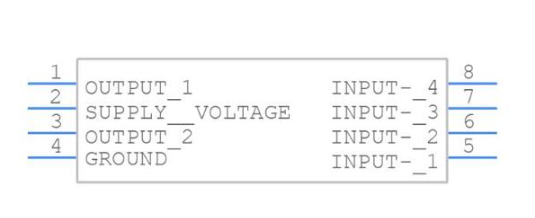
Pin |
Pin Name |
Pin Description |
|
1 |
Output 1 |
This pin is the output for Channel 1 of the IC and is
used to drive a speaker or headphones connected to the positive terminal of
the audio output for the first channel. |
|
2 |
Vcc |
This pin is the positive supply connection for the IC. It
is connected to the positive terminal of the power supply voltage, typically
ranging from 1.8V to 15V. This pin provides the required power for the
operation of the IC. |
|
3 |
Output 2 |
This pin is the output for Channel 2 of the IC and is
used to drive a speaker or headphones connected to the positive terminal of
the audio output for the second channel. |
|
4 |
Ground (Gnd) |
This pin is the ground or negative terminal for both
amplifiers within the IC. It is connected to the ground reference of the
circuit to complete the electrical circuit and provide a common reference
point. |
|
5 |
Input 2 (+) |
This pin is the inverting input for Channel 2 of the IC.
It is one of the input terminals for the second audio channel and is used for
the audio signal input. The input signal at this pin is typically in the form
of a voltage. |
|
6 |
Input 2 (-) |
This pin is the non-inverting input for Channel 2 of the
IC. It is the complementary input terminal to Pin 5 and together forms the
input differential amplifier for the second audio channel. The input signal
at this pin is also in the form of a voltage. |
|
7 |
Input 1 (+) |
This pin is the non-inverting input for Channel 1 of the
IC. It is one of the input terminals for the first audio channel and is used
for the audio signal input. The input signal at this pin is in voltage form. |
|
8 |
Input 1 (-) |
This pin is the inverting input for Channel 1 of the IC.
It is the complementary input terminal to Pin 7 and together forms the input
differential amplifier for the first audio channel. The input signal at this
pin is also in the form of a voltage. |
Alternatives
• KA2209
• KA2209B
• LM386
• NJM2073
• TDA2822
• PAM8403
• MC34119
TDA2822M Audio Amplifier Design
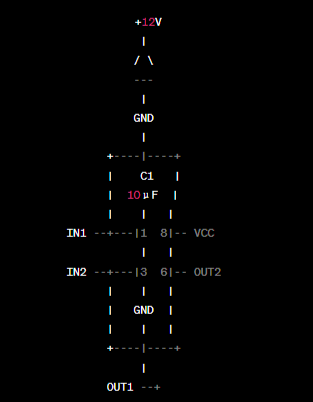
The TDA2822M provides a flexible foundation for creating audio amplifier circuits and can operate in a single-ended setup. For stereo output, mirror the configuration of the first channel to the second using the additional pins. You can attain peak circuit performance by referring to the datasheet, which provides insights into component selection, impedance matching, power output, and additional integrations within the circuit.
Power and Ground Connections
To power the amplifier, connect a +12V power supply to the VCC pin and ensure that the ground pin links securely to the circuit ground. This arrangement supports stable operation. You can take care to achieve a reliable ground connection to avoid noise interference, thereby preserving audio clarity.
Connecting Audio Inputs
The IN1 and IN2 pins manage audio input, accepting signals from devices like audio players or microphones. Including a 10μF coupling capacitor at this point removes DC components and facilitates smooth signal transfer. This method is well-regarded for safeguarding signal integrity and preventing disruptions.
Amplified Output and Speaker Connections
Amplified output signals are sourced from the OUT1 and OUT2 pins for direct speaker connection. You can ensure all grounds merge via the GND pin, aligning the amplifier with input sources for uniformity throughout the circuit. This design emphasizes the sophisticated understanding that proper grounding is used for achieving balanced and high-quality sound output.
Circuit Diagram for An Audio Amplifier
Voltage Input Reflections for TDA2822M
The TDA2822M is engineered to handle a wide range of input voltages, from a minimal 0.3V up to the level of VCC. It operates best when input voltages are kept within this range, which helps maintain the audio performance while keeping distortion at bay. Surpassing these boundaries may result in unpredictable behavior and could risk damaging the device. Following the IC's operational value guidelines ensures a reliable quality of audio output. Adhering to this voltage span helps preserve signal purity, a crucial aspect in delicate audio applications demanding accuracy.
The input impedance of the TDA2822M is typically around 30 kΩ. This factor significantly influences interfacing with external components, affecting circuit configuration and the selection of appropriate input sources. Designers need to consider the relationship between input impedance and the output features of the source. In practical applications, tuning the impedance carefully can minimize signal degradation and enhance audio clarity, similar to fine-tuning an instrument to create its most harmonious sound.
Features
|
Feature |
Description |
|
Dual-channel configuration |
Supports two audio channels for stereo applications. |
|
Low voltage operation |
Operates efficiently at low voltage levels, suitable for
portable devices. |
|
High power output |
Delivers significant power output for small amplifiers. |
|
Low distortion and noise |
Ensures high audio quality with minimal distortion and
noise. |
|
Wide frequency response |
Capable of handling a broad range of audio frequencies. |
|
Simple external circuitry |
Requires minimal additional components for operation. |
|
Thermal protection |
Includes built-in thermal protection for reliability. |
|
Minidip package |
Comes in a compact Minidip package, ideal for
space-constrained designs. |
Usage Scenarios
Convenient Audio Devices
Audio gadgets that prioritize compact design and operational efficiency greatly benefit from the TDA2822M. This integrated circuit, known for its minimal power draw and effective output, makes it excellent for upgrading sound quality in portable setups. You can often understand that a reliable amplifier extends battery life, a feature the TDA2822M skillfully delivers.
Personal Stereos and Multimedia Environments
The TDA2822M is used for achieving outstanding sound clarity and power in personal stereos and multimedia systems. These setups, comprising multiple parts, depend on the sturdy performance of the amplifier for smooth sound delivery. You can frequently observe that the straightforward configuration of the TDA2822M allows for uncomplicated integration and upkeep.
Communication and Vocal Devices
Building intercom systems commonly utilize the TDA2822M for clear communication. Voice devices similarly benefit, as precise sound delivery is an absolute necessity. You can note that the durable TDA2822M effectively tackles signal interference challenges typical in urban areas.
Musical Instrument Amplification
In the sphere of musical instruments, the TDA2822M ensures detailed and dynamic sound, supporting varied tonal demands with consistency. You can often select it for practice amps due to its ability to preserve sound clarity and depth. This feedback emphasizes the module's potential to maintain sound quality without distortion.
Educational and DIY Projects
The TDA2822M is an outstanding component for educational and DIY pursuits, inviting exploration and mastery in audio amplification. Its simplicity makes it a favored choice for teaching audio engineering details. This component offers a balance of simplicity and utility, facilitating hands-on discovery for budding you.
Schematic Diagram
CAD Model
Symbol
Footprint
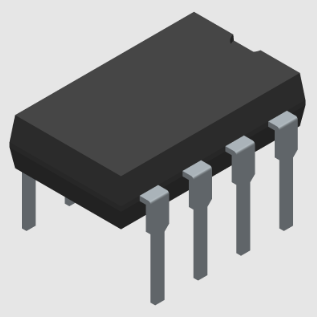
3D Representation
Datasheet PDF
TDA2822M Datasheets:
About us
ALLELCO LIMITED
Read more
Quick inquiry
Please send an inquiry, we will respond immediately.

IRFZ44N MOSFET: Features, Alternatives, and Advantages
on November 23th
Understanding the OP07 Operational Amplifier
on November 22th
Popular Posts
-

Complex Instruction Set Computers: How They Changed Computing?
on April 18th 147749
-

USB-C Pinout and Features
on April 18th 111901
-
Using Xilinx Unified Simulation Primitives: A Comprehensive Guide to FPGA Design and Simulation
on April 18th 111349
-

Power Supply Voltages in Electronics: Meaning of VCC, VDD, VEE, VSS, and GND
on April 18th 83714
-

RJ45 Connector Guide: Pinout, Wiring, Cable Types, and Uses
on January 1th 79502
-

The Ultimate Guide to Wire Color Codes in Modern Electrical Systems
The way our electrical systems use colors isn’t just for looks. Each wire color now indicates a specific function, making it easier to identify and handle electrical components correctly during ins...on January 1th 66867
-

Quality (Q) Factor: Equations and Applications
The quality factor, or 'Q', is important when checking how well inductors and resonators work in electronic systems that use radio frequencies (RF). 'Q' measures how well a circuit minimizes energy...on January 1th 63004
-
Purge Valve Guide: Function, Symptoms, Testing, and Replacement for Optimal Engine Performance
The purge valve is a key part of a car’s system that helps keep the air clean by managing fuel vapors before they can escape into the atmosphere. This not only helps the environment by reducing pol...on January 1th 62936
-

Achieving Peak Performance with the Maximum Power Transfer Theorem
The Maximum Power Transfer Theorem explains how energy from a source, such as a battery or generator, flows to a connected load. It shows the exact condition where the load receives the most power....on January 1th 54074
-

A23 Battery Specifications and Compatibility
The A23 battery is a small, cylinder-shaped battery with high voltage. Also called 23A, 23AE, or MN21, it runs at 12 volts and much higher than AA or AAA batteries. Its special design make...on January 1th 52087
HOT Part Number
-

XC3S50A-4VQG100C
AMD
IC FPGA 68 I/O 100VQFP
SI1102-A-GM
Silicon Labs
SENSOR OPT REFLECTIVE 50CM 8WDFN
TCN4-13+
Mini-Circuits
1:4 LTCC TRANSFORMER, 650 - 1250
VF30100S-E3/4W
Vishay General Semiconductor - Diodes Division
DIODE SCHOTTKY 100V 30A ITO220AB
GRM033R70J103KA01D
Murata Electronics
CAP CER 10000PF 6.3V X7R 0201
QMK212B7102MDHT
Taiyo Yuden
CAP CER 1000PF 250V X7R 0805
M82351G-12
MACOM Technology Solutions
ACCESS VOICE PROCESSOR
74LV132D,112
Nexperia USA Inc.
IC GATE NAND SCHMIT 4CH 2IN 14SO
AH1801-FJG-7
Diodes Incorporated
MAG SWITCH OMNIPOLAR DFN2020B-3
DG412DY-T1-E3
Vishay Siliconix
IC SWITCH SPST-NOX4 35OHM 16SOIC
PIC16F876A-I/SO
Microchip Technology
IC MCU 8BIT 14KB FLASH 28SOIC
LXA08FP600
Power Integrations
DIODE GP 600V 8A TO220 FULL PACK
FM25V20A-DG
Infineon Technologies
IC FRAM 2MBIT SPI 40MHZ 8DFN
CY7C1011CV33-10ZXC
Cypress Semiconductor Corp
IC SRAM 2MBIT PARALLEL 32TSOP II
04023C221KAT2A
KYOCERA AVX
CAP CER 220PF 25V X7R 0402
RO3101A
Murata Electronics
SAW RES 433.9200MHZ SMD
XRD9818ACGTR
MaxLinear, Inc.
IC AFE 3 CHAN 16BIT 28TSSOP
CL21F104ZBANNNC
Samsung Electro-Mechanics
CAP CER 0.1UF 50V Y5V 0805 -

BZT52-B16_R1_00001
Panjit International Inc.
SOD-123, ZENER
P0300ECL
Littelfuse Inc.
THYRISTOR 25V 400A TO226-2
TPS73615DBVTG4
Texas Instruments
IC REG LINEAR 1.5V 400MA SOT23-5
SN74AXC4T774BQBR
Texas Instruments
IC TRANSCEIVER HALF 4/4 16WQFN
170M5954
Eaton - Bussmann Electrical Division
FUSE SQUARE 350A 1KVAC RECT
CC0805KRX7R9BB682
YAGEO
CAP CER 6800PF 50V X7R 0805
SRP7028A-6R8M
Bourns Inc.
FIXED IND 6.8UH 4.5A 60 MOHM SMD
SMAJ150CA
Taiwan Semiconductor Corporation
TVS DIODE 150VWM 243VC DO214AC
PE-68675
Pulse Electronics
IC CHIP
MAX14890EATJ+
Analog Devices Inc./Maxim Integrated
IC RECEIVER 0/4 32TQFN
TFZGTR20B
Rohm Semiconductor
DIODE ZENER 20V 500MW TUMD2
1N5406-E3/73
Vishay General Semiconductor - Diodes Division
DIODE GEN PURP 600V 3A DO201AD
ME501610
Powerex Inc.
BRIDGE RECT 3P 1.6KV 100A MODULE
GRM1555C2A5R8DA01D
Murata Electronics
CAP CER 5.8PF 100V C0G/NP0 0402
MRF8S19140HSR3
NXP USA Inc.
FET RF 65V 1.96GHZ NI780HS
TN2130K1-G
Microchip Technology
MOSFET N-CH 300V 85MA TO236AB
ADL5519ACPZ-R7
Analog Devices Inc.
IC AMP LOG DETECT CTRLR 32LFCSP
SP3222ECT-L
MaxLinear, Inc.
IC TRANSCEIVER FULL 2/2 18SOIC -
502AT-2
Semitec USA Corp
NTC THERMISTORS 5KOHM 1%
NFM18CC101R1C3D
Murata Electronics
CAP FEEDTHRU 100PF 20% 16V 0603
PS2562L-1-F3-A
Renesas Electronics America Inc
OPTOISOLATOR 5KV DARL 4SMD
502494-0370
Affinity Medical Technologies - a Molex company
2.0 W/B SGL R/ARECASSY3CKTEMBSTP
C1206C223K5RACTU
KEMET
CAP CER 0.022UF 50V X7R 1206
NIS5102QP2HT1G
onsemi
IC HOT SWAP CTRLR GP 12PLLP
VI-J62-MY
Vicor Corporation
DC DC CONVERTER 15V 50W
ADR441ARMZ-REEL7
Analog Devices Inc.
IC VREF SERIES 0.12% 8MSOP
MIC5200-5.0BS
Microchip Technology
IC REG LINEAR 5V 100MA SOT223-3
TAS3251DKQR
Texas Instruments
IC AMP D MONO/STER 350W 56HSSOP
GRM1886T1H360JD01D
Murata Electronics
CAP CER 36PF 50V T2H 0603
TZM5249B-GS08
Vishay General Semiconductor - Diodes Division
DIODE ZENER 19V 500MW SOD80
LM2575-5.0YWM
Microchip Technology
IC REG BUCK 5V 1A 24SOIC
RT0402BRE075K6L
YAGEO
RES SMD 5.6K OHM 0.1% 1/16W 0402
C0603JB1A104M030BC
TDK Corporation
CAP CER 0.1UF 10V JB 0201
CSD17571Q2
Texas Instruments
MOSFET N-CH 30V 22A 6SON
P4SMA13CA
Bourns Inc.
TVS DIODE 11.1VWM 18.2VC DO214AC
AR0144ATSM20XUEA0-DPBR
onsemi
1MP 1/4 CIS SO