Comprehensive Guide to the 6N136 Transistor: Pinout, Circuit, and Datasheet
In this article, we dig into the 6N136 high-speed optocoupler, a cutting-edge component that exemplifies the latest advancements in photoelectric coupling technology. This optocoupler is planned to provide superior electrical isolation while maintaining rapid signal transmission, making it a basic part of circuits requiring both performance and safety. By combining an advanced infrared LED with a highly sensitive transistor, the 6N136 offers impressive features like high-speed data integrity, robust isolation, and compatibility with digital logic systems. We will explore its key features, applications, and practical use in industrial automation, data communication, and consumer electronics.Catalog

Understanding 6N136 Optocoupler
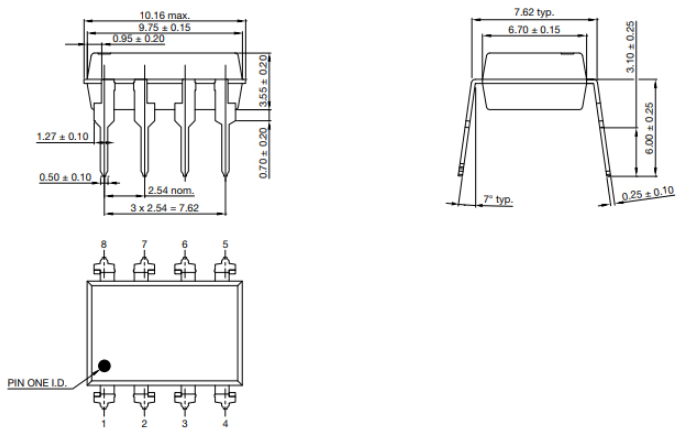
The 6N136, housed in a DIP-8 plastic package, is a sophisticated optocoupler that incorporates a GaAIAs infrared emitting diode optically coupled with an integrated photodetector. This photodetector includes a photodiode and a high-speed transistor. This advanced design permits the transmission of signals up to 2 MHz between electrically isolated circuits, ensuring that allowable potential differences do not exceed specified reference voltages. Its compact size, robustness, excellent anti-interference capabilities, high isolation voltage, speed, and TTL logic level compatibility make the 6N136 a versatile component in a myriad of applications.
Due to its high-speed transmission capability, the 6N136 ensures the integrity of signals even when surrounded by electrical noise. This attribute proves invaluable in industrial settings where electromagnetic interference (EMI) is a common challenge. Consider a factory automation scenario where precise signal transmission between controllers and actuators drives both operational efficiency and safety. This is where the 6N136 truly shines, maintaining the harmony of complex systems. Built for durability, the 6N136 is a reliable option for applications where maintenance access is limited or expensive. For example, remote sensing applications demand components that can function reliably over extended periods without intervention.
The 6N136’s high isolation voltage not only shields sensitive circuit elements from high voltage spikes but also ensures the device can handle high-speed data transmission. In data acquisition systems, where the precision and speed of data transmission disapprovingly affect the quality of collected data, this feature proves extremely beneficial. The TTL logic level compatibility of the 6N136 grants it exceptional versatility, enabling seamless integration with various digital circuits. During digital-to-analog and analog-to-digital conversion processes, maintaining signal fidelity and compatibility across different logic levels is used. The 6N136 effortlessly interfaces with other components in these scenarios, ensuring smooth data conversion and streamlined operations.
6N136 Pin Configuration

6N136 CAD Representation
Schematic Symbol

Footprint Layout

3D Visualization

Technical Features of 6N136
|
Feature |
Description |
|
Isolation Test Voltage |
5300 VRMS |
|
Compatibility |
TTL compatible |
|
Bit Rate |
1.0 Mbit/s |
|
Common-Mode Interference Immunity |
High |
|
Bandwidth |
2.0 MHz |
|
Output Type |
Open-collector output |
|
External Base Wiring |
Possible |
|
Lead (Pb) Content |
Lead-free component |
|
Compliance |
RoHS 2002/95/EC, WEEE 2002/96/EC |
6N136 Specifications
|
Type |
Parameter |
|
Factory Lead Time |
6 Weeks |
|
Mount |
Through Hole |
|
Mounting Type |
Through Hole |
|
Package / Case |
8-DIP (0.300, 7.62mm) |
|
Number of Pins |
8 |
|
Current Transfer Ratio - Min |
19% @ 16mA |
|
Number of Elements |
1 |
|
Operating Temperature |
-55°C to 100°C |
|
Packaging |
Tube |
|
Published |
2012 |
|
Part Status |
Active |
|
Moisture Sensitivity Level (MSL) |
1 (Unlimited) |
|
Additional Feature |
TTL Compatible |
|
Max Power Dissipation |
100mW |
|
Base Part Number |
6N136 |
|
Voltage - Isolation |
5300Vrms |
|
Output Voltage |
400mV |
|
Output Type |
Transistor with Base |
|
Configuration |
Single |
|
Number of Channels |
1 |
|
Power Dissipation |
100mW |
|
Voltage - Forward (Vf) (Typ) |
1.33V |
|
Input Type |
DC |
|
Optoelectronic Device Type |
Logic IC Output Optocoupler |
|
Forward Current |
25mA |
|
Max Output Voltage |
15V |
|
Data Rate |
1 MBps |
|
Output Current per Channel |
8mA |
|
Rise Time |
800ns |
|
Fall Time (Typ) |
800ns |
|
Max Collector Current |
8mA |
|
Reverse Breakdown Voltage |
5V |
|
Max Input Current |
25mA |
|
Turn On / Turn Off Time (Typ) |
200ns / 200ns |
|
Current Transfer Ratio |
35% |
|
Radiation Hardening |
No |
|
RoHS Status |
ROHS3 Compliant |
Comparable Components
|
Part Number |
Manufacturer |
Package / Case |
Number of Pins |
Number of Channels |
Voltage - Isolation |
Current Transfer Ratio |
Current Transfer Ratio (Min) |
Rise Time |
Max Output Voltage |
Output Voltage |
View Compare |
|
6N136-X001 |
Vishay Semiconductor Opto Division |
8-DIP (0.300, 7.62mm) |
8 |
1 |
5300Vrms |
35% |
19% @ 16mA |
800 ns |
15 V |
400 mV |
6N136-X001 VS SFH6136-X016 |
|
SFH6136-X016 |
Vishay Semiconductor Opto Division |
8-DIP (0.300, 7.62mm) |
6 |
1 |
500Vrms |
30% |
10% @ 10mA |
- |
30 V |
- |
|
|
6N136-X016 |
Vishay Semiconductor Opto Division |
8-DIP (0.400, 10.16mm) |
8 |
1 |
5300Vrms |
35% |
19% @ 16mA |
800 ns |
15 V |
400 mV |
6N136-X001 VS 6N136-X016 |
|
4N28 |
Lite-On Inc. |
8-DIP (0.400, 10.16mm) |
8 |
1 |
5300Vrms |
35% |
19% @ 16mA |
- |
25 V |
- |
6N136-X001 VS 4N28 |
|
SFH6345-X016 |
Vishay Semiconductor Opto Division |
8-DIP (0.400, 10.16mm) |
8 |
1 |
5300Vrms |
30% |
19% @ 16mA |
- |
25 V |
- |
6N136-X001 VS SFH6345-X016 |
6N136 Circuit Operation
Pull-Up Resistor Integration

Integrating a pull-up resistor into the circuit guarantees that when the transistor is off, the Vout pin consistently returns to the high logic level of 5 volts. Connected between the Vout pin and the positive supply voltage, this pull-up resistor has several purposes. Stabilizing the output voltage, ensuring it reaches the desired logic high state. Preventing floating states that could lead to unpredictable circuit behavior. Safeguarding against noise and false triggering within the circuit.
By fulfilling these roles, the pull-up resistor contributes to maintaining the circuit's overall reliability and performance. A carefully selected pull-up resistor value can prevent floating outputs. This stabilization leads to predictable and unwavering logic levels. By maintaining the Vout pin at a predictable voltage state when the transistor is in an off position, the pull-up resistor effectively reduces the likelihood of disturbances caused by noise. This stability is mostly active when precision and reliability are dominant in the functioning of digital circuits.
Thoughtful selection of the pull-up resistor's value is used in achieving desired performance. Typically, values range from a few kilohms to tens of kilohms, depending on the demands of the circuit. For instance, a 10k ohm resistor is frequently chosen as it strikes a balance between speed and current consumption, aligning well with a broad range of circuit needs. You can leverage their extensive expertise to determine the most suitable resistor values for their specific applications.
6N136 Circuit Layout
The LED inside activates and emits an IR beam whenever the appropriate input current reaches the terminals (+Vf and -Vf). When the IR beam strikes the phototransistor, it consequently activates. In embedded systems, this type of configuration is frequently utilized for signal isolation. By doing so, high-frequency noise or voltage spikes are prevented from causing damage to sensitive components.

In the provided diagram, the 6N136 IC performs the inversion of the input pulse polarity. Specifically, when a high input logic level is applied, a low output is generated. Conversely, a low input logic level produces a high output. This inversion mechanism plays a major role in digital signal processing, especially when there is a need to maintain or adapt specific logic levels for subsequent stages of a circuit.
In circuit designs utilizing the 6N136, both the efficiency and response time of the optocoupler must be taken into account. Practical experience shows that selecting suitable current-limiting resistors can optimize the activation time of the LED, thus boosting overall performance. Accurate timing is mostly notable in control applications, where even microsecond-level delays can influence system functionality.
Alternative to 6N136
|
Part Number |
Description |
Manufacturer |
|
6N139#500 |
1 Channel Logic Output Optocoupler, 0.1 Mbps, 0.300 Inch,
Surface Mount, DIP-8 |
Agilent Technologies Inc |
|
HCPL-5700#200 |
1 Channel Logic Output Optocoupler, 0.1 Mbps, Hermetic
Sealed, Ceramic, DIP-8 |
Avago Technologies |
|
HCPL-0700 |
1 Channel Logic Output Optocoupler, SO-8 |
Fairchild Semiconductor Corporation |
|
HCPL-2730-020 |
Logic IC Output Optocoupler, 2-Element, 5000V Isolation,
0.300 Inch, DIP-8 |
Agilent Technologies Inc |
|
HCPL0500V |
8-Pin SOIC 1 Mbit/s Single-Channel High Speed Transistor
Output Optocoupler, 3000-Tube |
onsemi |
|
HCPL-4503-560 |
1 Channel Logic Output Optocoupler, 1 Mbps, 0.300 Inch,
Surface Mount, DIP-8 |
Avago Technologies |
|
HCPL-0500V |
1 Channel Logic Output Optocoupler, 1 Mbps, Lead-Free,
SOIC-8 |
Rochester Electronics LLC |
|
HCNW4502E |
1 Channel Logic Output Optocoupler, 1 Mbps, 0.400 Inch,
Lead-Free, DIP-8 |
Avago Technologies |
|
SFH6325 |
Logic IC Output Optocoupler, 2-Element, 5300V Isolation,
1 Mbps, Plastic, DIP-8 |
Infineon Technologies AG |
|
HCPL-5701#200 |
Logic IC Output Optocoupler, 1-Element, 1500V Isolation,
0.1 Mbps, Hermetic Sealed, Ceramic, DIP-8 |
Agilent Technologies Inc |
6N136 Utilizations
Practical in Line Receivers
The 6N136 optocoupler finds substantial use in line receivers. It efficiently manages high-speed data transmission, minimizing signal distortion and upholding signal integrity over long distances. By leveraging its capabilities, environments where signal reliability is serious greatly benefit. This optoelectronic device plays a remarkable role in enhancing communication systems, ensuring robust data transfer in telecommunication infrastructures, and preserving operational efficiency in complex networks. Field applications have shown that the 6N136 can significantly reduce noise interference. In industrial settings with long cable runs, it excellently maintains signal fidelity.
Replacement for Pulse Transformers
The 6N136 optocoupler serves as an optimal replacement for traditional pulse transformers, offering advantages like size reduction, enhanced reliability, and improved efficiency. By swapping out pulse transformers with 6N136, systems see enhanced performance and reduced electromagnetic interference. This shift towards more compact and efficient electronic architectures emphasizes the trend in electronics towards miniaturization and enhanced performance standards. Implementations in various electronic circuits show 6N136 not only saves physical space but also boosts overall system dependability.
Interfaces with CMOS, LSTTL, and TTL
One of the standout features of the 6N136 is its seamless interfacing with CMOS, LSTTL, and TTL logic families. This versatility makes it a key component in diverse digital circuits. By bridging the compatibility gap between different logic standards, it simplifies circuit design and improves operational flexibility. You can use the 6N136 to address compatibility issues between various digital logic families, streamlining designs and reducing complexity. Its efficiency in interfacing with multiple logic levels has led to widespread adoption in integrated circuit design.
Wide Bandwidth Analog Coupling Utility
The 6N136 optocoupler proves invaluable for wide bandwidth analog coupling. With high-speed response and low distortion characteristics, it ensures accurate signal transmission across broad frequency ranges. In fields requiring precise analog signal reproduction, such as audio processing and high-speed data acquisition, its performance is mostly notable.
6N136 Packaging
About Vishay
Vishay is a leading provider specializing in discrete semiconductors (diodes, MOSFETs, optoelectronics) and passive components (resistors, inductors, capacitors). Their components find use in diverse sectors, including industrial, computing, automotive, consumer electronics, telecommunications, military, aerospace, and medical applications.
Vishay's discrete semiconductors and passive components are basic to modern technological devices. In the industrial sector, their products contribute to the reliability and efficiency of machinery and automation systems. For computing, Vishay supplies components foundational to both consumer electronics and enterprise-level servers. These elements ensure performance, stability, and the precision miniaturization of devices, catering to the ever-growing demands of technology.
Vishay's components also influence the advancing world of electric vehicles (EVs) and advanced driver-assistance systems (ADAS). Their MOSFETs and diodes are key to battery management systems and propulsion inverters, enhancing efficiency and reliability. In consumer electronics, Vishay's optoelectronics contribute to the miniaturization and energy efficiency of devices, providing you with a richer experience and ensuring device longevity. Telecommunications infrastructure is heavily dependent on Vishay's capacitors and inductors for maintaining signal integrity and power management. These components support high-speed data transmission and robust network performance, used for meeting the escalating demand for seamless bandwidth and connectivity in our interconnected world.
Datasheet PDF
HCPL0500V Datasheets:
Frequently Asked Questions [FAQ]
1. What is the difference between 6N135 and 6N136 optocoupler devices?
The 6N135 features an 850nm AlGaAs LED. Includes an integrated detector with a photodiode, linear op-amp, and Schottky clamped triode. Provides high-speed operation at 10MBd. Requires minimal input current, specifically 5mA. In contrast, the 6N136 has a high-level infrared LED. Incorporates a photosensitive transistor. Is recognized for robust anti-interference capabilities. Offers high-isolation voltage and superior TTL compatibility. When deciding between these two, the 6N135 shines in data communication with its rapid response and efficient power usage, ideal for environments where speed and efficiency coax precision. On the flip side, the 6N136 becomes indispensable in industrial or medical applications, where isolation and interference rejection maintain the integrity of the operation over time.
2. What is the difference between 6N137 and 6N136?
While the 6N137 and 6N136 serve similar purposes in opto-isolation. The 6N137 boasts a higher maximum speed of 10MBd. It operates within a narrower supply voltage range. Conversely, the 6N136 has a broader voltage tolerance. It operates at a lower speed of 1MBd. Thus, the 6N137 is perfect for cutting-edge communication systems requiring rapid data transfer, whereas the 6N136 adapts well to scenarios with varying power supplies, striking a balance between speed and versatility.
3. What Speed Does 6N136 Offer?
The 6N136 is tailored for high-speed operations, evident in its typical propagation delay of 0.5 microseconds with a load resistance of 1.9Ω. This enables it to support high-speed digital communication interfaces, reaching baud rates upwards of 500k, significantly outstripping standard devices such as the 4N25 or TILI17. However, achieving such performance in practical applications demands meticulous attention to circuit design and layout. Ensuring these fine details helps mitigate any potential signal degradation, securing the high-speed capability promised by the 6N136.
About us
ALLELCO LIMITED
Read more
Quick inquiry
Please send an inquiry, we will respond immediately.
LM741 vs. LM358: Understanding the Differences for Optimal Selection
on October 21th

1N4746A Zener Diode (18V, 1W) DO-41: Datasheet, Marking Details, and Equivalent Parts
on October 21th
Popular Posts
-

Complex Instruction Set Computers: How They Changed Computing?
on April 18th 147749
-

USB-C Pinout and Features
on April 18th 111908
-
Using Xilinx Unified Simulation Primitives: A Comprehensive Guide to FPGA Design and Simulation
on April 18th 111349
-

Power Supply Voltages in Electronics: Meaning of VCC, VDD, VEE, VSS, and GND
on April 18th 83714
-

RJ45 Connector Guide: Pinout, Wiring, Cable Types, and Uses
on January 1th 79502
-

The Ultimate Guide to Wire Color Codes in Modern Electrical Systems
The way our electrical systems use colors isn’t just for looks. Each wire color now indicates a specific function, making it easier to identify and handle electrical components correctly during ins...on January 1th 66869
-

Quality (Q) Factor: Equations and Applications
The quality factor, or 'Q', is important when checking how well inductors and resonators work in electronic systems that use radio frequencies (RF). 'Q' measures how well a circuit minimizes energy...on January 1th 63004
-
Purge Valve Guide: Function, Symptoms, Testing, and Replacement for Optimal Engine Performance
The purge valve is a key part of a car’s system that helps keep the air clean by managing fuel vapors before they can escape into the atmosphere. This not only helps the environment by reducing pol...on January 1th 62947
-

Achieving Peak Performance with the Maximum Power Transfer Theorem
The Maximum Power Transfer Theorem explains how energy from a source, such as a battery or generator, flows to a connected load. It shows the exact condition where the load receives the most power....on January 1th 54077
-

A23 Battery Specifications and Compatibility
The A23 battery is a small, cylinder-shaped battery with high voltage. Also called 23A, 23AE, or MN21, it runs at 12 volts and much higher than AA or AAA batteries. Its special design make...on January 1th 52089
HOT Part Number
-

BD9B100MUV-E2
Rohm Semiconductor
IC REG BUCK ADJ 1A 16VQFN
UPD70F3539AF5A9-PN7-Q-A
Renesas Electronics America Inc
IC MICROCONTROLLER
18081A621JAT2A
KYOCERA AVX
CAP CER 620PF 100V NP0 1808
FDN340P
onsemi
MOSFET P-CH 20V 2A SUPERSOT3
70231-101
Amphenol ICC (FCI)
CONN RCPT BLADE PWR 8POS EDGE MT
MPSW42RLRAG
onsemi
TRANS NPN 300V 0.5A TO92
MC7824BT
onsemi
IC REG LINEAR 24V 1A TO220AB
AD8009ARZ-REEL
Analog Devices Inc.
IC OPAMP CFA 1 CIRCUIT 8SOIC
LT1815CS5#TRPBF
Analog Devices Inc.
IC OPAMP VFB 1 CIRCUIT TSOT23-5
DG411DYZ
Renesas Electronics America Inc
IC SWITCH SPST-NCX4 35OHM 16SOIC
VFT2060C-M3/4W
Vishay General Semiconductor - Diodes Division
DIODE SCHOTTKY 20A 60V ITO-220AB
TSX562AIYST
STMicroelectronics
IC CMOS 2 CIRCUIT 8MINISO
MR256D08BMA45
Everspin Technologies Inc.
IC RAM 256KBIT PARALLEL 48FBGA
VSC3312YYP-01
Microchip Technology
IC SWITCH 16X16 6.5GBPS 196FCBGA
XC68HC908GP20CFB
Motorola
TSG 8BIT20K FLASH
CSR8811A08-ICXR-R
Qualcomm
IC RF TXRX+MCU BLUETOOTH
MPSW05
onsemi
TRANS NPN 60V 0.5A TO92
1N4055R
Solid State Inc.
DIODE GEN PURP REV 900V 275A DO9 -

ASX342ATSC00XPED0-DP
onsemi
IMAGE SENSOR VGA 1/4 CIS SOC
0433.125NR
Littelfuse Inc.
FUSE BOARD MNT 125MA 125VAC/VDC
1SMA5941BT3G
onsemi
DIODE ZENER 47V 1.5W SMA
DCP010512BP-U/700
Texas Instruments
DC DC CONVERTER 12V 1W
1-1734344-1
TE Connectivity AMP Connectors
CONN D-SUB HD RCPT 15P R/A SLDR
KSD1621STF
onsemi
TRANS NPN 25V 2A SOT89-3
BQ24161RGET
Texas Instruments
IC BATT CHG LI-ION 1CELL 24VQFN
BTA26-600BW
STMicroelectronics
TRIAC ALTERNISTOR 600V 25A TOP3
NCP1239DD65R2G
onsemi
IC OFFLINE SWITCH FLYBACK 7SOIC
TMS320TCI6482BZTZA
Texas Instruments
TMS320 - DIGITAL SIGNAL PROCESSO
BQ20Z90DBTR-V150
Texas Instruments
IC GAS GAUGE LI-ION 30TSSOP
PCMB104T-1R0MT
Susumu
FIXED IND 1UH 18A 3.3 MOHM SMD
CY29942AXCT
Infineon Technologies
IC CLK BUFFER 1:18 200MHZ 32TQFP
CC0402KRX7R9BB561
YAGEO
CAP CER 560PF 50V X7R 0402
STPS20M60SG-TR
STMicroelectronics
DIODE SCHOTTKY 60V 20A D2PAK
AT25010N-10SC-2.7
Microchip Technology
IC EEPROM 1KBIT SPI 3MHZ 8SOIC
04023A1R0CAT4A
KYOCERA AVX
CAP CER 1PF 25V C0G/NP0 0402
ISL6327IRZ
Intersil
SWITCHING CONTROLLER, VOLTAGE-MO -

LQW18AN75NG0ZD
Murata Electronics
FIXED IND
DFA100BA160
SanRex Corporation
DIODE MODULE 1600V 100A
BAR46AFILM
STMicroelectronics
DIODE ARRAY SCHOTTKY 100V SOT23
MAX825SEUK
Analog Devices Inc./Maxim Integrated
IC SUPERVISOR MPU
MMST2222A-7-F
Diodes Incorporated
TRANS NPN 40V 0.6A SOT323
FODM8801AR2
onsemi
OPTOISO 3.75KV TRANS 4-MINI-FLAT
FJV1845FMTF
Fairchild Semiconductor
SMALL SIGNAL BIPOLAR TRANSISTOR,
EVK105RH5R1JW-F
Taiyo Yuden
CAP CER 5.1PF 16V R2H 0402
6651170-3
TE Connectivity AMP Connectors
CONN EDGE DUAL FMALE 4POS 0.508
KSZ8893FQLI-FX
Microchip Technology
IC SWITCH ETH 3PORT 128QFP
170M6340
Eaton - Bussmann Electrical Division
FUSE SQUARE 400A 1.3KVAC RECT
BCM20741A2KFB1G
Broadcom Limited
SINGLE-CHIP BLUETOOTH
MAX3443EASA+
Analog Devices Inc./Maxim Integrated
IC TRANSCEIVER HALF 1/1 8SOIC
GRM0335C1H9R3DA01D
Murata Electronics
CAP CER 9.3PF 50V C0G/NP0 0201
TNY175PN
Power Integrations
11.5 W (85-265 VAC) 15 W (230 VA
742700726
Würth Elektronik
FERRITE CORE 278 OHM SOLID 4MM
DM74S20N
onsemi
IC GATE NAND 2CH 4-INP 14DIP
P4SMA56CA-E3/61
Vishay General Semiconductor - Diodes Division
TVS DIODE 47.8VWM 77VC DO214AC