EPF8820ARC208-4 FPGA Guide: Features, Architecture, Applications, and Programming
This article is about the EPF8820ARC208-4, a special chip used in electronics. It explains what the chip does, how it works, and where it can be used. You will learn about its parts, how to set it up, and why still use it today in things like radios, machines, cars, and more. It also shows how it compares to other similar chips.Catalog
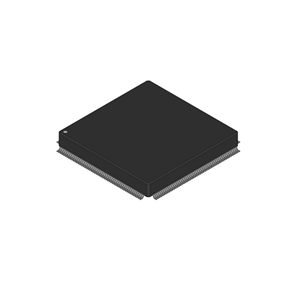
What is the EPF8820ARC208-4?
The EPF8820ARC208-4 is a legacy FPGA device from the FLEX 8000 series developed by Altera, now under Intel Programmable Solutions Group. Designed using a CMOS SRAM-based architecture, it belongs to a family of reconfigurable logic devices that marked a phase in programmable logic development. The FLEX 8000 series was recognized for its versatile logic cell structure and scalable interconnect, suitable for general-purpose digital integration. The EPF8820ARC208-4 specifically falls into a mid-speed grade variant within this series, and interconnect capabilities. It shares its architecture with other speed-grade variants such as the ‑2, ‑3, and ‑5, differing primarily in timing performance.
Looking for EPF8820ARC208-4? Contact us to check current stock, lead time, and pricing.
EPF8820ARC208-4 Features
• FLEX 8000 Architecture
The EPF8820ARC208-4 is built on Altera's FLEX 8000 architecture, which uses SRAM-based configuration for in-system programmability. It provides a cost-effective and flexible solution for mid-range logic density applications.
• Logic Density
This device integrates 672 logic elements, delivering approximately 8,000 usable system gates. It offers a suitable balance between complexity and performance for embedded control, glue logic, and state machine designs.
• 5V Core with MultiVolt™ I/O Support
Operating on a 5V supply, the device also supports 3.3V and 5V I/O standards using MultiVolt™ I/O technology. This makes it adaptable for mixed-voltage systems and legacy interfacing.
• In-Circuit Reprogrammable Configuration
The EPF8820ARC208-4 is SRAM-based and supports in-circuit configuration using external serial or parallel PROMs. It allows for rapid design updates and reconfiguration without removing the device from the circuit.
• FastTrack Interconnect Routing
Its FastTrack interconnect structure provides a predictable, high-speed routing fabric. This architecture supports efficient logic placement and timing control, enabling streamlined design performance.
• Carry and Cascade Chains for Arithmetic
Dedicated carry and cascade chains enhance the implementation of arithmetic functions like adders and counters. These features reduce logic delay and simplify the construction of complex math operations.
• PCI Bus Compliance (Rev 2.2)
This device complies with the PCI Local Bus Specification Revision 2.2, making it suitable for use in PCI-based systems. It supports 5V-tolerant PCI signaling environments.
• JTAG Boundary Scan Support
The EPF8820ARC208-4 includes built-in IEEE 1149.1 (JTAG) boundary-scan capabilities. This facilitates debugging, board testing, and in-system verification without requiring additional circuitry.
• Programmable Slew Rate Control
Its output drivers feature programmable slew rate control, helping to minimize switching noise. This is beneficial in high-speed designs for signal integrity.
• Low-Power Standby Mode
Designed for power efficiency, the device consumes less than 0.5 mA in standby mode. This allows systems to conserve power during idle or inactive periods.
• Operating Temperature: 0°C to 70°C
The component operates reliably within a commercial temperature range of 0°C to 70°C. It is ideal for general-purpose use in controlled environments.
FLEX 8000 Block Diagram
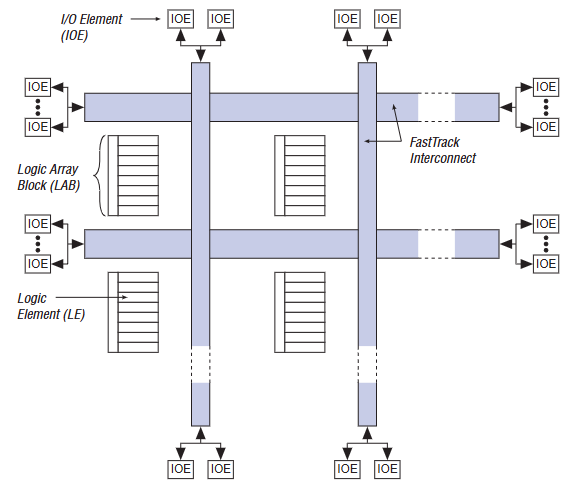
The diagram illustrates the internal structure and how the FPGA processes logic and connections. At the center are the Logic Array Blocks (LABs), which contain multiple Logic Elements (LEs). These LEs are programmable and can be configured to perform a wide range of logic tasks, supporting both combinational and sequential designs. This flexibility allows for custom digital circuit implementation.
Around the LABs are the I/O Elements (IOEs), which handle communication between the FPGA and external devices. They support input, output, and bidirectional signals while accommodating different voltage levels. Connecting all parts is the FastTrack Interconnect, a high-speed routing system that links LABs and IOEs efficiently. This setup ensures fast data transfer, smooth signal routing, and reliable performance across various applications within the FLEX 8000 series.
FLEX 8000 Timing Mode
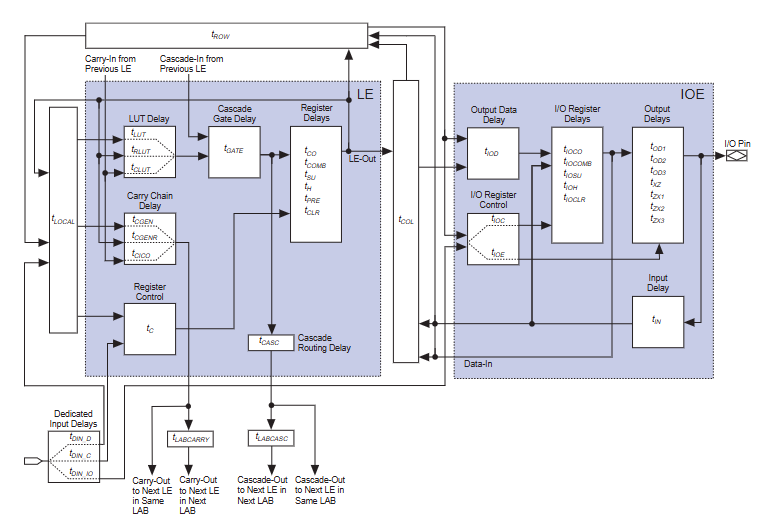
The diagram highlights how delays affect logic processing and signal flow within the FPGA. Inside each Logic Element (LE), timing factors like lookup table (LUT) delay, carry chain delay, and register setup/hold times determine how quickly logic operations respond to input changes. These internal delays are important for maintaining accurate and stable operation, especially in fast-switching circuits.
For I/O operations, the timing mode shows how signals behave as they enter and exit the FPGA. Key points include output delay, as well as input setup and hold times, which define how long external signals need to be stable for correct data capture. The diagram also outlines delays between connected LEs, including carry and cascade paths, which impact the flow of logic across the device. Altogether, these timing elements ensure synchronized, dependable performance across the FLEX 8000’s architecture.
FLEX 8000 Carry Chain Operation
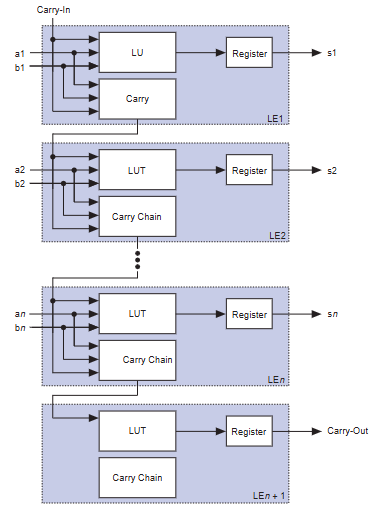
The carry chain operation in the EPF8820ARC208-4 FLEX 8000 is designed to perform fast arithmetic calculations by linking multiple Logic Elements (LEs) together. Each LE contains a Look-Up Table (LUT), a carry logic circuit, and a register. The process starts with a Carry-In signal entering the first LE (LE1), which, along with inputs a1 and b1, produces a sum output (s1) and a carry signal.
This carry signal is then passed directly to the next LE in the chain (LE2, LE3, and so on), allowing each LE to compute its own sum output (s2 to sn) using its inputs and the incoming carry. The last LE in the sequence generates the final Carry-Out signal, completing the operation. This carry chain structure enables rapid, efficient addition, ideal for building adders, counters, and other arithmetic-based logic in the FLEX 8000 architecture.
EPF8820ARC208-4 Specifications
|
Type |
Parameter |
|
Manufacturer |
Altera/Intel |
|
Series |
FLEX 8000 |
|
Packaging |
Tray |
|
Part Status |
Obsolete |
|
Number of LABs/CLBs |
84 |
|
Number of Logic Elements/Cells |
672 |
|
Number of I/O |
152 |
|
Number of Gates |
8000 |
|
Voltage - Supply |
4.75V ~ 5.25V |
|
Mounting Type |
Surface Mount |
|
Operating Temperature |
0°C ~ 70°C (TA) |
|
Package / Case |
208-BFQFP Exposed Pad |
|
Supplier Device Package |
208-RQFP (28x28) |
EPF8820ARC208-4 Applications
1. Digital Signal Processing (DSP) and Data-Path Control
The EPF8820ARC208-4 is well-suited for implementing custom DSP functions due to its moderate logic density and efficient routing architecture. It can handle data-path manipulation for operations such as filtering, modulation, and transformation of high-speed digital signals.
2. Custom Bus Interface and Coprocessor Offloading
With its large number of I/O pins and MultiVolt™ support, this FPGA is often used to design custom peripheral interfaces or bridge incompatible logic levels. It also serves as a co-processor that offloads repetitive control or data-handling tasks from the main processor.
3. Software-Defined Radio and Communication Processing
The device’s flexibility and ability to be reprogrammed make it ideal for applications like software-defined radio (SDR), where modulation schemes or protocols may change. It can dynamically handle encoding, decoding, and signal management across communication layers.
4. ASIC Prototyping and Hardware Emulation
The EPF8820ARC208-4 is commonly used during the prototyping phase of ASIC development. Its reprogrammable architecture allows fast validation, testing, and timing simulation of complex digital designs before committing to silicon.
5. Voice Recognition and Encryption Engines
This FPGA is capable of implementing medium-complexity logic like voice recognition pipelines and cryptographic algorithms. The presence of carry chains and registered I/Os ensures fast computation and low-latency signal processing required for such applications.
6. Industrial Control and Instrumentation Systems
The predictable timing, large fanout synchronous controls, and flexible logic blocks make this FPGA suitable for industrial automation systems. It is often used in programmable timing, state-machine control, and signal conditioning circuits.
7. Aerospace and Defense Embedded Systems
This device is utilized in aerospace and defense electronics where configuration flexibility and reliable operation in controlled environments are needed. It supports secure firmware loading and offers low standby power, which benefits mission-critical applications.
8. Automotive Electronic Modules
In automotive electronics, the EPF8820ARC208-4 can be found in control modules handling logic translation, diagnostics, or data aggregation between sensors and central ECUs. Its reconfigurable nature allows updates and enhancements even after deployment.
9. Telecommunications Switching and Protocol Handling
In telecom systems, this FPGA supports switching logic, protocol handling, and timing management. It can adapt to various signaling standards, ensuring compatibility and upgradability in dynamic communication networks.
EPF8820ARC208-4 Similar Parts
Here is a comparison table of EPF8820ARC208-4 and its most relevant similar parts from the same FLEX 8000 family:
|
Part Number |
Speed Grade |
Package Type |
I/O Pins |
Logic Elements |
Temperature Grade |
|
EPF8820ARC208-4 |
–4 (baseline) |
208-pin QFP |
152 |
672 |
Commercial |
|
EPF8820ARC208-2 |
–2 (slower) |
208-pin QFP |
152 |
672 |
Commercial (0–70 °C) |
|
EPF8820ARC208-3 |
–3 (medium) |
208-pin QFP |
152 |
672 |
Commercial |
|
EPF8820ARC208-5 |
–5 (faster) |
208-pin QFP |
152 |
672 |
Commercial |
|
EPF8820AQC208-4 |
–4 |
208-pin QFP (AQC) |
152 |
672 |
Commercial |
|
EPF8820ARI208-4H |
–4 |
208-pin QFP |
152 |
672 |
Industrial (–40–85 °C) |
EPF8820ARC208-4 Programming Steps
1. Generate Configuration File
Start by creating the configuration file using Altera's development software such as MAX+PLUS II or Quartus. This file, typically around 16KB in size, contains the complete bitstream needed to define the logic and routing of the EPF8820ARC208-4.
2. Select Configuration Scheme
Choose an appropriate configuration method based on system requirements: either Active Serial/Parallel (where the FPGA controls loading) or Passive Serial/Parallel (where an external controller handles configuration). Passive methods are ideal for systems requiring in-field reprogramming or dynamic updates.
3. Set Up Hardware Connections
Connect the necessary configuration lines such as nCONFIG, CONF_DONE, DCLK, and DATA0 between the FPGA and your chosen configuration memory device (e.g., EPC1, EPC1213). Ensure that pull-up resistors and clock sources are properly configured to match the selected configuration mode.
4. Power-On Initialization
When the system powers up or nCONFIG is asserted, the FPGA enters configuration mode and places all I/Os in a tri-state condition. The device is now ready to accept the configuration data based on the wiring scheme you implemented.
5. Load Configuration Data
In active mode, the FPGA fetches data directly from the EPROM using its internal oscillator. In passive mode, a host processor or configuration controller provides the data, and the process completes when the CONF_DONE signal goes high.
6. Internal Initialization and Transition to User Mode
Once the bitstream is fully loaded and CONF_DONE is asserted, the FPGA performs internal initialization, sets registers, and enables user I/O. The device then begins executing the logic design programmed into it.
7. Optional Reconfiguration
You can trigger a reconfiguration cycle by pulling nCONFIG low, which resets the device and re-enters configuration mode. This allows for fast, in-system updates or fallback logic recovery, with the entire reprogramming process typically completed in under 100 milliseconds.
EPF8820ARC208-4 Advantages
• Balanced Speed-Grade Choice
The EPF8820ARC208-4 offers an ideal balance between performance and cost, making it faster than lower-grade –2 or –3 variants while avoiding the higher price point of the –5 speed grade. This allows to meet timing requirements without overpaying for unused headroom.
• Predictable Routing Delays for Control Logic
Thanks to its fine-grained horizontal routing and consistent delay paths, the EPF8820ARC208-4 provides excellent timing predictability. This is useful in control-oriented or state-machine-heavy designs
• Fast In-Field Reconfiguration
Its SRAM-based structure allows reconfiguration in less than 100 milliseconds, enabling firmware updates and fallback logic in live systems. This is valuable in remote or mission-critical applications where downtime must be minimized.
• Cost-Effective
For applications requiring around 8,000 system gates, the EPF8820ARC208-4 provides just the right amount of logic without the overhead of larger modern FPGAs. This keeps BOM costs low while meeting functionality requirements.
• Simplified Mixed-Voltage Integration
With native support for both 3.3V and 5V I/O signaling, the device simplifies system design when interfacing with legacy TTL or mixed-voltage components. This eliminates the need for additional level shifters, saving board space and cost.
EPF8820ARC208-4 Packaging Dimensions
• Package Type: 208-pin RQFP (Rectangular Quad Flat Package)
• Body Size (D × E): 30.60 mm × 30.60 mm
• Package Outline (D1 × E1): Approximately 28.00 mm × 28.00 mm
• Lead Pitch (e): 0.50 mm
• Lead Length (L): 0.60 mm typical (range: 0.45 mm to 0.75 mm)
• Lead Width (b): 0.17 mm typical (range: 0.17 mm to 0.27 mm)
• Lead Angle: 0° to 8°
• Mounting Type: Surface Mount
EPF8820ARC208-4 Manufacturer
The EPF8820ARC208-4 is manufactured by Altera Corporation, a pioneering company in the field of programmable logic devices (PLDs) and field-programmable gate arrays (FPGAs). Altera originally developed the FLEX 8000 family, to which this device belongs, offering a reconfigurable architecture tailored for mid-density logic applications. In 2015, Altera was acquired by Intel Corporation, and the product continued to be supported under Intel’s Programmable Solutions Group. However, in 2024–2025, Intel re-established Altera as a standalone brand, reaffirming its focus on FPGA development and long-term support. While the EPF8820ARC208-4 is officially classified as obsolete, its manufacturing heritage remains tied to Altera’s legacy of delivering reliable, flexible, and widely adopted programmable logic solutions.
Conclusion
The EPF8820ARC208-4 is a flexible and reliable chip that offers a good mix of speed, features, and cost. It works well in many different systems because it can be reprogrammed, supports different voltages, and handles math and control tasks quickly. Its design helps make sure signals move smoothly and accurately. Even though it’s now considered an older or discontinued part, it’s still useful in systems that need stable performance and can’t easily switch to newer chips. This makes it a smart option for updates, repairs, or long-term support of older electronics.
About us
ALLELCO LIMITED
Read more
Quick inquiry
Please send an inquiry, we will respond immediately.
Frequently Asked Questions [FAQ]
1. Does EPF8820ARC208-4 require external configuration memory to boot up?
Yes, it uses external serial or parallel PROMs like EPC1 or EPC1213 to load the configuration data during system initialization or reset.
2. How do I know if my existing board design supports the EPF8820ARC208-4 configuration mode?
Check your schematic for required pins such as nCONFIG, CONF_DONE, DCLK, and DATA0. Also, ensure your configuration memory (like EPC1 or EPC1213) matches the chosen serial or parallel configuration method.
3. Can I perform partial reconfiguration on the EPF8820ARC208-4?
No, the EPF8820ARC208-4 does not support partial reconfiguration. Any updates or logic changes require a full bitstream reload via the standard configuration cycle.
4. Is there any risk of bitstream corruption during power-up?
Yes, if configuration timing or signal integrity is not properly maintained, bitstream corruption may occur. Ensure clean power sequencing and proper decoupling near the FPGA and configuration lines.
5. Can I use the EPF8820ARC208-4 for cryptographic functions or secure processing?
While not security-hardened, the device is suitable for implementing custom cryptographic logic like basic encryption engines or key handling, but it lacks built-in secure features found in modern FPGAs.
How the EPM7064AEFC100-10 Can Simplify Your Logic Design?
on July 14th

LC5768MC-75F256C CPLD: Features, Specs, Advantages and Applications
on July 10th
Popular Posts
-

Complex Instruction Set Computers: How They Changed Computing?
on April 18th 147768
-

USB-C Pinout and Features
on April 18th 111996
-
Using Xilinx Unified Simulation Primitives: A Comprehensive Guide to FPGA Design and Simulation
on April 18th 111351
-

Power Supply Voltages in Electronics: Meaning of VCC, VDD, VEE, VSS, and GND
on April 18th 83764
-

RJ45 Connector Guide: Pinout, Wiring, Cable Types, and Uses
on January 1th 79555
-

The Ultimate Guide to Wire Color Codes in Modern Electrical Systems
The way our electrical systems use colors isn’t just for looks. Each wire color now indicates a specific function, making it easier to identify and handle electrical components correctly during ins...on January 1th 66956
-
Purge Valve Guide: Function, Symptoms, Testing, and Replacement for Optimal Engine Performance
The purge valve is a key part of a car’s system that helps keep the air clean by managing fuel vapors before they can escape into the atmosphere. This not only helps the environment by reducing pol...on January 1th 63098
-

Quality (Q) Factor: Equations and Applications
The quality factor, or 'Q', is important when checking how well inductors and resonators work in electronic systems that use radio frequencies (RF). 'Q' measures how well a circuit minimizes energy...on January 1th 63029
-

Achieving Peak Performance with the Maximum Power Transfer Theorem
The Maximum Power Transfer Theorem explains how energy from a source, such as a battery or generator, flows to a connected load. It shows the exact condition where the load receives the most power....on January 1th 54095
-

A23 Battery Specifications and Compatibility
The A23 battery is a small, cylinder-shaped battery with high voltage. Also called 23A, 23AE, or MN21, it runs at 12 volts and much higher than AA or AAA batteries. Its special design make...on January 1th 52176
HOT Part Number
-

GRM0335C1E5R8CD01D
Murata Electronics
CAP CER 5.8PF 25V C0G/NP0 0201
NTD70N03RT4G
onsemi
MOSFET N-CH 25V 10A/32A DPAK
BXB75-48D3V3-2V5FL
Artesyn Embedded Power
DC DC CONVERTER 3.3V 2.5V 60W
GRM1555C1H5R6CZ01D
Murata Electronics
CAP CER 5.6PF 50V C0G/NP0 0402
LM5150QRUMRQ1
Texas Instruments
LM5150QRUMRQ1
DSPIC30F3012-30I/SO
Microchip Technology
IC MCU 16BIT 24KB FLASH 18SOIC
TPS22925BYPHT
Texas Instruments
IC PWR SWITCH N-CHAN 1:1 6DSBGA
RJK1055DPB-WS#J5
Renesas Electronics America Inc
IGBT
AD8304ARUZ
Analog Devices Inc.
IC LOGARITHMIC CONVERTER 14TSSOP
GRM188R61A106KAALD
Murata Electronics
CAP CER 10UF 10V X5R 0603
STM6777SYWB6F
STMicroelectronics
IC SUPERVISOR 2 CHANNEL SOT23-6
DS1306N
Analog Devices Inc./Maxim Integrated
IC RTC CLK/CALENDAR SPI 16DIP
STL40C30H3LL
STMicroelectronics
MOSFET N/P-CH 30V POWERFLAT
LTC4215CUFD#PBF
Linear Technology
HOT SWAP CONTROLLER WITH I2C COM
PI6C2409-1HLE+DLX
Diodes Incorporated
IC ZD BUFFER 16TSSOP
DRV612PW
Texas Instruments
IC AMP CLASS AB STEREO 14TSSOP
CRE2512-FZ-R002E-2
Bourns Inc.
RES 0.002 OHM 1% 2W 2512
ATMEGA328P-MN
Microchip Technology
IC MCU 8BIT 32KB FLASH 32VQFN -
CSPUA877ANLG8
Renesas Electronics America Inc
IC PLL CLK DVR SDRAM 40-VFQFPN
GS1574ACNE3
Semtech Corporation
IC VIDEO CABLE EQUALIZER 16QFN
MCP1726T-2502E/MF
Microchip Technology
IC REG LINEAR 2.5V 1A 8DFN
MBR20150CT
SMC Diode Solutions
DIODE ARRAY SCHOTTKY 150V TO220
S4EB-12V
Panasonic Electric Works
RELAY GEN PURPOSE 4PST 4A 12V
SPX5205M5-L/TR
MaxLinear, Inc.
IC REG LIN POS ADJ 150MA SOT23-5
TC642EOA
Microchip Technology
IC MOTOR DRIVER 3V-5.5V 8SOIC
LH28F800BJE-PTTL90
Sharp Microelectronics
IC FLASH 8MBIT PARALLEL 48TSOP
FJV92MTF
Fairchild Semiconductor
TRANS PNP 350V 0.5A SOT23-3
BRR1A16P
Agere Systems
IC LINE RECVR 0/4 16DIP
CBC2012T2R2M
Taiyo Yuden
FIXED IND 2.2UH 640MA 429MOHM SM
UCC2946PWTRG4
Texas Instruments
IC SUPERVISOR 1 CHANNEL 8TSSOP
RT1206BRD0724R9L
YAGEO
RES SMD 24.9 OHM 0.1% 1/4W 1206
CC2A25
Amphenol Telaire
SENSOR HUMID/TEMP 5V PDM 2% SMD
AQV217SZ
Panasonic Electric Works
SSR RELAY SPST-NO 160MA 0-200V
AS4C2M32SA-7TCN
Alliance Memory, Inc.
IC DRAM 64MBIT PAR 86TSOP II
B39881B7671A710
Qualcomm (RF front-end (RFFE) filters)
FILTER SAW 836.5/881.5MHZ 9SMD
MCC56-14IO1
IXYS
BIPOLAR MODULE - THYRISTOR TO-2 -

MAX701EPA
Analog Devices Inc./Maxim Integrated
IC SUPERVISOR 1 CHANNEL 8DIP
AT17LV256-10PU
Microchip Technology
IC SRL CONFIG EEPROM 256K 8-DIP
CD40174BE
Texas Instruments
IC FF D-TYPE SNGL 6BIT 16DIP
TNPW08054K59BEEN
Vishay Dale
RES 4.59K OHM 0.1% 1/8W 0805
TLE4276GV
Infineon Technologies
IC REG LINEAR VOLT TLE4276
9802-05-20
Coto Technology
RELAY RF SPST-NO 250MA 5V
GRM2195C2A160JZ01D
Murata Electronics
CAP CER 16PF 100V C0G/NP0 0805
BC818-40
Diotec Semiconductor
TRANS NPN 25V 0.8A SOT23-3
ADUC842BSZ62-5
Analog Devices Inc.
IC MCU 8BIT 62KB FLASH 52MQFP
GJM0225C1C1R2BB01L
Murata Electronics
CAP CER 1.2PF 16V C0G 01005
ATTINY44-20MU
Microchip Technology
IC MCU 8BIT 4KB FLASH 20QFN
NTMFS4927NT1G
onsemi
MOSFET N-CH 30V 7.9A/38A 5DFN
LTC2471IDD#PBF
Analog Devices Inc.
IC ADC 16BIT SIGMA-DELTA 12DFN
LQH31CN100K03L
Murata Electronics
FIXED IND 10UH 230MA 1.69OHM SMD
5035663900
Molex
CONN FPC BOTTOM 39POS 0.3MM R/A
MPQ20056GG-18-AEC1-Z
Monolithic Power Systems Inc.
IC REG LINEAR 1.8V 250MA 8QFN
74LCX760SJX
onsemi
IC BUFFER NON-INVERT 3.6V 20SOP
MMBZ5232BTW_R1_00001
Panjit International Inc.
SURFACE MOUNT SILICON ZENER DIOD