Exploring the CH341 High-Speed USB to Serial Interface
The CH341 chip is a versatile and cost-effective USB-to-serial UART converter designed by WCH, widely celebrated for its capability to bridge the gap between embedded systems and modern computing devices. With its compatibility across USB 1.1 and USB 2.0 standards and support for multiple protocols such as UART, I2C, SPI, and parallel interfaces, the CH341 has become a requisite tool for you. In this article, we dig into the features, pin configurations, applications, and design considerations of the CH341. Whether you are exploring microcontroller communication, enhancing industrial control systems, or simplifying DIY electronics projects, this guide provides comprehensive insights to help you leverage the full potential of the CH341.Catalog
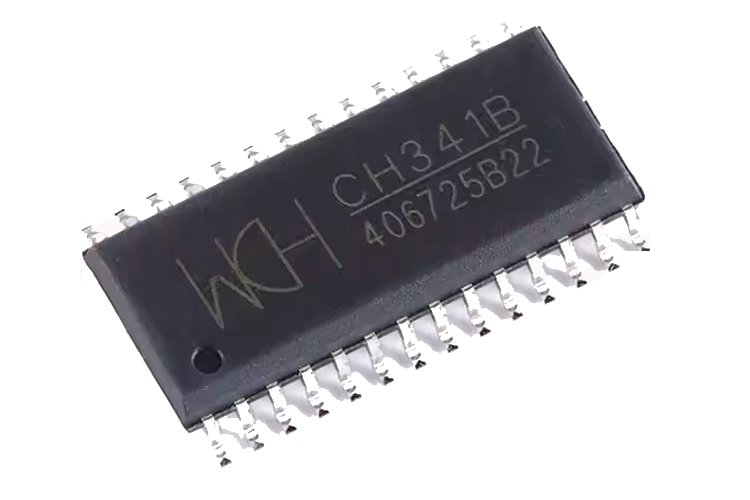
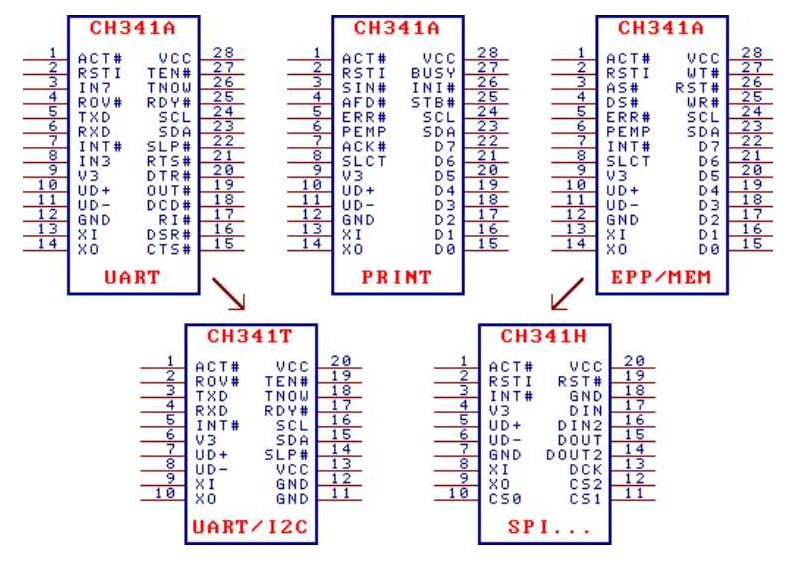
Pinout Configuration
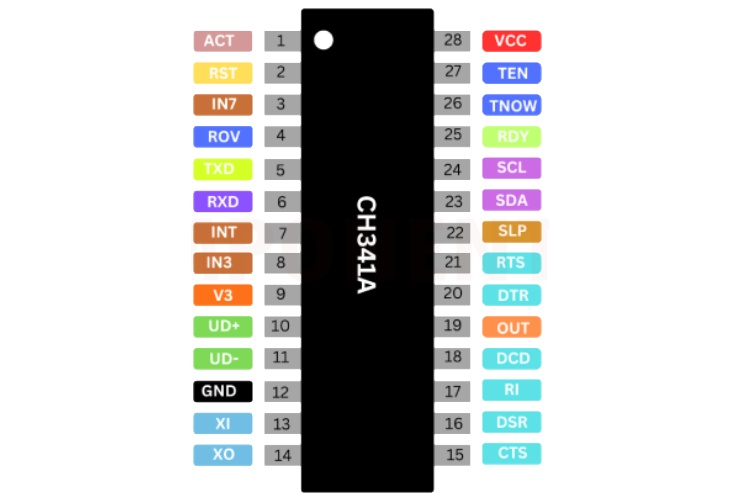
|
Pin No (341A) |
Pin No (341T) |
Pin No (341H) |
Pin Name |
Pin Type |
Pin Description |
|
28 |
13,20 |
20 |
VCC |
POWER |
A positive power input port requires a 0.1uF power
decoupling capacitance |
|
12 |
11,12 |
7,18 |
GND |
POWER |
Public ground, ground connection for USB bus |
|
9 |
6 |
4 |
V3 |
POWER |
Attachment of VCC input external power while 3.3V;
connects of 0.01uF decoupling capacitance outside while 5V |
|
13 |
9 |
8 |
XI |
IN |
Input of crystal oscillator, attachment of crystal and
crystal oscillator capacitance external |
|
14 |
10 |
9 |
XO |
OUT |
Opposite output of crystal oscillator, attachment of
crystal and crystal oscillator capacitance outside |
|
10 |
7 |
5 |
UD+ |
USB signal |
Directly connects to D+ data wire of USB bus |
|
11 |
8 |
6 |
UD- |
USB signal |
Directly connects to D- data wire of USB bus |
|
1 |
1 |
1 |
ACT# |
OUT |
After the USB device configuration output status, low
active |
|
2 |
No |
2 |
RSTI |
IN |
The input of external reset, active with high-level, with
pull-down resistor |
|
24 |
16 |
No |
SCL |
Open Drain Output |
The output of chip function configuration, with a pull-up
resistor, connect with SCL of serial EEPROM configuration chip |
|
23 |
15 |
No |
SDA |
Open Drain OUT/IN |
Input of chip function configuration, with pull-up
resistor, connect with SDA of serial EEPROM configuration chip |
Features
|
Feature |
Description |
|
USB Interface |
Full-speed USB device interface conforms to USB
Specification Version 2.0, requiring only crystal and capacitance external. |
|
Vendor ID and Product ID |
Optionally define vendor ID, product ID, and list number
using an external low-cost serial EEPROM. |
|
Power Source Support |
Supports 5V and 3.3V power sources. |
|
Low-Cost Conversion |
Directly converts serial peripheral equipment, parallel
printers, and parallel peripheral equipment. |
|
Packaging |
Available in SOP-28 and SSOP-20 packages, lead-free, and
compatible with RoHS standards. |
|
Application Layer Compatibility |
Compatible only with the application layer as interfaces
are diverted via USB. |
|
Serial Simulation |
Simulates standard serial for upgrading peripheral
equipment or adding extra serial ports via USB. |
|
Windows Compatibility |
Fully compatible with serial application programs in
Windows operating systems. |
|
Full-Duplex Serial Hardware |
On-chip transmit and receive buffers support 50bps to
2Mbps communication baud rates. |
|
Data Bit Support |
Supports 5, 6, 7, or 8 data bits and various parity
checks (odd, even, blank, token, or none). |
|
Signal Support |
Supports serial transfer and receive enable signals,
MODEM liaison signals, and transfer speed control signals. |
|
External Interface |
Provides RS232, RS485, and RS422 interfaces via external
level switch equipment. |
|
EEPROM Access |
Supports indirect access to external serial EEPROM memory
through standard serial communication. |
|
Printer Port Compatibility |
Upgrades parallel printers to USB printers, conforming to
USB specifications and compatible with Windows OS. |
|
Parallel Printer Support |
Compatible with various standard parallel printers,
supporting low-speed and high-speed print modes. |
|
Bi-Directional Communication |
Supports IEEE-1284 bi-directional communication, along
with single and bi-directional transfer modes. |
|
Parallel Interface Modes |
Provides EPP (Enhanced Parallel Port) and MEM (Memory
Mode) interface modes. |
|
EPP Mode Signals |
Supplies signals like AS#, DS#, and WR#, similar to EPP
V1.7 or V1.9. |
|
MEM Mode Signals |
Supplies signals like A0, RD#, and WR#, similar to memory
read/write mode. |
|
Synchronous Serial Interface |
Uses FlexWire™ technology to enable 2-wire to 5-wire
synchronous serial communication via software. |
|
Host/Master Endpoint Support |
Supports 2-wire and 4-wire synchronous serial interfaces. |
|
2-Wire Interface |
Supplies SCL and SDA signal wires and supports four
transfer speeds. |
Manufacturers
WCH operates as the sole manufacturer of the CH341, emphasizing the part's role in a variety of electronic applications. This exclusivity brings forth several considerations for industries that depend on the CH341 for their operational needs.
The unique production source of the CH341 introduces potential vulnerabilities within the supply chain. For example, should WCH face production delays or encounter quality control challenges, the market availability of the CH341 could be significantly impacted. This situation emphasizes the importance of proactive planning. Companies may benefit from exploring diverse sourcing strategies or investing in alternative technologies to alleviate risks tied to reliance on a single manufacturer.
Variants
The CH9102 has three variants, available in two different package types: SOP-28 and SSOP-20.
|
Package Shape |
Width of Plastic (mm) |
Width of Plastic (mil) |
Pitch of Pin (mm) |
Pitch of Pin (mil) |
Instruction of Package |
Part Number |
|
SOP-28 |
7.62 |
300 |
1.27 |
50 |
Small outline package of 28-pin |
CH341A |
|
SSOP-20 |
5.3 |
209 |
0.65 |
25 |
Shrink small outline package of 20-pin |
CH341T |
|
SSOP-20 |
5.3 |
209 |
0.65 |
25 |
Shrink small outline package of 20-pin |
CH341H |
Alternatives
• CH340
• FT230x
• CP2102
• PL2303HX
• CH343
• MCP2200
• CP2110
• FT232
Schematics

The schematic representation of the CH341 acts as an ultimate blueprint for grasping its operational framework. Dominant to this circuit, the USB data lines interface directly with the UD+ and UD- pins of the chip, enabling smooth communication with host devices. This connection serves as the backbone for data transfer, a process that has become increasingly substantial in our interconnected electronic landscape.
To maintain circuit stability, capacitors are thoughtfully positioned across the power supply and the V3 pin. These components contribute significantly to voltage stabilization and noise reduction, both of which are useful for preserving signal integrity. In practical scenarios, you can often highlight the role of these capacitors, recognizing their influence on the overall system performance. A well-structured power supply circuit can avert malfunctions and promote the longevity of the device. The Tx and Rx lines of the CH341 require precise connections to a microcontroller or a similar circuit. It is used for the TX line to connect to the Rx of the receiving device and vice versa, all while ensuring a shared ground. This principle of accurate signal routing transcends notional concepts; it reflects lessons learned from countless implementations. Misconnections can lead to communication breakdowns, potentially derailing projects and causing considerable frustration. Thus, a meticulous approach to wiring is active for successful integration.
Furthermore, a 12MHz crystal oscillator, accompanied by two 20pF capacitors, is utilized to produce the required clock signal for the CH341. This clock signal is basic for synchronizing data transmission, and its stability directly affects the chip's performance. In various applications, a dependable clock source has been shown to improve the overall efficiency of data processing tasks. You can frequently investigate alternative clock configurations and their effects on performance, illustrating the thorough consideration required in circuit design.
Troubleshooting CH341
When encountering communication difficulties with your USB-to-serial converter that employs the CH341, a well-structured troubleshooting process can greatly improve your chances of resolving the issue.
• Start by carefully checking all connections between the CH341 and the associated components. Pay particular attention to the alignment of the TX (transmit) and RX (receive) lines; even a slight misalignment can disrupt communication. Additionally, verify that the voltage levels of the signals match those of the devices you are connecting, as any discrepancies can lead to unpredictable behavior or total communication failure.
• A frequent oversight during troubleshooting is the USB cable itself. If problems continue, it may be worthwhile to replace the existing cable with another one, since a defective or subpar cable can create remarkable complications. The CH341's adaptability also extends to programming I2C and SPI EEPROMs; ready-made programmers like the CH341A or CH341 BIOS programmer can streamline this task. Becoming acquainted with these tools can save time and alleviate frustration.
• Thoroughly test the CH341, and ensure that the serial settings on your computer, especially the baud rate, are consistent with those of the device you aim to communicate with. A mismatch in these settings can result in data corruption or an inability to establish a connection. Conducting a loopback test is also a practical strategy to verify the functionality of the CH341; this involves connecting the TX and RX pins and checking that the transmitted data matches the received data.
• In situations where your computer does not recognize the integrated circuit (IC), it is required to conduct a comprehensive review of the installed drivers. Confirm that you have the appropriate drivers for the CH341, as outdated or incorrect drivers can lead to recognition problems. Furthermore, checking the Device Manager for any error messages can offer valuable clues regarding the underlying issues.
The troubleshooting journey is often a process of refinement, requiring both patience and meticulous attention to detail. By embracing a systematic approach and drawing on practical experiences from previous challenges, you can navigate these obstacles more effectively. Ultimately, successful troubleshooting hinges on a deep understanding of both the tools available and the complexities of the communication protocols at play.
PCB Design Considerations
When embarking on the journey of designing a PCB that incorporates the CH341, careful attention must be given to the strategic placement of decoupling capacitors in close proximity to the chip pins. This thoughtful arrangement not only fortifies the power supply but also alleviates voltage fluctuations that could potentially disrupt the chip's performance.
• Ensuring that the D+ and D- lines are routed in parallel and shielded by ground or copper pour plays a notable role in diminishing the risk of external signal interference. This layout strategy is backed by a wealth of successful designs, each revealing the benefits of improved data integrity and reliability.
• Another critical aspect involves maintaining short signal leads between the XI and XO pins. This practice helps to minimize high-frequency disturbances that could risk communication. You can frequently discover that implementing grounding or copper covering for associated components can significantly enhance the overall electromagnetic compatibility (EMC) of the PCB. This method not only aids in noise reduction but also fosters a more stable operating environment.
• The positioning of the USB port warrants careful consideration as well; placing it close to the CH341 allows for direct routing of data lines, which is needed for preserving signal integrity. It is wise to limit the number of vias in the data lines, as each via introduces additional capacitance and inductance that can compromise signal quality. You can often reflect on past experiences where minimizing vias resulted in noticeable performance enhancements, mostly in high-speed applications.
Uses of CH341
The CH341 chip stands out as a highly adaptable element within the electronics sector, boasting an array of applications that reach far beyond basic functionality. Its incorporation into diverse systems emphasizes its relevance in contemporary technology, especially in fields such as microcontroller programming, debugging, and testing. The chip's ability to interface with multiple protocols renders it required in industrial control systems, where accuracy and dependability are a must.
Microcontroller Programming and Debugging
Within the domain of microcontroller programming, the CH341 acts as a dynamic link between the programmer and the microcontroller. This connection not only facilitates code uploads but also supports debugging. The debugging process often requires a series of iterative adjustments based on system feedback, which can be both challenging and rewarding. You can indicate that a comprehensive grasp of CH341's features can greatly improve the efficiency of this iterative process, fostering a sense of accomplishment and mastery.
Industrial Control Systems
The impact of the CH341 on industrial control systems is notable. Its capacity to communicate with various devices ensures smooth integration into pre-existing setups. This flexibility is used, mostly in environments where older systems coexist with modern technologies. You can utilize the CH341 frequently to observe enhanced system reliability and diminished downtime, as it streamlines communication between different components, ultimately leading to a sense of satisfaction in their work.
DIY Electronics Projects
The CH341 unlocks a treasure trove of opportunities in DIY electronics projects. Its cost-effectiveness and accessible design make it an appealing choice for you. You can share that your experiments with the CH341 have deepened your understanding of serial communication and device interfacing. This hands-on engagement not only cultivates skills but also sparks creativity and innovation, instilling a sense of joy in the learning process.
Legacy Device Support
The enduring presence of legacy devices across various industries presents a distinct challenge. The CH341 provides a valuable solution by enabling contemporary systems to interact with older technologies. This functionality is especially advantageous in sectors where upgrading equipment is impractical due to financial constraints or compatibility issues. You can reveal that employing the CH341 can prolong the operational life of legacy systems, allowing for gradual advancements toward modern technologies, which can bring peace of mind to organizations navigating this transition.
Automation and Robotics
In the fields of automation and robotics, the CH341 serves a major role in facilitating communication between microcontrollers and other components. Its versatility allows for the integration of diverse sensors and actuators, thereby enhancing the capabilities of robotic systems. Actual applications have demonstrated that teams effectively leveraging the CH341 often achieve elevated levels of automation, ultimately resulting in increased productivity and a sense of fulfillment in their projects.
USB to Serial Conversions
The CH341 is mostly recognized for its proficiency in converting USB to RS485, RS232, and TTL serial ports. This functionality is vibrant for applications requiring USB connectivity for devices that typically depend on serial communication. You can remark that the CH341 simplifies the connection process between modern computers and older devices, promoting a more efficient workflow in environments where both technologies are in play. This seamless integration fosters a sense of ease and productivity.
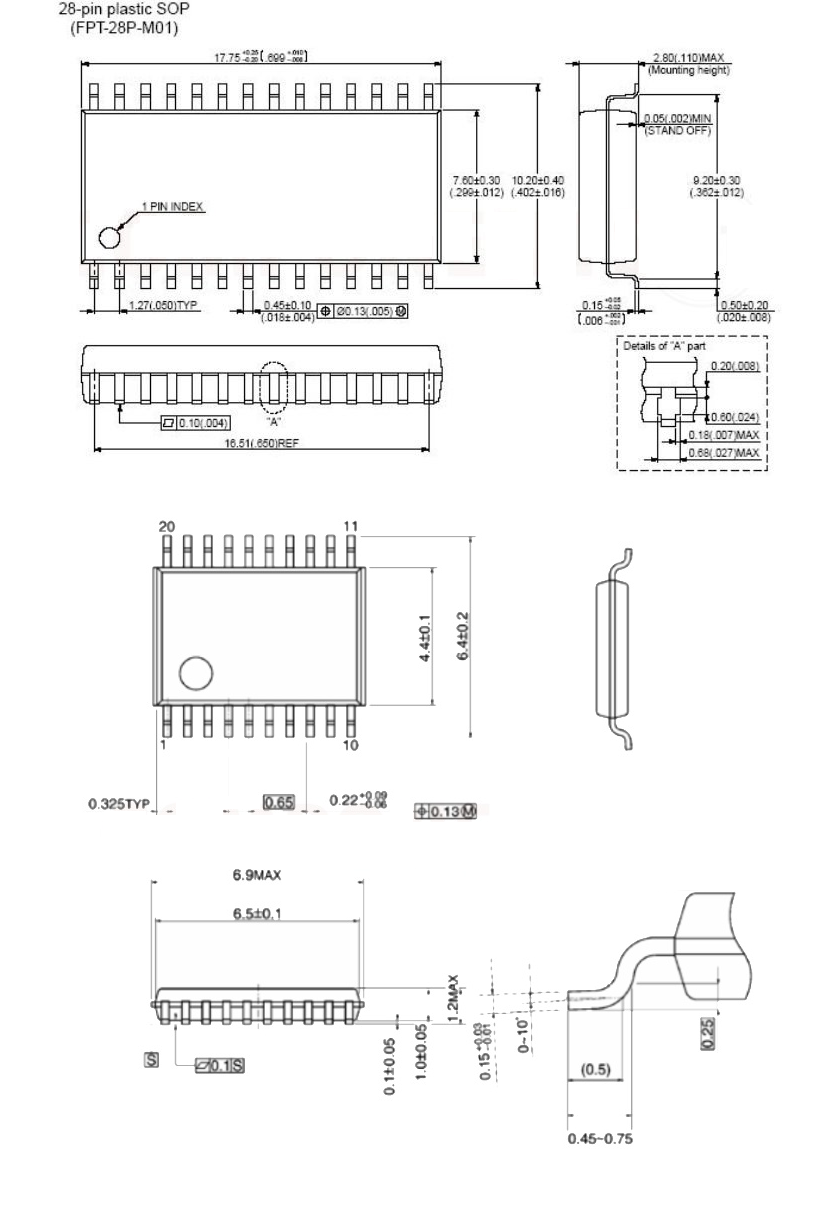
Footprint and Dimension
You can find the mechanical drawings and dimensions of the CH341 chip here. These dimensions are ideal for creating custom footprints for PCB design or CAD modeling.
About us
ALLELCO LIMITED
Read more
Quick inquiry
Please send an inquiry, we will respond immediately.
CD4071 OR Gate IC: Features, Applications, and Pinout
on December 26th
CD40106: Pinout, Features, and Alternatives
on December 26th
Popular Posts
-

Complex Instruction Set Computers: How They Changed Computing?
on April 18th 147749
-

USB-C Pinout and Features
on April 18th 111916
-
Using Xilinx Unified Simulation Primitives: A Comprehensive Guide to FPGA Design and Simulation
on April 18th 111349
-

Power Supply Voltages in Electronics: Meaning of VCC, VDD, VEE, VSS, and GND
on April 18th 83714
-

RJ45 Connector Guide: Pinout, Wiring, Cable Types, and Uses
on January 1th 79502
-

The Ultimate Guide to Wire Color Codes in Modern Electrical Systems
The way our electrical systems use colors isn’t just for looks. Each wire color now indicates a specific function, making it easier to identify and handle electrical components correctly during ins...on January 1th 66872
-

Quality (Q) Factor: Equations and Applications
The quality factor, or 'Q', is important when checking how well inductors and resonators work in electronic systems that use radio frequencies (RF). 'Q' measures how well a circuit minimizes energy...on January 1th 63005
-
Purge Valve Guide: Function, Symptoms, Testing, and Replacement for Optimal Engine Performance
The purge valve is a key part of a car’s system that helps keep the air clean by managing fuel vapors before they can escape into the atmosphere. This not only helps the environment by reducing pol...on January 1th 62948
-

Achieving Peak Performance with the Maximum Power Transfer Theorem
The Maximum Power Transfer Theorem explains how energy from a source, such as a battery or generator, flows to a connected load. It shows the exact condition where the load receives the most power....on January 1th 54077
-

A23 Battery Specifications and Compatibility
The A23 battery is a small, cylinder-shaped battery with high voltage. Also called 23A, 23AE, or MN21, it runs at 12 volts and much higher than AA or AAA batteries. Its special design make...on January 1th 52091
HOT Part Number
-

BD9B100MUV-E2
Rohm Semiconductor
IC REG BUCK ADJ 1A 16VQFN
UPD70F3539AF5A9-PN7-Q-A
Renesas Electronics America Inc
IC MICROCONTROLLER
18081A621JAT2A
KYOCERA AVX
CAP CER 620PF 100V NP0 1808
FDN340P
onsemi
MOSFET P-CH 20V 2A SUPERSOT3
70231-101
Amphenol ICC (FCI)
CONN RCPT BLADE PWR 8POS EDGE MT
MPSW42RLRAG
onsemi
TRANS NPN 300V 0.5A TO92
MC7824BT
onsemi
IC REG LINEAR 24V 1A TO220AB
AD8009ARZ-REEL
Analog Devices Inc.
IC OPAMP CFA 1 CIRCUIT 8SOIC
LT1815CS5#TRPBF
Analog Devices Inc.
IC OPAMP VFB 1 CIRCUIT TSOT23-5
DG411DYZ
Renesas Electronics America Inc
IC SWITCH SPST-NCX4 35OHM 16SOIC
VFT2060C-M3/4W
Vishay General Semiconductor - Diodes Division
DIODE SCHOTTKY 20A 60V ITO-220AB
TSX562AIYST
STMicroelectronics
IC CMOS 2 CIRCUIT 8MINISO
MR256D08BMA45
Everspin Technologies Inc.
IC RAM 256KBIT PARALLEL 48FBGA
VSC3312YYP-01
Microchip Technology
IC SWITCH 16X16 6.5GBPS 196FCBGA
XC68HC908GP20CFB
Motorola
TSG 8BIT20K FLASH
CSR8811A08-ICXR-R
Qualcomm
IC RF TXRX+MCU BLUETOOTH
MPSW05
onsemi
TRANS NPN 60V 0.5A TO92
1N4055R
Solid State Inc.
DIODE GEN PURP REV 900V 275A DO9 -

ASX342ATSC00XPED0-DP
onsemi
IMAGE SENSOR VGA 1/4 CIS SOC
0433.125NR
Littelfuse Inc.
FUSE BOARD MNT 125MA 125VAC/VDC
1SMA5941BT3G
onsemi
DIODE ZENER 47V 1.5W SMA
DCP010512BP-U/700
Texas Instruments
DC DC CONVERTER 12V 1W
1-1734344-1
TE Connectivity AMP Connectors
CONN D-SUB HD RCPT 15P R/A SLDR
KSD1621STF
onsemi
TRANS NPN 25V 2A SOT89-3
BQ24161RGET
Texas Instruments
IC BATT CHG LI-ION 1CELL 24VQFN
BTA26-600BW
STMicroelectronics
TRIAC ALTERNISTOR 600V 25A TOP3
NCP1239DD65R2G
onsemi
IC OFFLINE SWITCH FLYBACK 7SOIC
TMS320TCI6482BZTZA
Texas Instruments
TMS320 - DIGITAL SIGNAL PROCESSO
BQ20Z90DBTR-V150
Texas Instruments
IC GAS GAUGE LI-ION 30TSSOP
PCMB104T-1R0MT
Susumu
FIXED IND 1UH 18A 3.3 MOHM SMD
CY29942AXCT
Infineon Technologies
IC CLK BUFFER 1:18 200MHZ 32TQFP
CC0402KRX7R9BB561
YAGEO
CAP CER 560PF 50V X7R 0402
STPS20M60SG-TR
STMicroelectronics
DIODE SCHOTTKY 60V 20A D2PAK
AT25010N-10SC-2.7
Microchip Technology
IC EEPROM 1KBIT SPI 3MHZ 8SOIC
04023A1R0CAT4A
KYOCERA AVX
CAP CER 1PF 25V C0G/NP0 0402
ISL6327IRZ
Intersil
SWITCHING CONTROLLER, VOLTAGE-MO -

LQW18AN75NG0ZD
Murata Electronics
FIXED IND
DFA100BA160
SanRex Corporation
DIODE MODULE 1600V 100A
BAR46AFILM
STMicroelectronics
DIODE ARRAY SCHOTTKY 100V SOT23
MAX825SEUK
Analog Devices Inc./Maxim Integrated
IC SUPERVISOR MPU
MMST2222A-7-F
Diodes Incorporated
TRANS NPN 40V 0.6A SOT323
FODM8801AR2
onsemi
OPTOISO 3.75KV TRANS 4-MINI-FLAT
FJV1845FMTF
Fairchild Semiconductor
SMALL SIGNAL BIPOLAR TRANSISTOR,
EVK105RH5R1JW-F
Taiyo Yuden
CAP CER 5.1PF 16V R2H 0402
6651170-3
TE Connectivity AMP Connectors
CONN EDGE DUAL FMALE 4POS 0.508
KSZ8893FQLI-FX
Microchip Technology
IC SWITCH ETH 3PORT 128QFP
170M6340
Eaton - Bussmann Electrical Division
FUSE SQUARE 400A 1.3KVAC RECT
BCM20741A2KFB1G
Broadcom Limited
SINGLE-CHIP BLUETOOTH
MAX3443EASA+
Analog Devices Inc./Maxim Integrated
IC TRANSCEIVER HALF 1/1 8SOIC
GRM0335C1H9R3DA01D
Murata Electronics
CAP CER 9.3PF 50V C0G/NP0 0201
TNY175PN
Power Integrations
11.5 W (85-265 VAC) 15 W (230 VA
742700726
Würth Elektronik
FERRITE CORE 278 OHM SOLID 4MM
DM74S20N
onsemi
IC GATE NAND 2CH 4-INP 14DIP
P4SMA56CA-E3/61
Vishay General Semiconductor - Diodes Division
TVS DIODE 47.8VWM 77VC DO214AC