Exploring the LM741CN Operational Amplifier: Pinout, Specifications, and Use Cases
In this article, we’ll explore the LM741CN operational amplifier, a versatile and reliable component in electronics. Known for its enhanced features like internal compensation and overload protection, the LM741CN ensures consistent performance across various applications. From signal conditioning to analog computations, it remains a staple in both educational and professional settings. We'll cover its key features, pin configuration, and practical insights to highlight its continued impact on modern circuit design.Catalog

Overview of LM741CN
The LM741CN is famous for its adaptability as an operational amplifier, offering unique advantages over conventional models. It seamlessly integrates into applications replacing models like the 709C, LM201, MC1439, and 748. It offers comprehensive overload protection for input and output. Non-latching behavior upon exceeding common-mode limits. Strong resistance to oscillations.
The LM741CN exhibits flexibility with a variety of devices, highlighting its broad use. It frequently appears in audio systems, sensor amplification, and signal processing. Its dependability under variable voltage conditions makes it appealing for you, enriching diverse electronics projects. A distinct attribute of this model is its overload protection, defending against excessive current or voltage, thus enhancing longevity. Practically, this results in fewer component issues in active applications, such as medical instrumentation and aerospace technologies. With its non-latching design, the LM741CN ensures ongoing operation without manual resets. This is used in systems demanding uninterrupted functions, thereby reducing downtime and maintenance expenses. Observational data indicate fewer unexpected shutdowns, enhancing system performance.
Pin Configuration

|
NAME |
PIN NO. |
I/O |
DESCRIPTION |
|
INVERTING INPUT |
2 |
I |
Inverting signal input |
|
NC |
8 |
N/A |
No Connect, should be left floating |
|
NONINVERTING INPUT |
3 |
I |
Noninverting signal input |
|
OFFSET NULL |
1, 5 |
I |
Offset null pin used to eliminate the offset voltage and
balance the input voltages. |
|
OUTPUT |
6 |
O |
Amplified signal output |
|
V+ |
7 |
I |
Positive supply voltage |
|
V− |
4 |
I |
Negative supply voltage |
CAD Model Breakdown
Symbol

Footprint

3D Model

Characteristics and In-Depth Examination
|
Feature |
Description |
|
Overload Protection |
Protection on both input and output |
|
No Latch-Up |
Operates without latch-up when common-mode range is
exceeded |
|
High-Gain Op-Amps |
Two independent, high-gain, frequency compensated op-amps |
|
Input Offset Voltage |
2 mV |
|
Input Offset Current |
20 nA |
|
Input Bias Current |
80 nA |
|
Supply Current |
1.7 mA |
|
Supply Voltage Range |
±5V to ±18V |
Specifications of LM741CN
|
Type |
Parameter |
|
Mount |
Through Hole |
|
Mounting Type |
Through Hole |
|
Package / Case |
8-DIP (0.300, 7.62mm) |
|
Number of Pins |
8 |
|
Weight |
4.535924g |
|
Operating Temperature |
0°C ~ 70°C |
|
Packaging |
Tube |
|
JESD-609 Code |
e0 |
|
Pbfree Code |
No |
|
Part Status |
Obsolete |
|
Moisture Sensitivity Level (MSL) |
1 (Unlimited) |
|
Number of Terminations |
8 |
|
ECCN Code |
EAR99 |
|
Terminal Finish |
Tin/Lead (Sn/Pb) |
|
Packing Method |
RAIL |
|
Terminal Position |
DUAL |
|
Peak Reflow Temperature (°C) |
NOT SPECIFIED |
|
Number of Functions |
1 |
|
Supply Voltage |
15V |
|
Terminal Pitch |
2.54mm |
|
REACH Compliance Code |
Not Compliant |
|
Time @ Peak Reflow Temperature - Max (s) |
NOT SPECIFIED |
|
Base Part Number |
LM741 |
|
Pin Count |
8 |
|
Qualification Status |
Not Qualified |
|
Operating Supply Voltage |
22V |
|
Number of Channels |
1 |
|
Operating Supply Current |
1.7mA |
|
Nominal Supply Current |
1.7mA |
|
Power Dissipation |
500mW |
|
Output Current |
25mA |
|
Slew Rate |
0.5V/μs |
|
Architecture |
Voltage-Feedback |
|
Amplifier Type |
General Purpose |
|
Common Mode Rejection Ratio |
70dB |
|
Current - Input Bias |
80nA |
|
Voltage - Supply, Single/Dual (±) |
10V36V, ±5V18V |
|
Output Current per Channel |
25mA |
|
Input Offset Voltage (Vos) |
6mV |
|
Bandwidth |
1MHz |
|
Gain Bandwidth Product |
1.5MHz |
|
Negative Supply Voltage - Nom (Vsup) |
-15V |
|
Unity Gain BW - Nom |
437kHz |
|
Voltage Gain |
106.02dB |
|
Power Supply Rejection Ratio (PSRR) |
77dB |
|
Low-Offset |
No |
|
Frequency Compensation |
Yes |
|
Voltage - Input Offset |
2mV |
|
Bias Current - Max (IIB) @ 25°C |
0.5μA |
|
Height |
12.7mm |
|
Length |
12.7mm |
|
Width |
12.7mm |
|
REACH SVHC |
No SVHC |
|
RoHS Status |
Non-RoHS Compliant |
|
Lead Free |
Contains Lead |
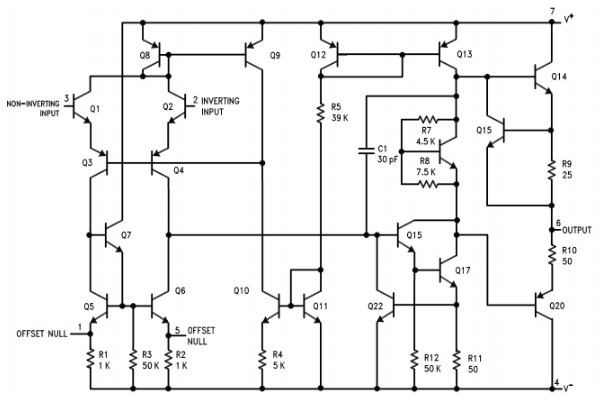
Functional Block Diagram of LM741CN
Design Insights

Enhancing system performance involves a thoughtful strategy toward arranging leads, placing components, and decoupling supply sources.
Lead Arrangement
The effective lead arrangement helps avoid interference and maintains signal integrity. Short, direct leads are preferred to minimize parasitic inductance and capacitance, which can otherwise distort signals. A seasoned approach includes evaluating lead paths during the layout phase to address any potential interference right from the start.
Component Placement
The efficiency of the system benefits significantly from strategic component placement. Positioning feedback resistors and decoupling capacitors near the device boosts stability, mitigates electromagnetic interference, and reduce noise. This method also simplifies troubleshooting and maintenance, enhancing reliability over time.
Supply Decoupling
Supply decoupling enhances the consistency of power delivery. Placing capacitors strategically along power supply lines ensures rapid compensation for transient voltage drops, maintaining steady operation. This practice is consistent with industry norms and supports a resilient power supply framework in demanding environments.
Alternative Options
|
Part |
Compare |
Manufacturers |
Category |
Description |
|
LM741CN |
Current Part |
TI |
Operational Amplifiers (General Purpose) |
TEXAS INSTRUMENTS LM741CN Operational Amplifier, Single,
1 Amplifier, 1MHz, 0.5V/µs, 10V to 36V, DIP, 8Pins |
|
UA741CP |
LM741CN VS UA741CP |
TI |
Operational Amplifiers (General Purpose) |
Operational Amplifier, Single, 1 Amplifier, 1MHz,
0.5V/µs, 7V to 36V, DIP, 8Pins |
|
UA741CD |
LM741CN VS UA741CD |
TI |
Operational Amplifiers (General Purpose) |
TEXAS INSTRUMENTS UA741CD Operational Amplifier, Single,
1 Amplifier, 1MHz, 0.5V/µs, ±9V to ±15V, SOIC, 8Pins |
|
UA741CPE4 |
LM741CN VS UA741CPE4 |
TI |
Operational Amplifiers (General Purpose) |
TEXAS INSTRUMENTS UA741CPE4 Operational Amplifier,
Single, 1MHz, 1 Amplifier, 0.5V/µs, ±9V to ±15V, DIP, 8Pins |
Application Areas
Comparators
Within electronic circuits, the LM741CN plays a substantial role as a comparator. By discerning and evaluating voltage levels, it caters to circuits needing decisions based on varying signal amplitudes. Imagine a temperature control system; it triggers responses when exceeding specific thresholds, embodying precision and reliability.
Multivibrators
The LM741CN is valuable in multivibrator circuits, generating accurate timing signals. Basic for clock generation or pulse shaping, these circuits contribute to the heart of timing-sensitive applications, enhancing synchronization and functionality.
DC Amplifiers
As a DC amplifier, the LM741CN ensures low-level signal amplification without distortion. This function is frequently useful in sensor interface circuits, where maintaining accurate signal representation is active. Such assurance fosters trust that serious signal information is accurately conserved and conveyed.
Summing Amplifiers
In summing amplifiers, the LM741CN enables the unification of multiple input signals into a single coherent output. This feature is beneficial in areas like audio mixing and sensor data integration, facilitating seamless data synthesis from varied sources.
Integrators and Differentiators
The LM741CN plays a valuable role in control systems and signal processing through integration and differentiation. An integrator accumulates signals over time, active in calculating metrics like velocity or charge. Meanwhile, a differentiator accentuates changes in signal levels, which is used for tasks like edge detection, offering exact insights.
Active Filters
Enhancing the design of active filters, the LM741CN shapes signal frequency responses for communications systems. Its application extends to audio processing, guaranteeing clarity and eliminating undesired noise, thus enriching the quality of auditory or data transmissions.
Enhanced Use Cases
In common scenarios, mostly the non-inverting amplifier setup, the LM741CN consistently aligns the phase of input and output. This setup is valued for its high input impedance and low output impedance, which foster input-output isolation. Such characteristics reduce signal distortion, preserving integrity in diverse applications. The design accommodates notable adjustments in gain, making it adaptable across many scenarios. By varying resistor values, the gain ranges from unity to substantially higher levels, allowing customization for distinct dynamic ranges and frequency responses. This adaptability is advantageous in audio amplification and signal processing, where precise gain control enhances performance without sacrificing sound quality.

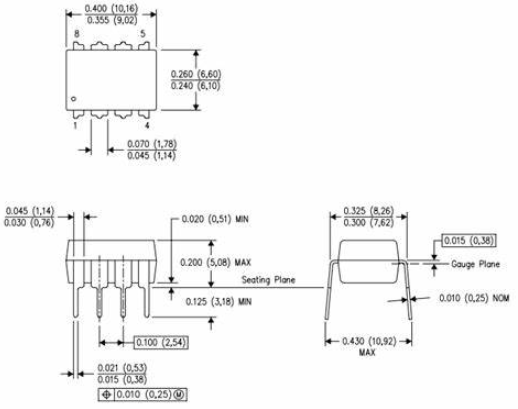
Package
Manufacturer Information
Texas Instruments (TI) plays a remarkable role in the global semiconductor arena, establishing operations in over 35 countries. The company is celebrated for its relentless pursuit of innovation and its agile response to evolving market demands, powered by a workforce deeply invested in the thrill of technological progress. Founded in the mid-20th century, TI consistently leads in electronic innovation. Its creation of the integrated circuit stands as a key moment, a testament to its influence across multiple sectors, including consumer electronics and automotive systems.
Engaging deeply in research and development, TI embraces the dynamic shifts in the technical landscape. The company's passion is evident in its continuous product enhancements and strategic partnerships that amplify its inventive prowess. Boasting offices in more than 35 countries, TI's extensive network empowers the company to customize solutions for diverse markets, addressing unique regional demands. This reach is complemented by a steadfast commitment to quality and efficiency, reflecting the high standards TI maintains globally.
Frequently Asked Questions [FAQ]
1. What is LM741CN?
The LM741CN is an operational amplifier integrated circuit, commonly embraced for its reliability in applications such as function generators, comparators, and DC amplifiers. You can appreciate its dependable nature and simplicity, making it attractive for learning and crafting practical circuits alike.
2. What defines inverting & non-inverting amplifiers?
Inverting amplifiers produce an output opposing the phase of the input signal, basically reversing it. Non-inverting amplifiers, however, retain the input's original phase. This distinction matters when designing circuits for nuanced signal manipulation. In audio processing, for example, selecting between these configurations can influence sound fidelity.
3. What is the difference between integrator and differentiator?
Differentiators act as rate-of-change detectors, maintaining steady outputs amidst input shifts, active in responsive control systems. Conversely, integrators offer variable outputs with steady inputs, serving as signal conditioners to smooth noise and fluctuations. Their roles are substantial in analog computing and signal processing, contributing to the creation of stable, precise systems.
4. What is the difference between LM358 and LM741?
The LM358 houses two operational amplifiers, catering to designs requiring multiple amplifiers while conserving space. Meanwhile, the LM741, with its single op-amp, suits simpler circuit needs. Each chip cleverly adapts to varying design scenarios based on specific engineering desires.
5. What is the difference between LM741 and UA741?
Though initially from separate manufacturers, the LM741 and UA741 are now both under Texas Instruments. Despite this, they exhibit silicon-level variations, affecting performance in non-standard applications. It's recommended to retest in such cases to verify compatibility. This distinction emphasizes the need to grasp component specifications for optimizing circuit functionality.
About us
ALLELCO LIMITED
Read more
Quick inquiry
Please send an inquiry, we will respond immediately.
LM7806: Pinout, Specifications, and Datasheet
on October 25th
LM386 Audio Amplifier IC: A Complete Guide to Usage and Applications
on October 25th
Popular Posts
-

Complex Instruction Set Computers: How They Changed Computing?
on April 18th 147753
-

USB-C Pinout and Features
on April 18th 111925
-
Using Xilinx Unified Simulation Primitives: A Comprehensive Guide to FPGA Design and Simulation
on April 18th 111349
-

Power Supply Voltages in Electronics: Meaning of VCC, VDD, VEE, VSS, and GND
on April 18th 83714
-

RJ45 Connector Guide: Pinout, Wiring, Cable Types, and Uses
on January 1th 79502
-

The Ultimate Guide to Wire Color Codes in Modern Electrical Systems
The way our electrical systems use colors isn’t just for looks. Each wire color now indicates a specific function, making it easier to identify and handle electrical components correctly during ins...on January 1th 66872
-

Quality (Q) Factor: Equations and Applications
The quality factor, or 'Q', is important when checking how well inductors and resonators work in electronic systems that use radio frequencies (RF). 'Q' measures how well a circuit minimizes energy...on January 1th 63005
-
Purge Valve Guide: Function, Symptoms, Testing, and Replacement for Optimal Engine Performance
The purge valve is a key part of a car’s system that helps keep the air clean by managing fuel vapors before they can escape into the atmosphere. This not only helps the environment by reducing pol...on January 1th 62956
-

Achieving Peak Performance with the Maximum Power Transfer Theorem
The Maximum Power Transfer Theorem explains how energy from a source, such as a battery or generator, flows to a connected load. It shows the exact condition where the load receives the most power....on January 1th 54078
-

A23 Battery Specifications and Compatibility
The A23 battery is a small, cylinder-shaped battery with high voltage. Also called 23A, 23AE, or MN21, it runs at 12 volts and much higher than AA or AAA batteries. Its special design make...on January 1th 52092
HOT Part Number
-

RMPA0959
onsemi
IC RF AMP CELL 824-849MHZ 11LCC
RCLAMP0554S.TCT
Semtech Corporation
TVS DIODE 5VWM 15VC SOT23-6
CM453232-R47KL
Bourns Inc.
FIXED IND 470NH 545MA 320MOHM SM
744028002
Würth Elektronik
FIXED IND 2.2UH 1.3A 155MOHM SMD
MIC3809YMM
Microchip Technology
IC REG CTRLR MULT TOPOLOGY 8MSOP
AONS36302
Alpha & Omega Semiconductor Inc.
MOSFET N-CH 30V 146A 8DFN
SP3238EEA-L/TR
MaxLinear, Inc.
IC TRANSCEIVER FULL 5/3 28SSOP
BF5020WH6327
Infineon Technologies
N-CHANNEL POWER MOSFET
C1608X8R1H102M080AE
TDK Corporation
CAP CER 1000PF 50V X8R 0603
TPS71525QDCKRQ1
Texas Instruments
IC REG LINEAR 2.5V 50MA SC70-5
170M5444
Eaton - Bussmann Electrical Division
FUSE SQUARE 500A 1.3KVAC RECT
IHLP4040DZER220M1A
Vishay Dale
IHLP-4040DZ-1A 22 20% ER E3
C0603X181J1HACAUTO
KEMET
CAP CER 0603 180PF 100V ULTRA ST
PIC16F1575-E/JQ
Microchip Technology
IC MCU 8BIT 14KB FLASH 16UQFN
OPA4354AIPWR
Texas Instruments
IC CMOS 4 CIRCUIT 14TSSOP
P6SMB33A
Bourns Inc.
TVS DIODE 28.2VWM 45.7VC DO214AA
GCM1885C1H4R4CA16D
Murata Electronics
CAP CER 4.4PF 50V C0G/NP0 0603
R5F100LGAFB#10
Renesas Electronics America Inc
IC MCU 16BIT 128KB FLASH 64LFQFP -
TC621CCOA
Microchip Technology
THERMOSTAT PROG ACTIVE LOW 8SOIC
IRG4BC20UDPBF
International Rectifier
IGBT, 13A I(C), 600V V(BR)CES, N
MICROSMD175F-2
Littelfuse Inc.
PTC RESET FUSE 6V 1.75A 1210
AC0603KRX7R8BB222
YAGEO
CAP CER 2200PF 25V X7R 0603
1812AA150JAT1A\SB
KYOCERA AVX
CAP CER 15PF 1KV NP0 1812
SY10ELT22ZC
Microchip Technology
IC TRANSLTR UNIDIRECTIONAL 8SOIC
SCW03B-12
MEAN WELL USA Inc.
DC DC CONVERTER 12V 3W
A4840
Sensata-Crydom
SSR RELAY SPST-NO 40A 80-530V
TC4426AEOA
Microchip Technology
IC GATE DRVR LOW-SIDE 8SOIC
C1608NP01H470J080AA
TDK Corporation
CAP CER 47PF 50V NP0 0603
GRM1555C2A8R1DA01J
Murata Electronics
CAP CER 8.1PF 100V C0G/NP0 0402
INA330AIDGST
Texas Instruments
IC OPAMP GP 1 CIRCUIT 10VSSOP
12061C273KAT2A
KYOCERA AVX
CAP CER 0.027UF 100V X7R 1206
74LX1G70CTR
STMicroelectronics
IC BUF NON-INVERT 5.5V SOT323-5
CSNE151-204
Honeywell Sensing and Productivity Solutions
SENSOR CURRENT HALL 90A AC/DC
LF353DT
STMicroelectronics
IC OPAMP JFET 2 CIRCUIT 8SOIC
SMK316B7223KLHT
Taiyo Yuden
CAP CER 0.022UF 630V X7R 1206
R9G01612XX
Powerex Inc.
DIODE GP 1.6KV 1200A DO200AB -
FPF2300MPX
Fairchild Semiconductor
DUAL OUTPUT CURRENT LIMIT SWITCH
HZB6.8MWATL-E
Renesas Electronics America Inc
TVS DIODE 3.5VWM 3CMPAK
P0111MA 1AA3
STMicroelectronics
SCR 600V 800MA TO92-3
88E1545-A1-LKJ2C000
Marvell Semiconductor, Inc.
IC TXRX FULL/HALF 4/4 128LQFP
MAX809SN293D1T1G
onsemi
IC SUPERVISOR 1 CHANNEL SOT23-3
ICL3232IBZ-T
Renesas Electronics America Inc
IC TRANSCEIVER FULL 2/2 16SOIC
EP1K50FI484-2
Altera
LOADABLE PLD, 0.4NS PBGA484
FDMF6824C
onsemi
IC HALF BRIDGE DRIVER 50A 40PQFN
HVD144AKRF-E
Renesas Electronics America Inc
PLANAR PIN DIODE
MCD56-12IO1B
IXYS
MOD THYRISTOR/DIO 1200V TO-240AA
CD3275A0DRCR
Texas Instruments
PROTOTYPE
SN74ALS240ANSR
Texas Instruments
IC BUFFER INVERT 5.5V 20SO
9FG104EGLF
Renesas Electronics America Inc
IC FREQ TIMING GENERATOR 28TSSOP
MPC8548EVTAUJB
Freescale Semiconductor
MPU, 32-BIT, 1333MHZ, PBGA783
NCP1070STCT3G
onsemi
IC OFFLINE SWITCH FLYBACK SOT223
MIC4422YM
Microchip Technology
IC GATE DRVR LOW-SIDE 8SOIC
BU2510-E3/51
Vishay General Semiconductor - Diodes Division
BRIDGE RECT 1P 1KV 3.5A BU
GS8642Z36GB-167IV
GSI Technology Inc.
IC SRAM 72MBIT PARALLEL 119FPBGA