
IRFZ44N MOSFET: Features, Alternatives, and Advantages
This article delves into the IRFZ44N MOSFET, a key component in modern electronic design, highlighting its robust features and diverse applications. The IRFZ44N stands out due to its ability to manage substantial current with low resistance, making it a preferred choice for power management tasks in various technologies. From motor control to power supply design, this MOSFET's efficiency and reliability are examined in detail, offering insights into its operational and versatility in the electronics industry.Catalog
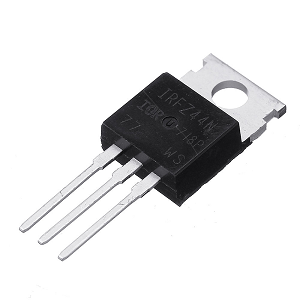
Overview of the IRFZ44N
The IRFZ44N, manufactured by Infineon Technologies, marks a noteworthy evolution in N-channel MOSFET technology. This device can handle an impressive drain current of 49A, complemented by a remarkably low on-resistance of 17.5 mΩ. Such specifications make it invaluable for a variety of power management tasks, including but not limited to motor control and power supply design, where reliability is not just preferred, but often demanded.
To attain the best performance at its peak drain current, a gate voltage of up to 10V is necessary. This aspect emphasizes the importance of a carefully designed gate driver circuit; the effectiveness of the overall system may often depend on how well this component functions. Having a thorough grasp of the intricacies of gate driver operations and their influence on MOSFET behavior can prove beneficial in demanding applications.
The IRFZ44N architecture supports efficient operation when power conservation is important. Moreover, its functionality at high frequencies, reaching up to 1MHz, paves the way for implementation in various sectors, such as telecommunications and computer hardware. The ramifications of working at elevated frequencies, often affecting not only performance but also aspects like electromagnetic compatibility and thermal management. The IRFZ44N's high input resistance and broad temperature tolerance contribute further to its dependability across a range of applications. It proves valuable in both industrial settings, characterized by different operational conditions and in electronics.
IRFZ44N Pin Configuration
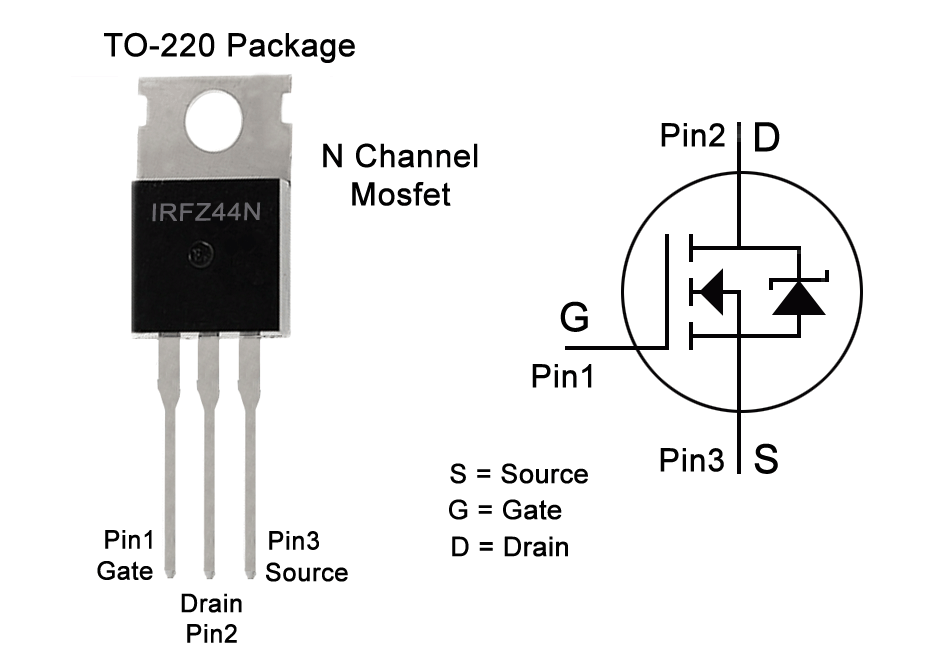
|
Pin No. |
Pin Name |
Description |
|
1 |
Gate |
Controls the biasing of the MOSFET |
|
2 |
Drain |
Current flows in through Drain |
|
3 |
Source |
Current flows out through Source |
Features of the IRFZ44N
• Gate Threshold Voltage (VGS-th) ranges from 2V (minimum) to 4V (maximum).
• Maximum Gate-Source Voltage (VGS) is ±20V.
• Drain-Source Voltage (VDS) supports up to 55V.
• Power dissipation capability peaks at 94W.
• Fast switching with a rise time of ~60ns and a fall time of ~45ns.
• Compatible with Arduino due to its low gate threshold current.
• Comes in a TO-220 package.
• N-Channel MOSFET designed for small signal applications.
• Continuous Drain Current (ID) reaches up to 49A at 25°C.
• Pulsed Drain Current (ID-peak) can handle up to 160A.
Alternatives of the IRFZ44N
• IRF2807
• IRFB3207
• IRFB4710
• IRF3205
• IRLZ44N
• FDP7030L
• IRFZ48N
How and Where to Use IRFZ44N MOSFET?
The IRFZ44N MOSFET is a popular choice in electronic circuits due to its ability to handle high currents efficiently and switch rapidly. Its low on-resistance ensures minimal power loss during operation, making it ideal for high-power applications. This MOSFET begins conducting at a gate voltage as low as 4 volts, but to fully turn on and carry maximum current, it requires a gate voltage of 10 volts. If you’re interfacing it with a microcontroller like an Arduino, which operates at lower output voltages, you might consider using the IRLZ44N, a variant better suited for lower gate drive voltages.
To effectively use the IRFZ44N, it’s important to understand that it operates based on voltage control at its gate, unlike older transistors that rely on current. When no voltage is applied to the gate, the MOSFET remains off, leaving the path between the drain and source open and preventing current flow. Applying sufficient voltage to the gate closes this path, allowing current to flow through. In simple switching applications with an Arduino, you can use a transistor circuit to boost the gate voltage to the required level for full activation. For more advanced applications, such as high-speed switching or amplification, it’s recommended to use a dedicated MOSFET driver to ensure optimal performance and reliability.
Using IRFZ44N with a 5V Gate Arduino
When pairing the IRFZ44N MOSFET with a 5V microcontroller like an Arduino or PIC, it's need to understand that a 5V gate voltage is insufficient to fully activate the MOSFET. This limitation can lead to suboptimal performance, particularly in applications requiring the handling of high currents. Based on the MOSFET's performance characteristics, a 5V gate voltage enables the device to conduct up to 20A of drain current, but it doesn't allow the MOSFET to operate at its full potential. To achieve proper performance, the gate voltage should be closer to 10V. In practical use, this means you’ll likely need a gate driver to step up the 5V signal from the microcontroller to the required 10V. A gate driver ensures the MOSFET switches on fully and operates efficiently. Without this adjustment, the MOSFET may experience issues such as overheating or incomplete switching, both of which can degrade performance or cause failure in the circuit. By providing an adequate gate voltage, the MOSFET will function safely and handle higher loads as intended.
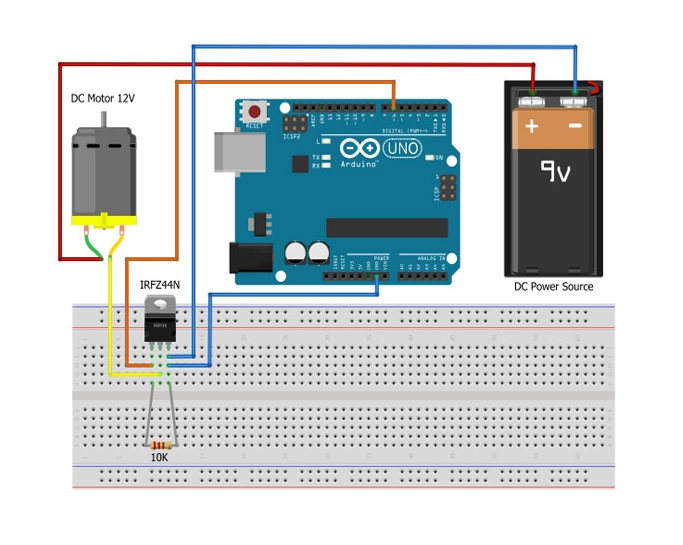
The image above shows a setup where an Arduino Uno controls a 12V DC motor using an IRFZ44N MOSFET. Since the Arduino outputs 5V and the MOSFET needs 10V to fully turn on, adding a gate driver would enhance the MOSFET's performance by increasing the gate voltage.
IRFZ44N Circuit Design for On-Off Switching
The IRFZ44N MOSFET can be used to build simple yet practical circuits, such as a touch-sensitive on-off switch for controlling high-power loads. This setup includes components like a 12V relay, a 104F ceramic capacitor, and a 1N4007 diode. The MOSFET serves as the main switching element, activated by a touch input signal. The 12V relay allows the circuit to handle higher voltage or current loads that the MOSFET or microcontroller alone could not directly manage. The ceramic capacitor prevents voltage fluctuations when the relay is triggered, ensuring stable operation. The 1N4007 diode protects the MOSFET from damaging voltage spikes generated by the relay coil during switching. This design combines the advantages of solid-state switching with the electromagnetic properties of a relay, creating a reliable and effective solution for controlling high-power devices. It demonstrates how to integrate MOSFETs with other components to build versatile and robust circuits.
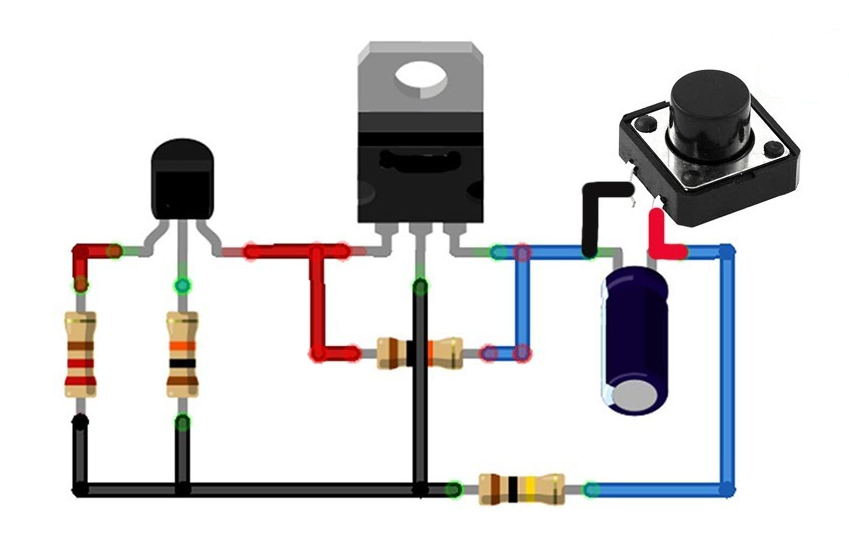
The image above shows a basic push-button ON/OFF switch circuit. This can be upgraded with an IRFZ44N MOSFET, a 12V relay, a ceramic capacitor, and a diode to control high-power loads more reliably.
Safe Operation of the IRFZ44N
To maximize the IRFZ44N's performance and lifespan, operate it below 80% of its maximum rated limits. This reduces stress, minimizes heat generation, and improves reliability. Proper thermal management is required. Use heat sinks and thermal paste to efficiently dissipate heat, preventing failures and ensuring durability. Balancing performance and safety is key. Strategies like distributing thermal loads with complementary components can further enhance efficiency and stability, extending the component’s operational life.
Steps in Designing Circuits
To design a circuit with the IRFZ44N power MOSFET, start by defining the requirements, including load type, input voltage, and output current, as these determine component selection and overall design. Choose resistors, capacitors, diodes, and other components based on their ratings and compatibility to ensure reliability and efficiency. Select the IRFZ44N MOSFET specifically for its high efficiency and switching reliability, confirming its current and voltage ratings meet the circuit's needs.
Next, calculate the gate voltage using the MOSFET datasheet to ensure proper switching, optimizing performance while minimizing power losses. Design a gate driver circuit, either using an external driver IC for faster switching or a simpler transistor-based solution, depending on the design priorities. Assemble the circuit carefully following the schematic, ensuring accurate connections to avoid errors. Once built, test the circuit using tools like multimeters and oscilloscopes to verify functionality, checking voltage and current values against expectations. Address any issues found and optimize the circuit by adjusting components, recalculating voltages, or refining the layout.
Applications of the IRFZ44N
• Power Management: Efficiently handles high voltages and currents in industrial equipment and computing systems, reducing energy loss and heat.
• Motor Speed Control: Enables precise motor speed adjustments for smooth, efficient operation in appliances, robotics, and automation.
• LED Dimming and Flashing: Supports PWM for energy-efficient light control in automotive and architectural lighting, with reliable thermal stability.
• Telecommunications and Computing: Provides fast switching for quick data transfer and stable performance in routers, modems, and processors.
• Power Converters and Inverters: Optimizes energy conversion in AC-DC and DC-AC systems, including renewable energy setups like solar and wind.
• Battery Charging: Ensures efficient and controlled charging for EV batteries and solar systems, protecting battery health.
• UPS Systems and Motor Drivers: Delivers uninterrupted power for devices and precise motor control in industrial and automotive applications.
• High-Frequency Switching: Ideal for modern electronics requiring reliable, fast, and efficient switching performance.
Advantages of the IRFZ44N
Increased Durability
The IRFZ44N is designed to withstand demanding conditions, ensuring long-term reliability. Its robust construction and quality materials make it capable of operating effectively even in environments prone to thermal or electrical stress.
Wide Availability
This component is easily obtainable through a broad network of distribution partners. Its consistent presence in the market simplifies the sourcing process, minimizing delays in production.
Compliance with Industry Standards
The IRFZ44N meets established industry qualification standards, ensuring it aligns with the safety and performance requirements expected in applications. You can rely on it to deliver consistent results across different systems without compromising regulatory compliance.
Efficient for Low-Frequency Applications
Its design is optimized for low-frequency circuits, where it consistently delivers high performance. The device ensures stable operation, making it a dependable choice for applications requiring smooth and controlled functionality in these frequency ranges.
Standardized Pin Configuration
The IRFZ44N features a universal pin-out design, which allows for straightforward integration into existing circuits. This standardization eliminates compatibility concerns, enabling you to replace or upgrade components effortlessly without redesigns.
Strong Current-Handling Capability
With its ability to manage high current loads effectively, the IRFZ44N provides reliable performance in power-intensive systems. Its thermal stability and current-carrying efficiency make it a solid choice for high-demand operations.
Differences Between IRLZ44N and IRFZ44N
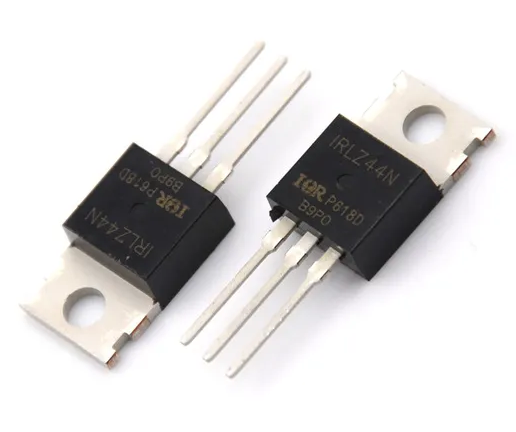
IRLZ44N MOSFET
Choosing between the two depends on the application’s needs: simplicity and microcontroller compatibility (IRLZ44N) vs. handling higher voltages with added complexity (IRFZ44N). The IRLZ44N has a low gate threshold voltage, making it ideal for direct control by microcontrollers without needing extra circuitry. This simplifies designs and reduces costs. The IRFZ44N requires higher gate voltage and needs gate drivers for optimal performance, adding complexity. The IRLZ44N is better for low-power systems and projects that prioritize ease of integration, such as microcontroller-driven circuits. The IRFZ44N excels in high-voltage, high-power applications, such as automotive or heavy machinery, where durability and reliability are needed.
IRFZ44N Troubleshooting Tips
Troubleshooting electronic circuits necessitates a structured method to uncover and resolve potential complications, promoting enduring functionality and superior performance. The strategies outlined below will explore various practices that bolster circuit reliability and instill confidence in the process.
Verify All Connections
Connections constitute the foundation of any electronic circuit. A comprehensive examination should encompass not only visual verification of undamaged wires but also the utilization of tools such as multimeters to evaluate continuity. Loose or oxidized connections may result in sporadic faults, emphasizing the importance of maintaining a secure and pristine interface among components.
Ensure Proper Gate Voltage
The gate voltage cannot be overstated, as it plays a role in dictating circuit behavior in field-effect transistors (FETs). Each component possesses specific voltage demands; hence, the use of a regulated power supply is instrumental in averting damage from voltage fluctuations.
Check for Overheating
Overheating can precipitate catastrophic failures in electronic circuits. Implementing tools like thermal imaging cameras or infrared thermometers to monitor temperature during operation can yield invaluable insights into component performance. Mastering thermal management strategies, such as utilizing heat sinks, fans, or thermal paste, can extend the lifespan of components. Anecdotal evidence suggests that circuits equipped with temperature monitoring systems experience fewer operational failures, highlighting the importance of proactive temperature management.
Inspect Integration of Additional Components
Integrating supplementary components, such as capacitors and resistors, demands careful consideration of their specifications. Over time, the incorporation of incompatible components can lead to inaccurate readings and erratic circuit behavior. A thorough review of the manufacturer's datasheet and a solid understanding of the interrelationships between components contribute to crafting a more resilient design.
Package of IRFZ44N
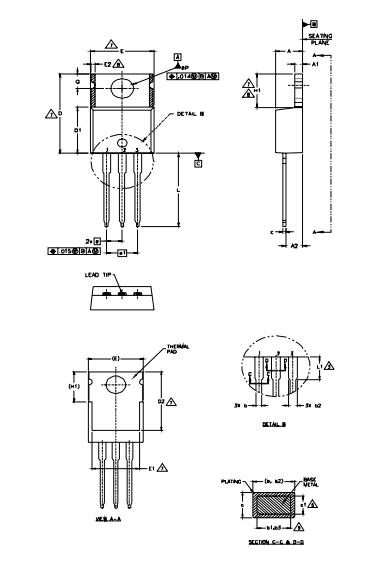
Conclusion
The IRFZ44N MOSFET is a super useful part for handling power in all kinds of electronic projects. Its ability to handle high currents and low resistance makes it perfect for jobs like controlling motors or designing power supplies. By learning how it works and using it the right way in your circuits, you can get the best performance and reliability. Whether you're working on small gadgets or big systems, the IRFZ44N is a go-to tool that proves just how important it is in today's electronic designs.
About us
ALLELCO LIMITED
Read more
Quick inquiry
Please send an inquiry, we will respond immediately.
Frequently Asked Questions [FAQ]
1. What are the capabilities of the IRFZ44N MOSFET?
The IRFZ44N MOSFET excels in managing substantial voltage and current, ideal for applications like motor control, amplifiers, and switching power supplies. Its role becomes useful when efficiency and precision are main factors in modern electronics, particularly in optimizing power management.
2. What is the gate threshold voltage of the IRFZ44N?
The IRFZ44N has a minimum gate threshold voltage of 2V, establishing the point at which the MOSFET initiates conduction. This feature is good for crafting circuits that require meticulous control over switching actions, affecting how the device moves from an off state to an on state. By adjusting the threshold to suit particular design goals, improved performance can be achieved under various scenarios.
3. What is the typical voltage drop across the IRFZ44N?
The voltage drop spans from 1 to 2V. This parameter influences both the efficiency and heat management of the device. A lower voltage drop signals improved conductivity, which decreases energy dissipation as heat and boosts overall system efficiency. Employing such components in circuit architectures can lead to devices with better energy utilization.
4. How is the power handling capacity of the IRFZ44N characterized?
Rated at 94 watts, the IRFZ44N defines its capacity to dissipate power safely without overheating. Effective heat management practices, including the use of heatsinks or thermal pads, can enhance performance and extend the lifespan of the MOSFET in power-demanding settings.
5. How can the quality of the IRFZ44N's field effect tube be assessed?
To assess the quality of the IRFZ44N, one can use an analog multimeter set to the R×1 range to measure the resistance after shorting the GS terminals, confirming that it indicates low resistance. This technique offers a practical approach to evaluating the device's integrity and capability, ensuring its dependable use. Comprehensive testing verifies that components meet design requirements and bolsters the durability of electronic systems.
6. What are the advantages of using MOSFETs?
MOSFETs regulate conductivity by modulating current flow via gate voltage. This ability promotes efficient power management, for both compact electronic devices and large-scale power systems. Their efficiency and rapid switching are key to advancements across numerous fields, from renewable energy to compact gadgets. Incorporating MOSFETs in designs supports the growing need for energy conservation and sustainable solutions.
74LS32 Quad 2-Input OR Gate: Pinout and Applications
on November 23th
Complete Guide to TDA2822M Audio Amplifier
on November 23th
Popular Posts
-

Complex Instruction Set Computers: How They Changed Computing?
on June 11th 148369
-

USB-C Pinout and Features
on June 11th 131089
-
Using Xilinx Unified Simulation Primitives: A Comprehensive Guide to FPGA Design and Simulation
on June 11th 111849
-

Power Supply Voltages in Electronics: Meaning of VCC, VDD, VEE, VSS, and GND
on June 11th 94098
-

RJ45 Connector Guide: Pinout, Wiring, Cable Types, and Uses
on January 1th 93471
-

The Ultimate Guide to Wire Color Codes in Modern Electrical Systems
The way our electrical systems use colors isn’t just for looks. Each wire color now indicates a specific function, making it easier to identify and handle electrical components correctly during ins...on January 1th 76627
-

Quality (Q) Factor: Equations and Applications
The quality factor, or 'Q', is important when checking how well inductors and resonators work in electronic systems that use radio frequencies (RF). 'Q' measures how well a circuit minimizes energy...on January 1th 74625
-
Purge Valve Guide: Function, Symptoms, Testing, and Replacement for Optimal Engine Performance
The purge valve is a key part of a car’s system that helps keep the air clean by managing fuel vapors before they can escape into the atmosphere. This not only helps the environment by reducing pol...on January 1th 68562
-

Understanding Capacitors and Their Symbols in Circuit Diagrams
Capacitors are small parts used in almost all electronic devices. They store and release electrical energy and are found in things like power supplies, radios, and circuits that help reduce noise. ...on June 11th 58353
-

A23 Battery Specifications and Compatibility
The A23 battery is a small, cylinder-shaped battery with high voltage. Also called 23A, 23AE, or MN21, it runs at 12 volts and much higher than AA or AAA batteries. Its special design make...on January 1th 57907
HOT Part Number
-

MGA-634P8-TR1G
Broadcom Limited
IC AMP CDMA 1.5GHZ-2.3GHZ 8QFN
AD8276BRMZ-R7
Analog Devices Inc.
IC OPAMP DIFF 1 CIRCUIT 8MSOP
RK73H2BTTD4420F
KOA Speer Electronics, Inc.
RES 442 OHM 1% 1/4W 1206
12105G106ZAT2A
KYOCERA AVX
CAP CER 10UF 50V Y5V 1210
8SLVP1204ANLGI/W
Renesas Electronics America Inc
IC CLK BUFFER 2:4 2GHZ 16VFQFN
VI-J11-EX
Vicor Corporation
DC DC CONVERTER 12V 75W
MM74C04M
onsemi
IC INVERTER 6CH 1-INP 14SOIC
THVD1420DR
Texas Instruments
3.3-V TO 5-V RS-485 TRANSCEIVER
MPXY8600DK6T1
NXP USA Inc.
RF TX IC FSK 315/434MHZ 32QFN
LTC2402IMS#PBF
Analog Devices Inc.
IC ADC 24BIT SIGMA-DELTA 10MSOP
HCPL-314J-500E
Broadcom Limited
OPTOISO 5KV 2CH GATE DRIVER 16SO
MIC5504-3.3YM5-T5
Microchip Technology
IC REG LINEAR 3.3V 300MA SOT23-5
XC4013XL-2BG256C
AMD
IC FPGA 192 I/O 256BGA
71M6534H-IGT/F
Analog Devices Inc./Maxim Integrated
IC ENERY METER 3PH 256K 120-LQFP
IRFS52N15DTRLP
Infineon Technologies
MOSFET N-CH 150V 51A D2PAK
0805ZC104KAT9A
KYOCERA AVX
CAP CER 0.1UF 10V X7R 0805
SIS444DN-T1-GE3
Vishay Siliconix
MOSFET N-CH 30V 35A PPAK1212-8
87972DYI-147LFT
Renesas Electronics America Inc
IC CLOCK MULTIPLIER 52TQFP -

2N6351
Microchip Technology
TRANS NPN DARL 150V 5A TO33
LCMXO256C-4M100C
Lattice Semiconductor Corporation
IC FPGA 78 I/O 100CSBGA
301A10059X
Conec
CONN D-SUB PLUG 25POS SLDR CUP
IPA60R520CP
Infineon Technologies
N-CHANNEL POWER MOSFET
WM8510GEDS/RV
Cirrus Logic Inc.
IC CODEC MONO SPEAKER DVR 28SSOP
0805CS-240EJTS
Delta Electronics/Components
FIXED IND 24NH 500MA 220MOHM SMD
SML-D12V8WT86
Rohm Semiconductor
LED RED DIFFUSED 0603 SMD
MM3Z13VST1G
onsemi
DIODE ZENER 13V 300MW SOD323
FAN53600AUC33X
onsemi
IC REG BUCK 3.3V 600MA 6WLCSP
AD8602ARZ-REEL7
Analog Devices Inc.
IC CMOS 2 CIRCUIT 8SOIC
EP3C40F484C6N
Intel
IC FPGA 331 I/O 484FBGA
S-8352A33MC-K2ST2G
ABLIC Inc.
IC REG CTRLR BOOST SOT23-5
S30460
Microchip Technology
RECTIFIER
NB100LVEP56DTR2G
onsemi
IC DIFF DIG MULTPL 2X2:1 20TSSOP
SI9114ADY-T1-E3
Vishay Siliconix
IC REG CTRLR MULT TOP 14SOIC
SI4896DY-T1-E3
Vishay Siliconix
MOSFET N-CH 80V 6.7A 8SO
FOD250L
onsemi
OPTOISO 5KV TRANS W/BASE 8DIP
BD4836G-TR
Rohm Semiconductor
IC SUPERVISOR 1 CHANNEL 5SSOP -
KSZ8721BL
Microchip Technology
IC TRANSCEIVER FULL 1/1 48LQFP
RT9011-MSGJ6
Richtek USA Inc.
IC REG LINEAR 2.8V/3.3V TSOT23-6
SN65HVD485ED
Texas Instruments
IC TRANSCEIVER HALF 1/1 8SOIC
VI-2N4-CU
Vicor Corporation
DC DC CONVERTER 48V 200W
UC2844AD
Texas Instruments
IC CUR-MODE PWM CONT 14-SOIC
STM32F072C8T7
STMicroelectronics
IC MCU 32BIT 64KB FLASH 48LQFP
1206L035/16YR
Littelfuse Inc.
PTC RESET FUSE 16V 350MA 1206
AD8553ARMZ-REEL
Analog Devices Inc.
IC INST AMP 1 CIRCUIT 10MSOP
MSP430F5310IRGCR
Texas Instruments
IC MCU 16BIT 32KB FLASH 64VQFN
SMAJ12A-E3/5A
Vishay General Semiconductor - Diodes Division
TVS DIODE 12VWM 19.9VC DO214AC
MOC3032VM
Fairchild Semiconductor
TRIAC OUTPUT OPTOCOUPLER WITH ZE
MT47H64M16HR-187E:H
Micron Technology Inc.
IC DRAM 1GBIT PAR 84FBGA
CY22393FXIT
Infineon Technologies
IC CLOCK GENERATOR 16TSSOP
MBR2535CT
Vishay General Semiconductor - Diodes Division
DIODE ARRAY SCHOTTKY 35V TO220AB
06035A101JA12A
KYOCERA AVX
CAP CER 100PF 50V C0G/NP0 0603
LM431ACMX
onsemi
IC VREF SHUNT ADJ 2% 8SOIC
HMC175MS8TR
Analog Devices Inc.
IC DOUBLER PASSIVE FREQ 8MSOP
TL072CDG4
Texas Instruments
IC OPAMP JFET 2 CIRCUIT 8SOIC