Inside IC 7490: A Comprehensive Guide to Decade Counter Circuits
In the vast and ever-expanding universe of digital electronics, the role of integrated circuits in enhancing the sophistication and efficiency of electronic systems cannot be overstated. Among these basic components, the IC 7490 stands out as a typical binary-coded decimal (BCD) counter, key in applications demanding precise and efficient counting. Known for its robust functionality, the IC 7490 facilitates digital excellence by seamlessly managing decimal digits and resetting effortlessly, making it requisite in devices ranging from digital clocks to complex control systems. This article digs into the IC 7490, uncovering its operational dynamics, structural nuances, and profound impact on digital electronics, thereby illuminating its major role in modern technological applications.Catalog

Exploring IC 7490
The Binary-Coded Decimal (BCD) counter remains a cornerstone in digital electronics. It is adept at counting decimal digits up to ten, resetting automatically with each clock pulse. Unique outputs from 0000 to 1001 in binary format are generated with precision, illustrating its contribution to system efficiency. The IC 7490 is a detailed integrated circuit specifically crafted for decimal counting, ensuring the seamless operation of electronic circuits.

BCD counters find their place in myriad applications, including digital clocks, odometers, and calculators. In scenarios requiring accurate representation of decimal numbers in binary forms, such counters excel by easing the conversion to formats readily understood. As BCD counters are utilized in control systems and devices demanding precise numerical representation, a deeper appreciation of their practicality emerges through everyday use.
The IC 7490 marks a noteworthy step forward in digital design, promoting seamless transitions and robust performance in counting tasks. Engineers hold its adaptability in high regard, especially when working on intricate electronics, due to its versatile handling of various counting functions. This efficiency in operation renders it a favored option for crafting digital systems where precision and dependability hold significant value.
IC 7490 Overview
IC 7490 is a sophisticated integrated circuit designed as a 4-bit decade counter. At its core, it utilizes a ripple-carry mechanism and features a series of interconnected master/slave flip-flops. The circuit is ingeniously organized into two distinct functional segments: one facilitating a divide-by-two operation and the other a divide-by-five operation. This dual configuration responds to varying clock frequencies, resulting in dynamic state transitions with each clock pulse. Such a structural approach permits versatile counting capabilities, opening avenues for intricate digital implementations.
The IC's unique dual-section framework empowers you to explore an array of digital counting applications. Embracing the divide-by-two and divide-by-five functionalities, you can tailor-counting ranges using complex logic designs. This adaptability proves advantageous in applications involving frequency division, making it a valuable asset in clocks, frequency counters, and related circuits. You can often push the limits of its features, striving for optimized performance in both synchronous and asynchronous counting endeavors.
IC 7490 Pin Configuration

|
Pin No. |
Pin Name |
Description |
|
1 |
CLKB |
Clock Input 2 |
|
2 |
R1 |
Reset 1 |
|
3 |
R2 |
Reset 2 |
|
4 |
NC |
Not Connected |
|
5 |
Vcc |
Positive Supply Input |
|
6 |
R3 |
Reset 3 |
|
7 |
R4 |
Reset 4 |
|
8 |
Qc |
Output Pin 3 |
|
9 |
Qb |
Output Pin 2 |
|
10 |
Gnd |
Ground |
|
11 |
Qd |
Output Pin 4 |
|
12 |
Qa |
Output Pin 1 |
|
13 |
NC |
Not Connected |
|
14 |
CLKA |
Clock Input 1 |
Truth Table
The table below presents the truth table for the IC 7490-decade counter. As demonstrated, the counter sequentially progresses through states from 0 to 9, at which point it automatically resets and begins a new counting cycle.

Features and Technical Specifications
|
Feature/Specification |
Description |
|
Power Dissipation |
Approximately 145 milliwatts |
|
Count Frequency |
Operates at 42 megahertz |
|
Counting Modes |
Offers various counting modes |
|
Input Clamp Diodes |
Restricts high-speed termination impact |
|
Supply Voltage |
Operates within a supply voltage of 5 volts |
|
Ambient Temperature Range |
Functional from -55°C to 125°C |
IC 7490 Circuitry
Internal Circuit

The IC 7490 is architected with a series of four Master-Slave JK flip-flops cohesively connected, forming the nucleus of its operational scheme. The initiation of this sequence begins with a flip-flop energized by the CLKA pin, paving the way for subsequent flip-flops that are maneuvered through the CLKB pin, orchestrating a harmonious and sequential signal progression.
Block Diagram

The structural diagram of the IC 7490 showcases its components, with a particular focus on inputs that guide its functionality.
• VCC and GND provide the circuit’s energy, with VCC representing the higher voltage level and GND acting as the stabilizing ground.
• Clock Inputs (A and B) cater to the rhythmic pulsing required for IC operation, embodying a hallmark of counter-IC design.
• Set Inputs (S1 and S2) typically connect to GND in their dormant state, offering a pathway to presetting the IC into a defined condition, where the count often embarks from 0000 (0).
Intricacies in Counter Design with IC 7490
Several concepts serve as the backbone of counter design; understanding them is major for effective application:
• Asynchronous Counters enable each flip-flop to function independently, devoid of synchronized clocking, as exemplified by ICs such as 7490 and 7493.
• Synchronous Counters rely on a unified clock source, promoting synchronized actions, which is apparent in IC models like 74160 and 74163.
• BCD (Binary Coded Decimal) transforms decimal numbers into a binary format, promoting smoother data interactions within digital frameworks.
• Mod-n Counting delineates progress across 'n' states before a reset occurs, defining the modulus of a counter.
• Frequency Division articulates a method of segmenting the frequency of a clock signal by modulating the rate of flip-flop activation, thus showcasing how counters adeptly modulate signal frequencies.

Frequency Divider Implementation Utilizing IC 7490

The functional ability of the IC 7490 in frequency division is manifest in its application with a 10MHz crystal oscillator, accompanied by a hex inverter IC 7404 and several 7490 units. This setup deftly produces a spectrum of frequencies ranging from 1MHz to 1Hz. At each counter level, the frequency undergoes division by a factor of ten, visually represented by LED indicators that highlight output frequencies, emphasizing the IC 7490's robust capability in executing sophisticated frequency division tasks.
Operation of the 7490 Decade Counter
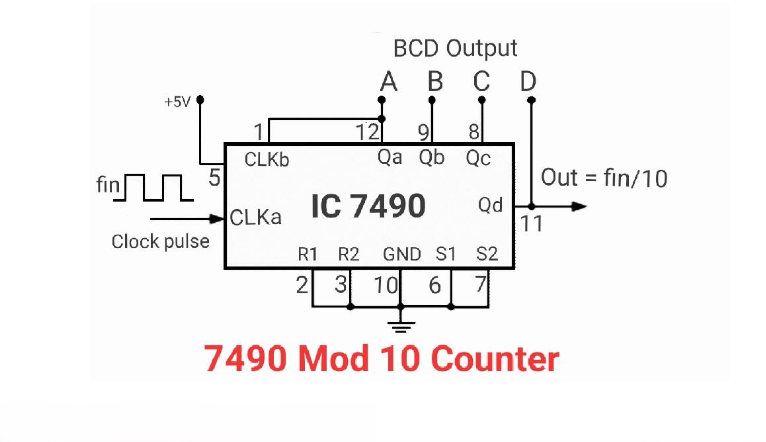
The IC 7490 operates as a Binary-Coded Decimal (BCD) counter, progressing elegantly through ten distinct states ranging from 0 to 9, earning it the designation of a modulo-10 (mod-10) counter. At its core are two integrated counting units: a mod-2 and a mod-5 counter. In unison, these units manifest decade-counting capabilities, fulfilling the requirements of both precision and efficiency. The process initiates with the mod-2 counter that oscillates between two states, 0 and 1. This oscillation generates an output that functions as a clock input, steering the mod-5 counter. Exact connections are useful: link the clock of the mod-5 counter to CLKB and the mod-2 counter to CLKA to ensure smooth operation.
Modular Counter

The moment a clock signal engages the mod-2 section, it skillfully alternates its output, Qa, between 0 and 1. This oscillating output propels the mod-5 section through five distinct states, completing a BCD cycle from 0 to 9 with impeccable functionality. Equipped with two reset pins (R0 and R1) and two set pins (S0 and S1), the counter offers flexible control over its state. Engaging a reset pin with a high signal or setting a set pin low impeccably resets the count to 0000, harmonizing the circuit to begin anew. On the flip side, a low signal on the reset and a high on the set allow the counter to soar to its maximum count of 1001, or nine.

To boldly expand the counting capacity to double digits (reaching 99, mod-100) or even triple digits (extending to 999, mod-1000) requires minimal adjustments. By incorporating the highest output from one IC as the clock input to another in a sequential series, these adjustments become feasible. For typical mod-10 operations, the second clock input, found at pin 1, should be linked to QA, with all other reset pins suitably grounded. A single pulse delivered to pin 1 effectively kick-starts the counting. Adopting a querying mind, for mod-6 operations, engage input 1 with reset pins R3 and R4 grounded, and ingeniously connect QA to input 2 to recalibrate the counting framework.
Integrating IC 7490 and a 7-Segment Display
Exploring digital circuit design with IC 7490 and IC 7446 to display counts from 0 to 9 on a 7-segment display offers a thrilling journey into electronics. Each clock pulse alters this combination, creating an engaging sequence of visual displays.
The IC 7490 serves as a decade counter, guiding counting from 0 to 9. Its task involves splitting the clock pulse into ten outputs, underpinning the accuracy of the counting sequence visible on the display. You can often admire the IC 7490 for its dependability, especially in digital clocks and frequency counters requiring precise sequence control.
In practice, setting up IC 7490 involves meticulous considerations such as power levels, noise reduction, and exact alignment of input signals. Successfully managing these aspects secures smooth performance and prevents erratic counting. You can often draw on their experience to fine-tune circuit parameters, elevating both stability and precision.

Connecting IC 7490 and 7-Segment Displays with IC 7446
IC 7446 plays a major role in converting binary count outputs into visually comprehensible numbers on a 7-segment display. It functions as a driver, interpreting IC 7490's binary output and activating the proper segments for decimal digit formation.
Implementing IC 7446 involves practical considerations. Ensuring segment current limitations and connection quality prevents burnout and ensures clear digit visibility. You can strategically incorporate resistors to balance current flow, thus prolonging display life.
The hallmark of refined digital systems lies in their functional versatility and adaptation to varying clock frequencies. Ensuring alignment between clock pulse frequency and the counting system supports smooth operation, with required adjustments to accommodate different design needs and environments.
Applications of IC 7490
Digital Counting Mechanisms
Within the world of digital counting, the IC 7490 takes center stage with its innate capacity to cycle through numbers 0 to 9. As devices strive for exact count management, the versatility and compatibility of this decade counter-shine when meshed with other digital elements, revealing a symbiotic relationship you admire.
Display Enhancement with 7-Segment Displays
IC 7490 finds a meaningful role in 7-segment displays, facilitating a structured approach to numeral representation. Such displays are prevalent in consumer electronics, ensuring effortless readability. You can often dig into the distinctions of fine-tuning the IC 7490 to achieve optimal display performance, a craft that not only boosts your interaction but also paves the way for discovering unexpected efficiencies. Calibrating these displays with precision distinguishes you from novices eager to learn.
Precision in Digital Timers and Clocks
When placed at the center of digital timers and clocks, the IC 7490 reveals its prowess in accurately dividing time. Through its influence on time-dependent systems, it provides reliable time segments used for operations. Mastering its synchronization with complementary components demands a considered blend of theory and hands-on experimentation. This careful endeavor transforms baseline functionality into sophisticated timing innovations cherished by timekeeping aficionados.
Streamlined Automation and Control in Server Environments
Incorporating IC 7490 into automated control circuits within digital systems and servers promotes enhanced operational effectiveness. It orchestrates intricate processes such as task scheduling and resource distribution by meticulously keeping track of operational cycles. Those seasoned in server orchestration leverage these features to refine server throughput, subtly shaping the dynamics of network traffic management. This prudent application showcases how deeply integrated technology redefines and elevates system capabilities.
Conclusion
The exploration of the IC 7490 in this article emphasizes its serious role as a decade counter in digital electronics. With its precise counting and reset capabilities, the IC 7490 has proven requisite in many applications that require reliability and accuracy. Its integration into various devices not only enhances performance but also streamlines the complexity inherent in digital circuit design. As we continue to push the boundaries of what is possible in digital electronics, the initial principles exemplified by the IC 7490 will undoubtedly inspire further innovations, ensuring that it remains a cornerstone in developing advanced electronic systems. This detailed examination of the IC 7490 not only enriches our understanding but also celebrates its enduring relevance in shaping the future of technology.
About us
ALLELCO LIMITED
Read more
Quick inquiry
Please send an inquiry, we will respond immediately.
Frequently Asked Questions [FAQ]
1. What does the IC 7490 do?
The IC 7490 is a binary counter that counts from 0000 to 1001, ideal for digital counting in ten states. It is commonly used in devices requiring precise counting, such as digital clocks or measurement counters. This IC helps divide time into clear segments, offering both practical utility and a reminder of the passage of time.
2. What is the structure of IC 7490?
The IC 7490 is built with interconnected master/slave flip-flops, organized into divide-by-two and divide-by-five sections. This arrangement ensures efficient transitions between binary states, supporting synchronization in complex systems like a well-coordinated performance.
3. Is IC 7490 synchronous or asynchronous?
The IC 7490 operates asynchronously as a modulo-10 counter. It is suitable for applications where precise timing is less dangerous, offering a simpler and more cost-effective solution compared to synchronous counters.
4. What type of output does IC 7490 produce?
The IC 7490 produces a decade counter output, cycling through ten predefined states. This predictable output is useful in applications that require consistent patterns, such as event counters or frequency dividers in digital signal processing.
5. How is IC 7490 different from IC 4017?
The IC 7490 performs binary counting from 0 to 9, suitable for standard decade counting. In contrast, the IC 4017 has ten discrete outputs, better for directly driving displays or controlling step sequences. The choice between these ICs depends on the specific needs of the output interface.
6. What makes IC 7490 different from IC 7493?
The IC 7490 manages ten states (MOD-10), making it suitable for tasks that involve counting up to a single decade. On the other hand, the IC 7493 can handle up to sixteen states (MOD-16), which is beneficial for broader counting applications like multifunctional counters or more complex digital clocks.
7. How does a decade counter work?
A decade counter moves through ten distinct states, usually from 0 to 9, and then resets. In a 4-bit configuration, it can also count up to 15. These counters are often used in devices that require orderly state changes, such as multiplexed displays or systems that log events based on counting. This function ensures that every cycle is accurately tracked and recorded.
Everything About the LM7809 Voltage Regulator
on November 28th

Complete Guide to the TL494 PWM Controller IC
on November 27th
Popular Posts
-

Complex Instruction Set Computers: How They Changed Computing?
on April 18th 147751
-

USB-C Pinout and Features
on April 18th 111923
-
Using Xilinx Unified Simulation Primitives: A Comprehensive Guide to FPGA Design and Simulation
on April 18th 111349
-

Power Supply Voltages in Electronics: Meaning of VCC, VDD, VEE, VSS, and GND
on April 18th 83714
-

RJ45 Connector Guide: Pinout, Wiring, Cable Types, and Uses
on January 1th 79502
-

The Ultimate Guide to Wire Color Codes in Modern Electrical Systems
The way our electrical systems use colors isn’t just for looks. Each wire color now indicates a specific function, making it easier to identify and handle electrical components correctly during ins...on January 1th 66872
-

Quality (Q) Factor: Equations and Applications
The quality factor, or 'Q', is important when checking how well inductors and resonators work in electronic systems that use radio frequencies (RF). 'Q' measures how well a circuit minimizes energy...on January 1th 63005
-
Purge Valve Guide: Function, Symptoms, Testing, and Replacement for Optimal Engine Performance
The purge valve is a key part of a car’s system that helps keep the air clean by managing fuel vapors before they can escape into the atmosphere. This not only helps the environment by reducing pol...on January 1th 62955
-

Achieving Peak Performance with the Maximum Power Transfer Theorem
The Maximum Power Transfer Theorem explains how energy from a source, such as a battery or generator, flows to a connected load. It shows the exact condition where the load receives the most power....on January 1th 54078
-

A23 Battery Specifications and Compatibility
The A23 battery is a small, cylinder-shaped battery with high voltage. Also called 23A, 23AE, or MN21, it runs at 12 volts and much higher than AA or AAA batteries. Its special design make...on January 1th 52092
HOT Part Number
-

AP2553FDC-7
Diodes Incorporated
IC PWR SWITCH P-CHANNEL 1:1 6DFN
REG1117FA-5.0/500
Texas Instruments
IC REG LIN 5V 1A DDPAK/TO263-3
DSPIC33CH64MP508-I/PT
Microchip Technology
IC MCU 16BIT 88KB FLASH 80TQFP
NVTFS5826NLWFTWG
onsemi
MOSFET N-CH 60V 7.6A 8WDFN
CL03C180JA3ANNC
Samsung Electro-Mechanics
CAP CER 18PF 25V C0G/NP0 0201
C1608X8R1H103M080AE
TDK Corporation
CAP CER 10000PF 50V X8R 0603
LTC1682IMS8-5#PBF
Analog Devices Inc.
IC REG CHARGE PUMP 5V 50MA 8MSOP
PXAS30KBA
Rochester Electronics, LLC
IC MCU 16BIT ROMLESS 68PLCC
C3216Y5V1C106Z
TDK Corporation
CAP CER 10UF 16V Y5V 1206
ADA4610-1ARZ-R7
Analog Devices Inc.
IC OPAMP JFET 1 CIRCUIT 8SOIC
BYM11-200-E3/97
Vishay General Semiconductor - Diodes Division
DIODE GEN PURP 200V 1A DO213AB
GRM2167U1H560JZ01D
Murata Electronics
CAP CER 56PF 50V U2J 0805
TOP258GN-TL
Power Integrations
IC OFFLINE SWITCH FLYBACK 8SMD
STM8S207RBT3
STMicroelectronics
IC MCU 8BIT 128KB FLASH 64LQFP
XC6701B502MR-G
Torex Semiconductor Ltd
IC REG LINEAR 5V 150MA SOT25
08053G104ZAT2A
AVX Corporation
CAP CER 0.1UF 25V Y5V 0805
BZM55B13-TR
Vishay General Semiconductor - Diodes Division
DIODE ZENER 13V 500MW MICROMELF
MCH5809-TL-E
onsemi
NCH+SBD 2.5V DRIVE SERIES -

BZD17C3V6P-E3-08
Vishay General Semiconductor - Diodes Division
DIODE ZENER 3.6V 800MW DO219AB
DSRHD06-13
Diodes Incorporated
BRIDGE RECT 1P 600V 1A T-MINIDIP
BCX54-16E6327
Infineon Technologies
SMALL SIGNAL BIPOLAR TRANSISTOR
AD9961BCPZ
Analog Devices Inc.
IC BROADBAND FRONT-END 72LFCSP
AT80C51RD2-RLRUM
Microchip Technology
IC MCU 8BIT ROMLESS 44VQFP
PHK31NQ03LT,518
Nexperia USA Inc.
MOSFET N-CH 30V 30.4A 8SO
1469002-1
TE Connectivity AMP Connectors
CONN HDR HIGH SPEED 120POS PCB
S5JHE3_A/I
Vishay General Semiconductor - Diodes Division
DIODE GEN PURP 600V 5A DO214AB
SCAN90004TVS
Texas Instruments
IC REDRIVER LVDS 4CH 48TQFP
CD4025BCN
onsemi
IC GATE NOR 3CH 3-INP 14DIP
2225HC332KAT1A
KYOCERA AVX
CAP CER 3300PF 3KV X7R 2225
MN63Y1208-E1
Panasonic Electronic Components
IC RFID READR/TRAN 13.56MZ 16QFN
06035C112JAT2A
KYOCERA AVX
CAP CER 1100PF 50V X7R 0603
LFE3-95EA-8LFN672I
Lattice Semiconductor Corporation
IC FPGA 380 I/O 672FPBGA
XBS053V13R-G
Torex Semiconductor Ltd
DIODE SCHOTTKY 20V 500MA SOD323A
GRM0335C2A6R5CA01J
Murata Electronics
CAP CER 6.5PF 100V C0G/NP0 0201
STW36N55M5
STMicroelectronics
MOSFET N-CH 550V 33A TO247
C1608C0G2A090D080AA
TDK Corporation
CAP CER 9PF 100V C0G 0603 -
GRM1886P1H4R8CZ01D
Murata Electronics
CAP CER 4.8PF 50V P2H 0603
M29W128FL70N6E
Micron Technology Inc.
IC FLASH 128MBIT PARALLEL 56TSOP
70MT100KB
Vishay General Semiconductor - Diodes Division
BRIDGE RECT 3PHASE 1KV 70A MTK
ADXL344ACCZ-RL7
Analog Devices Inc.
ACCEL 2-16G I2C/SPI 16LGA
BZX84C39-HE3-08
Vishay General Semiconductor - Diodes Division
DIODE ZENER 39V 300MW SOT23-3
1735447-7
TE Connectivity AMP Connectors
CONN RCPT HSG 7POS 2.00MM
1808AA150JAT1A
KYOCERA AVX
CAP CER 15PF 1KV NP0 1808
Z84C4106PEC
Zilog
IC INTERFACE SPECIALIZED 40DIP
GRM1555C1H7R4WZ01D
Murata Electronics
CAP CER 7.4PF 50V C0G/NP0 0402
BDCN-20-13+
Mini-Circuits
RF DIR COUPLER 360MHZ-1GHZ 6SMD
MCC19-14IO1B
IXYS
MOD THYRISTOR DUAL 1400V TO240AA
OP467GPZ
Analog Devices Inc.
IC OPAMP GP 4 CIRCUIT 14DIP
LA4636-E
Sanyo
11 WATT 2-CHANNEL BTL AF POWER A
P6KE82A-T
Diodes Incorporated
TVS DIODE 70.1VWM 113VC DO15
NCV7608DWR2G
onsemi
IC HALF BRIDGE DRIVER 28SOIC
TLJA227M004R1100
KYOCERA AVX
CAP TANT 220UF 20% 4V 1206
TUSB2136PM
Texas Instruments
IC USB HUB I/O CONTROL 64-LQFP
HUFA75637P3
onsemi
MOSFET N-CH 100V 44A TO220-3