L298 Motor Driver IC: Functions and Working Principles
This article delves into the L298 IC’s core features, applications, and practical considerations, offering a detailed examination of its pin configuration and technical specifications. It also provides insights into selecting the appropriate motor driver by comparing the L298 with the L293D, another popular motor control solution. You will gain a deeper understanding of how the L298 IC can be effectively integrated into various projects, enhancing motor control with reliable and adaptable solutions.Catalog
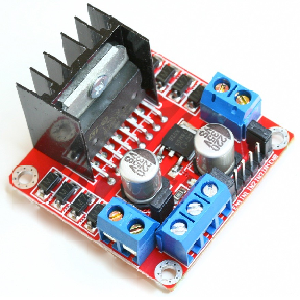
Overview of the L298 Motor Driver IC
The L298 Motor Driver IC excels in efficiently handling high-power loads, which makes it a favored option for controlling various inductive loads. These include DC motors, solenoids, relays, and stepper motors. As a dual full-bridge driver, it can manage substantial current and voltage, transforming low current signals into high current outputs needed for motor operation.
The L298 contains four power amplifiers in two H-bridge setups: H-bridge A and H-bridge B. Each bridge switches motor polarities, good for controlling bipolar stepper motors. This is achieved with current sense pins (CSA and CSB) and enable pins (ENA and ENB), offering seamless integration with microcontrollers through 5V TTL logic levels. Often used in robotics and automation, the L298 IC delivers precise motor control where desired. Its capability to convert low voltage control signals to higher current outputs ensures effective motor management in dynamic settings.
When using the L298, paying attention to heat dissipation is wise, as the IC can generate heat under heavy loads. Utilizing heat sinks or fans can improve stability and performance. Mastering PWM (Pulse Width Modulation) can greatly enhance motor speed control with this IC. With these insights, you can effectively capitalize on the L298's potential for varied motor control tasks.
Pin Configuration of L298 Motor Driver IC

The L298 IC contains 15 pins, each serving distinct functions within its dual H-bridges for motor control applications. Let's explore the functionalities of these pins:
Current Sensing and Load Regulation
Pin 1, known as Current Sensing A, is good for managing load current. Precise motor control relies on this feature, minimizing risks of circuit overload. This approach is widely respected and for enhancing system reliability.
Output Pins for Current Flow
Pins for directional current flow:
• Pins 2 and 3
• Pins 13 and 14
These enable bidirectional motor rotation. Proper wiring and calibration ensure optimal performance in robotics and automation.
Voltage Supply and Ground Connections
Voltage Supply and Ground are maintained by:
• Pin 4: Main Voltage Supply
• Pin 8: Ground
Stable connections here ensure consistent motor driver operation. Stability affects motor efficiency and lifespan, routinely assessed in practice.
Control Inputs and Bridge Activation
Managing H-bridges involves:
• Bridges A and B Control Inputs
Enable pins 6 and 11 activate the respective bridges. This control offers detailed management of motor operations for advanced motor-driven systems.
Logic Voltage Supply
Pin 9 provides the Logic Voltage Supply, need for the internal logic power of the IC. Proper logic voltage prevents mismatches leading to malfunctions, similar to customizing digital circuit voltages for desired outcomes.
L298 Motor Driver IC Features
Board Features
The L298N board supports DC motors ranging from 5 to 35V and efficiently manages relays and solenoids. It features a 5V regulator to sustain logic circuits, presenting itself as an economical choice with optional 5V power inputs.
L298N with DC Motor
In partnership with a DC motor, the L298N allows for fine-tuning of rotation and speed through PWM signals. Input selections guide the motor's direction, while an onboard regulator ensures precise operation, enriching the experience.
Simplified Implementation Strategy
Working with a DC motor becomes a breeze, needing only straightforward coding to control speed and direction. This design ensures smooth functionality when paired with Arduino Uno pins and custom functions.
Technical Specifications of L298 Motor Driver IC
|
Specifications |
Detail |
|
Operating Voltage Range |
Up to 46V |
|
Maximum Continuous Current |
Up to 4A |
|
Low Saturation Voltage |
Yes |
|
Over-temperature Protection |
Yes |
|
Power Dissipation |
25W |
|
Voltage Supply Range |
+5V to +46V |
|
Maximum Supply Voltage |
50V |
|
Maximum Input and Enable Voltage |
+7V |
|
TTL-Compatible Control Inputs |
Yes |
|
Storage Temperature Range |
-40°C to 150°C |
|
Operating Temperature Range |
-23°C to 130°C |
|
Maximum Allowed Output Current |
3A per output |
Comparison Between L293D and L298N Motor Drivers
Both drivers handle DC motors, stepper motors, and relays, but they each possess specialized capabilities that cater to diverse applications. The L293D driver thrives in low-current scenarios, operating within a 4.5V to 36V range. The H-bridge configuration enhances DC motor control and brings adaptable solutions to projects with modest power needs. It becomes appealing for educational settings and smaller robotics ventures, where simplicity and reduced power consumption are appreciated. Deploying L293D in applications involves mindful attention to its current limitations. It adeptly manages motors in compact devices, cutting operational expenses and simplifying complexity.
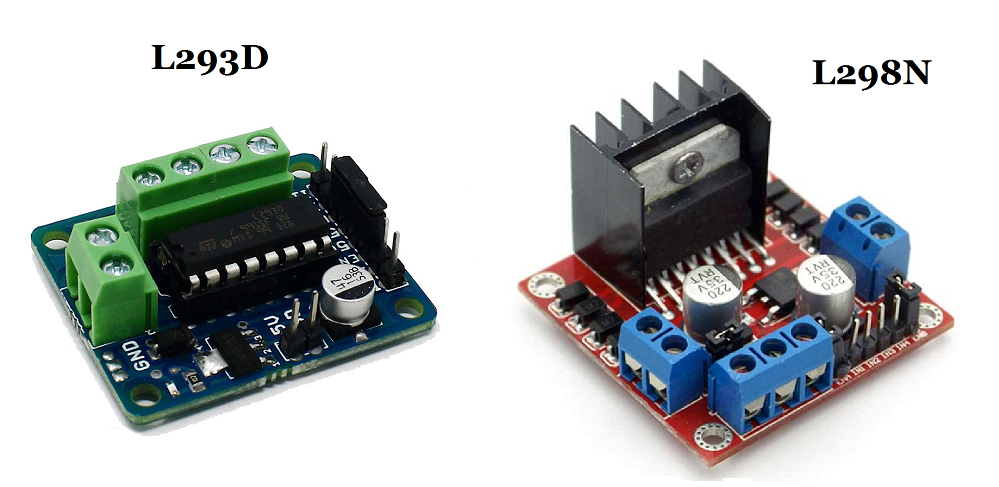
The L298N driver is crafted for high-current demands, withstanding voltages up to 46V. Celebrated for its robust performance, its H-bridge design thrives in challenging environments, providing enhanced motor control flexibility and ensuring reliability for larger motor tasks. The L298N’s power-handling capabilities support demanding activities, such as industrial automation and robotic systems. Employing thermal management, like heat sinks, is encouraged to sustain efficiency and avoid overheating, recognized as a frequent challenge in practical applications.
Choosing the Appropriate Driver
When deciding between L293D and L298N, it's important to deeply grasp the specific demands of your project. L293D suits applications with lower current and moderate voltage needs. It excels in small projects like educational robots or simple motorized toys, where a compact design and cost-consciousness are valued.
On the other hand, L298N shines in applications needing higher current capacity and greater voltage tolerance. It's ideal for more demanding uses such as medium-sized robotic arms or electric vehicles, where larger power requirements are present. The ability to handle increased power levels without overheating should be weighed carefully in these contexts.
Selecting the right driver goes beyond technical specs, requiring attention to operational conditions. Aspects like thermal management, load characteristics, and financial constraints are require. A thorough evaluation of L293D and L298N requires balancing technical needs with practical realities. Considerations of future upgrades and scalability should be included. Reflecting on industry tendencies, it's observable that this decision influences both immediate functionality and the project's long-term success.
Conclusion
The L298 Motor Driver IC plays a role in efficient motor control and speed management, offering adaptable solutions for varied voltage, current, and power requirements. This adaptability enhances its use in interfacing DC motors with microcontrollers, spanning applications from robotics to industrial automation. By customizing configurations to align with specific project goals, one can enhance functionality and utilize resources efficiently. As the demand for smarter systems surges, coupling the L298 with advanced sensors and IoT platforms could unlock new automation and control possibilities.
About us
ALLELCO LIMITED
Read more
Quick inquiry
Please send an inquiry, we will respond immediately.
STM32F103C6T6 Microcontroller: Specifications, Pinout, and Use Cases
on October 1th
TDA8356: Specifications, Features, and Circuit Applications
on October 1th
Popular Posts
-

Complex Instruction Set Computers: How They Changed Computing?
on April 18th 147749
-

USB-C Pinout and Features
on April 18th 111904
-
Using Xilinx Unified Simulation Primitives: A Comprehensive Guide to FPGA Design and Simulation
on April 18th 111349
-

Power Supply Voltages in Electronics: Meaning of VCC, VDD, VEE, VSS, and GND
on April 18th 83714
-

RJ45 Connector Guide: Pinout, Wiring, Cable Types, and Uses
on January 1th 79502
-

The Ultimate Guide to Wire Color Codes in Modern Electrical Systems
The way our electrical systems use colors isn’t just for looks. Each wire color now indicates a specific function, making it easier to identify and handle electrical components correctly during ins...on January 1th 66868
-

Quality (Q) Factor: Equations and Applications
The quality factor, or 'Q', is important when checking how well inductors and resonators work in electronic systems that use radio frequencies (RF). 'Q' measures how well a circuit minimizes energy...on January 1th 63004
-
Purge Valve Guide: Function, Symptoms, Testing, and Replacement for Optimal Engine Performance
The purge valve is a key part of a car’s system that helps keep the air clean by managing fuel vapors before they can escape into the atmosphere. This not only helps the environment by reducing pol...on January 1th 62937
-

Achieving Peak Performance with the Maximum Power Transfer Theorem
The Maximum Power Transfer Theorem explains how energy from a source, such as a battery or generator, flows to a connected load. It shows the exact condition where the load receives the most power....on January 1th 54076
-

A23 Battery Specifications and Compatibility
The A23 battery is a small, cylinder-shaped battery with high voltage. Also called 23A, 23AE, or MN21, it runs at 12 volts and much higher than AA or AAA batteries. Its special design make...on January 1th 52087
HOT Part Number
-
LTC4063EDD#TRPBF
Analog Devices Inc.
IC BATT CHG LI-ION 1CELL 10DFN
MIMX8MM1CVTKZAA
NXP USA Inc.
IC MPU I.MX 8M MINI SOLOLITE
APDS-9005-020
Broadcom Limited
SENSOR OPT 500NM AMB 6CHIPLED
06031A820KAT2A
KYOCERA AVX
CAP CER 82PF 100V C0G/NP0 0603
ICM-20602
TDK InvenSense
IMU ACCEL/GYRO/TEMP I2C/SPI LGA
170M4611
Eaton - Bussmann Electrical Division
FUSE SQUARE 350A 700VAC RECT
08053C105JAZ2A
KYOCERA AVX
CAP CER 1UF 25V X7R 0805
EP1C12F324C6N
Intel
IC FPGA 249 I/O 324FBGA
2SC4617T1G
onsemi
TRANS NPN 50V 0.1A SC75 SOT416
TL431AILPRAG
onsemi
IC VREF SHUNT ADJ 1% TO92-3
ADAU1787BCBZRL
Analog Devices Inc.
4 ADC, 2 DAC LOW POWER CODEC, AU
74VHC164MTCX
onsemi
IC SHIFT REGISTER 8BIT 14TSSOP
DAN222M3T5G
onsemi
DIODE ARRAY GP 80V 100MA SOT723
NR3015T470M
Taiyo Yuden
FIXED IND 47UH 300MA 1.608OHM SM
MM3Z18VC
onsemi
DIODE ZENER 18V 200MW SOD323F
1N4001W
Rectron USA
DIODE GEN 1A 50V SOD-123F
SMBJ90A
Taiwan Semiconductor Corporation
TVS DIODE 90VWM 146VC DO214AA
NTA1215MC
Murata Power Solutions Inc.
DC DC CONVERTER +/-15V 1W -
SDR1307-101KL
Bourns Inc.
FIXED IND 100UH 1.9A 180MOHM SMD
AOT5B65M1
Alpha & Omega Semiconductor Inc.
IGBT 650V 5A TO220
STP16CP596B1R
STMicroelectronics
IC LED DRIVER LINEAR 50MA 24DIP
AD7895ANZ-2
Analog Devices Inc.
IC ADC 12BIT SAR 8DIP
MURB1620CTT4G
onsemi
DIODE ARRAY GP 200V 8A D2PAK
STGIPS30C60T-H
STMicroelectronics
MOD IPM SLLIMM 30A 600V 25SDIP
IXDN604SIA
IXYS Integrated Circuits Division
IC GATE DRVR LOW-SIDE 8SOIC
CY7C63743-SC
Infineon Technologies
IC MCU 8K LS USB/PS-2 24-SOIC
U2745B-MFBG3
Microchip Technology
RF TX IC UHF 310-440MHZ 16LSSOP
DSPIC30F4013T-30I/PT
Microchip Technology
IC MCU 16BIT 48KB FLASH 44TQFP
ADF4106BRUZ-RL
Analog Devices Inc.
IC CLK/FREQ SYNTH 16TSSOP
EL8403IS
Elantec
IC OPAMP GP 4 CIRCUIT 14SOIC
8A35001B-001AJG
Renesas Electronics America Inc
NETWORK TIMING
GRM0337U1HR90BD01D
Murata Electronics
CAP CER 0.9PF 50V U2J 0201
LT1356CS#PBF
Analog Devices Inc.
IC VOLTAGE FEEDBACK 2 CIRC 16SO
AON7280
Alpha & Omega Semiconductor Inc.
MOSFET N-CH 80V 20A/50A 8DFN
IRLI540N
Infineon Technologies
MOSFET N-CH 100V 23A TO220AB FP
VI-J6Z-MZ
Vicor Corporation
VI-J6Z-MZ 300V 2V 5A -
LMH6722MA
Texas Instruments
IC AMP CURRENT FEEDBACK 14SOIC
HZM6.8Z4MWATL-E
Renesas Electronics America Inc
TVS DIODE 3.5VWM 3MPAK
LM4041DIM7-1.2
Texas Instruments
IC VREF SHUNT 1% SC70-5
RT6200GE
Richtek USA Inc.
IC REG BUCK ADJ 600MA SOT23-6
R5F21274SNFP#X6
Renesas Electronics America Inc
IC MCU 16BIT 16KB FLASH 32LQFP
1N5227B
onsemi
DIODE ZENER 3.6V 500MW DO35
12102C472JAT2A
KYOCERA AVX
CAP CER 4700PF 200V X7R 1210
PZTA64
Fairchild Semiconductor
SMALL SIGNAL BIPOLAR TRANSISTOR,
XC1765ELSO8C
AMD
IC PROM SER C-TEMP 3.3V 8-SOIC
XR88C92CJ-F
MaxLinear, Inc.
IC UART FIFO DUAL 44PLCC
RT24C2X202
Bourns, Inc.
TRIMMER 2K OHM 0.75W PC PIN SIDE
DLW31SN900SQ2L
Murata Electronics
CMC 370MA 2LN 90 OHM SMD
LMK432F476ZM-T
Taiyo Yuden
CAP CER 47UF 10V Y5V 1812
MOC207R1VM
onsemi
OPTOISO 2.5KV TRANS W/BASE 8SOIC
GRM0335C1E390JD01D
Murata Electronics
CAP CER 39PF 25V C0G/NP0 0201
SE10PG-M3/84A
Vishay General Semiconductor - Diodes Division
DIODE GEN PURP 400V 1A DO220AA
RABS15M REG
Taiwan Semiconductor Corporation
BRIDGE RECT 1P 1KV 1.5A ABS-L
PI74LPT16245AEX
Diodes Incorporated
IC TXRX NON-INVERT 3.6V 48TSSOP