LIS3DHTR Sensor Overview Features and Practical Uses
The LIS3DHTR accelerometer is a powerful sensor that helps detect movement in three dimensions, making it perfect for a range of smart devices. This article covers its features, applications, and how to use it with various platforms.Catalog

Overview of the LIS3DHTR Accelerometer
The LIS3DHTR is a three-axis linear accelerometer known for its high performance and low power use. Designed for applications where both accuracy and battery life are valued, this sensor has modes that let it operate efficiently while conserving energy. Its I2C and SPI digital output interfaces make it versatile for various devices, allowing smooth integration into electronic systems. With this sensor, you can detect movement across three dimensions, making it useful for applications ranging from mobile devices to wearable tech. Its design also includes several modes that help it adjust its performance based on your needs, enabling better control over power use and accuracy.
LIS3DHTR CAD Model
LIS3DHTR Symbol
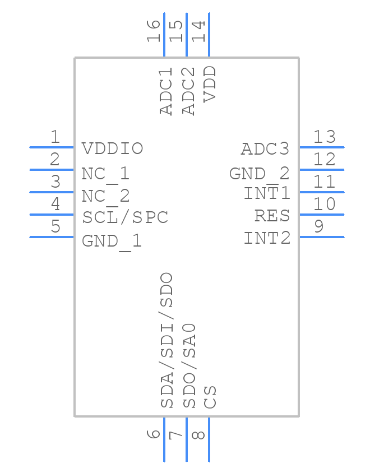
LIS3DHTR Footprint
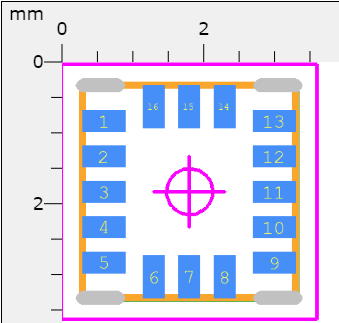
LIS3DHTR 3D Model
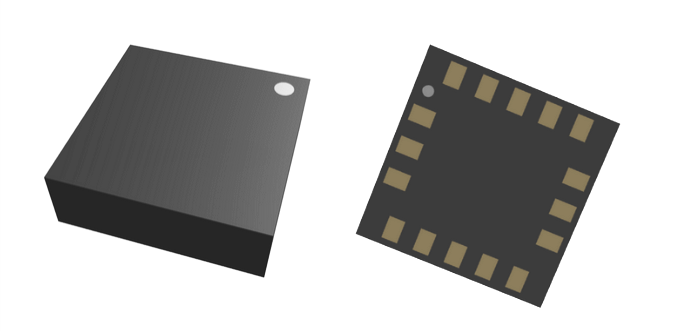
Pin Configuration for LIS3DHTR
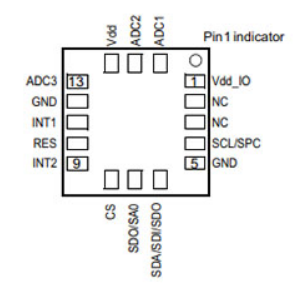
| Pin Number | Name | Function |
| 1 | Vdd_IO | Power supply for I/O pins |
| 2 | NC | Not connected |
| 3 | NC | Not connected |
| 4 | SCL / SPC | I²C serial clock (SCL) / SPI serial port clock (SPC) |
| 5 | GND | 0 V supply |
| 6 | SDA / SDI / SDO | I²C serial data (SDA) / SPI serial data input (SDI) / 3-wire interface serial data output (SDO) |
| 7 | SDO / SA0 | SPI serial data output (SDO) / I²C less significant bit of the device address (SA0) |
| 8 | CS | SPI enable / I²C/SPI mode selection: 1: SPI idle mode / I²C communication enabled, 0: SPI communication mode / I²C disabled |
| 9 | INT2 | Inertial interrupt 2 |
| 10 | RES | Connect to GND |
| 11 | INT1 | Inertial interrupt 1 |
| 12 | GND | 0 V supply |
| 13 | ADC3 | Analog-to-digital converter input 3 |
| 14 | Vdd | Power supply |
| 15 | ADC2 | Analog-to-digital converter input 2 |
| 16 | ADC1 | Analog-to-digital converter input 1 |
LIS3DHTR Block Diagram
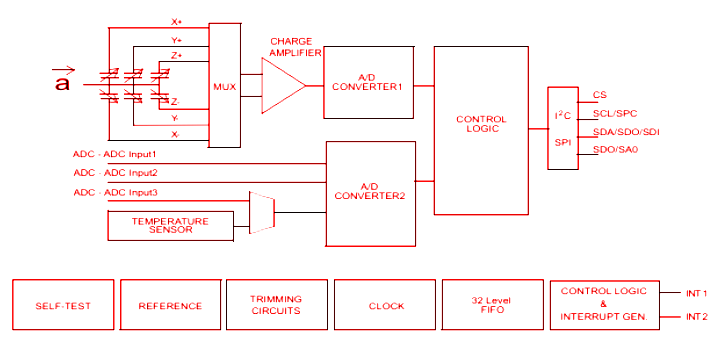
LIS3DHTR Specifications
Technical specifications, features, characteristics, and components with comparable specifications of STMicroelectronics LIS3DHTR
| Type | Parameter |
| Lifecycle Status | ACTIVE (Last Updated: 7 months ago) |
| Factory Lead Time | 16 Weeks |
| Contact Plating | Gold |
| Mounting Type | Surface Mount |
| Package / Case | 16-VFLGA |
| Surface Mount | YES |
| Number of Pins | 16 |
| Usage Level | Industrial grade |
| Operating Temperature | -40°C ~ 85°C TA |
| Packaging | Tape & Reel (TR) |
| JESD-609 Code | e4 |
| Part Status | Active |
| Moisture Sensitivity Level (MSL) | 3 (168 Hours) |
| Number of Terminations | 16 |
| ECCN Code | EAR99 |
| Type | Digital |
| HTS Code | 8542.39.00.01 |
| Voltage - Supply | 1.71V ~ 3.6V |
| Terminal Position | Bottom |
| Terminal Form | Butt |
| Peak Reflow Temperature (°C) | 260 |
| Number of Functions | 1 |
| Supply Voltage | 2.5V |
| Terminal Pitch | 0.5mm |
| Depth | 3mm |
| Time@Peak Reflow Temperature-Max (s) | 30 |
| Base Part Number | LIS3 |
| Pin Count | 16 |
| Output Type | I2C, SPI |
| Operating Supply Voltage | 2.5V |
| Interface | I2C, SPI |
| Operating Supply Current | 11μA |
| Resolution | 2 B |
| Sensor Type | 3 Axis |
| Max Supply Voltage (DC) | 3.6V |
| Min Supply Voltage (DC) | 1.71V |
| Axis | X, Y, Z |
| Acceleration Range | ±2g, 4g, 8g, 16g |
| Features | Adjustable Bandwidth, Selectable Scale, Temperature Sensor |
| Sensitivity (LSB/g) | 1000 (±2g) ~ 83 (±16g) |
| Height | 1mm |
| Length | 3mm |
| Width | 3mm |
| REACH SVHC | No SVHC |
| Radiation Hardening | No |
| RoHS Status | ROHS3 Compliant |
| Lead Free | Lead Free |
Key Features of LIS3DHTR
Wide Voltage Range
This sensor operates with a flexible voltage range, from 1.71 V to 3.6 V. This flexibility allows it to fit into a variety of power configurations without needing additional converters, making it easy to use across different devices and setups.
Independent IO Supply
An independent IO supply, set at 1.8 V, ensures compatibility with other low-voltage devices. This feature enables smooth communication and data sharing with a broad range of microcontrollers and processing units.
Ultra-Low Power Consumption
With power consumption as low as 2 μA, the LIS3DHTR offers a good choice for battery-powered applications. You can use it for extended periods without draining the battery, making it practical for wearables, IoT devices, and portable electronics.
Dynamic Full-Scale Range
The sensor provides selectable full-scale ranges of ±2g, ±4g, ±8g, and ±16g. This flexibility allows you to adjust the sensitivity depending on your specific application needs, whether you need precise measurements for smaller movements or broader range detection.
I2C/SPI Digital Interface
Equipped with both I2C and SPI interfaces, the LIS3DHTR is compatible with various microcontroller platforms. This dual interface option allows you to choose the protocol that best suits your design, ensuring easier integration and adaptability.
High-Resolution 16-Bit Data Output
The sensor outputs data in 16-bit resolution, which enhances accuracy in readings. This level of precision ensures more reliable data for applications requiring precise movement detection or environmental monitoring.
Programmable Interrupts
Two programmable interrupt generators allow for features like free-fall and motion detection. This capability provides real-time response to movement changes, making it ideal for applications like fall detection and motion-triggered actions.
Orientation Detection
With 6D/4D orientation detection, the sensor can determine its position in space. This feature is particularly useful for applications where knowing the device’s orientation—whether it’s face up, down, or tilted—is necessary for functionality.
Built-In Temperature Sensor
A built-in temperature sensor allows the LIS3DHTR to monitor its own temperature, which helps maintain consistent performance across varying environmental conditions.
Self-Test Functionality
The self-test feature enables you to verify the sensor’s functionality on demand. This is helpful in applications requiring regular checks to confirm that the sensor is working accurately.
FIFO Data Buffer
The embedded 32-level FIFO buffer allows data to be stored temporarily, which reduces the load on your processor and ensures efficient data handling. It’s especially useful in situations where real-time processing might not be possible.
High Shock Survivability
With a shock tolerance up to 10000 g, this sensor is resilient to high-impact forces, making it reliable in applications exposed to sudden shocks or impacts.
Environmentally Friendly Compliance
The LIS3DHTR is certified under ECOPACK® and RoHS standards, meeting environmental guidelines for safer electronic waste disposal. Its compliance makes it a sustainable option for eco-conscious projects.
Operational Modes of the LIS3DHTR
The LIS3DH provides three modes to choose from: high-resolution, normal, and low-power. Here’s a quick guide on selecting each operational mode.
| Operating Mode | CTRL_REG1[3] (LPen bit) | CTRL_REG4[3] (HR bit) | BW [Hz] | Turn-on Time [ms] | So @ ±2g [mg/digit] |
| Low-power mode (8-bit data output) | 1 | 0 | ODR/2 | 1 | 16 |
| Normal mode (10-bit data output) | 0 | 0 | ODR/2 | 1.6 | 4 |
| High-resolution mode (12-bit data output) | 0 | 1 | ODR/9 | 7/ODR | 1 |
| Not allowed | 1 | 1 | -- | -- | -- |
Applications of the LIS3DHTR Accelerometer
Motion-Activated Functions
This accelerometer is suitable for triggering functions based on movement. Whether used in smart lights, displays, or other responsive devices, it can help initiate actions based on specific motion triggers.
Free-Fall Detection
The LIS3DHTR can detect free-fall events, which is valuable for protective systems. For example, in devices where sudden drops might damage components, the sensor can help signal an immediate shutdown to protect hardware.
Click and Double-Click Recognition
This sensor can detect single and double-click movements, allowing users to interact with devices through simple taps. This feature can be particularly useful in wearable devices or handheld controllers.
Power-Saving for Portable Devices
Its low-power modes and motion detection make this accelerometer ideal for saving energy in portable electronics. It can be programmed to enter sleep mode when the device is inactive, conserving battery life.
Step Counting in Pedometers
The sensor’s ability to detect movement across different axes makes it a good fit for step counters. By tracking steps, it contributes to health and fitness applications, giving users accurate data on their daily activity.
Screen Orientation Adjustment
The LIS3DHTR can detect orientation changes, making it useful in adjusting display orientation automatically. This application is common in smartphones, tablets, and other devices with screens that need to rotate based on user positioning.
Gaming and Virtual Reality Control
Its ability to track movement makes this accelerometer suitable for gaming and VR devices. It enhances the user experience by adding responsive, immersive control based on the user’s movements.
Impact Recognition and Logging
The LIS3DHTR can register sudden impacts, which can be used to log and analyze events in applications like vehicle data recorders or impact-sensitive machinery.
Vibration Monitoring and Correction
In devices sensitive to vibrations, this accelerometer helps monitor and adjust for any external disturbances. This capability is especially beneficial in machinery that requires stability, where detecting and compensating for vibrations ensures smooth operation.
LIS3DHTR Mechanical Specifications
Vdd = 2.5 V, T = 25 °C unless otherwise noted (c)
| Symbol | Parameter | Test Conditions | Min. | Typ. | Max. | Unit |
| FS | Measurement range | FS bit set to 00 | ±2.0 | g | ||
| FS bit set to 01 | ±4.0 | g | ||||
| FS bit set to 10 | ±8.0 | g | ||||
| FS bit set to 11 | ±16.0 | g | ||||
| Sensitivity | FS bit set to 00; High-resolution mode | 1 | mg/digit | |||
| FS bit set to 00; Normal mode | 4 | mg/digit | ||||
| FS bit set to 00; Low-power mode | 16 | mg/digit | ||||
| FS bit set to 01; High-resolution mode | 2 | mg/digit | ||||
| FS bit set to 01; Normal mode | 8 | mg/digit | ||||
| FS bit set to 01; Low-power mode | 32 | mg/digit | ||||
| FS bit set to 10; High-resolution mode | 4 | mg/digit | ||||
| FS bit set to 10; Normal mode | 16 | mg/digit | ||||
| FS bit set to 10; Low-power mode | 64 | mg/digit | ||||
| FS bit set to 11; High-resolution mode | 12 | mg/digit | ||||
| FS bit set to 11; Normal mode | 48 | mg/digit | ||||
| FS bit set to 11; Low-power mode | 192 | mg/digit | ||||
| TCSO | Sensitivity change vs temperature | FS bit set to 00 | 0.01 | %/°C | ||
| TyOff | Typical zero-g level offset accuracy | FS bit set to 00 | ±40 | mg | ||
| TCOFF | Zero-g level change vs temperature | Max delta from 25 °C | ±0.5 | mg/°C | ||
| An | Acceleration noise density | FS bit set to 00, High-Resolution mode | 220 | µg/√Hz | ||
| Vst | Self-test output change | X-axis; FS bit set to 00 | 17 | 360 | 810 | LSB |
| Y-axis; FS bit set to 00 | 17 | 360 | 810 | LSB | ||
| Top | Operating temperature range | -40 | 85 | °C |
Temperature Sensor Properties of LIS3DHTR
Vdd = 2.5 V, T = 25 °C unless otherwise noted (c)
| Symbol | Parameter | Test Condition | Min. | Typ. | Max. | Unit |
| TSDr | Temperature sensor output change vs temperature | 1 | digit/°C | |||
| TODR | Temperature refresh rate | ODR | Hz | |||
| Top | Operating temperature range | -40 | 85 | °C |
Electrical Properties of LIS3DHTR
Vdd = 2.5 V, T = 25 °C unless otherwise noted (c)
| Symbol | Parameter | Test Conditions | Min. | Typ. | Max. | Unit |
| Vdd | Supply voltage | 1.71 | 2.5 | 3.6 | V | |
| Vdd_IO | I/O pins supply voltage | 1.71 | Vdd + 0.1 | V | ||
| Idd | Current consumption in normal mode | 50 Hz ODR | 11 | µA | ||
| Current consumption in normal mode | 1 Hz ODR | 2 | µA | |||
| IddLP | Current consumption in low-power mode | 50 Hz ODR | 1 | µA | ||
| IddPdn | Current consumption in power-down mode | 0.5 | µA | |||
| VIH | Digital high-level input voltage | 0.8 * Vdd_IO | V | |||
| VIL | Digital low-level input voltage | 0.2 * Vdd_IO | V | |||
| VOH | High-level output voltage | 0.9 * Vdd_IO | V | |||
| VOL | Low-level output voltage | 0.1 * Vdd_IO | V | |||
| BW | System bandwidth | ODR/2 | Hz | |||
| Top | Operating temperature range | -40 | 85 | °C |
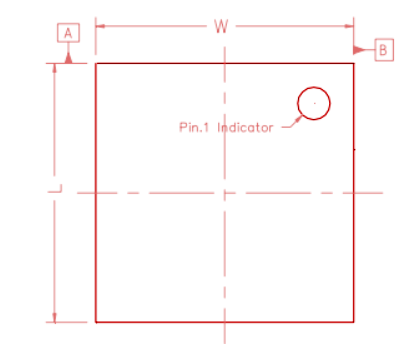
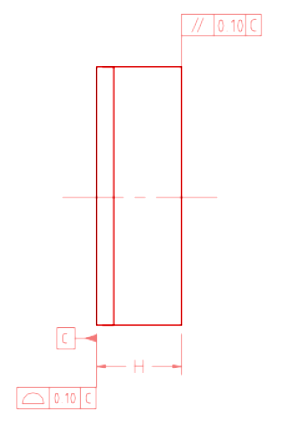
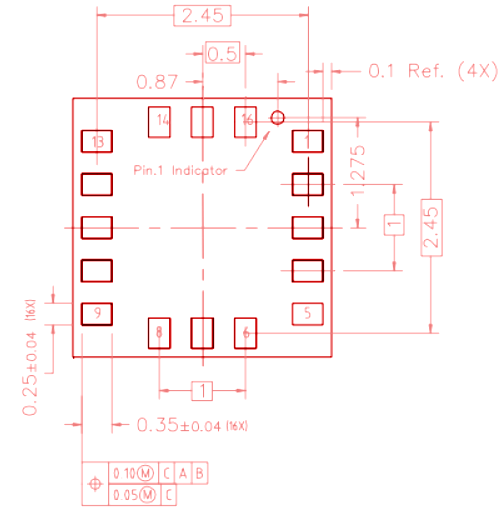
Dimensions of the LIS3DHTR
About the Manufacturer, STMicroelectronics
STMicroelectronics is a well-known company in the semiconductor industry, recognized for producing a wide range of microelectronics products. By combining deep expertise in silicon design, manufacturing strength, and a broad network of technology partners, they stay at the forefront of innovation. STMicroelectronics plays a big role in creating system-on-chip (SoC) technologies that support many modern electronic devices. The company's solutions are found in diverse applications, providing both reliability and adaptability, which meet the needs of today’s fast-evolving tech landscape.
Datasheet PDF
LIS3DHTR Datasheet:
About us
ALLELCO LIMITED
Read more
Quick inquiry
Please send an inquiry, we will respond immediately.
Frequently Asked Questions [FAQ]
1. How can I connect the LIS3DH to an Arduino?
The LIS3DH accelerometer is designed to detect movement across three axes, which makes it perfect for projects that require motion detection. The "3D" in its name refers to three Degrees of Freedom, meaning it can detect movement along the X, Y, and Z axes. This sensor includes analog inputs and features to detect free-fall as well as overflow alerts for its FIFO data buffer, which helps prevent data loss during quick movements.
2. How can I use the LIS3DH with a Raspberry Pi?
Connecting the LIS3DH to a Raspberry Pi is straightforward with Python or CircuitPython, thanks to the Adafruit CircuitPython LIS3DH module. This module simplifies the process of reading acceleration data, allowing you to easily write Python code to interact with the sensor and capture real-time movement information.
3. How do I connect the LIS3DH to an ESP32?
The LIS3DH driver works well with the ESP8266 and the esp-open-rtos system. If the driver isn’t in the extras/lis3dh folder of the main repository, it may not have been merged yet. In that case, you can find it in the lis3dh branch on my fork, which provides the necessary code for smooth operation with the ESP32.
2N3053 Transistor: Overview of Features, Applications, and Setup
on October 30th
STM32F446RET6 Microcontroller Overview
on October 30th
Popular Posts
-

Complex Instruction Set Computers: How They Changed Computing?
on April 18th 147749
-

USB-C Pinout and Features
on April 18th 111898
-
Using Xilinx Unified Simulation Primitives: A Comprehensive Guide to FPGA Design and Simulation
on April 18th 111349
-

Power Supply Voltages in Electronics: Meaning of VCC, VDD, VEE, VSS, and GND
on April 18th 83713
-

RJ45 Connector Guide: Pinout, Wiring, Cable Types, and Uses
on January 1th 79502
-

The Ultimate Guide to Wire Color Codes in Modern Electrical Systems
The way our electrical systems use colors isn’t just for looks. Each wire color now indicates a specific function, making it easier to identify and handle electrical components correctly during ins...on January 1th 66866
-

Quality (Q) Factor: Equations and Applications
The quality factor, or 'Q', is important when checking how well inductors and resonators work in electronic systems that use radio frequencies (RF). 'Q' measures how well a circuit minimizes energy...on January 1th 63004
-
Purge Valve Guide: Function, Symptoms, Testing, and Replacement for Optimal Engine Performance
The purge valve is a key part of a car’s system that helps keep the air clean by managing fuel vapors before they can escape into the atmosphere. This not only helps the environment by reducing pol...on January 1th 62934
-

Achieving Peak Performance with the Maximum Power Transfer Theorem
The Maximum Power Transfer Theorem explains how energy from a source, such as a battery or generator, flows to a connected load. It shows the exact condition where the load receives the most power....on January 1th 54074
-

A23 Battery Specifications and Compatibility
The A23 battery is a small, cylinder-shaped battery with high voltage. Also called 23A, 23AE, or MN21, it runs at 12 volts and much higher than AA or AAA batteries. Its special design make...on January 1th 52087
HOT Part Number
-

XC3S50A-4VQG100C
AMD
IC FPGA 68 I/O 100VQFP
SI1102-A-GM
Silicon Labs
SENSOR OPT REFLECTIVE 50CM 8WDFN
TCN4-13+
Mini-Circuits
1:4 LTCC TRANSFORMER, 650 - 1250
VF30100S-E3/4W
Vishay General Semiconductor - Diodes Division
DIODE SCHOTTKY 100V 30A ITO220AB
GRM033R70J103KA01D
Murata Electronics
CAP CER 10000PF 6.3V X7R 0201
QMK212B7102MDHT
Taiyo Yuden
CAP CER 1000PF 250V X7R 0805
M82351G-12
MACOM Technology Solutions
ACCESS VOICE PROCESSOR
74LV132D,112
Nexperia USA Inc.
IC GATE NAND SCHMIT 4CH 2IN 14SO
AH1801-FJG-7
Diodes Incorporated
MAG SWITCH OMNIPOLAR DFN2020B-3
DG412DY-T1-E3
Vishay Siliconix
IC SWITCH SPST-NOX4 35OHM 16SOIC
PIC16F876A-I/SO
Microchip Technology
IC MCU 8BIT 14KB FLASH 28SOIC
LXA08FP600
Power Integrations
DIODE GP 600V 8A TO220 FULL PACK
FM25V20A-DG
Infineon Technologies
IC FRAM 2MBIT SPI 40MHZ 8DFN
CY7C1011CV33-10ZXC
Cypress Semiconductor Corp
IC SRAM 2MBIT PARALLEL 32TSOP II
04023C221KAT2A
KYOCERA AVX
CAP CER 220PF 25V X7R 0402
RO3101A
Murata Electronics
SAW RES 433.9200MHZ SMD
XRD9818ACGTR
MaxLinear, Inc.
IC AFE 3 CHAN 16BIT 28TSSOP
CL21F104ZBANNNC
Samsung Electro-Mechanics
CAP CER 0.1UF 50V Y5V 0805 -

BZT52-B16_R1_00001
Panjit International Inc.
SOD-123, ZENER
P0300ECL
Littelfuse Inc.
THYRISTOR 25V 400A TO226-2
TPS73615DBVTG4
Texas Instruments
IC REG LINEAR 1.5V 400MA SOT23-5
SN74AXC4T774BQBR
Texas Instruments
IC TRANSCEIVER HALF 4/4 16WQFN
170M5954
Eaton - Bussmann Electrical Division
FUSE SQUARE 350A 1KVAC RECT
CC0805KRX7R9BB682
YAGEO
CAP CER 6800PF 50V X7R 0805
SRP7028A-6R8M
Bourns Inc.
FIXED IND 6.8UH 4.5A 60 MOHM SMD
SMAJ150CA
Taiwan Semiconductor Corporation
TVS DIODE 150VWM 243VC DO214AC
PE-68675
Pulse Electronics
IC CHIP
MAX14890EATJ+
Analog Devices Inc./Maxim Integrated
IC RECEIVER 0/4 32TQFN
TFZGTR20B
Rohm Semiconductor
DIODE ZENER 20V 500MW TUMD2
1N5406-E3/73
Vishay General Semiconductor - Diodes Division
DIODE GEN PURP 600V 3A DO201AD
ME501610
Powerex Inc.
BRIDGE RECT 3P 1.6KV 100A MODULE
GRM1555C2A5R8DA01D
Murata Electronics
CAP CER 5.8PF 100V C0G/NP0 0402
MRF8S19140HSR3
NXP USA Inc.
FET RF 65V 1.96GHZ NI780HS
TN2130K1-G
Microchip Technology
MOSFET N-CH 300V 85MA TO236AB
ADL5519ACPZ-R7
Analog Devices Inc.
IC AMP LOG DETECT CTRLR 32LFCSP
SP3222ECT-L
MaxLinear, Inc.
IC TRANSCEIVER FULL 2/2 18SOIC -
502AT-2
Semitec USA Corp
NTC THERMISTORS 5KOHM 1%
NFM18CC101R1C3D
Murata Electronics
CAP FEEDTHRU 100PF 20% 16V 0603
PS2562L-1-F3-A
Renesas Electronics America Inc
OPTOISOLATOR 5KV DARL 4SMD
502494-0370
Affinity Medical Technologies - a Molex company
2.0 W/B SGL R/ARECASSY3CKTEMBSTP
C1206C223K5RACTU
KEMET
CAP CER 0.022UF 50V X7R 1206
NIS5102QP2HT1G
onsemi
IC HOT SWAP CTRLR GP 12PLLP
VI-J62-MY
Vicor Corporation
DC DC CONVERTER 15V 50W
ADR441ARMZ-REEL7
Analog Devices Inc.
IC VREF SERIES 0.12% 8MSOP
MIC5200-5.0BS
Microchip Technology
IC REG LINEAR 5V 100MA SOT223-3
TAS3251DKQR
Texas Instruments
IC AMP D MONO/STER 350W 56HSSOP
GRM1886T1H360JD01D
Murata Electronics
CAP CER 36PF 50V T2H 0603
TZM5249B-GS08
Vishay General Semiconductor - Diodes Division
DIODE ZENER 19V 500MW SOD80
LM2575-5.0YWM
Microchip Technology
IC REG BUCK 5V 1A 24SOIC
RT0402BRE075K6L
YAGEO
RES SMD 5.6K OHM 0.1% 1/16W 0402
C0603JB1A104M030BC
TDK Corporation
CAP CER 0.1UF 10V JB 0201
CSD17571Q2
Texas Instruments
MOSFET N-CH 30V 22A 6SON
P4SMA13CA
Bourns Inc.
TVS DIODE 11.1VWM 18.2VC DO214AC
AR0144ATSM20XUEA0-DPBR
onsemi
1MP 1/4 CIS SO