LM358 Dual Op-Amp: Equivalents, Pinout, and Working Principles
The LM358 operational amplifier is designed for versatility and efficiency, making it ideal for low to medium voltage applications. Its compact size and affordability make it popular in diverse uses like amplifying signals, enhancing DC gain, and filtering. Operating on a 3V to 32V DC supply and capable of delivering up to 20 mA per channel, the LM358 is useful in devices ranging from simple to complex electronic systems. This article explores the features, configurations, and broad applications of the LM358, providing insights into its integration and performance across various electronic environments.Catalog

Overview of the LM358
The LM358 IC serves as a dual operational amplifier, incorporating two distinct op-amps which utilize a common power source. This configuration parallels half of the LM324, which operates with four op-amps fed by a single power input. The brilliance of LM358 lies in its two independently functioning, high-gain amplifiers accompanied by internally fixed frequency compensation. Skillfully bridging single- and multi-supply systems, the LM358 seamlessly integrates into single-supply settings, enhancing its appeal for a myriad of circuit designs.
Crafted to accommodate a vast voltage supply spectrum, the LM358 operates efficiently within the 3V to 32V range. Such versatility promises steadfast performance across varied electronics contexts. The broad operational range suggests particular utility in battery-powered gadgets. The LM358 features a quiescent current nearly one-fifth of the MC1741 per amplifier, underscoring its proficiency in low-power applications.
The LM358 earns its place as a favored choice due to its prowess in managing diverse input conditions while maintaining consistent performance. Its expansive input voltage capacity, reaching the negative power rail, ensures adaptability under shifting load scenarios, proving beneficial in applications like sensor signal conditioning, active filters, and other analog signal processing endeavors. The design eliminates the need for external biasing parts, streamlining circuit layouts and minimizing assembly durations, enhancing dependability and usability across fields such as automotive and electronics.
LM358 Pin Configuration

|
Pin No. |
Pin Name |
Description |
|
1 |
Output A |
Output of the first operational amplifier. |
|
2 |
Inverting Input A |
Inverting input of the first operational amplifier. |
|
3 |
Non-inverting Input A |
Non-inverting input of the first operational amplifier. |
|
4 |
Ground (GND) |
Ground or negative supply for the operational amplifiers. |
|
5 |
Non-inverting Input B |
Non-inverting input of the second operational amplifier. |
|
6 |
Inverting Input B |
Inverting input of the second operational amplifier. |
|
7 |
Output B |
Output of the second operational amplifier. |
|
8 |
Vcc |
Positive voltage supply for both operational amplifiers. |
LM358 Features and Specifications
• Dual Operational Amplifiers: The LM358 includes two operational amplifiers in one chip, making it useful for many applications.
• Wide Power Supply Range: It works with single power supplies from 3V to 32V or dual supplies from ±1.5V to ±16V, allowing for flexibility in voltage requirements.
• High Voltage Gain: Delivers a voltage gain of about 100 dB, ideal for amplifying weak signals.
• 1 MHz Bandwidth: Handles higher frequency signals efficiently.
• Low Power Consumption: Draws only 700 µA of supply current, saving energy.
• Wide Output Voltage Swing: Outputs signals that cover a large voltage range, close to the supply limits.
• Input Voltage Flexibility: The differential input voltage range matches the power supply voltage, increasing compatibility.
• Short Circuit Protection: The output is protected from damage during short circuits.
• Internal Frequency Compensation: Includes built-in compensation, so external components are unnecessary for unity gain.
• Common-Mode Voltage to Ground: Handles input voltages that go down to ground, reducing the need for extra biasing.
• Low Input Bias Currents: Requires minimal input bias current, ensuring stable operation.
• Single or Dual Supply Support: Works with both single and dual power supplies for greater versatility.
• Standard Operating Temperature: Performs reliably in temperatures from 0°C to 70°C.
• High Soldering Temperature Tolerance: Withstands soldering at up to 260°C, making assembly easier.
• Multiple Package Options: Comes in TO-99, CDIP, SOIC, PDIP, and DSBGA formats for different design needs.
• ESD Protection: Built-in electrostatic discharge protection on input pins increases durability.
LM358 Application Circuit
Infrared-Based Intrusion Alarms
This intricate circuit design centers on the detection of infrared signals emitted, setting off an audio alarm when a person enters a predefined monitoring area. The system consists of an infrared sensor, a signal amplifier, a voltage comparator, delay mechanisms, and an audio notification device. The primary aim is to enhance and scrutinize the sensor's input to prompt an alarm after a specific delay period, ignoring short and harmless disturbances. By incorporating considerations like environmental temperature and potential false alarms, this setup enhances reliability in diverse conditions.

LM358 Circuit: Infrared Detection Alarm
High-End Current Detection
In tackling hurdles such as the failure of low-voltage detection and interference issues with direct AD input, the high-end detection circuit provides a sophisticated remedy. This setup delivers a stable output, ensuring clear signal reception without erroneous outputs in the absence of current. Through the use of feedback systems and precisely engineered filtering stages, these circuits facilitate accurate current evaluation across extensive ranges, for tasks where high precision is sought.

LM358 Circuit: High-End Current Detection
DC-Coupled Low-Pass RC Active Filter

LM358 Circuit: DC-Coupled Low-Pass RC Active Filter
RC Active Band-Pass Filter

LM358 Circuit: RC Active Band-Pass Filter
Square Wave Generator
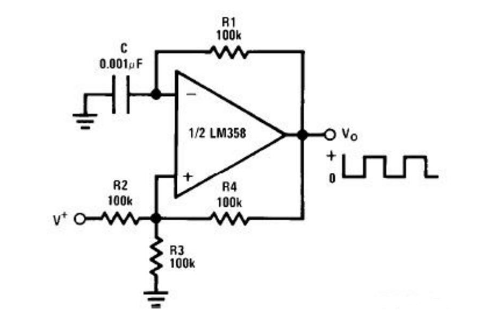
LM358 Circuit: Square Wave Generator
Operating Principles of the LM358
The LM358 is a versatile integrated circuit that functions as both an operational amplifier and a comparator. It operates on a wide input voltage range, with pin 8 as its power input. As a comparator, it works with 3V to 32V, while as an op-amp, it handles ±1.5V to ±16V. In comparator mode, the LM358 compares voltages between two pins and outputs either high or low based on the difference. This simplifies tasks like voltage monitoring or zero-crossing detection without extra components, such as pull-up resistors. It’s commonly used in systems like power management for its quick response and simplicity.
In op-amp mode, the LM358 amplifies differential input voltages and supports tasks like audio processing and sensor signal enhancement. Its two channels allow simultaneous processing of signals, making circuits more efficient and compact. This is useful for applications like filtering and voltage regulation. The LM358 is praised for its reliability, wide temperature tolerance, and ease of use. Its ability to switch seamlessly between functions makes it a favorite for seeking simple, robust designs. As the demand for multifunctional ICs grows, the LM358 remains a popular choice for reducing circuit complexity and improving performance.
Advantages of the LM358 Operational Amplifier
Adaptable Architecture and Integration
The LM358 operational amplifier includes two internally compensated op-amps within a single housing. This dual op-amp setup allows the option to employ both amplifiers at the same time or separately, providing a depth of adaptability in design tasks. The absence of a requirement for dual power supplies makes circuit design more straightforward and reduces the complexity and cost of components.
Ground Sensing Capabilities
A notable aspect is its ability to directly sense near ground potential, which expands the spectrum of possible uses. This makes the LM358 highly effective in contexts demanding precise low-level signal detection. In tangible applications, you have harnessed this ability to fine-tune the precision of sensor interfaces, frequently leading to systems that instill confidence through enhanced reliability.
Broad Compatibility and Seamless Integration
The LM358 integrates smoothly with all logic families, ensuring effortless fit into various electronic systems. Its extensive compatibility makes it a preferred choice across a range of projects, be they analog or mixed-signal. Consequently, when faced with the task of developing equipment that necessitates interaction between analog inputs and digital circuitry, they often see the LM358's compatibility as a valuable asset, simplifying what could otherwise be a daunting process.
Efficiency in Battery-Operated Devices
The LM358 demonstrates remarkable efficiency in battery-operated contexts. Its low power consumption prolongs battery life, making it a sought-after option for portable or remote applications where energy conservation is a great consideration. The LM358 operational amplifier effectively navigates various hurdles in circuit design, covering aspects from adaptability and integration to energy efficiency. Its subtle capability to sense just above ground without power supply concerns, coupled with its extensive compatibility, provides practical and reassuring solutions across multiple realms of electronic design.
LM358 Equivalent Models
• LM324
• LM158
• LM258
• LM2904
• LM2409
LM358 Replacement Models
• GL358
• NE532
• OP04
• OP221
• OP290
• OP295
• OPA2237
• TA75358-P
• UPC358C
• AN6561
• CA358E
• HA17904
Applications of the LM358
Adaptability in DC Gain Blocks
The LM358 demonstrates an impressive capacity to function effectively within DC gain blocks, establishing itself as a key element in diverse electronic circuits. These gain blocks are instrumental in amplifying low-level signals without necessitating a dual power supply, easing the intricacies of circuit design and offering cost benefits. Especially in the initial stages of signal processing, such functionality proves invaluable for precise amplification needs. By optimizing gain levels thoughtfully, circuits can attain the intended signal strength needed for subsequent manipulation or detailed analysis. Regular experimentation and customization in gain settings have shown to yield enhanced performance in electronic applications, revealing new layers of potential.
Accuracy in Digital Multimeters
Within digital multimeters, the dual operational amplifier configuration of the LM358 lends the precision indispensable for accurate voltage and current assessments. Its capability to adeptly handle both AC and DC signal amplification contributes enormously to the multimeter's adaptability. Such functioning ensures the reliability of readings, an aspect deeply intertwined with diagnosing electrical complexities and validating circuit designs.
Clarity in Signal Representation for Oscilloscopes
When integrated into oscilloscopes, the LM358 is great in upholding signal integrity through stable gain across multiple frequencies. It is need for amplifying signals to enhance visualization on the oscilloscope screen. During complex waveform analyses, the importance of reliability cannot be exaggerated, as the slightest distortion could yield misleading interpretations. It has been frequently observed that including buffer stages can augment signal clarity and resolution, expanding the possibilities in signal analysis.
Refined Signal Conditioning
For signal conditioning processes, the LM358 is good in accurately transforming sensor outputs to satisfy diverse data acquisition system needs. It capably alters amplitude, translates signal formats, and filters out noise, setting the stage for subsequent data processing. Employing the LM358 consistently in signal conditioning has shown notable improvements in signal quality, elevating the precision of analyzed data and the resultant outcomes.
Amplification for Transducer Applications
In transducer settings, the LM358 is employed for its adeptness in amplifying faint signals from varied sensors. This amplification is important for translating physical phenomena into measurable electrical signals.
Influence in Current Loop Transmitters
The setup of current loop transmitters reaps advantages from the LM358's proficiency in converting sensor outputs into standardized current signals, suitable for long-distance transmission. This transformation holds industrial contexts, where maintaining signal integrity across extensive cable runs is of utmost concern. Enhanced transmission stability is often realized by combining shielding and proper grounding techniques with the LM358, a valued trait in field applications.
Expanding Horizons in Active Filters and Comparators
The adaptability of the LM358 stretches into roles such as active filters and comparators. In the active filters, it enables selective frequency manipulation for varied communication systems. When functioning as a comparator, it delivers swift switching responses for digital circuits. Customized adjustments in these applications often lead to heightened efficiency and minimized signal disruption. The broad spectrum of applications of the LM358 highlights its adaptability and dependability.
LM358 Package Variants
|
Package |
Dimension |
Unit |
|
DSBGA (8) |
1.31 x 1.31 |
mm |
|
PDIP (8) |
1.91 x 6.35 |
mm |
|
TO-CAN (8) |
9.08 x 9.31 |
mm |
|
SOIC (8) |
4.90 x 3.91 |
mm |

LM358 Package
About us
ALLELCO LIMITED
Read more
Quick inquiry
Please send an inquiry, we will respond immediately.
Frequently Asked Questions [FAQ]
1. What is LM358 used for?
The LM358 finds frequent use as a transducer amplifier and a block for DC gain, delivering an impressive DC voltage gain of about 100dB. Its capability is evident in its accommodation for varying power supply setups and its extensive output voltage range. This versatility enables to utilize it in various contexts, whether in consumer electronics or industrial measurement systems, where its flexibility aligns well with demands for consistency and adaptability.
2. What is the difference between LM741 and LM358?
In examining the LM358 alongside the LM741, the LM358 stands out as a low-power operational amplifier, contrasting with the LM741's role as a voltage comparator. The LM358’s efficiency makes it highly suitable for battery-powered devices. This difference transcends theoretical specifications and illuminates the significance of power consumption in choosing components, particularly in applications like portable medical devices and remote sensors.
3. Can LM324 and LM358 be replaced?
Despite sharing many parameters, the interchangeability of LM324 and LM358 in circuits requires some attention to circuit modifications. The LM358 is frequently selected for its ease of integration into simpler designs. The decision between these options may often hinge on specific requirements of a project, such as limitations in board space or the desire to minimize redesign.
4. Can use LM358 and LM358s interchangeably in circuit?
While similar, the LM358S offers enhanced performance, making it suitable for applications demanding precision and speed. The LM358S shows its advantages in high-frequency or rapidly changing systems, providing a distinctive edge in developing cutting-edge solutions.
5. What are the advantages of LM258 compared to LM358?
The LM258 is characterized by industrial-grade quality, exceeded by the performance of the commercial-grade LM358. Others often opt for the LM258 in scenarios requiring enhanced reliability and longevity. This part is advantageous in settings demanding robustness, such as industrial automation or challenging environments, underlining its role in high-demand applications.

Understanding the LM340T5 Voltage Regulator
on November 27th

Exploring the 2N5457 JFET Transistor
on November 26th
Popular Posts
-

Complex Instruction Set Computers: How They Changed Computing?
on April 18th 147749
-

USB-C Pinout and Features
on April 18th 111896
-
Using Xilinx Unified Simulation Primitives: A Comprehensive Guide to FPGA Design and Simulation
on April 18th 111349
-

Power Supply Voltages in Electronics: Meaning of VCC, VDD, VEE, VSS, and GND
on April 18th 83713
-

RJ45 Connector Guide: Pinout, Wiring, Cable Types, and Uses
on January 1th 79502
-

The Ultimate Guide to Wire Color Codes in Modern Electrical Systems
The way our electrical systems use colors isn’t just for looks. Each wire color now indicates a specific function, making it easier to identify and handle electrical components correctly during ins...on January 1th 66866
-

Quality (Q) Factor: Equations and Applications
The quality factor, or 'Q', is important when checking how well inductors and resonators work in electronic systems that use radio frequencies (RF). 'Q' measures how well a circuit minimizes energy...on January 1th 63003
-
Purge Valve Guide: Function, Symptoms, Testing, and Replacement for Optimal Engine Performance
The purge valve is a key part of a car’s system that helps keep the air clean by managing fuel vapors before they can escape into the atmosphere. This not only helps the environment by reducing pol...on January 1th 62934
-

Achieving Peak Performance with the Maximum Power Transfer Theorem
The Maximum Power Transfer Theorem explains how energy from a source, such as a battery or generator, flows to a connected load. It shows the exact condition where the load receives the most power....on January 1th 54073
-

A23 Battery Specifications and Compatibility
The A23 battery is a small, cylinder-shaped battery with high voltage. Also called 23A, 23AE, or MN21, it runs at 12 volts and much higher than AA or AAA batteries. Its special design make...on January 1th 52087
HOT Part Number
-
MAX208ECNG+
Analog Devices Inc./Maxim Integrated
IC TRANSCEIVER FULL 4/4 24DIP
ADP5022ACBZ-4-R7
Analog Devices Inc.
IC REG TRPL BCK/LNR SYNC 16WLCSP
DS1217A-64K-25
Analog Devices Inc./Maxim Integrated
MODULE NVRAM 8KB 250NS CARTRIDGE
AD5744RCSUZ
Analog Devices Inc.
IC DAC 14BIT V-OUT 32TQFP
TLC7528CNS
Texas Instruments
IC DAC 8BIT A-OUT 20SO
06035A910JAT2A
KYOCERA AVX
CAP CER 91PF 50V NP0 0603
FAN4800AUN
onsemi
IC PFC CTR AV CURR 268KHZ 16DIP
RR264MM-400TR
Rohm Semiconductor
DIODE GEN PURP 400V 1A PMDU
TMP106YZCT
Texas Instruments
SENSOR DIGITAL -40C-125C 6DSBGA
MCT06030C1002FP500
Electro-Films (EFI) / Vishay
RES SMD 10K OHM 1% 1/8W 0603
DMN6068LK3Q-13
Diodes Incorporated
MOSFET BVDSS: 41V 60V TO252
ADS7845E/2K5G4
Texas Instruments
IC SCREEN CNTRL 12BIT 16SSOP
XC4005E-3PQ100I
AMD
IC FPGA 77 I/O 100QFP
1812HC821KAT3A\SB
KYOCERA AVX
CAP CER 820PF 3KV X7R 1812
NRVTS12100PFST3G
onsemi
DIODE SCHOTTKY 100V 12A TO277-3
6N135-500E
Broadcom Limited
OPTOISO 3.75KV TRANS W/BASE 8SMD
MAX333AEUP+T
Analog Devices Inc./Maxim Integrated
IC SWITCH SPDT X 4 45OHM 20TSSOP
LFB212G45CG1C187
Murata Electronics
RF-D -

SC1565IST18TRT
Semtech Corporation
IC REG LINEAR 1.8V 1.5A SOT223-3
AD5220BN10
Analog Devices Inc.
IC POT DGTL 10K 128POS 8-DIP
LM2904AVQPWRG4
Texas Instruments
IC OPAMP GP 2 CIRCUIT 8TSSOP
BTF3125EJXUMA1
Infineon Technologies
IC PWR SWITCH N-CHAN 1:1 TDSO-8
744773115
Würth Elektronik
FIXED IND 15UH 1.2A 235 MOHM SMD
LP2981AIM5X-2.9
Texas Instruments
IC REG LINEAR FIXED LDO REG
1808SC102MAJ1A
KYOCERA AVX
CAP CER 1000PF 1.5KV X7R 1808
DS89C420-MNL
Analog Devices Inc./Maxim Integrated
IC MCU 8BIT 16KB FLASH 40DIP
STP16DPS05MTR
STMicroelectronics
IC LED DRIVER LINEAR 100MA 24SO
VC060305A150DP
KYOCERA AVX
VARISTOR 8.5V 30A 0603
CSD16410Q5A
Texas Instruments
MOSFET N-CH 25V 16A/59A 8VSON
HAL1000UT-K
TDK-Micronas GmbH
MAGNETIC SWITCH PROG TO92UT
SI1403BDL-T1-GE3
Vishay Siliconix
MOSFET P-CH 20V 1.5A SC70-6
AD7999YRJZ-1500RL7
Analog Devices Inc.
IC ADC 8BIT SAR SOT23-8
EP2A15B724C7
Intel
IC FPGA 492 I/O 724BGA
SN74AHC138RGYR
Texas Instruments
IC DECODER/DEMUX 1X3:8 16VQFN
PIC16F627A-I/SS
Microchip Technology
IC MCU 8BIT 1.75KB FLASH 20SSOP
MAX98307ETE+T
Analog Devices Inc./Maxim Integrated
IC AMP CLASS DG MONO 3.3W 16TQFN -

AOB290L
Alpha & Omega Semiconductor Inc.
MOSFET N-CH 100V 18A/140A TO263
MAX13433EETD+T
Analog Devices Inc./Maxim Integrated
IC TRANSCEIVER FULL 1/1 14TDFN
SN74LVC112ADR
Texas Instruments
IC FF JK TYPE DUAL 1BIT 16SOIC
ATSAM4SD32BA-MU
Microchip Technology
IC MCU 32BIT 2MB FLASH 64QFN
CL31A106KPHNNNF
Samsung Electro-Mechanics
CAP CER 10UF 10V X5R 1206
SOLC-120-02-F-Q-A
Samtec Inc.
CONN RCPT 80POS 0.05 GOLD SMD
UPW1J101MPD
Nichicon
CAP ALUM 100UF 20% 63V RADIAL
CS5532-BSZR
Cirrus Logic Inc.
IC ADC 24BIT SIGMA-DELTA 20SSOP
CC0603GRNPO9BN120
YAGEO
CAP CER 12PF 50V C0G/NPO 0603
S-812C50AMC-C3ET2G
ABLIC Inc.
IC REG LINEAR 5V 75MA SOT23-5
C3216X8R1H684M160AE
TDK Corporation
CAP CER 0.68UF 50V X8R 1206
CY2309NZSC-1HT
Cypress Semiconductor Corp
IC CLK BUF 1:9 133.3MHZ 16SOIC
FDD6632
Fairchild Semiconductor
MOSFET N-CH 30V 9A DPAK
GCM155R71E473KA55D
Murata Electronics
CAP CER 0.047UF 25V X7R 0402
LM2743MTCX
Texas Instruments
IC REG CTRLR BUCK 14TSSOP
7440650047
Würth Elektronik
FIXED IND 4.7UH 4.6A 23 MOHM SMD
SS2P4HM3/84A
Vishay General Semiconductor - Diodes Division
DIODE SCHOTTKY 40V 2A DO220AA
V24C12H100BS
Vicor Corporation
DC DC CONVERTER 12V 100W