PIC16F876 Microcontroller Comprehensive Guide to Features and Uses
The PIC16F876 microcontroller is a compact, powerful solution that combines performance and adaptability for a range of applications. This article will guide you through its features, configurations, and real-world uses, offering a straightforward look at how this microcontroller meets various needs in fields like automotive, industrial, and consumer electronics.Catalog

Overview of the PIC16F876 Microcontroller
The PIC16F876 microcontroller brings a powerful blend of performance and ease of use, making it a practical choice for many applications. This 8-bit CMOS FLASH-based microcontroller, featuring Microchip’s PIC® architecture, fits a range of devices in its 28-pin package and is compatible with previous PIC models like the PIC16C5X, PIC12CXXX, and PIC16C7X. The architecture enables rapid 200-nanosecond instruction execution, supporting both speed and efficiency.
With its 256 bytes of EEPROM data memory, built-in self-programming, and in-circuit debugging, this microcontroller stands out for its adaptability across a variety of tasks. It includes five channels of 10-bit analog-to-digital conversion (ADC), useful for analog applications, and is equipped with two additional timers, capture/compare/PWM functions, and multiple communication ports. The ports can be configured as either a three-wire Serial Peripheral Interface (SPI) or a two-wire Inter-Integrated Circuit (I2C) bus, along with a Universal Asynchronous Receiver Transmitter (USART) for flexible data transfer. Together, these features enhance its suitability in fields like automotive, industrial, appliance, and consumer electronics.
Pin Configuration of PIC16F876

CAD Models for PIC16F876
PIC16F876 Symbol

PIC16F876 Footprint
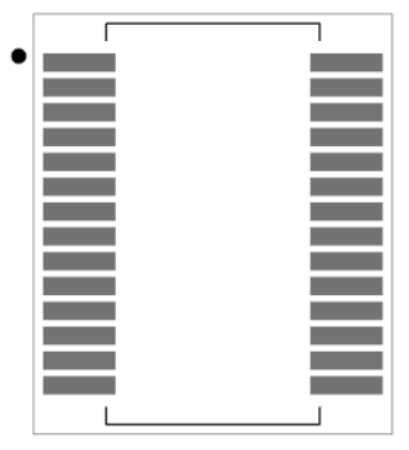
PIC16F876 3D Model

Key Features of the PIC16F876 Microcontroller
High-Performance RISC CPU
This microcontroller's RISC CPU architecture simplifies learning, with just 35 instructions to master. All instructions are single-cycle, except for program branches that take two cycles. Operating at speeds up to 20 MHz, it handles demanding tasks while maintaining efficiency. The memory structure includes up to 8K x 14 words of Flash Program Memory, 368 x 8 bytes of RAM, and 256 x 8 bytes of EEPROM, providing sufficient storage for both programs and data.
Peripheral Features
With three built-in timers and a range of other features, this microcontroller is well-prepared to manage various tasks. Timer0 is an 8-bit timer/counter with an 8-bit prescaler. Timer1 is a 16-bit timer/counter with prescaler and can increment during Sleep mode via an external crystal. Timer2 is another 8-bit timer with an 8-bit period register, prescaler, and postscaler. The device also includes two Capture, Compare, and PWM (Pulse Width Modulation) modules, along with synchronous and asynchronous communication interfaces such as SPI, I2C, and USART.
Analog Features
The PIC16F876 includes a 10-bit analog-to-digital converter with up to 8 channels, allowing it to handle various analog inputs for precise measurements. Additionally, it has two analog comparators with programmable on-chip voltage reference options and flexible input multiplexing, making it versatile for analog applications that require consistent performance.
Special Microcontroller Features
This microcontroller is designed for flexibility and reliability, featuring an impressive 100,000 erase/write cycles for its Enhanced Flash memory and 1,000,000 erase/write cycles for the Data EEPROM. Data EEPROM is built to retain data for over 40 years, ensuring data stability over time. It supports In-Circuit Serial Programming (ICSP) through two pins, enabling easy updates and modifications. Watchdog Timer (WDT) and Power-saving Sleep mode add to its reliability, along with code protection for added security.
CMOS Technology
Built with low-power CMOS technology, the PIC16F876 operates efficiently across a voltage range of 2.0V to 5.5V, making it suitable for various power setups. Its fully static design allows it to handle low-power applications, while offering both commercial and industrial temperature ranges, giving it versatility across different environments.
Technical Specifications for PIC16F876
Technical specifications, attributes, parameters, and comparable parts for the Microchip Technology PIC16F876A-I/SS microcontroller.
| Type | Parameter |
| Factory Lead Time | 8 Weeks |
| Mount | Surface Mount |
| Mounting Type | Surface Mount |
| Package / Case | 28-SSOP (0.209, 5.30mm Width) |
| Number of Pins | 28 |
| Data Converters | A/D 5x10b |
| Number of I/Os | 22 |
| Watchdog Timers | Yes |
| Operating Temperature | -40°C ~ 85°C TA |
| Packaging | Tube |
| Series | PIC® 16F |
| Published | 1997 |
| JESD-609 Code | e3 |
| Pbfree Code | Yes |
| Part Status | Active |
| Moisture Sensitivity Level (MSL) | 1 (Unlimited) |
| Number of Terminations | 28 |
| ECCN Code | EAR99 |
| Terminal Finish | Matte Tin (Sn) |
| Additional Feature | Operates at 4V Minimum Supply |
| Terminal Position | Dual |
| Terminal Form | Gull Wing |
| Peak Reflow Temperature (°C) | 260 |
| Supply Voltage | 5V |
| Frequency | 20MHz |
| Time@Peak Reflow Temperature-Max (s) | 40 |
| Base Part Number | PIC16F876A |
| Pin Count | 28 |
| Power Supplies | 5V |
| Interface | I2C, SPI, SSP, UART, USART |
| Memory Size | 14kB |
| Oscillator Type | External |
| Nominal Supply Current | 1.6mA |
| RAM Size | 368 x 8 |
| Voltage - Supply (Vcc/Vdd) | 4V ~ 5.5V |
| uPs/uCs/Peripheral ICs Type | Microcontroller, RISC |
| Number of Bits | 8 |
| Core Processor | PIC |
| Peripherals | |
| Program Memory Type | FLASH |
| Core Size | 8-Bit |
| Program Memory Size | 14KB (8K x 14) |
| Connectivity | I2C, SPI, UART/USART |
| Bit Size | 8 |
| Access Time | 20 μs |
| Has ADC | Yes |
| DMA Channels | No |
| Data Bus Width | 8b |
| Number of Timers/Counters | 3 |
| Address Bus Width | 8b |
| Density | 112 kb |
| EEPROM Size | 256 x 8 |
| CPU Family | PIC |
| Number of ADC Channels | 5 |
| Number of PWM Channels | 2 |
| Number of I2C Channels | 1 |
| Height | 1.83mm |
| Length | 10.34mm |
| Width | 5.38mm |
| REACH SVHC | No SVHC |
| Radiation Hardening | No |
| RoHS Status | ROHS3 Compliant |
| Lead Free | Lead Free |
Components with Comparable Specifications
| Part Number | PIC16F876A-I/SS | PIC16F767-I/SS | PIC16F73-I/SS | PIC16F76-I/SS |
| Manufacturer | Microchip Technology | Microchip Technology | Microchip Technology | Microchip Technology |
| Package / Case | 28-SSOP (0.209, 5.30mm Width) | 28-SSOP (0.209, 5.30mm Width) | 28-SSOP (0.209, 5.30mm Width) | 28-SSOP (0.209, 5.30mm Width) |
| Number of Pins | 28 | 28 | 28 | 28 |
| Data Bus Width | 8 b | 8 b | 8 b | 8 b |
| Number of I/O | 22 | 25 | 22 | 22 |
| Interface | I2C, SPI, SSP, UART, USART | I2C, SPI, UART, USART | I2C, SPI, SSP, UART, USART | I2C, SPI, SSP, UART, USART |
| Memory Size | 14 kB | 14 kB | 14 kB | 7 kB |
| Supply Voltage | 5 V | 5 V | 5 V | 5 V |
| Peripherals | Brown-out Detect/Reset, ... | Brown-out Detect/Reset, ... | Brown-out Detect/Reset, ... | Brown-out Detect/Reset, ... |
Functional Block Diagram of PIC16F876

SPWM Circuit for PIC16F876 Microcontroller

Alternative Products for PIC16F876
| Part Number | Description | Manufacturer |
| PIC16F876T-04I/SO | MICROCONTROLLERS AND PROCESSORS 8-BIT, FLASH, 4 MHz, RISC MICROCONTROLLER, PDSO28, 0.300 INCH, PLASTIC, MS-013, SO-28 | Microchip Technology Inc |
| PIC16F876T-04/SO | MICROCONTROLLERS AND PROCESSORS 8-BIT, FLASH, 4 MHz, RISC MICROCONTROLLER, PDSO28, 0.300 INCH, PLASTIC, MS-013, SO-28 | Microchip Technology Inc |
| PIC16F876-04I/PM | MICROCONTROLLERS AND PROCESSORS 8-BIT, FLASH, 4 MHz, RISC MICROCONTROLLER, PDIP28, PLASTIC, DIP-28 | Microchip Technology Inc |
| PIC16F876T-04/PQ | MICROCONTROLLERS AND PROCESSORS 8-BIT, FLASH, 4 MHz, RISC MICROCONTROLLER, PQFP44, 10 X 10 MM, 2 MM HEIGHT, METRIC, PLASTIC, QFP-44 | Microchip Technology Inc |
| PIC16F876-04/L | MICROCONTROLLERS AND PROCESSORS 8-BIT, FLASH, 4 MHz, RISC MICROCONTROLLER, PQCC44, PLASTIC, LCC-44 | Microchip Technology Inc |
| PIC16F876T-04/L | MICROCONTROLLERS AND PROCESSORS 8-BIT, FLASH, 4 MHz, RISC MICROCONTROLLER, PQCC44, PLASTIC, LCC-44 | Microchip Technology Inc |
| PIC16F876T-04I/PT | MICROCONTROLLERS AND PROCESSORS 8-BIT, FLASH, 4 MHz, RISC MICROCONTROLLER, PQFP44, 10 X 10 MM, 1 MM HEIGHT, PLASTIC, TQFP-44 | Microchip Technology Inc |
| PIC16F876-04/PQ | MICROCONTROLLERS AND PROCESSORS 8-BIT, FLASH, 4 MHz, RISC MICROCONTROLLER, PQFP44, 10 X 10 MM, 2 MM HEIGHT, METRIC, PLASTIC, QFP-44 | Microchip Technology Inc |
| PIC16F876-04I-SP | MICROCONTROLLERS AND PROCESSORS 8-BIT, FLASH, 4 MHz, RISC MICROCONTROLLER, PDIP28, 0.300 INCH, SKINNY, PLASTIC, MO-095, DIP-28 | Microchip Technology Inc |
| PIC16F876-04I/SO | MICROCONTROLLERS AND PROCESSORS 8-BIT, FLASH, 4 MHz, RISC MICROCONTROLLER, PDSO28, 0.300 INCH, PLASTIC, MS-013, SO-28 | Microchip Technology Inc |
Applications for PIC16F876 Microcontroller
Automotive
In automotive systems, the PIC16F876 is often used for controlling sensors, managing signals, and processing data from various components. Its analog-to-digital conversion and pulse width modulation capabilities make it useful in monitoring engine parameters and controlling actuators, providing reliable performance for vehicle functions.
Industrial
The PIC16F876’s robust features, including multiple timers, communication interfaces, and analog capabilities, suit it well for industrial automation tasks. It can control machinery, handle sensor inputs, and enable precise timing and data handling in manufacturing processes, helping maintain consistency and accuracy in industrial operations.
Appliances
This microcontroller’s versatility makes it ideal for modern appliances, where it can handle a variety of functions, from motor control in washing machines to sensor management in smart thermostats. Its power-saving Sleep mode and wide operating voltage range are particularly advantageous in appliance applications where energy efficiency is valued.
Consumer Electronics
In consumer electronics, the PIC16F876 manages tasks that involve user interfaces, data handling, and control functions. Its analog and digital capabilities enable it to work with sensors, manage data from inputs like buttons or dials, and control outputs, making it suitable for products like home automation devices, remote controls, and interactive electronics.
Package Information for PIC16F876

About the Manufacturer: Microchip Technology, Inc.
Microchip Technology, Inc. designs and supplies embedded control solutions that help create reliable, connected, and secure devices. The company’s products and development tools allow engineers to create highly optimized designs that balance cost, performance, and time to market. Headquartered in Chandler, Arizona, Microchip serves a diverse range of industries, including automotive, industrial, consumer electronics, aerospace, defense, and communications.
Over 120,000 customers rely on Microchip for quality and consistency, which are reflected in its delivery standards and product dependability. The company prioritizes technical support, offering resources that help customers effectively integrate Microchip components into their designs. This focus on customer support, paired with a broad selection of embedded solutions, reinforces Microchip's role as a leading choice in the market.
Datasheet PDF
PIC16F876-04I/SP Datasheet:
Frequently Asked Questions [FAQ]
1. Why isn’t my PIC16F876 circuit oscillating with an external crystal oscillator?
The oscillator might not be vibrating because of the crystal itself or the circuit board connections. Different types of oscillators, such as ceramic and metal crystal oscillators, connect differently. Ensure that the connections align with the type of crystal oscillator you are using. Double-checking the circuit board layout can also help identify any connection issues.
2. How can the PIC16F876 access an array like float A[100] in program memory?
Only constants can be stored in the program memory, which means that data can only be accessed using a lookup table. This array data, once stored in the program register along with the program, becomes read-only and can’t be modified by the program itself. If you need to change the data, consider adding an external flash memory chip, which will act as expandable data memory that the PIC16F876 can access and modify as needed.
3. Does the PIC16F876 have built-in pull-up resistors?
Yes, the RB port on the PIC16F876 has a built-in pull-up resistor, but it works only when the port is set as an input. When configured as an output, the pull-up resistor is disabled. To ensure proper function, verify that the configuration bits are set correctly. For instance, if you’re using a 4M crystal, set it to XT, while an 8M crystal should be set to HS for high-speed oscillation. Also, ensure the low-voltage programming bit (LVP) is turned off.
About us
ALLELCO LIMITED
Read more
Quick inquiry
Please send an inquiry, we will respond immediately.
CR1632 vs CR2032 Battery Comparison Guide
on October 29th
TMP36 Sensor: Specifications, Applications, and Features
on October 29th
Popular Posts
-

Complex Instruction Set Computers: How They Changed Computing?
on April 18th 147749
-

USB-C Pinout and Features
on April 18th 111904
-
Using Xilinx Unified Simulation Primitives: A Comprehensive Guide to FPGA Design and Simulation
on April 18th 111349
-

Power Supply Voltages in Electronics: Meaning of VCC, VDD, VEE, VSS, and GND
on April 18th 83714
-

RJ45 Connector Guide: Pinout, Wiring, Cable Types, and Uses
on January 1th 79502
-

The Ultimate Guide to Wire Color Codes in Modern Electrical Systems
The way our electrical systems use colors isn’t just for looks. Each wire color now indicates a specific function, making it easier to identify and handle electrical components correctly during ins...on January 1th 66868
-

Quality (Q) Factor: Equations and Applications
The quality factor, or 'Q', is important when checking how well inductors and resonators work in electronic systems that use radio frequencies (RF). 'Q' measures how well a circuit minimizes energy...on January 1th 63004
-
Purge Valve Guide: Function, Symptoms, Testing, and Replacement for Optimal Engine Performance
The purge valve is a key part of a car’s system that helps keep the air clean by managing fuel vapors before they can escape into the atmosphere. This not only helps the environment by reducing pol...on January 1th 62939
-

Achieving Peak Performance with the Maximum Power Transfer Theorem
The Maximum Power Transfer Theorem explains how energy from a source, such as a battery or generator, flows to a connected load. It shows the exact condition where the load receives the most power....on January 1th 54076
-

A23 Battery Specifications and Compatibility
The A23 battery is a small, cylinder-shaped battery with high voltage. Also called 23A, 23AE, or MN21, it runs at 12 volts and much higher than AA or AAA batteries. Its special design make...on January 1th 52087
HOT Part Number
-

LTC4063EDD#TRPBF
Analog Devices Inc.
IC BATT CHG LI-ION 1CELL 10DFN
MIMX8MM1CVTKZAA
NXP USA Inc.
IC MPU I.MX 8M MINI SOLOLITE
APDS-9005-020
Broadcom Limited
SENSOR OPT 500NM AMB 6CHIPLED
06031A820KAT2A
KYOCERA AVX
CAP CER 82PF 100V C0G/NP0 0603
ICM-20602
TDK InvenSense
IMU ACCEL/GYRO/TEMP I2C/SPI LGA
170M4611
Eaton - Bussmann Electrical Division
FUSE SQUARE 350A 700VAC RECT
08053C105JAZ2A
KYOCERA AVX
CAP CER 1UF 25V X7R 0805
EP1C12F324C6N
Intel
IC FPGA 249 I/O 324FBGA
2SC4617T1G
onsemi
TRANS NPN 50V 0.1A SC75 SOT416
TL431AILPRAG
onsemi
IC VREF SHUNT ADJ 1% TO92-3
ADAU1787BCBZRL
Analog Devices Inc.
4 ADC, 2 DAC LOW POWER CODEC, AU
74VHC164MTCX
onsemi
IC SHIFT REGISTER 8BIT 14TSSOP
DAN222M3T5G
onsemi
DIODE ARRAY GP 80V 100MA SOT723
NR3015T470M
Taiyo Yuden
FIXED IND 47UH 300MA 1.608OHM SM
MM3Z18VC
onsemi
DIODE ZENER 18V 200MW SOD323F
1N4001W
Rectron USA
DIODE GEN 1A 50V SOD-123F
SMBJ90A
Taiwan Semiconductor Corporation
TVS DIODE 90VWM 146VC DO214AA
NTA1215MC
Murata Power Solutions Inc.
DC DC CONVERTER +/-15V 1W -
SDR1307-101KL
Bourns Inc.
FIXED IND 100UH 1.9A 180MOHM SMD
AOT5B65M1
Alpha & Omega Semiconductor Inc.
IGBT 650V 5A TO220
STP16CP596B1R
STMicroelectronics
IC LED DRIVER LINEAR 50MA 24DIP
AD7895ANZ-2
Analog Devices Inc.
IC ADC 12BIT SAR 8DIP
MURB1620CTT4G
onsemi
DIODE ARRAY GP 200V 8A D2PAK
STGIPS30C60T-H
STMicroelectronics
MOD IPM SLLIMM 30A 600V 25SDIP
IXDN604SIA
IXYS Integrated Circuits Division
IC GATE DRVR LOW-SIDE 8SOIC
CY7C63743-SC
Infineon Technologies
IC MCU 8K LS USB/PS-2 24-SOIC
U2745B-MFBG3
Microchip Technology
RF TX IC UHF 310-440MHZ 16LSSOP
DSPIC30F4013T-30I/PT
Microchip Technology
IC MCU 16BIT 48KB FLASH 44TQFP
ADF4106BRUZ-RL
Analog Devices Inc.
IC CLK/FREQ SYNTH 16TSSOP
EL8403IS
Elantec
IC OPAMP GP 4 CIRCUIT 14SOIC
8A35001B-001AJG
Renesas Electronics America Inc
NETWORK TIMING
GRM0337U1HR90BD01D
Murata Electronics
CAP CER 0.9PF 50V U2J 0201
LT1356CS#PBF
Analog Devices Inc.
IC VOLTAGE FEEDBACK 2 CIRC 16SO
AON7280
Alpha & Omega Semiconductor Inc.
MOSFET N-CH 80V 20A/50A 8DFN
IRLI540N
Infineon Technologies
MOSFET N-CH 100V 23A TO220AB FP
VI-J6Z-MZ
Vicor Corporation
VI-J6Z-MZ 300V 2V 5A -
LMH6722MA
Texas Instruments
IC AMP CURRENT FEEDBACK 14SOIC
HZM6.8Z4MWATL-E
Renesas Electronics America Inc
TVS DIODE 3.5VWM 3MPAK
LM4041DIM7-1.2
Texas Instruments
IC VREF SHUNT 1% SC70-5
RT6200GE
Richtek USA Inc.
IC REG BUCK ADJ 600MA SOT23-6
R5F21274SNFP#X6
Renesas Electronics America Inc
IC MCU 16BIT 16KB FLASH 32LQFP
1N5227B
onsemi
DIODE ZENER 3.6V 500MW DO35
12102C472JAT2A
KYOCERA AVX
CAP CER 4700PF 200V X7R 1210
PZTA64
Fairchild Semiconductor
SMALL SIGNAL BIPOLAR TRANSISTOR,
XC1765ELSO8C
AMD
IC PROM SER C-TEMP 3.3V 8-SOIC
XR88C92CJ-F
MaxLinear, Inc.
IC UART FIFO DUAL 44PLCC
RT24C2X202
Bourns, Inc.
TRIMMER 2K OHM 0.75W PC PIN SIDE
DLW31SN900SQ2L
Murata Electronics
CMC 370MA 2LN 90 OHM SMD
LMK432F476ZM-T
Taiyo Yuden
CAP CER 47UF 10V Y5V 1812
MOC207R1VM
onsemi
OPTOISO 2.5KV TRANS W/BASE 8SOIC
GRM0335C1E390JD01D
Murata Electronics
CAP CER 39PF 25V C0G/NP0 0201
SE10PG-M3/84A
Vishay General Semiconductor - Diodes Division
DIODE GEN PURP 400V 1A DO220AA
RABS15M REG
Taiwan Semiconductor Corporation
BRIDGE RECT 1P 1KV 1.5A ABS-L
PI74LPT16245AEX
Diodes Incorporated
IC TXRX NON-INVERT 3.6V 48TSSOP