PIC18F2550 Microcontroller: Architecture, Pinout, and Applications
This in-depth guide explores the PIC18F2550, engineered to efficiently manage multiple peripherals while minimizing power consumption. Covering its architecture, pinout, specifications, and a wide range of applications, this article provides a comprehensive look at its features and potential in today's tech-focused world.Catalog

Overview of the PIC18F2550 Microcontroller
The PIC18F2550 microcontroller is a popular and budget-friendly choice, supported by a vibrant online community that makes it beginner-friendly for electronics projects. It features 32K bytes of flash memory and 24 programmable I/O pins, allowing easy interaction with various devices. Its built-in USB interface simplifies communication with computers, expanding its use in different computing applications. The Watchdog timer improves reliability by resetting the system during errors, ensuring smooth operation. This microcontroller is widely used for making programming tasks simpler and enabling direct interaction with computer protocols. Its versatility makes it a great fit for automation and IoT projects.
PIC18F2550 Microcontroller Functionality
The PIC18F2550 microcontroller is more advanced than standard digital circuits because it can run programs stored in its memory. When powered on, it activates instructions saved in its non-volatile FLASH memory, allowing it to perform complex tasks beyond the capabilities of basic circuits. This microcontroller works by following a step-by-step process, executing code written by programmers to perform specific actions. It has ability to handle detailed instructions for tasks that require precision and reliability, especially in industries that need consistent results. Unlike simple digital circuits, which only perform fixed hardware-based tasks, the PIC18F2550 can be reprogrammed to adapt to new tasks through software updates. This flexibility makes it a valuable tool in rapidly evolving technology, enabling continuous improvement and the addition of advanced features.
PIC18F2550 Pin Configuration
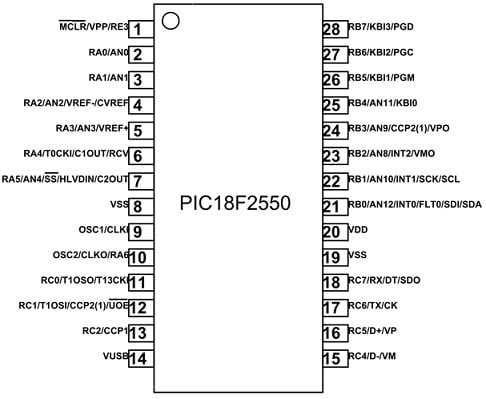
|
Pin No. |
Pin Name |
Function |
|
1 |
MCLR/VPP/RE3 |
MCLR: Master Clear or RESET Input |
|
VPP: Programming voltage input |
||
|
RE3: I/O pin of PORT-E |
||
|
2 |
RA0/AN0 |
RA0: I/O pin of PORT-A |
|
AN0: Analog input-0 |
||
|
3 |
RA1/AN1 |
RA1: I/O pin of PORT-A |
|
AN1: Analog input-1 |
||
|
4 |
RA2/AN2/VREF-/CVREF |
RA2: I/O pin of PORT-A |
|
AN2: Analog input-2 |
||
|
VREF-: A/D reference low voltage input |
||
|
CVREF: Comparator reference output |
||
|
5 |
RA3/AN3/VREF+ |
RA3: I/O pin of PORT-A |
|
AN3: Analog input-3 |
||
|
VREF+: A/D reference high voltage input |
||
|
6 |
RA4/T0CKI/C1OUT/RCV |
RA4: I/O pin of PORT-A |
|
T0CKI: Timer-0 external CLK input |
||
|
C1OUT: Comparator-1 output |
||
|
RCV: External RCV input of USB transceiver |
||
|
7 |
RA5/AN4/SS/HLVDIN/C2OUT |
RA5: I/O pin of PORT-A |
|
AN4: Analog input-4 |
||
|
SS: SPI slave select |
||
|
HLVDIN: High/low-voltage detect input |
||
|
C2OUT: Comparator-2 output |
||
|
8 |
VSS |
Ground pin |
|
9 |
OSC1/CLKI |
OSC1: Oscillator pin-1 |
|
CLKI: External CLK source input |
||
|
10 |
OSC2/CLKO/RA6 |
OSC2: Oscillator pin-2 |
|
CLKO: CLK source output |
||
|
RA6: I/O pin of PORT-A |
||
|
11 |
RC0/T1OSO/T13CKI |
RC0: I/O pin of PORT-C |
|
T1OSO: Timer-1 oscillator output |
||
|
T13CKI: Timer1 or Timer3 CLK input |
||
|
12 |
RC1/T1OSI/CCP2/UOE |
RC1: I/O pin of PORT-C |
|
T1OSI: Timer-1 oscillator input |
||
|
CCP2: Capture-2/Compare-2/PWM2 output |
||
|
UOE: External OE output of USB transceiver |
||
|
13 |
RC2/CCP1 |
RC2: I/O pin of PORT-C |
|
CCP1: Capture-1/Compare-1/PWM1 output |
||
|
14 |
VUSB |
Internal voltage regulator USB 3.3V output |
|
15 |
RC4/D-/VM |
RC4: I/O pin of PORT-C |
|
D-: USB differential minus line |
||
|
VM: VM input of USB transceiver |
||
|
16 |
RC5/D+/VP |
RC5: I/O pin of PORT-C |
|
D+: USB differential plus line |
||
|
VP: VP input of USB transceiver |
||
|
17 |
RC6/TX/CK |
RC6: I/O pin of PORT-C |
|
TX: Asynchronous transmit pin |
||
|
CK: Synchronous CLK of EUSART |
||
|
18 |
RC7/RX/DT/SDO |
RC7: I/O pin of PORT-C |
|
RX: Asynchronous receive pin |
||
|
DT: Synchronous data pin |
||
|
SDO: SPI data out |
||
|
19 |
VSS |
Ground pin |
|
20 |
VDD |
+5V positive power supply |
|
21 |
RB0/AN12/INT0/FLT0/SDI/SDA |
RB0: I/O pin of PORT-B |
|
AN12: Analog input-12 |
||
|
INT0: External interrupt-0 |
||
|
FLT0: Enhanced PWM fault input |
||
|
SDI: SPI data in |
||
|
SDA: I2C data I/O |
||
|
22 |
RB1/AN10/INT1/SCK/SCL |
RB1: I/O pin of PORT-B |
|
AN10: Analog input-10 |
||
|
INT1: External interrupt-1 |
||
|
SCK: SPI serial CLK |
||
|
SCL: I2C serial CLK |
||
|
23 |
RB2/AN8/INT2/VMO |
RB2: I/O pin of PORT-B |
|
AN8: Analog input-8 |
||
|
INT2: External interrupt-2 |
||
|
VMO: VMO output of USB transceiver |
||
|
24 |
RB3/AN9/CCP2/VPO |
RB3: I/O pin of PORT-B |
|
AN9: Analog input-9 |
||
|
CCP2: Capture-2/Compare-2/PWM2 output |
||
|
VPO: VPO output of USB transceiver |
||
|
25 |
RB4/AN11/KBI0 |
RB4: I/O pin of PORT-B |
|
AN11: Analog input-11 |
||
|
KBI0: Interrupt-on-change |
||
|
26 |
RB5/KBI1/PGM |
RB5: I/O pin of PORT-B |
|
KBI1: Interrupt-on-change |
||
|
PGM: Low-voltage ICSP programming enable |
||
|
27 |
RB6/KBI2/PGC |
RB6: I/O pin of PORT-B |
|
KBI2: Interrupt-on-change |
||
|
PGC: ICSP programming CLK pin |
||
|
28 |
RB7/KBI3/PGD |
RB7: I/O pin of PORT-B |
|
KBI3: Interrupt-on-change |
||
|
PGD: ICSP programming data pin |
PIC18F2550 Features and Specifications
|
Feature/Specification |
Description |
|
Number of Pins |
28-pin |
|
Operating Voltage |
+4.0 to +5.5V |
|
CPU Type |
8-bit |
|
Programmable I/O Pins |
24 |
|
Communication Interfaces |
USB Serial Interface (pins 15, 16), Master/Slave SPI
(pins 7, 18, 21, 22), UART (pins 17, 18), Two-wire Serial Interface (pins 21,
22) |
|
Counters |
1 x 8-bit counter, 3 x 16-bit counters |
|
ADC Module |
10 channels, 10-bit resolution |
|
PWM Channels |
2 |
|
Analog Comparators |
2 |
|
Internal Oscillator |
32 kHz to 8 MHz |
|
External Oscillator |
Up to 48 MHz |
|
Program Memory Type |
Flash |
|
Power-saving Modes |
Yes |
|
RAM |
2 KB |
|
Program Memory/Flash Memory |
32 KB |
|
EEPROM Memory |
256 Bytes |
|
CPU Speed |
12 MIPS |
|
Watchdog Timer |
Programmable, includes separate On-chip Oscillator |
|
Operating Temperature |
-40°C to +85°C |
Programming the PIC18F2550 Microcontroller
Programming the PIC18F2550 microcontroller involves a series of straightforward but precise steps to configure its hardware and implement desired functionalities. The process relies heavily on the use of General Purpose Input/Output (GPIO) pins, which allow the microcontroller to interact with external components like sensors, actuators, or other peripherals. You can write the program in either C or assembly language, with each offering unique advantages. C is often preferred for its simplicity and readability, while assembly language provides greater control over hardware, making it ideal for highly performance-sensitive tasks.
The programming workflow begins with writing the code in an Integrated Development Environment (IDE) that supports PIC microcontrollers, such as MPLABX or Mikro C. The chosen language influences not only the ease of development but also the performance of the final program. Once the code is written, it is compiled within the IDE. The compiler checks for errors in syntax and logic, ensuring the code matches the intended functionality. If the compilation is successful, the result is a HEX file, a compact, machine-readable version of your code.
The next step is transferring the HEX file to the microcontroller. This requires a hardware programmer, such as a Pickit3, to establish a connection between your PC and the PIC18F2550. After connecting the programmer, you’ll use compatible software to upload the HEX file, effectively "burning" it into the microcontroller's flash memory. Once the upload is complete, disconnect the programmer, and integrate the microcontroller with any required peripherals.
Tools Needed for Programming
Software Tools: The primary software tools are an Integrated Development Environment (IDE) and a compiler. Popular choices include Mikro C, MPLABX IDE, and PIC CCS Compiler. These tools not only help write and compile code but also include debugging features and libraries that simplify working with the microcontroller's peripherals. Built-in libraries are useful for handling advanced functionalities like Analog-to-Digital Conversions (ADC) or managing communication protocols such as I2C or SPI.
Hardware Tools: A hardware programmer, such as the Pickit3, is required for transferring the compiled HEX file from your computer to the microcontroller. This device acts as a bridge between your development environment and the PIC18F2550’s flash memory. While not strictly required, PIC development boards can streamline the programming and testing process. These boards come equipped with GPIO connectors, ADCs, and even pre-installed sensors, providing a convenient platform to experiment with and test your code. They make it easier to move from coding in a theoretical context to practical applications with time data and external devices.
Architecture of the PIC18F2550 Microcontroller
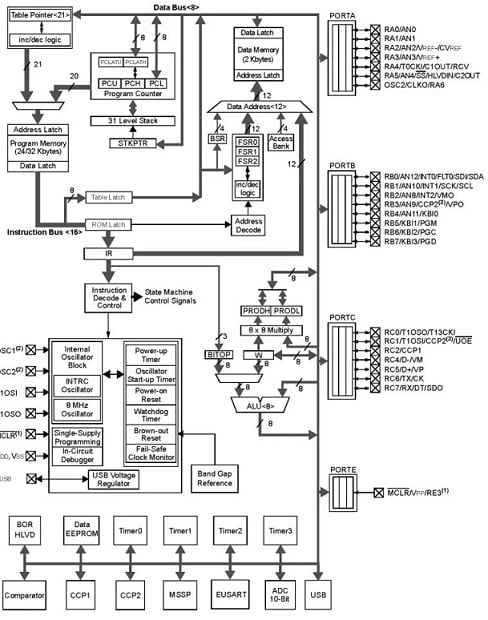
The PIC18F2550 is a versatile microcontroller designed for modern digital applications. It features four GPIO ports (Port-A, Port-B, Port-C, and Port-E), each capable of handling a variety of input and output tasks. Ports A and B are ideal for standard TTL logic, commonly used in digital circuits, while Port-C supports ST logic for higher performance. These ports, with pins labeled RA0 to RC7, offer flexibility for tasks ranging from basic LED control to complex communication protocols, making the microcontroller adaptable to diverse systems.
Digital Input and Interrupt Handling
The PIC18F2550 is built for responsive digital input processing, supporting both TTL and ST logic inputs on different ports. This compatibility ensures smooth integration with a variety of devices and reduces design complexity. Its interrupt system allows the microcontroller to quickly respond to external events. With three external interrupt vectors (INT0, INT1, and INT2), it efficiently handles time tasks, such as automation or robotics, without overburdening the processor.
Serial Communication Options
This microcontroller offers robust serial communication capabilities, including EUSART, SPI, and I2C interfaces. The EUSART interface handles both sending and receiving data, ensuring reliable communication with other devices. SPI is optimized for fast, short-distance data exchange, while I2C enables efficient multi-device communication over just two wires. These features make the PIC18F2550 suitable for both simple and complex setups requiring dependable data transfer.
Programming and USB Connectivity
The PIC18F2550 simplifies programming and connectivity with its ICSP (In-Circuit Serial Programming) and USB interface. ICSP allows to update firmware directly without removing the chip, using six dedicated pins for error-free programming. Its USB interface supports both half-speed and full-speed operations, offering flexible connectivity for a wide range of applications. This combination makes firmware updates and USB-based system designs straightforward and efficient.
Timers and Advanced Features
The microcontroller includes four timers, a 10-channel ADC, comparators, and PWM modules to expand its functionality. The timers handle everything from basic timing to advanced control tasks like motor management. The ADC converts analog signals into digital data, making it needed for sensor applications. Comparators and PWM modules further enhance control, enabling precise signal processing and device management.
Interfacing the PIC18F2550 Microcontroller with an LDR
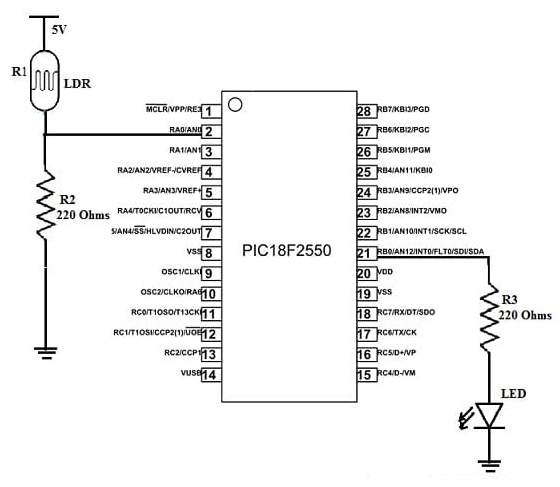
The PIC18F2550 microcontroller seamlessly integrates with a Light Dependent Resistor (LDR) to enable light-responsive circuits. Using its Analog-to-Digital Converter (ADC) and General-Purpose Input/Output (GPIO) functionalities, the microcontroller powers systems that react to light intensity changes, such as automatic lighting and other innovative applications. To connect an LDR to the PIC18F2550, the resistor is linked to one of the microcontroller's analog input pins. This allows the ADC to detect resistance variations caused by changing light levels. For instance, as light intensity increases or decreases, the voltage across the LDR shifts, and the microcontroller translates these changes into digital data. Proper selection and positioning of resistors are needed to achieving both sensitivity and stability.
Once the LDR is connected, fine-tuning the ADC settings ensures accurate readings. Adjusting the resolution and reference voltage helps the system provide reliable results. Empirical calibration, where the system is tested under different lighting conditions, further enhances precision. These steps ensure the microcontroller accurately interprets light intensity changes, improving its ability to handle diverse environments. The combination of an LDR and the PIC18F2550 opens doors to a variety of applications. Beyond automatic lighting, this setup can drive systems like intelligent blinds, light-sensitive alarms, or adaptive display brightness controls. As microcontroller and sensor technologies continue to advance, they offer new opportunities to create systems that align your needs, enhancing how technology interacts with natural light and everyday life.
PIC18F2550 Advantages and Disadvantages
Advantages
• High Performance: Offers impressive computational efficiency, ideal for a variety of users.
• Affordable: Provides cost-effective solutions.
• Durable: Ensures reliable operation even in challenging environments.
• Versatile Interfaces: Includes USB and UART, enabling easy integration and frequent data exchange.
• Ample RAM: Handles large datasets efficiently, ideal for data logging and control systems.
Disadvantages
• Limited Memory: Requires creative programming to optimize resource usage.
• Basic Interrupt Handling: Challenging for applications needing precise timing or immediate responses.
• Project-Specific Feasibility: Limitations demand careful evaluation to ensure compatibility with project requirements.
PIC18F2550 Microcontroller Applications
Versatility in the Contemporary Epoch
The PIC18F2550 boasts a suite of features that lend themselves to pioneering applications within a wide array of industries such as USB peripheral development, industrial automation, electronics, medical technology, and burgeoning IoT domains.
USB Peripheral Development
With a built-in USB interface, integration into devices requiring steady USB connectivity becomes straightforward. As the appetite for seamless device communication continues to rise, the PIC18F2550 offers an efficient pathway.
Industrial Automation
When it comes to industrial automation, the microcontroller excels by enhancing machine efficiency and facilitating precision in intricate operations. Its ability to be customized ensures tailored solutions for industrial requirements, underlining the layers of innovation present in today's industrial landscapes.
Electronics
The trajectory of electronics is toward demanding more intuitive and interactive experiences. Catering to devices that necessitate time processing and connectivity, this microcontroller serves as a core element in automating appliances and enriching interactions with daily technologies.
Medical Devices
Precision in designing medical devices often relies on dependable technological companions like the PIC18F2550. Its dedication to precision supports the creation of equipment fulfilling roles and contributing to patient care and operational success.
IoT Applications
In the Internet of Things, where connectivity defines the landscape, embedded devices are in continuous communication. The microcontroller's adeptness at managing these demands forecasts an era where effective IoT solutions revolutionize environmental interactions, propelling the development of more cohesive networks.
About us
ALLELCO LIMITED
Read more
Quick inquiry
Please send an inquiry, we will respond immediately.
Guide to the CA3130 MOSFET Operational Amplifier
on December 17th

BC557 Transistor: Features, Pinout, and Applications
on December 17th
Popular Posts
-

Complex Instruction Set Computers: How They Changed Computing?
on April 18th 147749
-

USB-C Pinout and Features
on April 18th 111893
-
Using Xilinx Unified Simulation Primitives: A Comprehensive Guide to FPGA Design and Simulation
on April 18th 111349
-

Power Supply Voltages in Electronics: Meaning of VCC, VDD, VEE, VSS, and GND
on April 18th 83713
-

RJ45 Connector Guide: Pinout, Wiring, Cable Types, and Uses
on January 1th 79502
-

The Ultimate Guide to Wire Color Codes in Modern Electrical Systems
The way our electrical systems use colors isn’t just for looks. Each wire color now indicates a specific function, making it easier to identify and handle electrical components correctly during ins...on January 1th 66865
-

Quality (Q) Factor: Equations and Applications
The quality factor, or 'Q', is important when checking how well inductors and resonators work in electronic systems that use radio frequencies (RF). 'Q' measures how well a circuit minimizes energy...on January 1th 63001
-
Purge Valve Guide: Function, Symptoms, Testing, and Replacement for Optimal Engine Performance
The purge valve is a key part of a car’s system that helps keep the air clean by managing fuel vapors before they can escape into the atmosphere. This not only helps the environment by reducing pol...on January 1th 62924
-

Achieving Peak Performance with the Maximum Power Transfer Theorem
The Maximum Power Transfer Theorem explains how energy from a source, such as a battery or generator, flows to a connected load. It shows the exact condition where the load receives the most power....on January 1th 54071
-

A23 Battery Specifications and Compatibility
The A23 battery is a small, cylinder-shaped battery with high voltage. Also called 23A, 23AE, or MN21, it runs at 12 volts and much higher than AA or AAA batteries. Its special design make...on January 1th 52086
HOT Part Number
-
NCV7720DQAR2G
onsemi
IC MOTOR DRIVER 24SSOP
1N5227B
SMC Diode Solutions
DIODE ZENER 3.6V 500MW DO35
ADS7830IPWR
Texas Instruments
IC ADC 8BIT SAR 16TSSOP
NP60N06PDK-E1-AY
Renesas Electronics America Inc
MOSFET TRANSISTOR MORE 1 W
TL441CN
Texas Instruments
IC LOGARITHMIC 1 CIRCUIT 16DIP
2SAR514P5T100
Rohm Semiconductor
TRANS PNP 80V 0.7A MPT3
SMA6J18A-TR
STMicroelectronics
TVS DIODE 18VWM 33.2VC SMA
C8051F124
Silicon Labs
IC MCU 8BIT 128KB FLASH 100TQFP
2N5089
NTE Electronics, Inc
TRANS NPN 25V 0.05A TO92
18121C104JAT2A
KYOCERA AVX
CAP CER 0.1UF 100V X7R 1812
HCPL-7721-060E
Broadcom Limited
OPTOISO 3.75KV PUSH PULL 8DIP
NCT72CMTR2G
onsemi
SENSOR DIGITAL -40C-125C 8WDFN
AMK316AC7476MLHT
Taiyo Yuden
CAP CER 47UF 4V X7S 1206
AT17C65-10JC
Microchip Technology
IC SERIAL CONFIG PROM 64K 20PLCC
AD5248BRMZ100-RL7
Analog Devices Inc.
IC DGT POT 100KOHM 256TAP 10MSOP
PIC32MZ2048EFM100-E/GJX
Microchip Technology
IC MCU 32BIT 2MB FLASH 100TFBGA
12101K3R9CBTTR
KYOCERA AVX
CAP THIN FILM 3.9PF 100V 1210
GBPC5010W
GeneSiC Semiconductor
BRIDGE RECT 1P 1KV 50A GBPC-W -

UMK316F474ZF-T
Taiyo Yuden
CAP CER 0.47UF 50V Y5V 1206
CY25100SXC-064T
Infineon Technologies
IC CLOCK GENERATOR
9UMS9633BKLF
Renesas Electronics America Inc
IC MOBILE PC CLK EMEBED 48VFQFPN
AFT05MP075NR1
NXP USA Inc.
FET RF 2CH 40V 520MHZ TO270-4
LFE3-150EA-7FN672I
Lattice Semiconductor Corporation
IC FPGA 380 I/O 672FPBGA
VC060309A200RP
KYOCERA AVX
VARISTOR 12.7V 30A 0603
IRS44262STRPBF
Infineon Technologies
IC GATE DRVR LOW-SIDE 8SOIC
CY2544C016
Infineon Technologies
TSBU
MIC2551AYML
Micrel Inc.
USB TRANSCEIVER
DRV5021A3EDBZRQ1
Texas Instruments
MAGNETIC SWITCH UNIPOLAR SOT23-3
SY88343BLEY
Microchip Technology
IC LIMITING 1 CIRCUIT 10MSOP
AOT440
Alpha & Omega Semiconductor Inc.
MOSFET N-CH 40V 15.5A/105A TO220
VI-2W2-EW
Vicor Corporation
DC DC CONVERTER 15V 100W
MCP6292IDR
Texas Instruments
IC OPAMP GP 2 CIRCUIT 8SOIC
ATF750C-15JI
Microchip Technology
IC CPLD 10MC 15NS 28PLCC
640550-7
TE Connectivity AMP Connectors
CONN DUST COVER 7POS CLOSED
PM10CZF120
Powerex Inc.
MOD IPM 6PAC 1200V 10A
TLC277CP
Texas Instruments
IC CMOS 2 CIRCUIT 8DIP -

RT1206BRD071K2L
YAGEO
RES SMD 1.2K OHM 0.1% 1/4W 1206
SN74F163ANS
Texas Instruments
IC BINARY COUNTER 4-BIT 16SO
ATA664251-WGQW
Microchip Technology
IC MCU 8BIT 16KB FLASH 48QFN
AT28BV64-30JC
Microchip Technology
IC EEPROM 64KBIT PARALLEL 32PLCC
GBPC2508
Yangjie Technology
GBPC 800V 25.0A Diodes Bridge
MT47H128M16RT-25E IT:C
Micron Technology Inc.
IC DRAM 2GBIT PARALLEL 84FBGA
AD9644BCPZ-80
Analog Devices Inc.
IC ADC 14BIT PIPELINED 48LFCSP
MK21DX256VLK5
NXP USA Inc.
IC MCU 32BIT 256KB FLASH 80FQFP
FQPF3N90
Fairchild Semiconductor
MOSFET N-CH 900V 2.1A TO220F
74HC541D,653
NXP USA Inc.
IC BUFF/DVR TRI-ST 8BIT 20SOIC
MX25V8035ZNI-15G
Macronix
IC FLASH 8MBIT SPI 66MHZ 8WSON
P6SMB18CA
Taiwan Semiconductor Corporation
TVS DIODE 15.3VWM 25.5VC DO214AA
AUIPS7091S
Infineon Technologies
IC PWR SWITCH N-CHAN 1:1 D2PAK-5
RP122K331D-TR
Nisshinbo Micro Devices Inc.
IC REG LIN 3.3V 400MA DFN1010-4
GALI-51+
Mini-Circuits
IC AMP CELLULAR 0HZ-4GHZ SOT89
770901-1
TE Connectivity AMP Connectors
CONN PIN 22-26AWG TIN CRIMP
IPA60R800CEXKSA1
Infineon Technologies
MOSFET N-CH 600V 5.6A TO220-FP
P4SMA91A
Meritek
TVS DIODE 77.8VWM 125VC