PIC18F4620 Microcontroller: Features, Pinouts, and Datasheet Guide
This article begins by exploring the PIC18F4620 microcontroller, discuss its balance between computational power and cost-efficiency. We'll examine the microcontroller’s capabilities in detail, such as its durability and energy efficiency. This method not only makes the information more relatable but also more useful for you, encouraging a deeper appreciation of the technology and motivating further exploration into the PIC18F4620's role in advancing microcontroller technology.Catalog

Overview of PIC18F4620
The PIC18F4620 microcontroller showcases a blend of computational efficiency and cost-effectiveness, leveraging its Enhanced Flash program memory for superior durability and an extended lifespan. This characteristic finds utility in applications requiring frequent memory rewrites, ensuring long-term reliability. The PIC18 series including the PIC18F2525, PIC18F2620, PIC18F4525, and PIC18F4620 models is crafted to fulfill the needs of high-performance and power-sensitive implementations.
Pinout of PIC18F4620
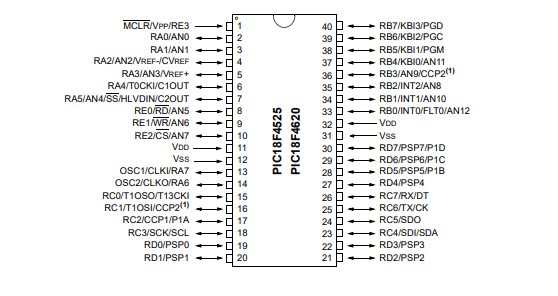
Pin Configuration
Power and Ground Pins
The power requirements for the PIC18F4620 range from 2V to 5.5V, catered through the VDD and VSS pins. VDD connects to the positive supply voltage. VSS is designated for ground.
Placing appropriate decoupling capacitors, such as ceramic or tantalum types, near these pins helps in noise reduction and maintaining stable operation, stable power delivery underpins consistent microcontroller performance.
Oscillator Pins
The OSC1 and OSC2 pins are utilized for connecting external crystals or resonators, generating the clock signal needed for operation. The choice of clock source is use as it influences both power consumption and performance. Selecting suitable oscillator components ensures that the microcontroller functions at the desired frequency with minimal jitter.
Input/Output Ports
The microcontroller comprises several I/O ports: PORTA, PORTB, PORTC, PORTD, and PORTE. Each port, consisting of multiple pins, can be configured as input or output depending on application requirements.
Effectively using these ports can streamline design processes, initialization of TRIS registers determines the input or output status of pins for controlling external circuits like sensors, switches, and LEDs.
Special Function Pins
Specific pins are allocated for specialized functions:
Analog-to-Digital Conversion (ADC) Channels
Pulse-Width Modulation (PWM) Outputs
Communication Interfaces: UART, SPI, and I2C
Leveraging these built-in peripherals, such as timers and communication modules, enriches circuit designs and boosts functionality. For example, utilizing the built-in UART communication can simplify coding efforts and enhance data transmission reliability in serial communication projects.
PIC18F4620 Symbol, Footprint, and CAD Model

PIC18F4620 Symbol
The symbol of the PIC18F4620 serves as a graphical representation used in schematics to indicate the component and its electrical connections. The symbol includes all the pins and their designated functions, enabling seamless schematic design.
PIC18F4620 Footprint
The footprint for the PIC18F4620 specifies the physical layout and size of the component on the PCB. This includes the arrangement and dimensions of pads, which are good for secure and reliable soldering.
PIC18F4620 CAD Model
A CAD (Computer-Aided Design) model offers a 3D representation of the PIC18F4620 microcontroller, detailing physical aspects such as height, width, and pin layout. The CAD model is instrumental for precise PCB design, enabling accurate placement and spatial planning.
Features of PIC18F4620
PIC18F4620 provides adaptable operating modes to distinct power-saving requirements, adding a touch to its usability:
Operating Modes
Run: Activates both the CPU and peripherals, ensuring immediate responsiveness for active tasks.
Idle: Disables the CPU while maintaining peripheral activity, perfect for scenarios where background processes require attention.
Sleep: Powers down the CPU and peripherals, ideal for conserving energy during periods of inactivity.
Power Efficiency
Ultra-Low 50nA Input Leakage: This minimizes unintended current, a factor in precision applications where leakage could compromise performance and, by extension, reliability.
Run Mode: Consumes a modest 11µA, reflecting its suitability for power-sensitive operations needing frequent activation without excessive energy draw.
Idle Mode: Draws merely 2.5µA, beneficial for tasks that require peripheral monitoring without demanding full processing power.
Sleep Mode: Uses an extremely low 100nA, ideal for applications where battery life preservation during long periods of inactivity is great.
Timer1 Oscillator: Operates at 900nA with a 32 kHz frequency, maintaining timekeeping functions with minimal power, ensuring the accuracy of time-dependent operations even in low-power states.
Watchdog Timer: Consumes 1.4µA, contributing to system stability by automatically resetting the microcontroller if a software fault or unresponsive state is detected, a safeguard reassuring for relying on uninterrupted service.
Applications in Embedded Systems
Balancing Performance with Power Consumption: Selecting appropriate modes based on operational needs can extend battery life in portable devices.
Accuracy and Reliability: The ultra-low input leakage current and efficient oscillators ensure the system remains precise and dependable, even when operating in low-power states.
Advantages of the PIC18F4620
Oscillator Flexibility
Crystal Oscillator: Operating up to 40 MHz, enhanced by a 4x Phase Lock Loop (PLL), offers remarkable performance and speed, making it suitable for applications where precision is needed.
RC Modes: Handles up to 4 MHz with an external resistor-capacitor (RC) setup, extendable to 40 MHz with an external clock source, providing adaptability in diverse scenarios.
Internal Oscillator Block: Ranges from 31 kHz to 8 MHz, ensuring a swift wake-up time from Sleep mode (1 µs), which reduces latency and aids in effective power management.
Fail-Safe Clock Monitor: Adds reliability by ensuring safe shutdown in case of a peripheral clock failure, bolstering system robustness.
Notable Peripherals
High-Current Sink/Source: Each I/O pin manages up to 25 mA, accommodating higher power requirements without external drivers.
Multiple Interrupts and PWM Outputs: This feature supports synchronous control over various modules for motor control and communication systems, enhancing operational efficiency.
Master Synchronous Serial Port (MSSP): Supports SPI/I2C protocols imperative for efficient multi-IC communication, enabling seamless integration in sophisticated designs.
Enhanced USART and ADC Module: The USART supports both asynchronous and synchronous modes, while the 10-bit ADC offers up to 13 channels for extensive data acquisition and serial communication in sensor interfacing and telemetry.
Analog Comparators and HLVD: Dual analog comparators and 16-level High/Low-Voltage Detection (HLVD) facilitate precise voltage monitoring and decision-making, supporting accuracy-demanding applications.
Special Features
C Compiler Optimized Architecture: Tailored for C compilers, this feature simplifies development, streamlining the path to market for complex projects.
Durable Memory Cycles: Offers 100,000 erase/write cycles for Enhanced Flash and up to 1,000,000 cycles for EEPROM, ensuring the durability and reliability of stored data in rigorous applications.
Self-Programmable and In-Circuit Debug: Supports self-programming and in-circuit debugging via two pins, improving programming flexibility and troubleshooting efficiency, a notable advantage in various engineering practices.
Wide Voltage Range: Operates from 2.0V to 5.5V with brown-out reset options, providing stable performance across diverse power conditions in portable and power-sensitive devices.
PIC18F4620 Technical Specifications
|
Type |
Parameter |
|
Factory Lead Time |
6 Weeks |
|
Mount |
Through Hole |
|
Mounting Type |
Through Hole |
|
Package / Case |
40-DIP (0.600, 15.24mm) |
|
Number of Pins |
40 |
|
Data Converters |
A/D 13x10b |
|
Number of I/Os |
36 |
|
Watchdog Timers |
Yes |
|
Operating Temperature |
-40°C~125°C TA |
|
Packaging |
Tube |
|
Series |
PIC® 18F |
|
Published |
2004 |
|
JESD-609 Code |
e3 |
|
Pbfree Code |
Yes |
|
Part Status |
Active |
|
Moisture Sensitivity Level (MSL) |
Not Applicable |
|
Number of Terminations |
40 |
|
Terminal Finish |
Matte Tin (Sn) |
|
Max Power Dissipation |
1W |
|
Terminal Position |
DUAL |
|
Supply Voltage |
5V |
|
Frequency |
40MHz |
|
Base Part Number |
PIC18F4620 |
|
Pin Count |
40 |
|
Supply Voltage-Max (Vsup) |
5.5V |
|
Power Supplies |
5V |
|
Interface |
I2C, SPI, UART, USART |
|
Memory Size |
64kB |
|
Oscillator Type |
Internal |
|
RAM Size |
3.8K x 8 |
|
Voltage - Supply (Vcc/Vdd) |
4.2V~5.5V |
|
uPs/uCs/Peripheral ICs Type |
MICROCONTROLLER |
|
Number of Bits |
8 |
|
Core Processor |
PIC |
|
Peripherals |
Brown-out Detect/Reset, HLVD, POR, PWM, WDT |
|
Program Memory Type |
FLASH |
|
Core Size |
8-Bit |
|
Program Memory Size |
64KB 32K x 16 |
|
Connectivity |
I2C, SPI, UART/USART |
|
Supply Current-Max |
35mA |
|
Bit Size |
8 |
|
Access Time |
40 μs |
|
Has ADC |
YES |
|
DMA Channels |
NO |
|
Data Bus Width |
8b |
|
Number of Timers/Counters |
4 |
|
EEPROM Size |
1K x 8 |
|
CPU Family |
PIC |
|
Number of ADC Channels |
13 |
|
Number of PWM Channels |
2 |
|
Number of USB Channels |
1 |
|
Height |
4.953mm |
|
Length |
53.09mm |
|
Width |
14.732mm |
|
REACH SVHC |
No SVHC |
|
Radiation Hardening |
No |
|
RoHS Status |
ROHS3 Compliant |
|
Lead Free |
Lead Free |
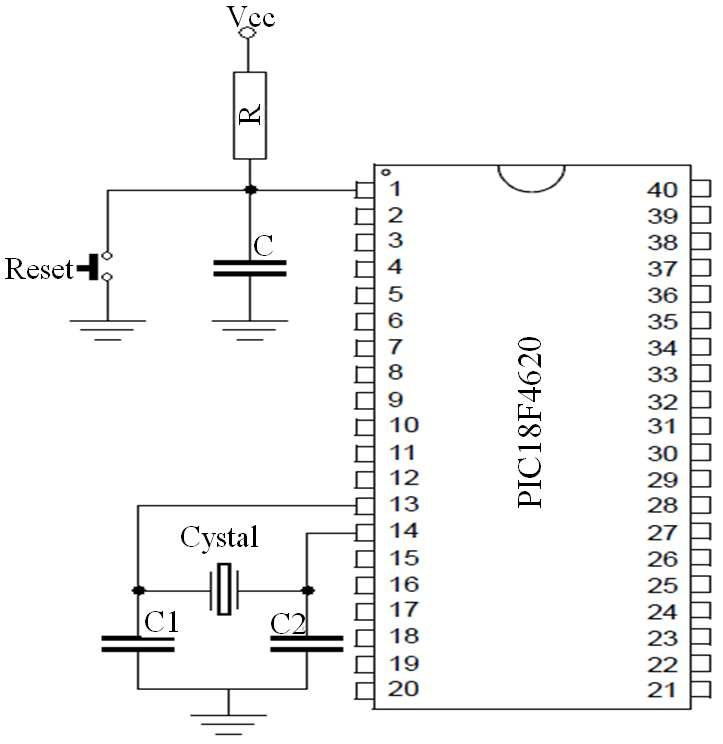
Functional Block Diagram
Equivalent Models of PIC18F4620
• PIC18F4620-I/ML MICROCONTROLLERS AND PROCESSORS
• PIC18LF4620-I/ML MICROCONTROLLERS AND PROCESSORS
• PIC18LF4620T-E/ML MICROCONTROLLERS AND PROCESSORS
• PIC18F4620-E/ML MICROCONTROLLERS AND PROCESSORS
PIC18F4620 Comparable Parts
|
Part Number |
Manufacturer |
Package / Case |
Number of Pins |
Data Bus Width |
Number of I/O |
Interface |
Memory Size |
Supply Voltage |
Peripherals |
View Compare |
|
PIC18F4620-E/P |
Microchip Technology |
40-DIP (0.600, 15.24mm) |
40 |
8 b |
36 |
I2C, SPI, UART, USART |
64 kB |
5 V |
Brown-out Detect/Reset, HLVD, POR, PWM,
WDT |
|
|
PIC18F4680-E/P |
Microchip Technology |
40-DIP (0.600, 15.24mm) |
40 |
8 b |
36 |
CAN, I2C, SPI, UART, USART |
64 kB |
5 V |
Brown-out Detect/Reset, HLVD, POR, PWM,
WDT |
PIC18F4620-E/P VS PIC18F4680-E/P |
|
PIC18F4680-I/P |
Microchip Technology |
40-DIP (0.600, 15.24mm) |
40 |
8 b |
36 |
CAN, I2C, SPI, UART, USART |
64 kB |
5 V |
Brown-out Detect/Reset, HLVD, POR, PWM,
WDT |
PIC18F4620-E/P VS PIC18F4680-I/P |
|
PIC18F4610-I/P |
Microchip Technology |
40-DIP (0.600, 15.24mm) |
40 |
8 b |
36 |
I2C, SPI, UART, USART |
64 kB |
5 V |
Brown-out Detect/Reset, HLVD, POR, PWM,
WDT |
PIC18F4620-E/P VS PIC18F4610-I/P |
Packaging and Dimensions of PIC18F4620

|
PIC18F4620 Dimensions |
Dimension Limits |
MIN (inches) |
NOM (inches) |
MAX (inches) |
|
Number of Pins |
N |
40 | ||
|
Pitch |
e |
0.100 BSC | ||
|
Top to Seating Plane |
A |
0.25 |
||
|
Molded Package Thickness |
A2 |
0.125 |
0.195 |
|
|
Base to Seating Plane |
A1 |
0.015 |
||
|
Shoulder to Shoulder Width |
E |
0.59 |
0.625 |
|
|
Molded Package Width |
E1 |
0.485 |
0.58 |
|
|
Overall Length |
D |
1.98 |
2.095 |
|
|
Tip to Seating Plane |
L |
0.115 |
0.2 |
|
|
Lead Thickness |
c |
0.008 |
0.015 |
|
|
Upper Lead Width |
b1 |
0.03 |
0.07 |
|
|
Lower Lead Width |
b |
0.014 |
0.023 |
|
|
Overall Row Spacing |
eB |
0.7 |
Manufacturer Background
Microchip Technology Inc. excels in microcontroller, mixed-signal, and analog advancements. The firm actively engages in educational outreach, supplying an extensive collection of resources. Among them are organized labs, detailed curricula, specialized training sessions, and advanced development tools.
Datasheet PDF
PIC18LF4620-I/ML Datasheets:
PIC18Fx525, x620 Datasheet.pdf
Label and Packing Changes 23/Sep/2015.pdf
Packing Changes 10/Oct/2016.pdf
PIC18F(2, 4)zzz Programming Specification.pdf
Wire Bond Chg Qual 19/Jul/2016.pdf
PIC18F4620-E/P Datasheets:
PIC18F(2, 4)zzz Programming Specification.pdf
PIC18Fx525, x620 Datasheet.pdf
Label and Packing Changes 23/Sep/2015.pdf
Packing Changes 10/Oct/2016.pdf
Frequently Asked Questions [FAQ]
1. What is PIC18F4620?
The PIC18F4620 is a versatile microcontroller praised for its adaptability in industrial applications. Its architecture, designed to minimize power usage, delivers robust processing capabilities that resonate well in rigorous environments. Others often lean towards this microcontroller given its endurance and the extensive tool support that simplifies the development processes.
2. How do I program pic18f4620?
To program the PIC18F4620, follow these steps:
Open MPLAB, an all-encompassing IDE designed for Microchip products.
Choose the type of project you are working on.
Specify the exact microcontroller model.
Select the appropriate compiler.
Define the project path for organized workflow.
3. What's the size of PIC18f4620?
The PIC18F4620, with dimensions of 2.095 x 0.58 x 0.195 inches, seamlessly fits into tight spaces, required in compact and embedded systems. This size allows for effortless integration into various hardware layouts, aligning with the space-conscious design principles that drive contemporary technology advancements.
About us
ALLELCO LIMITED
Read more
Quick inquiry
Please send an inquiry, we will respond immediately.
Comparing Coin Cell Batteries: CR1616 Versus CR1620
on October 11th
Understanding the BC338 NPN Transistor: Features and Uses
on October 10th
Popular Posts
-

Complex Instruction Set Computers: How They Changed Computing?
on April 18th 147749
-

USB-C Pinout and Features
on April 18th 111901
-
Using Xilinx Unified Simulation Primitives: A Comprehensive Guide to FPGA Design and Simulation
on April 18th 111349
-

Power Supply Voltages in Electronics: Meaning of VCC, VDD, VEE, VSS, and GND
on April 18th 83714
-

RJ45 Connector Guide: Pinout, Wiring, Cable Types, and Uses
on January 1th 79502
-

The Ultimate Guide to Wire Color Codes in Modern Electrical Systems
The way our electrical systems use colors isn’t just for looks. Each wire color now indicates a specific function, making it easier to identify and handle electrical components correctly during ins...on January 1th 66866
-

Quality (Q) Factor: Equations and Applications
The quality factor, or 'Q', is important when checking how well inductors and resonators work in electronic systems that use radio frequencies (RF). 'Q' measures how well a circuit minimizes energy...on January 1th 63004
-
Purge Valve Guide: Function, Symptoms, Testing, and Replacement for Optimal Engine Performance
The purge valve is a key part of a car’s system that helps keep the air clean by managing fuel vapors before they can escape into the atmosphere. This not only helps the environment by reducing pol...on January 1th 62935
-

Achieving Peak Performance with the Maximum Power Transfer Theorem
The Maximum Power Transfer Theorem explains how energy from a source, such as a battery or generator, flows to a connected load. It shows the exact condition where the load receives the most power....on January 1th 54074
-

A23 Battery Specifications and Compatibility
The A23 battery is a small, cylinder-shaped battery with high voltage. Also called 23A, 23AE, or MN21, it runs at 12 volts and much higher than AA or AAA batteries. Its special design make...on January 1th 52087
HOT Part Number
-

XC3S50A-4VQG100C
AMD
IC FPGA 68 I/O 100VQFP
SI1102-A-GM
Silicon Labs
SENSOR OPT REFLECTIVE 50CM 8WDFN
TCN4-13+
Mini-Circuits
1:4 LTCC TRANSFORMER, 650 - 1250
VF30100S-E3/4W
Vishay General Semiconductor - Diodes Division
DIODE SCHOTTKY 100V 30A ITO220AB
GRM033R70J103KA01D
Murata Electronics
CAP CER 10000PF 6.3V X7R 0201
QMK212B7102MDHT
Taiyo Yuden
CAP CER 1000PF 250V X7R 0805
M82351G-12
MACOM Technology Solutions
ACCESS VOICE PROCESSOR
74LV132D,112
Nexperia USA Inc.
IC GATE NAND SCHMIT 4CH 2IN 14SO
AH1801-FJG-7
Diodes Incorporated
MAG SWITCH OMNIPOLAR DFN2020B-3
DG412DY-T1-E3
Vishay Siliconix
IC SWITCH SPST-NOX4 35OHM 16SOIC
PIC16F876A-I/SO
Microchip Technology
IC MCU 8BIT 14KB FLASH 28SOIC
LXA08FP600
Power Integrations
DIODE GP 600V 8A TO220 FULL PACK
FM25V20A-DG
Infineon Technologies
IC FRAM 2MBIT SPI 40MHZ 8DFN
CY7C1011CV33-10ZXC
Cypress Semiconductor Corp
IC SRAM 2MBIT PARALLEL 32TSOP II
04023C221KAT2A
KYOCERA AVX
CAP CER 220PF 25V X7R 0402
RO3101A
Murata Electronics
SAW RES 433.9200MHZ SMD
XRD9818ACGTR
MaxLinear, Inc.
IC AFE 3 CHAN 16BIT 28TSSOP
CL21F104ZBANNNC
Samsung Electro-Mechanics
CAP CER 0.1UF 50V Y5V 0805 -

BZT52-B16_R1_00001
Panjit International Inc.
SOD-123, ZENER
P0300ECL
Littelfuse Inc.
THYRISTOR 25V 400A TO226-2
TPS73615DBVTG4
Texas Instruments
IC REG LINEAR 1.5V 400MA SOT23-5
SN74AXC4T774BQBR
Texas Instruments
IC TRANSCEIVER HALF 4/4 16WQFN
170M5954
Eaton - Bussmann Electrical Division
FUSE SQUARE 350A 1KVAC RECT
CC0805KRX7R9BB682
YAGEO
CAP CER 6800PF 50V X7R 0805
SRP7028A-6R8M
Bourns Inc.
FIXED IND 6.8UH 4.5A 60 MOHM SMD
SMAJ150CA
Taiwan Semiconductor Corporation
TVS DIODE 150VWM 243VC DO214AC
PE-68675
Pulse Electronics
IC CHIP
MAX14890EATJ+
Analog Devices Inc./Maxim Integrated
IC RECEIVER 0/4 32TQFN
TFZGTR20B
Rohm Semiconductor
DIODE ZENER 20V 500MW TUMD2
1N5406-E3/73
Vishay General Semiconductor - Diodes Division
DIODE GEN PURP 600V 3A DO201AD
ME501610
Powerex Inc.
BRIDGE RECT 3P 1.6KV 100A MODULE
GRM1555C2A5R8DA01D
Murata Electronics
CAP CER 5.8PF 100V C0G/NP0 0402
MRF8S19140HSR3
NXP USA Inc.
FET RF 65V 1.96GHZ NI780HS
TN2130K1-G
Microchip Technology
MOSFET N-CH 300V 85MA TO236AB
ADL5519ACPZ-R7
Analog Devices Inc.
IC AMP LOG DETECT CTRLR 32LFCSP
SP3222ECT-L
MaxLinear, Inc.
IC TRANSCEIVER FULL 2/2 18SOIC -
502AT-2
Semitec USA Corp
NTC THERMISTORS 5KOHM 1%
NFM18CC101R1C3D
Murata Electronics
CAP FEEDTHRU 100PF 20% 16V 0603
PS2562L-1-F3-A
Renesas Electronics America Inc
OPTOISOLATOR 5KV DARL 4SMD
502494-0370
Affinity Medical Technologies - a Molex company
2.0 W/B SGL R/ARECASSY3CKTEMBSTP
C1206C223K5RACTU
KEMET
CAP CER 0.022UF 50V X7R 1206
NIS5102QP2HT1G
onsemi
IC HOT SWAP CTRLR GP 12PLLP
VI-J62-MY
Vicor Corporation
DC DC CONVERTER 15V 50W
ADR441ARMZ-REEL7
Analog Devices Inc.
IC VREF SERIES 0.12% 8MSOP
MIC5200-5.0BS
Microchip Technology
IC REG LINEAR 5V 100MA SOT223-3
TAS3251DKQR
Texas Instruments
IC AMP D MONO/STER 350W 56HSSOP
GRM1886T1H360JD01D
Murata Electronics
CAP CER 36PF 50V T2H 0603
TZM5249B-GS08
Vishay General Semiconductor - Diodes Division
DIODE ZENER 19V 500MW SOD80
LM2575-5.0YWM
Microchip Technology
IC REG BUCK 5V 1A 24SOIC
RT0402BRE075K6L
YAGEO
RES SMD 5.6K OHM 0.1% 1/16W 0402
C0603JB1A104M030BC
TDK Corporation
CAP CER 0.1UF 10V JB 0201
CSD17571Q2
Texas Instruments
MOSFET N-CH 30V 22A 6SON
P4SMA13CA
Bourns Inc.
TVS DIODE 11.1VWM 18.2VC DO214AC
AR0144ATSM20XUEA0-DPBR
onsemi
1MP 1/4 CIS SO