Residual Current Circuit Breaker (RCCB): Working Principle, Types, Wiring, and Comparison
In this article, you will learn what an RCCB is, how it works, and the main parts inside it that make protection possible. You will also understand its ratings, different types, basic wiring ideas, and how it compares with other breakers. Practical uses in houses, commercial spaces, factories, and moisture-prone areas are also covered so you can clearly see its importance.Catalog
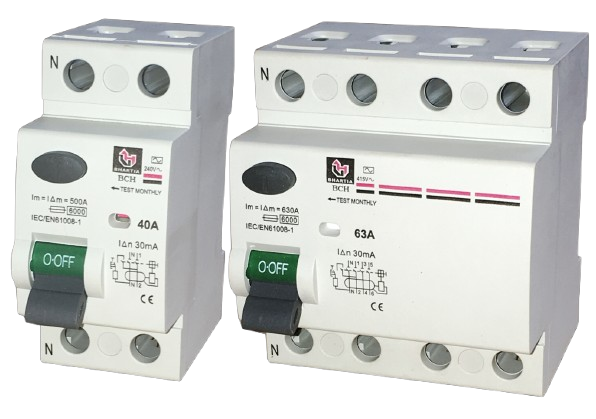
Figure 1. Residual Current Circuit Breaker (RCCB)
What is a Residual Current Circuit Breaker?
A Residual Current Circuit Breaker (RCCB) is an electrical safety device used to protect you from electric shock and prevent fire caused by leakage current. It constantly checks the current flowing through the live and neutral wires and shuts off the power when an unsafe difference is detected. The term residual current means the small amount of electric current that escapes from the normal circuit path due to insulation faults or accidental contact. An RCCB is commonly installed in homes, offices, and industrial panels to improve electrical safety. Its main purpose is fast disconnection of power before harm or damage occurs.
Working Principle of an RCCB
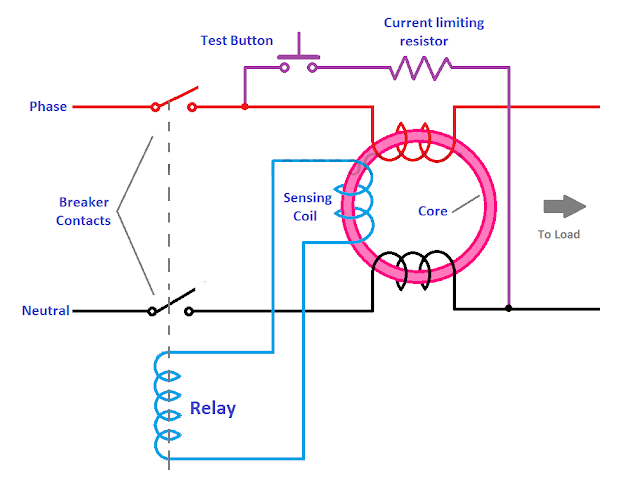
Figure 2. Working Principle of RCCB
An RCCB works by monitoring the balance of current between the phase and neutral conductors. Under normal conditions, the current entering through the phase wire is equal to the current returning through the neutral wire. If a person touches a live part or a leakage path appears, some current flows to the ground, creating an imbalance. The sensing mechanism inside the RCCB immediately detects this difference and activates the tripping system. Once the imbalance exceeds the set sensitivity level, the breaker disconnects the circuit within milliseconds. This quick response reduces the risk of electric shock and electrical fires.
Construction of an RCCB
An RCCB is built with several internal components that work together to detect leakage and interrupt power safely. These parts are compactly arranged inside a molded insulating enclosure for durability and protection.
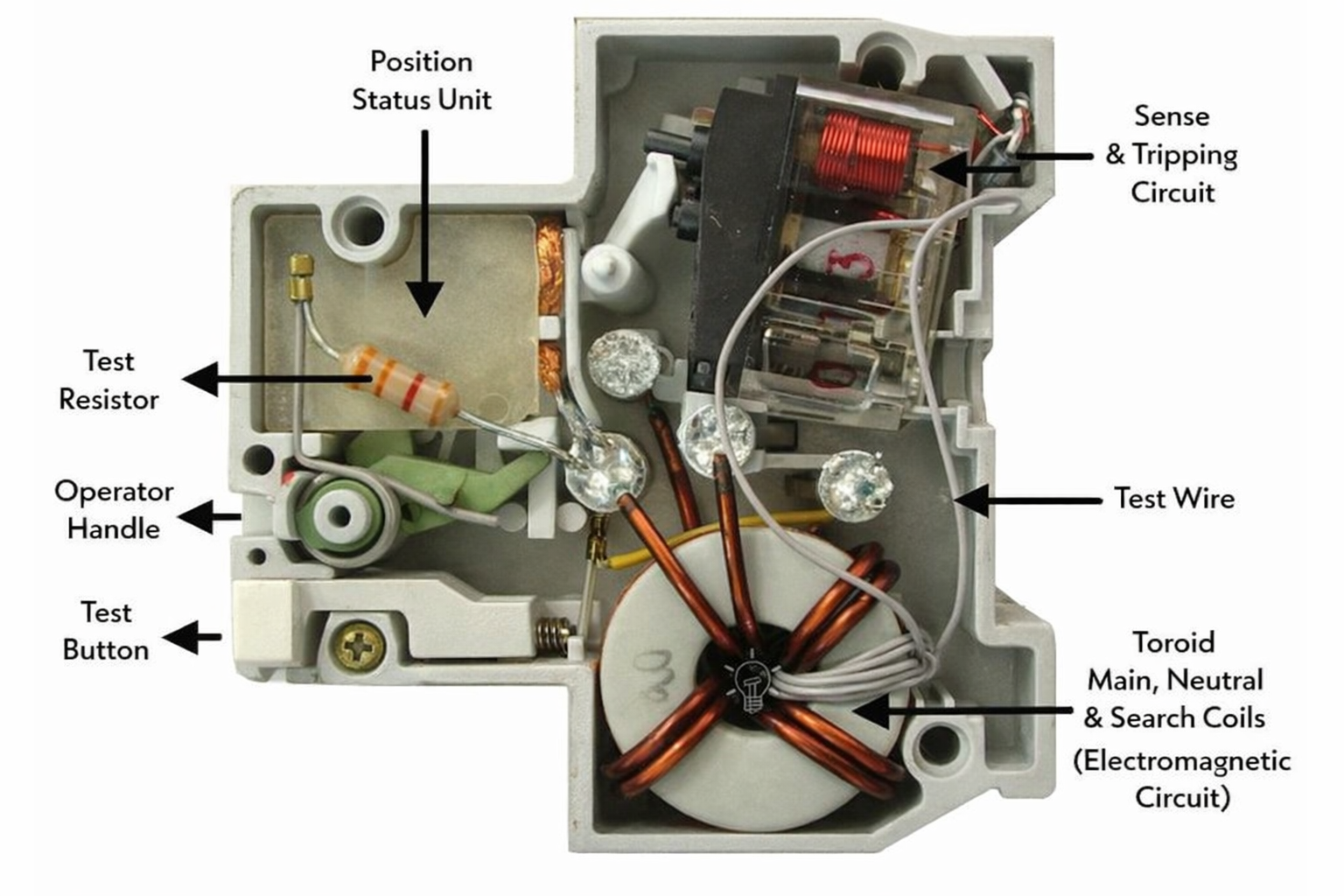
Figure 3. Internal Construction of RCCB
• Core (Toroidal Core)
The core is a circular magnetic ring made of high-permeability material. It acts as the main sensing medium where phase and neutral conductors pass through. This core helps detect magnetic imbalance when leakage current occurs.
• Sensing Coil
The sensing coil is wound around the toroidal core and is responsible for detecting changes in magnetic flux. When an imbalance appears, it generates a small electrical signal. This signal is then used to trigger the tripping mechanism.
• Relay / Tripping Mechanism
The relay receives the signal from the sensing coil and mechanically opens the circuit contacts. It is designed for fast response to ensure immediate disconnection. This component prevents prolonged exposure to dangerous current leakage.
• Test Button
The test button is a manual safety feature located on the front panel. Pressing it creates a small artificial leakage current to check if the RCCB trips correctly. It helps verify that the protection system is functioning properly.
• Operator Handle
The operator handle allows manual switching of the RCCB ON or OFF. It also resets the breaker after a trip event. This handle provides control and visible status indication.
RCCB Ratings and Specifications
|
Parameter |
Specifications |
|
Rated Current (In) |
16 A, 25 A, 40 A, 63 A |
|
Sensitivity / Rated Residual Current (IΔn) |
10 mA, 30 mA, 100 mA, 300 mA |
|
Rated Voltage |
230 V / 240 V (Single-Phase), 400 V / 415 V (Three-Phase) |
|
Frequency |
50 Hz / 60 Hz |
|
Number of Poles |
2 Pole, 4 Pole |
|
Breaking Capacity |
6 kA – 10 kA |
|
Operating Time |
≤ 30 ms |
|
Insulation Voltage (Ui) |
500 V |
|
Impulse Withstand Voltage |
4 kV |
|
Mechanical Life |
10,000 operations |
|
Electrical Life |
5,000 operations |
|
Protection Degree |
IP20 / IP40 |
|
Mounting Type |
DIN Rail |
|
Standard Compliance |
IEC 61008-1 |
|
Ambient Operating Temperature |
−5°C to +40°C |
Types of Residual Current Circuit Breakers
Type AC RCCB
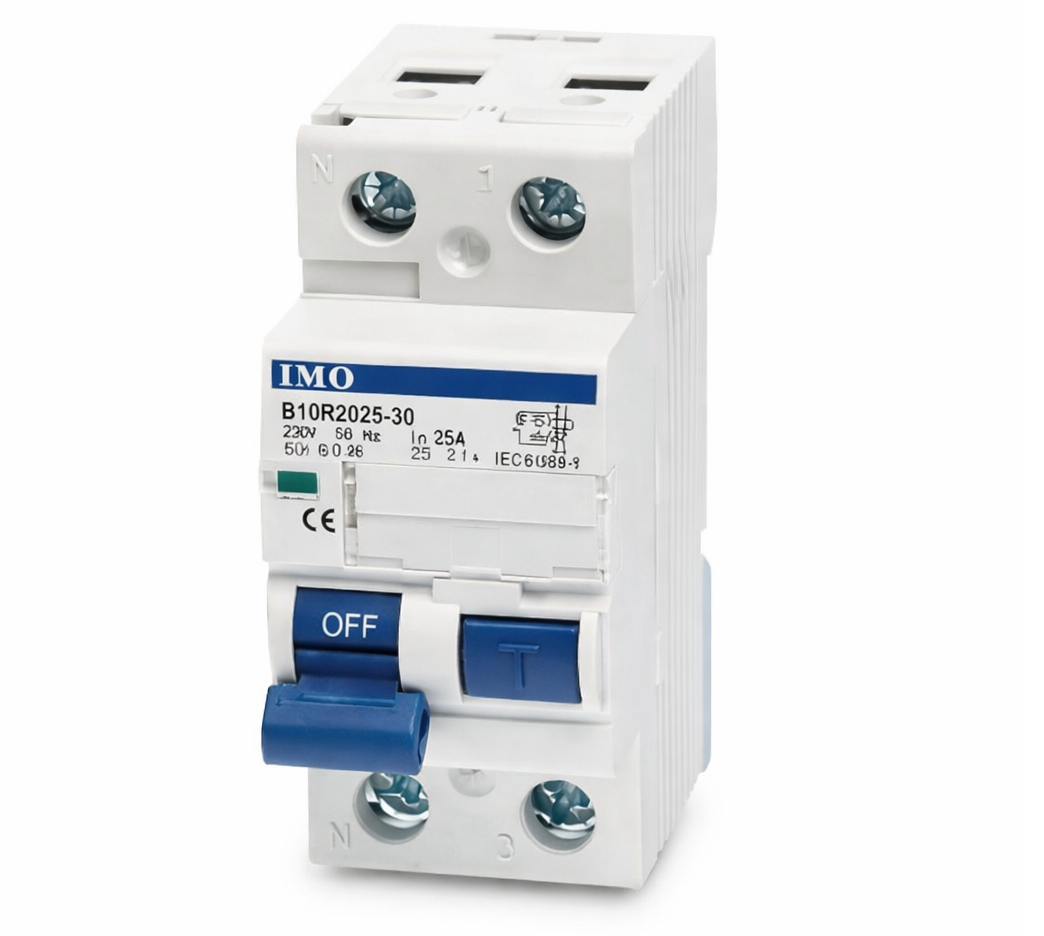
Figure 4. Type AC RCCB
A Type AC RCCB is a protection device designed to detect only pure alternating current (AC) leakage. It operates when a sinusoidal AC fault current flows to the ground due to insulation failure or accidental contact. In the figure, the device is shown connected to standard residential loads where only basic AC appliances are used. This type is commonly installed in lighting circuits, fans, and simple household wiring systems. It reacts quickly to sudden AC leakage and disconnects the supply within milliseconds. Type AC RCCBs are suitable for environments where no electronic converters or DC-producing equipment are present. Because of its focused detection ability, it provides cost-effective and dependable safety for basic electrical installations.
Type A RCCB
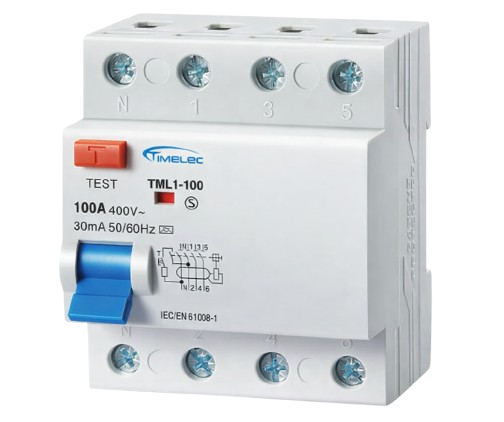
Figure 5. Type A RCCB
A Type A RCCB is a safety breaker that can detect both pure AC leakage and pulsating direct current (DC) leakage. It is designed for circuits that include electronic devices which may generate small DC components. In the figure, the RCCB is connected to mixed household and office loads such as washing machines, computers, and LED lighting systems. This type improves protection where modern electronics are involved because it senses irregular current waveforms. Type A RCCBs respond quickly to leakage faults without being affected by minor electrical noise. They are widely used in residential and commercial panels where variable-speed drives or switching power supplies exist. Its broader detection capability makes it more versatile than AC-only models in modern electrical systems.
Type B RCCB
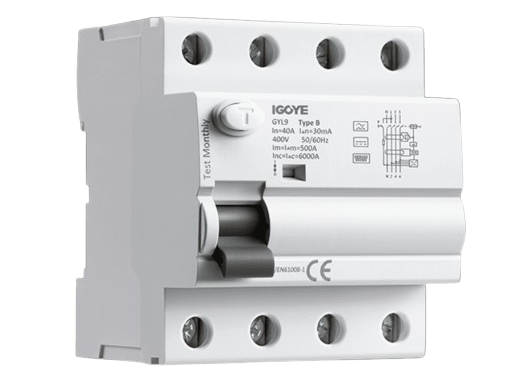
Figure 6. Type B RCCB
A Type B RCCB is an advanced residual current device capable of detecting AC, pulsating DC, smooth DC, and high-frequency leakage currents. It is engineered for complex electrical systems that involve inverters, variable frequency drives, and electric vehicle charging stations. In the figure, the RCCB is shown in a multi-phase configuration connected to industrial and high-tech equipment. This type maintains reliable tripping even when leakage currents are non-linear or continuous. Type B RCCBs are commonly used in solar power systems, medical facilities, and EV infrastructure. They provide high-level safety in applications where electronic converters and DC components are significant. Because of its wide detection range, it is considered the most comprehensive RCCB classification for advanced installations.
RCCB Wiring and Installation Diagram
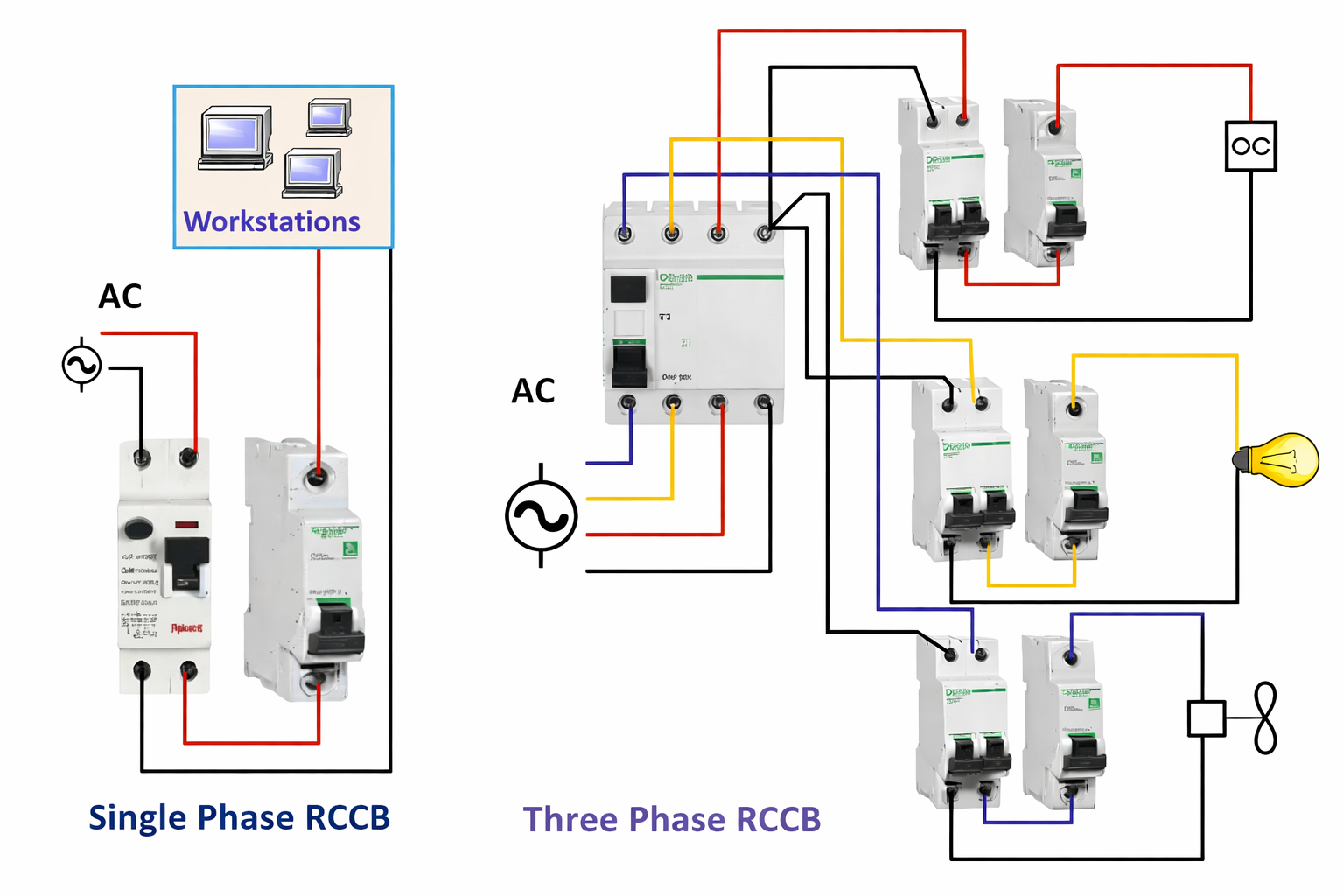
Figure 7. RCCB Wiring and Installation Diagram
RCCB wiring diagrams illustrate how the device is connected externally to ensure safe operation. The figure shows both single-phase and three-phase RCCB connections, where phase and neutral conductors pass through the device terminals before reaching the load. Correct terminal orientation is important because reversing live and neutral can cause improper tripping behavior.
In single-phase systems, two poles are used, while three-phase systems typically require four poles including neutral. The diagram also highlights the distribution of circuits to different loads after the RCCB. Proper wiring ensures accurate leakage detection and prevents false trips. These installation diagrams serve as a visual guide for safe and standardized electrical panel setup.
RCCB vs MCB vs ELCB
These devices are often compared because they are all circuit protection tools found in electrical panels. However, they protect against different types of electrical faults.
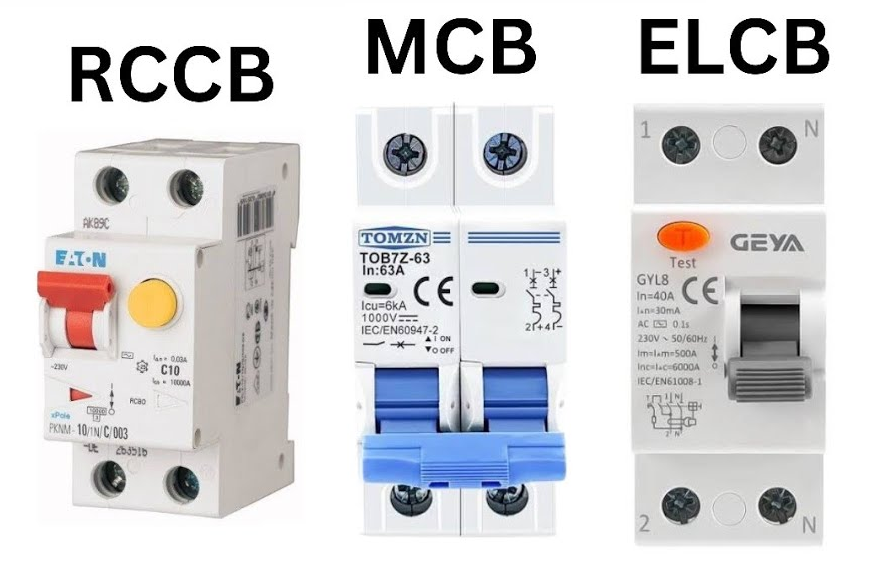
Figure 8. RCCB vs MCB vs ELCB
|
Parameter |
RCCB |
MCB |
ELCB |
|
Main Function |
Trips on leakage current typically 10–300 mA |
Trips on overcurrent typically 6–63 A |
Trips on earth voltage typically 40–60 V |
|
Electric Shock Protection Threshold |
Common personal protection level 30 mA |
No defined shock trip threshold |
Typical shock trip range 50 mA – 300 mA |
|
Overload Trip Range |
Not rated for overload current |
Thermal trip approx. 1.13–1.45 × In |
Not rated for overload current |
|
Short-Circuit Trip Range |
No magnetic short-circuit trip |
Magnetic trip approx. 5–10 × In |
No magnetic short-circuit trip |
|
Fault Detection Type |
Current imbalance between phase and neutral |
Excess line current above rated value |
Voltage rise between earth and neutral |
|
Operating Voltage |
230 V / 400 V AC |
230 V / 400 V AC |
230 V AC |
|
Typical Sensitivity Levels |
10 mA, 30 mA, 100 mA, 300 mA |
Not expressed in mA |
30 mA – 300 mA |
|
Response Time |
≤ 30 ms at 30 mA |
100–500 ms depending on fault |
100–300 ms typical |
|
Rated Current Range |
16 A – 100 A |
1 A – 125 A |
16 A – 63 A |
|
Frequency |
50 / 60 Hz |
50 / 60 Hz |
50 / 60 Hz |
|
Wiring Conductors Required |
Phase + Neutral |
Phase only (neutral optional in DP) |
Phase + Earth |
|
Standard Reference |
IEC 61008-1 |
IEC 60898-1 |
IEC 61008 / older IEC 1008 |
|
Mechanical Life |
10,000 operations typical |
20,000 operations typical |
8,000–10,000 operations |
|
Breaking Capacity |
6 kA – 10 kA |
4.5 kA – 10 kA |
3 kA – 6 kA |
|
Common Installation Point |
Main distribution board |
Branch circuit line |
Legacy earth-fault panels |
RCCB vs RCBO
This section compares RCCB and RCBO because both are modern safety breakers, but they provide different levels of protection.
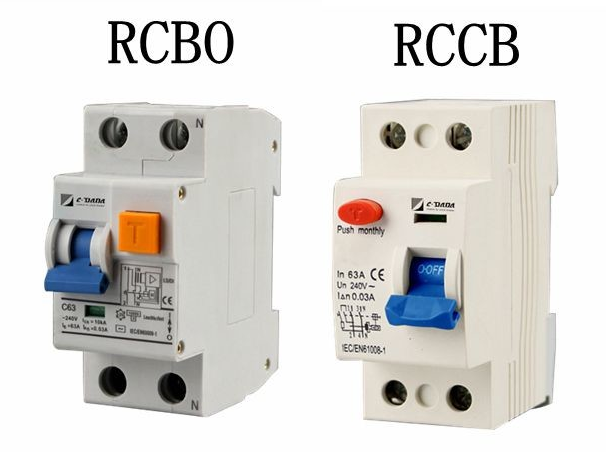
Figure 9. RCCB vs RCBO
|
Features |
RCCB |
RCBO |
|
Full Name |
Residual Current Circuit Breaker |
Residual Current Breaker with Overcurrent |
|
Leakage Trip Sensitivity |
10 mA, 30 mA, 100 mA, 300 mA |
10 mA, 30 mA, 100 mA, 300 mA |
|
Overload Trip Range |
Not rated for overload current |
Thermal trip approx. 1.13–1.45 × In |
|
Short-Circuit Trip Range |
No magnetic short-circuit element |
Magnetic trip approx. 5–10 × In |
|
Rated Current Range |
16 A – 100 A |
6 A – 63 A |
|
Operating Voltage |
230 V / 400 V AC |
230 V / 400 V AC |
|
Frequency |
50 / 60 Hz |
50 / 60 Hz |
|
Number of Poles |
2P, 4P |
1P+N, 2P |
|
Typical Module Width (DIN) |
36–72 mm |
18–36 mm |
|
Response Time (Leakage) |
≤ 30 ms at 30 mA |
≤ 30 ms at 30 mA |
|
Breaking Capacity |
6 kA – 10 kA |
4.5 kA – 10 kA |
|
Standard Reference |
IEC 61008-1 |
IEC 61009-1 |
|
Mechanical Life |
10,000 operations typical |
10,000–20,000 operations typical |
|
Typical Installation Point |
Main distribution board |
Final branch circuit |
|
Protection Coverage |
Earth leakage faults only |
Leakage + overload + short circuit |
Applications of Residual Current Circuit Breakers
1. Residential Homes
RCCBs are installed in household distribution boards to reduce the risk of electric shock from damaged wiring or faulty appliances. They monitor leakage in lighting and socket circuits used every day. This adds an extra safety layer for regular home electrical use.
2. Commercial Buildings
Commercial spaces such as offices, malls, and public facilities use RCCBs to improve electrical safety for occupants. They reduce the risk of electrical accidents in high-traffic areas. Their fast tripping ability supports compliance with safety standards.
3. Industrial Facilities
Industrial plants and workshops apply RCCBs to manage leakage risks around machinery and motor-driven equipment. They help maintain safer working conditions where electrical loads are high. This contributes to more stable and secure system operation.
4. Wet and Outdoor Areas
Locations exposed to moisture, including bathrooms, kitchens, pools, and outdoor installations, commonly use RCCBs due to higher leakage probability. These environments are more prone to insulation failure and accidental contact. RCCBs provide additional electrical protection in such conditions.
Conclusion
RCCBs help keep you safe by constantly checking the current flow and cutting off power when leakage appears. Their internal components, proper ratings, and types like AC, A, and B allow you to match the right device to your electrical system. Knowing correct wiring and the differences between RCCB, MCB, ELCB, and RCBO helps you choose better protection. Because they react quickly and work in many environments, RCCBs remain an essential part of everyday electrical safety.
About us
ALLELCO LIMITED
Read more
Quick inquiry
Please send an inquiry, we will respond immediately.
Frequently Asked Questions [FAQ]
1. Can an RCCB protect against short circuits or overloads?
No. An RCCB only detects leakage current. You still need an MCB or fuse in the circuit to protect against overloads and short circuits.
2. Is it safe to reset an RCCB after it trips?
Yes, but only after checking the cause. If it trips again immediately, there is likely a real leakage fault that needs inspection before reuse.
3. Can I install an RCCB without a ground wire?
It can still detect imbalance without a ground wire, but proper grounding improves overall electrical safety and reduces shock risk.
4. Can one RCCB protect the entire house?
Yes, but using multiple RCCBs for different circuits gives better fault isolation. This prevents the whole house from losing power due to a single leakage issue.
5. How often should I test my RCCB using the test button?
You should press the test button about once a month. This confirms the tripping mechanism still works and ensures the device has not become stuck or faulty.
Motor Starting Capacitors Explained for Single-Phase Motors
on January 30th
Half Wave Rectifier: Working Principle, Circuit, Waveforms, Formula, and Applications
on January 28th
Popular Posts
-

Complex Instruction Set Computers: How They Changed Computing?
on April 18th 147768
-

USB-C Pinout and Features
on April 18th 111996
-
Using Xilinx Unified Simulation Primitives: A Comprehensive Guide to FPGA Design and Simulation
on April 18th 111351
-

Power Supply Voltages in Electronics: Meaning of VCC, VDD, VEE, VSS, and GND
on April 18th 83758
-

RJ45 Connector Guide: Pinout, Wiring, Cable Types, and Uses
on January 1th 79555
-

The Ultimate Guide to Wire Color Codes in Modern Electrical Systems
The way our electrical systems use colors isn’t just for looks. Each wire color now indicates a specific function, making it easier to identify and handle electrical components correctly during ins...on January 1th 66955
-
Purge Valve Guide: Function, Symptoms, Testing, and Replacement for Optimal Engine Performance
The purge valve is a key part of a car’s system that helps keep the air clean by managing fuel vapors before they can escape into the atmosphere. This not only helps the environment by reducing pol...on January 1th 63098
-

Quality (Q) Factor: Equations and Applications
The quality factor, or 'Q', is important when checking how well inductors and resonators work in electronic systems that use radio frequencies (RF). 'Q' measures how well a circuit minimizes energy...on January 1th 63029
-

Achieving Peak Performance with the Maximum Power Transfer Theorem
The Maximum Power Transfer Theorem explains how energy from a source, such as a battery or generator, flows to a connected load. It shows the exact condition where the load receives the most power....on January 1th 54095
-

A23 Battery Specifications and Compatibility
The A23 battery is a small, cylinder-shaped battery with high voltage. Also called 23A, 23AE, or MN21, it runs at 12 volts and much higher than AA or AAA batteries. Its special design make...on January 1th 52176
HOT Part Number
-
PCM1807PWR
Texas Instruments
IC ADC/AUDIO 24BIT 96K 14TSSOP
FDS6630A
onsemi
MOSFET N-CH 30V 6.5A 8SOIC
THCV214
THine Solutions, Inc.
IC DESERIALIZER LVDS 48TQFP
MBR1545CT
Vishay General Semiconductor - Diodes Division
DIODE ARRAY SCHOTTKY 45V TO220AB
SMA6J7.0A
Littelfuse Inc.
TVS DIODE 7VWM 12VC DO214AC TR
LD39100PU33R
STMicroelectronics
IC REG LINEAR 3.3V 1A 6DFN
KA5M0965QYDTU
onsemi
IC OFFLINE SW MULT TOP TO3P-5L
XC2S150-6PQ208C
AMD
IC FPGA 140 I/O 208QFP
1825WC562MAT1A
KYOCERA AVX
CAP CER 5600PF 2.5KV X7R 1825
MPC8572EVTAVNE
Freescale Semiconductor
POWERQUICC RISC MICROPROCESSOR
STF12NM60N
STMicroelectronics
MOSFET N-CH 600V 10A TO220FP
TLV2773IDGS
Texas Instruments
IC CMOS 2 CIRCUIT 10VSSOP
FDB3502
onsemi
MOSFET N-CH 75V 6A/14A TO263AB
FJY3004R
Fairchild Semiconductor
0.1A, 50V, NPN
MAX20078AUE+
Analog Devices Inc./Maxim Integrated
IC LED DRV CTRL PWM 10MA 16TSSOP
TPD6S300RUKR
Texas Instruments
SURGE SUPP 8VC 2-CIRCUIT 20WQFN
BAT54WS
SMC Diode Solutions
DIODE SCHOTTKY 30V 100MA SOD323
MCP6L02T-E/MS
Microchip Technology
IC OPAMP GP 2 CIRCUIT 8MSOP -

TK40A06N1,S4X
Toshiba Semiconductor and Storage
MOSFET N-CH 60V 40A TO220SIS
ADM6319C29ARJZ-RL7
Analog Devices Inc.
IC SUPERVISOR MANUAL RST SOT23-5
ADSP-2185NBSTZ-320
Analog Devices Inc.
IC DSP CONTROLLER 16BIT 100LQFP
EC4H07C-TL
onsemi
BIP NPN 30MA 4V FT=10G
JAN1N4549RB
Microchip Technology
ZENER DIODE
SA115C563JAR
AVX Corporation
CAP CER 0.056UF 50V X7R AXIAL
VE-251-EU
Vicor Corporation
DC DC CONVERTER 12V 200W
AONS66920
Alpha & Omega Semiconductor Inc.
MOSFET N-CH 100V 17.5A/48A 8DFN
CDCLVD1208RHDT
Texas Instruments
IC CLK BUFFER 2:8 800MHZ 28VQFN
AT49SV163DT-80CU
Microchip Technology
IC FLASH 16MBIT PARALLEL 48CBGA
XC9235D08CER-G
Torex Semiconductor Ltd
IC REG STEPDOWN DCDC 600MA SYNCH
S-24CS02AFJ-TB-G
ABLIC Inc.
IC EEPROM 2KBIT I2C 400KHZ 8SOP
SZMMSZ2V4T1G
onsemi
DIODE ZENER 2.4V 500MW SOD123
HTSW-104-08-L-S-RA
Samtec Inc.
CONN HEADER R/A 4POS 2.54MM
SIHG32N50D-GE3
Vishay Siliconix
MOSFET N-CH 500V 30A TO247AC
MC100LVEP16DR2
onsemi
IC RECEIVER/DRVR DIFF ECL 8-SOIC
C1608X5R1A105M080AC
TDK Corporation
CAP CER 1UF 10V X5R 0603
P6KE62C
Littelfuse Inc.
TVS DIODE 53VWM 89.25VC DO204AC -

BCM11125IFEBG
Broadcom Limited
MAP/AP-ONLY
STPS41L60CG-TR
STMicroelectronics
DIODE ARRAY SCHOTTKY 60V D2PAK
STW28N60DM2
STMicroelectronics
MOSFET N-CH 600V 21A TO247
G-MRCO-001
TE Connectivity Measurement Specialties
SENSOR MR ANALOG SOT223
LTC6102CMS8#PBF
Analog Devices Inc.
IC CURRENT SENSE 1 CIRCUIT 8MSOP
DF30FB-30DP-0.4V(81)
Hirose Electric Co Ltd
CONN HDR 30POS SMD GOLD
GRM0225C1C6R0BD05L
Murata Electronics
CAP CER 6PF 16V C0G/NP0 01005
AT91SAM7X128-AU
Microchip Technology
IC MCU 16/32B 128KB FLSH 100LQFP
GRM0337U1H110GD01D
Murata Electronics
CAP CER 11PF 50V U2J 0201
LT1638IMS8#PBF
Analog Devices Inc.
IC OPAMP GP 2 CIRCUIT 8MSOP
FEMTOSMDC010F-2
Littelfuse Inc.
PTC RESET FUSE 12V 100MA 0603
TMPM3HQFDFG
Toshiba Semiconductor and Storage
TXZ FAMILY MCU
AP2162AFGEG-7
Diodes Incorporated
IC PWR SWITCH P-CHAN 1:2 8UDFN
GRM1555C1H7R1CA01D
Murata Electronics
CAP CER 7.1PF 50V C0G/NP0 0402
MMSZ4695T1G
onsemi
DIODE ZENER 8.7V 500MW SOD123
HCPL2630SM
onsemi
OPTOISO 5KV 2CH OPEN COLL 8SMD
MC33201VDR2G
onsemi
IC OPAMP GP 1 CIRCUIT 8SOIC
4816P-T01-100LF
Bourns Inc.
RES ARRAY 8 RES 10 OHM 16SOIC