Understanding the BMI270 Motion Sensor
In the fast-evolving world of wearable technology, the BMI270 Inertial Measurement Unit (IMU) stands out as a low-power, high-precision sensor, perfectly tailored for modern applications. This article explores its detailed pin configuration, versatile applications, and standout technical specifications found in the datasheet. We'll explore how the BMI270 supports advanced motion tracking across fitness wearables, medical devices, and immersive technologies like AR/VR. In addition, comparisons with similar sensors reveal the BMI270's unique benefits, emphasizing its role in extending battery life, enhancing your experience, and fostering innovative interactions with technology.Catalog

Pin Configuration

|
Pin No. |
Description |
|
1 |
SDO, Serial data output in SPI 4W |
|
2 |
ASDx, Aux interface / OIS interface |
|
3 |
ASCx, Aux interface / OIS interface |
|
4 |
INT1, Interrupt Pin 1 |
|
5 |
VDDIo, Digital Vo supply voltage (1.2 .. 3.6V) |
|
6 |
GNDio, Ground for V0 |
|
7 |
GND, Ground for digital and analogue |
|
8 |
VDD, Power supply analog and digital (1.71 .. 3.6V) |
|
9 |
INT2, Interrupt Pin 2 |
|
10 |
OCSB, OIS interface |
|
11 |
OSDO, OIS interface |
|
12 |
CSB, Chip select for SPI mode |
|
13 |
SCx, SP/4C serial clock (SCK/SCL) |
|
14 |
SDx, Serial data Vo |
BMI270 CAD Design
Symbol

Footprint

3D Visualization

BMI270 Overview
The BMI270 is meticulously crafted for wearable devices prioritizing low power consumption while boasting extraordinary motion detection through its ensemble of integrated sensors. This intricate device merges a triaxial gyroscope with a 16-bit accelerometer in its tightly-knit structure, striking a balance between efficient space usage and full-fledged functionality.
The ability of the BMI270 to minimize energy use while providing precise motion analysis represents a notable technological leap. In the world of wearable tech, where power efficiency shapes your experience, such advancements can significantly affect your contentment. For tech aficionados who value convenience, extended battery longevity lessens the hassle of regular charging.
The consolidation of the triaxial gyroscope and accelerometer into one unit optimizes both the precision of data and the diminutive design of the device. Experiences across the technology sector suggest that the seamless incorporation of parts is key in maintaining a device's performance while simplifying its build and reducing its size. This strategy not only benefits you by lowering development expenses but also accommodates a diverse array of uses, from tracking fitness activities to enabling gesture control functionalities.
Characteristics of the BMI270 Sensor
|
Feature |
Description |
|
Package |
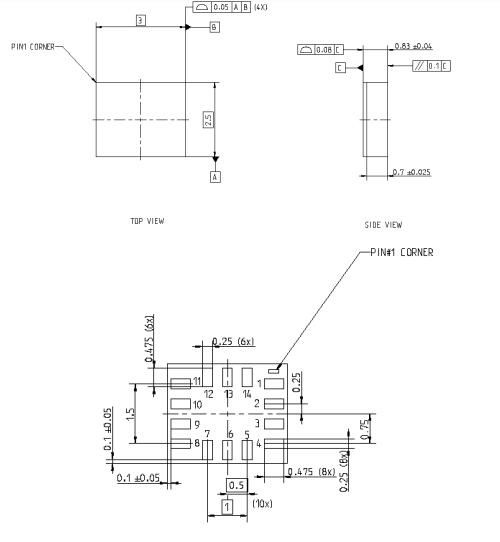
Compact standard size LGA mold package, 14 pins,
footprint 2.5x3.0mm², height 0.83mm |
|
Digital Interface |
Primary digital interface with 10 MHz SPI (4-wire,
3-wire) and up to 1 MHz I²C (Fm+) |
|
Output Data Rates (ODR) |
25 Hz - 6.4 kHz (gyroscope), 0.78 Hz - 1.6 kHz
(accelerometer) |
|
Low-pass Filter |
Programmable low-pass filter with bandwidth ~513-680 Hz
(accelerometer), ~890 Hz (gyroscope) |
|
Power Supply |
Analog VDD: 1.71V - 3.6V; independent VDDIO: 1.2V - 3.6V |
|
Power Consumption |
Ultra-low current consumption, typical 685 μA (in full
ODR and aliasing-free operation) |
|
Gyroscope Performance Mode |
Low noise level, typical < 8 mdps/√Hz |
|
Power Management Unit (PMU) |
Built-in PMU for advanced power management and low power
modes |
|
Startup Time |
2 ms for gyroscope (fast start mode), 2 ms for
accelerometer |
|
Secondary Interface |
Freely configurable; 400 kHz I²C (Fm) master interface
hub for one AUX sensor (e.g., magnetometer, pressure) |
|
High-speed SPI |
10 MHz SPI (4-wire, 3-wire) for high-speed applications;
up to 6.4 kHz ODR with max 676 μs group delay |
|
On-chip FIFO Buffer |
2 KB FIFO buffer for accelerometer, gyroscope,
timestamps, and AUX sensor data |
|
Offset Compensation |
Fast offset error compensation for accelerometer and
gyroscope |
|
Sensitivity Compensation |
Fast sensitivity error compensation for gyroscope (CRT,
max sensitivity error < 1%) |
|
Synchronization |
HW synchronization of accelerometer, gyroscope, and AUX
sensor (< 1 μs) |
|
Timestamps |
Sensor timestamps for accurate system and sensor time
synchronization (< 40 μs) |
|
Programmable I/O Pins |
2 independent programmable Vo pins for interrupt and
synchronization events |
|
Compliance |
RoHS compliant, halogen and lead-free |
Applications of BMI270
The BMI270 sensor finds its place in various cutting-edge technologies owing to its small size and accuracy. Its integration caters to industries focused on elevating your engagement and experiences.
Wearable Technology
For wearable devices, the BMI270 shines with its motion-sensing prowess. This component delivers accurate data useful for tracking fitness, monitoring health, and recognizing activities. You can often find that such seamless sensor integrations enrich daily activities and inspire a healthier lifestyle. The sensor's efficiency in managing power consumption extends the battery life of these devices, making them more portable and accessible.
Audio Accessories
In the world of audio accessories, the sensor's ability to process acceleration data enhances features like noise cancellation and audio adjustments. This adaptive technology responds to your movements and environmental changes, offering a richer and more intuitive auditory experience that effortlessly fits into one's daily rhythm.
Innovative Textiles
The field of innovative textiles has been revolutionized with the BMI270 sensor. Smart garments equipped with this sensor offer activity analysis, assisting in body posture correction. As the demand for versatile clothing rises, integrating these sensors provides insights into your behavior and ergonomics, fostering more individualized solutions in wellness and fitness.
AR/VR Technology
Within augmented and virtual reality, the BMI270 is basic for enabling swift and precise motion tracking. It permits you to dive into the digital world with enhanced control and interaction. By minimizing motion sickness, the sensor boosts comfort and engagement, with insights from AR/VR deployments enhancing these trailblazing experiences to better align with your desires and needs.
Block Diagram

Integrating the BMI270 Sensor into Modern Systems
The BMI270 sensor excels in its application to contemporary wearable and hearable technology. With adept support for both I2C and SPI interfaces, it opens doors to applications like gesture recognition and activity/context detection, fostering a seamless experience with technology and an enhanced awareness of their surroundings.
Gesture recognition facilitated by the BMI270 allows for a sophisticated yet natural interaction between you and your technological devices. By correctly interpreting your gestures, the sensor redefines the functionality of your interfaces. In the world of wearable technology, gestures often stand in for conventional button controls. This makes it possible for you to manage devices discreetly and effectively, a mostly advantageous feature when physical interaction is less feasible. Continual improvements in gesture recognition algorithms contribute to a more adaptable and responsive system that aligns with diverse preferences and requirements.
Fitness trackers commonly feature gesture recognition, allowing you to switch exercise modes or initiate workout sessions with a mere flick of the wrist. This gesture-controlled functionality is mirrored in smart earbuds, where you enjoy the convenience of altering songs or adjusting volume levels without the need to physically interact with their devices. The advancement of such gesture technology highlights its capacity to elevate your satisfaction and deepen engagement across various applications.
Technical Specifications
|
Type |
Parameter |
|
Factory Lead Time |
14 Weeks |
|
Mounting Type |
Surface Mount |
|
Package / Case |
14-VFLGA |
|
Operating Temperature |
-40°C ~ 85°C |
|
Packaging |
Tape & Reel (TR) |
|
Part Status |
Active |
|
Moisture Sensitivity Level (MSL) |
1 (Unlimited) |
|
Output Type |
I2C, SPI |
|
Sensor Type |
Accelerometer, Gyroscope, 6 Axis |
|
RoHS Status |
ROHS3 Compliant |
Package
Manufacturer Profile
Bosch Sensortec GmbH, operating under the Robert Bosch GmbH umbrella, stands out for its expertise in MEMS (Micro-Electro-Mechanical Systems) technology. This firm's primary mission is to craft advanced sensor solutions that elevate how different devices engage with their environments. The technology developed here finds its way into numerous consumer electronics and the ever-growing domain of IoT (Internet of Things) devices. The profound influence of these sensors is evident in their enhancement of the accuracy and functionality of innovations like wearable technology, smart home devices, and various industrial applications.
Through relentless innovation and notable investment in research and development, Bosch Sensortec GmbH has designed sensors characterized by heightened precision, efficiency, and reliability. Their MEMS-based innovations serve diverse areas, including motion sensing, environmental monitoring, and energy management. For example, the sensors play a serious role in upgrading mobile device capabilities, such as orientation detection, gesture recognition, and adaptation to environmental changes. This progress not only enriches your experiences but also establishes new industry standards for state-of-the-art sensor technology.
Datasheet PDF
BMI270 Datasheets:
About us
ALLELCO LIMITED
Read more
Quick inquiry
Please send an inquiry, we will respond immediately.
Frequently Asked Questions [FAQ]
1. How does BMI270 combine its motion-triggered features?
BMI270 integrates motion-triggered features by combining precise acceleration and angular rate measurements. This integration supports enhanced motion detection and tracking capabilities used in various consumer electronic applications. By leveraging these advanced measurements, devices can achieve superior performance in tracking physical movement and orientation. This enables a broad spectrum of functionalities, ranging from immersive gaming experiences to meticulous fitness tracking.
2. Who is the manufacturer of BMI270?
The BMI270 is crafted by Bosch Sensortec, a company acclaimed for its high-quality sensors utilized across diverse industries. Bosch's deep-rooted expertise in sensor technology ensures that the BMI270 meets the rigorous benchmarks of modern electronic devices, consistently delivering dependable performance.
3. What are the enhancements featured in BMI270?
BMI270 features several enhancements improved accelerometer, engineered for higher accuracy under dynamic conditions. This enhancement proves mostly advantageous in scenarios necessitating precise motion sensing, such as virtual reality or autonomous navigation, where even minor inaccuracies could disrupt your experience.
4. In what ways does BMI270 elevate performance?
The performance of the BMI270 is elevated through comprehensive improvements in the accelerometer's functionality. These enhancements include noise reduction and minimization of measurement errors, enabling devices equipped with BMI270 to operate more effectively under various conditions. In industries where precision is dominant, such as medical or aerospace technology, these upgrades present substantial benefits.
5. What are the notable enhancements in BMI270?
BMI270 achieves noteworthy enhancements by reducing the zero-g offset and decreasing the sensitivity error. The reduction in zero-g offset bolsters the sensor’s accuracy during stationary periods, while the lowered sensitivity error assures more reliable operation across diverse environmental conditions. These dual improvements make BMI270 a compelling option for you prioritizing precision and reliability in sensor solutions.

TCMT4100 Transistor Output Optocouplers: Specifications, Alternatives, and Datasheet
on November 4th
1N5711 Schottky Diode: Alternatives, Features, and Datasheet
on November 4th
Popular Posts
-

Complex Instruction Set Computers: How They Changed Computing?
on April 18th 147753
-

USB-C Pinout and Features
on April 18th 111926
-
Using Xilinx Unified Simulation Primitives: A Comprehensive Guide to FPGA Design and Simulation
on April 18th 111349
-

Power Supply Voltages in Electronics: Meaning of VCC, VDD, VEE, VSS, and GND
on April 18th 83714
-

RJ45 Connector Guide: Pinout, Wiring, Cable Types, and Uses
on January 1th 79504
-

The Ultimate Guide to Wire Color Codes in Modern Electrical Systems
The way our electrical systems use colors isn’t just for looks. Each wire color now indicates a specific function, making it easier to identify and handle electrical components correctly during ins...on January 1th 66872
-

Quality (Q) Factor: Equations and Applications
The quality factor, or 'Q', is important when checking how well inductors and resonators work in electronic systems that use radio frequencies (RF). 'Q' measures how well a circuit minimizes energy...on January 1th 63005
-
Purge Valve Guide: Function, Symptoms, Testing, and Replacement for Optimal Engine Performance
The purge valve is a key part of a car’s system that helps keep the air clean by managing fuel vapors before they can escape into the atmosphere. This not only helps the environment by reducing pol...on January 1th 62957
-

Achieving Peak Performance with the Maximum Power Transfer Theorem
The Maximum Power Transfer Theorem explains how energy from a source, such as a battery or generator, flows to a connected load. It shows the exact condition where the load receives the most power....on January 1th 54078
-

A23 Battery Specifications and Compatibility
The A23 battery is a small, cylinder-shaped battery with high voltage. Also called 23A, 23AE, or MN21, it runs at 12 volts and much higher than AA or AAA batteries. Its special design make...on January 1th 52092
HOT Part Number
-

RMPA0959
onsemi
IC RF AMP CELL 824-849MHZ 11LCC
RCLAMP0554S.TCT
Semtech Corporation
TVS DIODE 5VWM 15VC SOT23-6
CM453232-R47KL
Bourns Inc.
FIXED IND 470NH 545MA 320MOHM SM
744028002
Würth Elektronik
FIXED IND 2.2UH 1.3A 155MOHM SMD
MIC3809YMM
Microchip Technology
IC REG CTRLR MULT TOPOLOGY 8MSOP
AONS36302
Alpha & Omega Semiconductor Inc.
MOSFET N-CH 30V 146A 8DFN
SP3238EEA-L/TR
MaxLinear, Inc.
IC TRANSCEIVER FULL 5/3 28SSOP
BF5020WH6327
Infineon Technologies
N-CHANNEL POWER MOSFET
C1608X8R1H102M080AE
TDK Corporation
CAP CER 1000PF 50V X8R 0603
TPS71525QDCKRQ1
Texas Instruments
IC REG LINEAR 2.5V 50MA SC70-5
170M5444
Eaton - Bussmann Electrical Division
FUSE SQUARE 500A 1.3KVAC RECT
IHLP4040DZER220M1A
Vishay Dale
IHLP-4040DZ-1A 22 20% ER E3
C0603X181J1HACAUTO
KEMET
CAP CER 0603 180PF 100V ULTRA ST
PIC16F1575-E/JQ
Microchip Technology
IC MCU 8BIT 14KB FLASH 16UQFN
OPA4354AIPWR
Texas Instruments
IC CMOS 4 CIRCUIT 14TSSOP
P6SMB33A
Bourns Inc.
TVS DIODE 28.2VWM 45.7VC DO214AA
GCM1885C1H4R4CA16D
Murata Electronics
CAP CER 4.4PF 50V C0G/NP0 0603
R5F100LGAFB#10
Renesas Electronics America Inc
IC MCU 16BIT 128KB FLASH 64LFQFP -
TC621CCOA
Microchip Technology
THERMOSTAT PROG ACTIVE LOW 8SOIC
IRG4BC20UDPBF
International Rectifier
IGBT, 13A I(C), 600V V(BR)CES, N
MICROSMD175F-2
Littelfuse Inc.
PTC RESET FUSE 6V 1.75A 1210
AC0603KRX7R8BB222
YAGEO
CAP CER 2200PF 25V X7R 0603
1812AA150JAT1A\SB
KYOCERA AVX
CAP CER 15PF 1KV NP0 1812
SY10ELT22ZC
Microchip Technology
IC TRANSLTR UNIDIRECTIONAL 8SOIC
SCW03B-12
MEAN WELL USA Inc.
DC DC CONVERTER 12V 3W
A4840
Sensata-Crydom
SSR RELAY SPST-NO 40A 80-530V
TC4426AEOA
Microchip Technology
IC GATE DRVR LOW-SIDE 8SOIC
C1608NP01H470J080AA
TDK Corporation
CAP CER 47PF 50V NP0 0603
GRM1555C2A8R1DA01J
Murata Electronics
CAP CER 8.1PF 100V C0G/NP0 0402
INA330AIDGST
Texas Instruments
IC OPAMP GP 1 CIRCUIT 10VSSOP
12061C273KAT2A
KYOCERA AVX
CAP CER 0.027UF 100V X7R 1206
74LX1G70CTR
STMicroelectronics
IC BUF NON-INVERT 5.5V SOT323-5
CSNE151-204
Honeywell Sensing and Productivity Solutions
SENSOR CURRENT HALL 90A AC/DC
LF353DT
STMicroelectronics
IC OPAMP JFET 2 CIRCUIT 8SOIC
SMK316B7223KLHT
Taiyo Yuden
CAP CER 0.022UF 630V X7R 1206
R9G01612XX
Powerex Inc.
DIODE GP 1.6KV 1200A DO200AB -
FPF2300MPX
Fairchild Semiconductor
DUAL OUTPUT CURRENT LIMIT SWITCH
HZB6.8MWATL-E
Renesas Electronics America Inc
TVS DIODE 3.5VWM 3CMPAK
P0111MA 1AA3
STMicroelectronics
SCR 600V 800MA TO92-3
88E1545-A1-LKJ2C000
Marvell Semiconductor, Inc.
IC TXRX FULL/HALF 4/4 128LQFP
MAX809SN293D1T1G
onsemi
IC SUPERVISOR 1 CHANNEL SOT23-3
ICL3232IBZ-T
Renesas Electronics America Inc
IC TRANSCEIVER FULL 2/2 16SOIC
EP1K50FI484-2
Altera
LOADABLE PLD, 0.4NS PBGA484
FDMF6824C
onsemi
IC HALF BRIDGE DRIVER 50A 40PQFN
HVD144AKRF-E
Renesas Electronics America Inc
PLANAR PIN DIODE
MCD56-12IO1B
IXYS
MOD THYRISTOR/DIO 1200V TO-240AA
CD3275A0DRCR
Texas Instruments
PROTOTYPE
SN74ALS240ANSR
Texas Instruments
IC BUFFER INVERT 5.5V 20SO
9FG104EGLF
Renesas Electronics America Inc
IC FREQ TIMING GENERATOR 28TSSOP
MPC8548EVTAUJB
Freescale Semiconductor
MPU, 32-BIT, 1333MHZ, PBGA783
NCP1070STCT3G
onsemi
IC OFFLINE SWITCH FLYBACK SOT223
MIC4422YM
Microchip Technology
IC GATE DRVR LOW-SIDE 8SOIC
BU2510-E3/51
Vishay General Semiconductor - Diodes Division
BRIDGE RECT 1P 1KV 3.5A BU
GS8642Z36GB-167IV
GSI Technology Inc.
IC SRAM 72MBIT PARALLEL 119FPBGA