Why Choose MAX250CSD for Serial Communication Projects
The MAX250CSD gives you a simple way to connect modern logic circuits to classic RS-232 serial ports. With built-in drivers and receivers, it handles both transmit and receive paths in one small package. You can run it from a single 5V supply, and it even creates the required RS-232 voltage levels internally. That means fewer external parts and an easier layout. Whether you're linking a control board to a PC or adding a serial port to your system, this chip keeps things clean and reliable. Its full duplex design lets you send and receive data at the same time without extra switching. In this guide, you’ll explore its features, pin details, internal structure, and common applications.Catalog
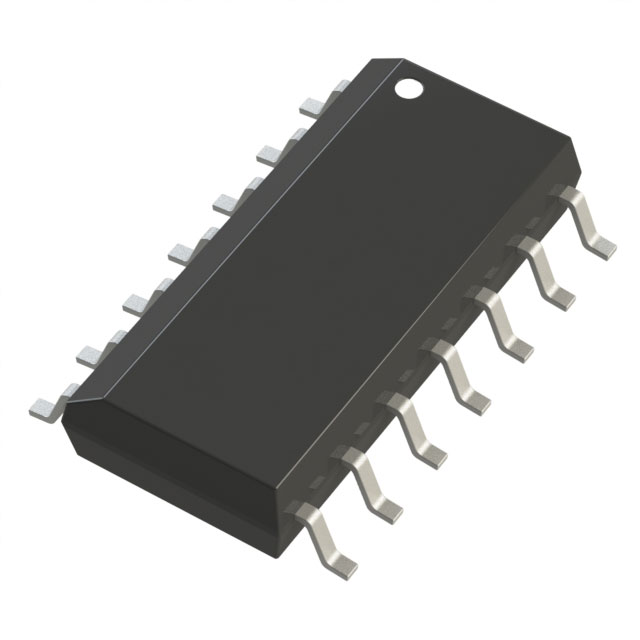
MAX250CSD Overview
The MAX250CSD is a full duplex RS 232 transceiver designed to connect CMOS and TTL logic levels to standard serial communication ports. It integrates two line drivers and two line receivers in a 14 pin SOIC package, supporting bidirectional data exchange through a single 5 volt supply. An internal charge pump generates the required positive and negative output voltages for RS 232 signaling without the need for dual power rails. The device is suited for embedded systems, industrial controls, and legacy serial equipment that require reliable port conversion. Looking for MAX250CSD? Contact us to check current stock, lead time, and pricing.
MAX250CSD Pinout Details
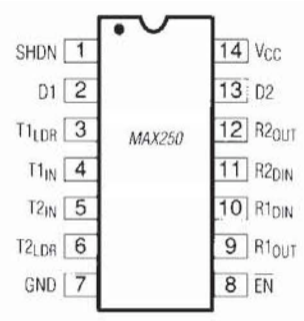
MAX250CSD Pin Description
| Pin Number | Pin Name | Description |
| 1 | SHDN | Shutdown input, logic control to disable the device and reduce power consumption |
| 2 | D1 | Driver 1 output, RS-232 level output |
| 3 | T1LDR | Transmitter 1 load driver control |
| 4 | T1IN | Transmitter 1 input, TTL/CMOS logic input |
| 5 | T2IN | Transmitter 2 input, TTL/CMOS logic input |
| 6 | T2LDR | Transmitter 2 load driver control |
| 7 | GND | Ground reference |
| 8 | EN | Enable input, enables normal device operation |
| 9 | R1OUT | Receiver 1 output, TTL/CMOS logic output |
| 10 | R1DIN | Receiver 1 input, RS-232 level input |
| 11 | R2DIN | Receiver 2 input, RS-232 level input |
| 12 | R2OUT | Receiver 2 output, TTL/CMOS logic output |
| 13 | D2 | Driver 2 output, RS-232 level output |
| 14 | VCC | Positive supply voltage, 4.5V to 5.5V |
MAX250CSD CAD Model
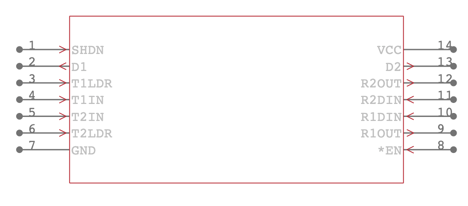
MAX250CSD Symbol
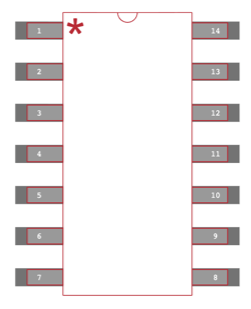
MAX250CSD Footprint
MAX250CSD 3D Model
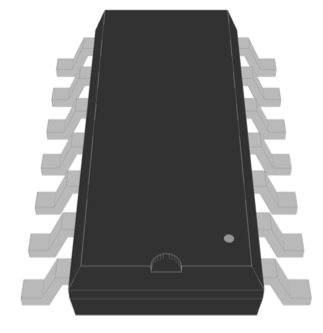
Features of MAX250CSD
RS 232 Communication Support
The MAX250CSD is designed to meet standard RS 232 electrical specifications for serial data exchange. It converts low level CMOS and TTL logic signals into RS 232 voltage levels for transmission, and converts incoming RS 232 signals back into logic level outputs. This allows direct connection between digital circuits and traditional serial ports without external level shifting components. The device supports reliable communication across typical serial data rates used in embedded and control systems.
Dual Channel Communication
The MAX250CSD integrates two line drivers and two line receivers in a single package. This 2 by 2 configuration enables two independent transmit and receive paths, supporting full duplex data transfer. Each driver and receiver operates as a matched pair, allowing simultaneous sending and receiving of data between connected devices. This structure reduces the need for separate interface components and simplifies board layout.
Full Duplex Data Transmission
The device supports full duplex communication, which allows data to be transmitted and received at the same time. This mode improves communication efficiency in systems that require continuous two way data flow. It eliminates the need to alternate between transmit and receive states, which helps maintain stable and uninterrupted serial communication.
Single 5 V Supply Operation
The MAX250CSD operates from a single supply voltage between 4.5 volts and 5.5 volts. An internal charge pump generates the positive and negative voltage levels required for RS 232 signaling. This removes the need for dual power supplies and reduces external component count. The simplified power requirement supports compact and straightforward circuit design.
Receiver Hysteresis for Noise Tolerance
Each receiver includes approximately 600 millivolts of input hysteresis. This feature improves resistance to noise and slow signal transitions on the RS 232 input lines. It helps prevent false switching and unstable output levels in environments where electrical interference may be present. As a result, logic outputs remain stable during normal operating conditions.
14 Pin SOIC Surface Mount Package
The MAX250CSD is housed in a 14 pin SOIC surface mount package. This compact format supports efficient use of printed circuit board space and is suitable for automated assembly processes. The package design allows reliable solder connections and consistent mechanical placement in standard surface mount layouts.
Commercial Temperature Range Operation
The device is specified for operation from 0 degrees Celsius to 70 degrees Celsius. This temperature range supports use in commercial and indoor electronic equipment. It maintains stable performance within this range when operated under recommended supply and load conditions.
CMOS and TTL Logic Compatibility
The MAX250CSD is compatible with standard CMOS and TTL logic levels. It can interface directly with microcontrollers, digital processors, and other logic based systems without additional signal conditioning. This compatibility simplifies integration into a wide range of digital designs that require RS 232 communication.
MAX250CSD Technical Specifications
| Product Attribute | Attribute Value |
| Manufacturer | Maxim Integrated |
| Voltage - Supply | 4.5V ~ 5.5V |
| Type | Transceiver |
| Supplier Device Package | 14-SOIC |
| Receiver Hysteresis | 600 mV |
| Protocol | RS232 |
| Package / Case | 14-SOIC (0.154', 3.90mm Width) |
| Package | Tube |
| Operating Temperature | 0°C ~ 70°C |
| Number of Drivers/Receivers | 2/2 |
| Mounting Type | Surface Mount |
| Duplex | Full |
| Base Product Number | MAX250 |
| RoHS Status | RoHS non-compliant |
| Moisture Sensitivity Level (MSL) | 1 (Unlimited) |
| REACH Status | REACH Unaffected |
| ECCN | EAR99 |
| HTSUS | 8542.39.0001 |
Block Diagram of MAX250CSD
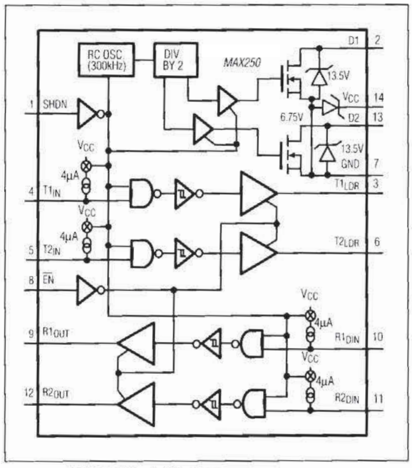
Internal architecture arranged around a dual transmitter and dual receiver configuration powered from a single 5 V supply. An on-chip 300 kHz RC oscillator feeds a divide by two stage that drives a charge pump, generating the positive and negative voltage levels required for RS-232 signaling. Two transmitter paths accept TTL or CMOS inputs at T1IN and T2IN, pass through logic control and driver stages, and deliver RS-232 outputs at D1 and D2 with associated load driver control pins. Two receiver channels accept RS-232 inputs at R1DIN and R2DIN, process them through comparator stages with defined bias currents, and provide logic-level outputs at R1OUT and R2OUT. Control inputs including SHDN and EN manage oscillator operation and channel enable functions, while VCC and GND define the device supply and reference nodes.
Chip Topographies of MAX250CSD
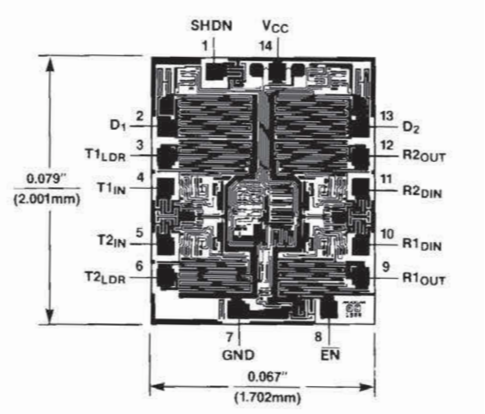
Die layout of the MAX250CSD showing internal circuit regions and bond pad placement corresponding to the 14 external pins. Peripheral pads are labeled SHDN, VCC, D1, D2, T1IN, T2IN, R1DIN, R2DIN, R1OUT, R2OUT, EN, and GND, matching the package pinout. Four large symmetric regions occupy the central area, associated with the dual transmitter and dual receiver channels, while smaller control and bias circuitry is distributed between them. Measured die dimensions are approximately 0.079 inches by 0.067 inches, indicating the physical silicon size within the package. The arrangement reflects separation between high voltage driver sections and lower voltage logic and control blocks.
Applications of MAX250CSD
PC Serial Port Communication Interfaces
The MAX250CSD is used to connect embedded boards and digital subsystems to standard PC serial ports. It converts 5 volt logic signals into RS 232 voltage levels that desktop and laptop serial connectors require. This allows firmware updates, configuration settings, and diagnostic data to be exchanged through a direct serial link. Its full duplex structure supports simultaneous transmit and receive paths, which keeps communication stable during continuous data transfer.
Industrial Equipment with RS 232 Connectivity
Many industrial machines include RS 232 ports for setup, calibration, and monitoring tasks. The MAX250CSD provides the signal translation between internal control logic and external serial connectors. It supports reliable two way communication for sending commands and receiving status information. With a single 5 volt supply and internal voltage generation, it fits easily into compact control boards used in factory and process equipment.
Point Of Sale Systems
Point of sale terminals often communicate with printers, scanners, and cash drawers through serial connections. The MAX250CSD enables the main processing unit to interface directly with these RS 232 based peripherals. Its dual driver and receiver configuration allows transaction data to be transmitted while acknowledgments are received at the same time. This supports smooth data flow during payment processing and receipt printing.
Data Communication Terminals
In data terminals that rely on serial links, the MAX250CSD manages the conversion between internal digital signals and external RS 232 lines. It maintains proper voltage levels on both transmit and receive paths, allowing structured data to move between devices without signal mismatch. This makes it suitable for terminals used in identification systems, access control units, and field data collection equipment.
Embedded Systems Requiring Legacy RS 232 Interface
Some embedded designs continue to include RS 232 ports for compatibility with existing infrastructure. The MAX250CSD allows modern CMOS and TTL logic circuits to connect directly to these legacy interfaces. It supports configuration ports, service connections, and communication with older equipment while operating from a single regulated supply. This approach preserves backward compatibility without adding complex external circuitry.
Telecommunications Equipment with Standard Serial Ports
Telecommunications devices often use serial ports for diagnostics and system control. The MAX250CSD provides the required voltage level translation between internal logic circuits and external RS 232 connectors. It supports steady bidirectional communication for command exchange and status reporting. Its compact surface mount package allows integration into communication boards where space and layout efficiency are controlled.
Outline Dimensions of MAX250CSD
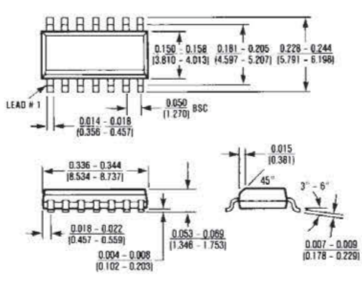
Mechanical outline drawing defining the 14 lead small outline package used for the MAX250CSD. The diagram provides top, side, and end views with dimensional tolerances in inches and millimeters, including overall body length, body width, lead pitch of 0.050 inches BSC, and lead width and thickness ranges. Seating plane height, standoff dimensions, and lead bend angle are specified to support PCB footprint design and assembly. Lead 1 identification is marked to ensure correct orientation during placement. Thermal characteristics are listed with θJA of 115 degrees C per watt and θJC of 60 degrees C per watt, indicating junction to ambient and junction to case thermal resistance for thermal analysis.
MAX250CSD Advantages and Disadvantages
Advantages
• Integrates two drivers and two receivers in one package, reducing external components
• Supports full duplex communication for simultaneous transmit and receive operation
• Includes 600 mV receiver hysteresis for improved noise tolerance
• Operates from a single 5 V supply, simplifying power requirements
• Available in a compact 14 pin SOIC package for space efficient layouts
• Well suited for systems that rely on established RS 232 serial standards
Disadvantages
• Limited to RS 232 communication protocol
• Specified for operation only within 0 C to 70 C temperature range
• Requires a 5 V supply, not directly compatible with 3.3 V logic systems
• Not aligned with newer low voltage serial interface standards
• Not compliant with RoHS material restrictions
MAX250CSD Alternatives
| Part Number | Manufacturer | Key Features | Use Case/Notes |
| MAX250CSD+G55 | Analog Devices Inc./Maxim Integrated | Dual RS-232 transceiver operating from a single 5 V supply. Provides two drivers and two receivers with built-in hysteresis for improved noise immunity and stable full-duplex communication. | Used in embedded systems, industrial controllers, and serial communication interfaces requiring reliable RS-232 connectivity. |
| MAX250CSD+ | Analog Devices Inc./Maxim Integrated | RS-232 transceiver with integrated charge pump, supporting 4.5 V to 5.5 V supply range. Designed for full-duplex operation with improved signal integrity. | Suitable for communication modules, microcontroller interfaces, and legacy serial port applications. |
| MAX250CSD+T | Analog Devices Inc./Maxim Integrated | Dual driver/receiver RS-232 interface IC packaged for automated assembly. Provides stable data transmission and supports standard serial communication levels. | Commonly used in compact PCB designs for data acquisition, instrumentation, and communication equipment. |
| MAX250CPD | Analog Devices Inc./Maxim Integrated | RS-232 transceiver supporting dual drivers and receivers with reliable 5 V operation. Designed for stable full-duplex communication in surface-mount format. | Appropriate for industrial communication boards, serial interface adapters, and embedded system connectivity. |
About Maxim Integrated
Maxim Integrated Products, Inc. was founded in 1983 and established its headquarters in San Jose, California. The company specialized in the design and development of analog and mixed signal integrated circuits for a wide range of electronic systems. Its product portfolio covered power management, signal processing, data conversion, and interface solutions used in industrial, automotive, communications, medical, and consumer applications. In 2021, Maxim Integrated became part of Analog Devices, Inc., expanding its technological resources and global reach within the semiconductor industry.
Conclusion
The MAX250CSD helps you bridge the gap between 5V logic and traditional RS-232 serial ports without adding complex circuits. With two drivers and two receivers inside a compact 14-pin SOIC package, it supports smooth full duplex communication. Its internal charge pump removes the need for dual power supplies, which keeps your design simple. You also get built-in noise tolerance thanks to receiver hysteresis, helping maintain stable data transfer. From embedded boards to serial-based equipment, it fits easily into many setups. If you need a reliable and straightforward RS-232 interface solution, this device gives you a clean and practical option.
Datasheet PDF
MAX250CSD Datasheet:
About us
ALLELCO LIMITED
Read more
Quick inquiry
Please send an inquiry, we will respond immediately.
Frequently Asked Questions [FAQ]
1. What is the MPC8548EVUAUJ mainly used for?
The MPC8548EVUAUJ is mainly used in networking and communication equipment such as routers, switches, gateways, and secure network appliances. It manages data routing, packet processing, and system control. Because it integrates Ethernet, memory control, and security features, it works well in systems that run continuously and handle steady traffic.
2. What processor core does the MPC8548EVUAUJ use?
It uses a 32-bit PowerPC e500 core. This core is designed for embedded communication systems and supports stable instruction handling and predictable performance. It can run at speeds up to 1.333 GHz, which allows it to process network traffic efficiently.
3. Does the MPC8548EVUAUJ support hardware encryption?
Yes, it includes a built-in Security Engine. This hardware block handles encryption, decryption, and secure key generation. By performing these tasks directly on the chip, it helps maintain protected communication without adding extra external security components.
4. What types of memory are compatible with this processor?
The processor supports DDR, DDR2, and SDRAM through its integrated memory controller. This gives you flexibility when choosing external memory based on speed and capacity needs. Direct memory integration also helps maintain smooth data transfer between the processor and memory devices.
5. What package does the MPC8548EVUAUJ come in?
It comes in a 783-pin flip-chip ball grid array (FCBGA) package, measuring about 29 mm by 29 mm. This surface-mount format supports compact board layouts and provides stable electrical connections across many pins, making it suitable for dense networking system designs.

Why ADG708CRU Is Ideal for Signal Switching and Measurement Systems
on February 19th
Understanding MPC8548EVUAUJ Block Diagram and Performance Capabilities
on February 18th
Popular Posts
-

Complex Instruction Set Computers: How They Changed Computing?
on April 18th 147758
-

USB-C Pinout and Features
on April 18th 111960
-
Using Xilinx Unified Simulation Primitives: A Comprehensive Guide to FPGA Design and Simulation
on April 18th 111349
-

Power Supply Voltages in Electronics: Meaning of VCC, VDD, VEE, VSS, and GND
on April 18th 83726
-

RJ45 Connector Guide: Pinout, Wiring, Cable Types, and Uses
on January 1th 79512
-

The Ultimate Guide to Wire Color Codes in Modern Electrical Systems
The way our electrical systems use colors isn’t just for looks. Each wire color now indicates a specific function, making it easier to identify and handle electrical components correctly during ins...on January 1th 66930
-
Purge Valve Guide: Function, Symptoms, Testing, and Replacement for Optimal Engine Performance
The purge valve is a key part of a car’s system that helps keep the air clean by managing fuel vapors before they can escape into the atmosphere. This not only helps the environment by reducing pol...on January 1th 63078
-

Quality (Q) Factor: Equations and Applications
The quality factor, or 'Q', is important when checking how well inductors and resonators work in electronic systems that use radio frequencies (RF). 'Q' measures how well a circuit minimizes energy...on January 1th 63019
-

Achieving Peak Performance with the Maximum Power Transfer Theorem
The Maximum Power Transfer Theorem explains how energy from a source, such as a battery or generator, flows to a connected load. It shows the exact condition where the load receives the most power....on January 1th 54086
-

A23 Battery Specifications and Compatibility
The A23 battery is a small, cylinder-shaped battery with high voltage. Also called 23A, 23AE, or MN21, it runs at 12 volts and much higher than AA or AAA batteries. Its special design make...on January 1th 52159
HOT Part Number
-

LM4136CN
Texas Instruments
IC OPAMP GP 4 CIRCUIT 14DIP
LFE2M35E-6F484C
Lattice Semiconductor Corporation
IC FPGA 303 I/O 484FBGA
CHS-08TA
Nidec Components Corporation
SWITCH SLIDE DIP SPST 100MA 6V
LTC2870IUFD#PBF
Analog Devices Inc.
IC TRANSCEIVER FULL 2/2 28QFN
SN74ABT125PWR
Texas Instruments
IC BUF NON-INVERT 5.5V 14TSSOP
LTC4263CDE-1#TRPBF
Analog Devices Inc.
IC POE CNTRL 1 CHANNEL 14DFN
GRM155R6YA224KE01D
Murata Electronics
CAP CER 0.22UF 35V X5R 0402
CP0603A0897HNTR
KYOCERA AVX
DIRECTIONAL COUPLER
1N3161
Microchip Technology
STANDARD RECTIFIER
MAX6129BEUK25+T
Analog Devices Inc./Maxim Integrated
IC VREF SERIES 1% SOT23-5
BXB100-48S05FLTJ
Artesyn Embedded Power
DC DC CONVERTER 5V 100W
BD9874CP-V5E2
Rohm Semiconductor
IC REG BUCK ADJUSTABLE 3A
XMC4700F144K1536AAXQMA1
Infineon Technologies
IC MCU 32BIT 1.5MB FLASH 144LQFP
MAX4259EEE
Analog Devices Inc./Maxim Integrated
IC AMP VIDEO/MUX 2CHAN 16-QSOP
AT24C1024BY7-YH25-T
Microchip Technology
IC EEPROM 1MBIT I2C 1MHZ 8UDFN
XC2S15-5TQG144I
AMD
IC FPGA 86 I/O 144TQFP
04023U2R1BAT2A
KYOCERA AVX
CAP CER 2.1PF 25V NP0 0402
NZH11C,115
Nexperia USA Inc.
DIODE ZENER 11V 500MW SOD123F -
STP22NM60N
STMicroelectronics
MOSFET N-CH 600V 16A TO220AB
STTH15R06D
STMicroelectronics
DIODE GEN PURP 600V 15A TO220AC
STLED25JR
STMicroelectronics
IC LED DRV RGLTR PWM 12FLIPCHIP
BU4241F-TR
Rohm Semiconductor
IC SUPERVISOR 1 CHANNEL 4SOP
6TPE150M
Panasonic Electronic Components
CAP TANT POLY 150UF 6.3V 2917
IL260-3E
NVE Corporation
DGTL ISO 2.5KV GEN PURP 16SOIC
71V3558S133PF
IDT, Integrated Device Technology Inc
IC SRAM 4.5MBIT PARALLEL 100TQFP
1SMA54AT3G
onsemi
TVS DIODE 54VWM 87.1VC 6TDFN
TPS71401DCKR
Texas Instruments
IC REG LIN POS ADJ 80MA SC70-5
MC10EP56DTR2
onsemi
IC DIFF DIG MULTPL 2X2:1 20TSSOP
SKY77596-11
Skyworks Solutions Inc.
IC FRONT END MOD GSM/GPRS 28MCM
SI4168DY-T1-GE3
Vishay Siliconix
MOSFET N-CH 30V 24A 8SO
SE3455-002
Honeywell Sensing and Productivity Solutions
EMITTER IR 935NM 100MA TO-46
TRSF3222IDBR
Texas Instruments
IC TRANSCEIVER FULL 2/2 20SSOP
AP2815CMMTR-G1
Diodes Incorporated
IC PWR SWITCH N-CHAN 1:1 8MSOP
LM1282N
Texas Instruments
VIDEO AMPLIFIER, 3 CHANNEL
SUP85N03-04P-E3
Vishay Siliconix
MOSFET N-CH 30V 85A TO220AB
HTST-117-02-G-D
Samtec Inc.
CONN HEADER VERT 34POS 2.54MM -

2SAR522MT2L
Rohm Semiconductor
TRANS PNP 20V 0.2A VMT3
CY2309SXC-1H
Infineon Technologies
IC FANOUT BUFFER 16SOIC
STM32L476JGY7TR
STMicroelectronics
IC MCU 32BIT 1MB FLASH 72WLCSP
FAN1112SX
onsemi
IC REG LINEAR 1.2V 1A SOT223-4
VE-J01-MZ
Vicor Corporation
DC DC CONVERTER 12V 25W
ISL8700AIBZ-T
Intersil
IC SUPERVISOR 4 CHANNEL 14SOIC
T491X226K035AT
KEMET
CAP TANT 22UF 10% 35V 2917
MAX809R
UMW
2.63V LOWEFFECTIVE 1 SUPERVISOR
SN74ALVCH374DWR
Texas Instruments
IC FF D-TYPE SNGL 8BIT 20SOIC
IXFH150N15P
IXYS
MOSFET N-CH 150V 150A TO247AD
SMBJ120CA
Bourns Inc.
TVS DIODE 120VWM 193VC SMB
0603ZD103KAT2A
KYOCERA AVX
CAP CER 10000PF 10V X5R 0603
CLC3601ISO14X
MaxLinear, Inc.
IC OPAMP CFA 3 CIRCUIT 14SOIC
APT56F60B2
Microchip Technology
MOSFET N-CH 600V 60A T-MAX
ZDT1048TA
Diodes Incorporated
TRANS 2NPN 17.5V 5A SM8
TPS65262-2RHBT
Texas Instruments
IC REG 5OUT BUCK/LNR SYNC 32VQFN
MAX1168BEEG+
Analog Devices Inc./Maxim Integrated
IC ADC 16BIT SAR 24QSOP
GRM1885C1H5R7DZ01D
Murata Electronics
CAP CER 5.7PF 50V C0G/NP0 0603