BC548 Transistor: Working, Benefits, and Circuit Uses
The BC548 transistor is a commonly used component in electronic circuits for switching and amplifying signals. It is versatile, reliable, and suitable for low-power applications. This article explores its features, working principles, pin configuration, and various uses, providing a clear understanding of its functionality.Catalog
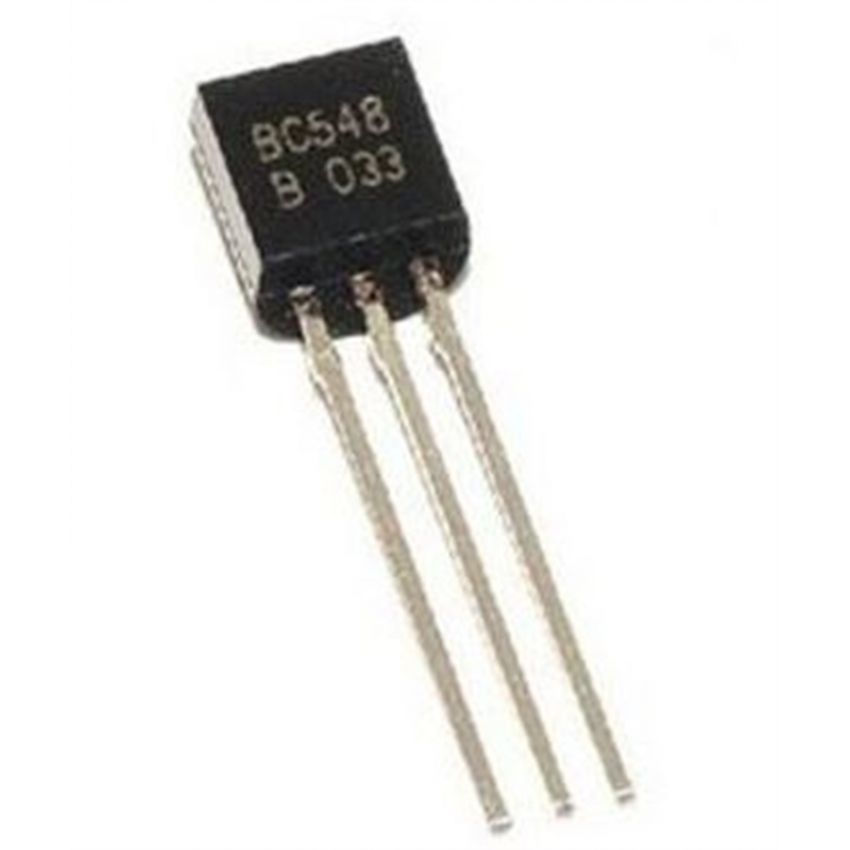
Overview of the BC548 NPN Transistor
The BC548 is a widely used NPN bipolar junction transistor designed for tasks like switching and amplifying signals in electronic circuits. It can handle a load of up to 500mA when used as a switch, making it versatile for various low-power applications. This transistor comes in three variants: BC548A, BC548B, and BC548C. The main difference among these models lies in their DC current gain values.
The gain for the BC548A ranges between 110 and 220, while the BC548B has a gain range of 200 to 450, and the BC548C offers the highest range of 420 to 800. These values determine how much the transistor can amplify a signal, which is why selecting the right variant based on your circuit's needs is crucial. Whether you're working on amplification or switching tasks, the BC548 offers a reliable and efficient solution.
Detailed Functioning of the BC548 Transistor
The BC548 transistor operates by using a small current at its base terminal to control the flow of a larger current between its collector and emitter terminals. To work correctly, the current supplied to the base must be limited to no more than 5mA. When the base pin is connected to the ground, the connection between the collector and emitter remains open, preventing any current from flowing through.
When a signal is applied to the base terminal, it closes this connection, allowing current to flow between the collector and emitter. This state is referred to as the saturation region, where the transistor is fully "on," and it can handle up to 500mA of current. On the other hand, when the signal to the base is removed, the transistor enters the cut-off region, switching completely "off" and stopping current flow.
If you slightly increase the voltage at the base terminal, it can cause a significant change in the current flowing through the collector and emitter. The emitter terminal is heavily doped compared to the other terminals, which makes the collector voltage higher than the base voltage. This behavior allows the BC548 to effectively amplify signals, making it a reliable choice for many switching and amplification tasks.
BC548 Transistor Pin Layout and Configuration
The BC548 transistor has three terminals, each playing a distinct role in its operation. These terminals differ in terms of their doping levels and specific tasks within the circuit. Understanding the pin configuration helps you connect the transistor correctly in your circuit.
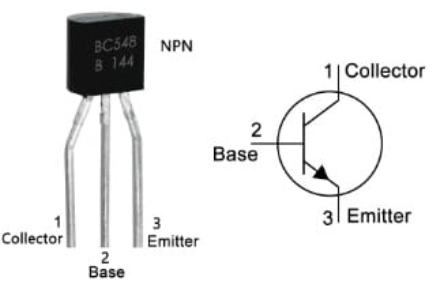
• Pin-1 (Collector): This is where the current enters the transistor. It acts as the input terminal for the main current flow in the circuit.
• Pin-2 (Base): The base terminal is the control point of the transistor. A small current applied here regulates the larger current flowing between the collector and emitter.
• Pin-3 (Emitter): This is the terminal through which the current exits the transistor after completing its path through the circuit.
Key Features and Technical Specifications of BC548 Transistor
The features and specifications of the BC548 transistor are detailed below to provide insight into its functionality and design.
| Parameter | Value |
| Transistor Type | Bi-Polar, NPN |
| Number of Pins | 3 |
| Package Type | TO-92 |
| Maximum Collector Current (IC) | 500mA |
| Maximum Collector-Emitter Voltage (VCE) | 30V |
| Maximum Collector-Base Voltage (VCB) | 30V |
| Maximum Emitter-Base Voltage (VEB) | 5V |
| Transition Frequency (fT) | 150 MHz |
| Maximum Collector Dissipation | 625 mW |
| DC Current Gain (hFE) | 110 to 800 |
| Operating and Storage Temperature Range | -55°C to +150°C |
| Mount Type | Through-Hole |
| Moisture Sensitivity Level (MSL) | 1 (Unlimited) |
| Maximum Power | 500 mW |
Equivalents of BC548 Transistor
• BC547
• BC549
• BC550
• 2N2222
• 2N3904
• 2N3906
PNP Complementary Transistors:
• BC557
• BC558
• BC556
Guidelines for Safe Use of BC548 Transistor in Circuits
To ensure the BC548 transistor works well and lasts a long time, it’s important to follow a few safety measures. Always stick to the recommended specifications, as exceeding them can cause damage. For instance, avoid connecting any load that requires more than 30V or 500mA, as this goes beyond the transistor's capacity.
Pay close attention to the pin connections. The transistor's pins need to be connected correctly; reversing or misplacing them can result in malfunction or permanent damage. Using a suitable resistor at the base terminal is equally important. This helps control the current flowing into the base, which should not exceed 5mA.
Finally, make sure the operating temperature stays within the range of -55°C to +150°C. Excessive heat or cold can reduce the transistor’s performance or lead to failure. Following these simple steps can help you get the most out of the BC548 transistor in your projects.
Crystal Tester Circuit Using the BC548 Transistor
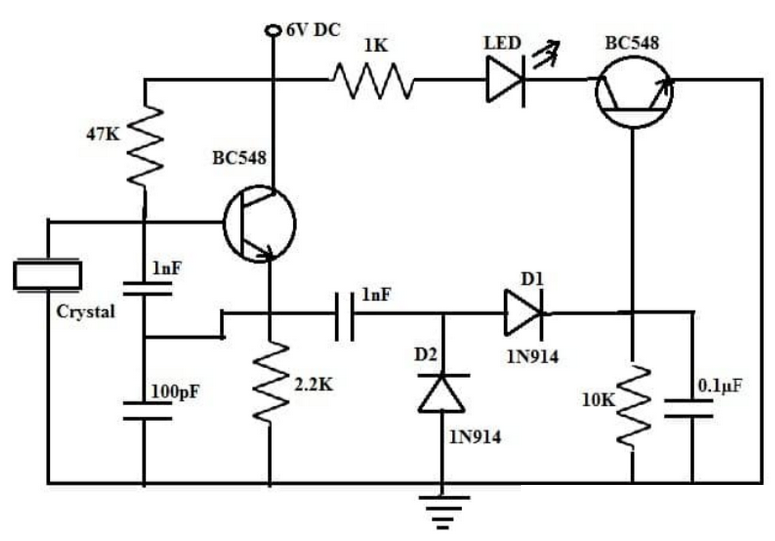
The crystal tester circuit, built using the BC548 transistor, is a simple and effective way to check if a crystal component is working properly. Crystals are a key part of many electronic projects, as they help generate specific frequencies. This circuit forms an oscillator, and if the crystal is functional, the LED in the circuit will blink to indicate it is working correctly.
To create this circuit, you’ll need a few basic components: a 6V DC power supply, two BC548 transistors, two 1N914 diodes, an LED, and resistors of 2.2KΩ, 47KΩ, 1KΩ, and 10KΩ. Additionally, capacitors of values 0.1µF, 1nF, and 100pF are required. Once you assemble the circuit following the diagram, the setup will allow you to test crystals with ease.
When the crystal is connected, the circuit generates oscillations, which trigger the first BC548 transistor. The signal is then rectified by the diodes and filtered by capacitors before reaching the second BC548 transistor, which activates the LED. A glowing LED indicates a working crystal, while no light suggests the crystal is faulty. This simple tester can save time and ensure that the crystals used in your projects are functioning as they should.
Operating Principles of the Crystal Tester Circuit with BC548
This circuit uses two BC548 transistors working together to test the functionality of a crystal. Powered by a 6V supply, the circuit is designed to safely control current flow by placing resistors before each component. The crystal under test is connected directly to the base terminal of the first transistor (T1).
When the crystal generates oscillations, it triggers T1, producing an output that passes through 1N914 diodes. These diodes rectify the signal, which is then filtered by capacitors before it reaches the base of the second transistor (T2). T2 amplifies the signal and lights up an LED if the crystal is working correctly.
If the LED does not glow, the crystal is either faulty or damaged. This setup is highly useful for quickly verifying the operation of crystals, especially in high-frequency projects where precision oscillators are needed. The simplicity and reliability of this circuit make it a valuable tool for ensuring that your crystals are functioning as expected.
Benefits and Performance Advantages of the BC548 Transistor
Advanced Process Technology
This transistor is built using advanced process technology, ensuring it operates efficiently and reliably in a wide range of circuits. The technology used makes it suitable for both switching and amplification tasks, giving it an edge in performance.
Low Error Voltage
The BC548 transistor is designed to produce very low error voltage. This means it operates with high precision, maintaining stability in your circuit. This feature makes it a dependable choice for circuits requiring accuracy.
High Switching Speed
Its ability to switch between on and off states quickly makes the BC548 ideal for fast-switching applications. Whether you're working on a digital circuit or a frequency-dependent setup, the quick response ensures smooth performance.
Full Voltage Operation
The transistor supports full voltage operation, which adds flexibility to its use. It can handle the maximum collector-to-emitter voltage effectively, ensuring safe and consistent operation within its rated limits.
High Current and Power Handling
With a maximum current rating of 500mA, the BC548 is capable of driving several components simultaneously. Its power-handling capacity also makes it suitable for a variety of applications, from driving LEDs to relays.
Excellent DC Current Gain
The BC548 features a high DC current gain, ranging from 110 to 800, depending on the variant. This makes it highly effective for amplifying signals, especially in low-power audio and signal processing circuits.
Low Noise Levels
Compared to similar transistors like the BC549 and BC550, the BC548 produces less noise. This makes it a great option for circuits where noise reduction is a priority, such as in audio amplifiers or sensitive signal amplifications.
Versatile Component Compatibility
Thanks to its ability to handle up to 500mA, the BC548 can drive a variety of components. It is often used with integrated circuits, other transistors, LEDs, and relays, making it a versatile choice for many electronic applications.
Applications of the BC548 Transistor
Amplifying Weak Signals
The BC548 transistor is commonly used in Darlington pairs to amplify weak signals. By pairing it with another transistor, it greatly enhances signal strength, making it ideal for applications requiring high amplification.
Sensor Circuits
This transistor is a key component in sensor circuits, helping to process and amplify signals from sensors for further use in electronic systems.
Driving Low-Power Loads
With its ability to handle loads up to 500mA, the BC548 is perfect for driving small loads such as LEDs, relays, and similar low-power devices.
Audio Amplification and Driver Modules
The BC548 is often used in audio circuits for amplifying sound. It is also employed in various driver modules, including LED drivers, relay drivers, and switching modules.
Amplifier Modules
It is widely used in different types of amplifier modules like signal amplifiers, push-pull amplifiers, and audio amplifiers. Its high gain and low noise make it an excellent choice for these applications.
General Purpose Circuits
You will find the BC548 in numerous general-purpose circuits, such as audio preamps, touch switches, LED flash circuits, RF circuits, heat sensors, and PWM (Pulse Width Modulation) systems.
Quick-Switching and Alarm Devices
Thanks to its fast switching speed, the BC548 is used in quick-switching devices and alarm circuits. These applications benefit from its ability to turn on and off rapidly without delays.
General-Purpose Replacement
The BC548 can replace many other general-purpose transistors, such as the BC547 and 2N3904, in various electronic projects, making it a versatile substitute for similar components.
Broad Range Load Handling
With its 500mA collector current rating, the BC548 can drive a wide range of loads, making it suitable for circuits that require multiple components to be powered simultaneously.
Pre-Amplification Applications
Its excellent collector dissipation and high DC current gain make the BC548 ideal for use in both amplification and pre-amplification stages of circuits. This ensures clear signal processing and efficient performance.
About us
ALLELCO LIMITED
Read more
Quick inquiry
Please send an inquiry, we will respond immediately.
INA226: The Ultimate IC for High-Accuracy Current, Voltage, and Power Measurement
on December 26th

Simple Guide to the BC550 Transistor for Beginners
on December 26th
Popular Posts
-

Complex Instruction Set Computers: How They Changed Computing?
on April 18th 147764
-

USB-C Pinout and Features
on April 18th 111984
-
Using Xilinx Unified Simulation Primitives: A Comprehensive Guide to FPGA Design and Simulation
on April 18th 111351
-

Power Supply Voltages in Electronics: Meaning of VCC, VDD, VEE, VSS, and GND
on April 18th 83743
-

RJ45 Connector Guide: Pinout, Wiring, Cable Types, and Uses
on January 1th 79538
-

The Ultimate Guide to Wire Color Codes in Modern Electrical Systems
The way our electrical systems use colors isn’t just for looks. Each wire color now indicates a specific function, making it easier to identify and handle electrical components correctly during ins...on January 1th 66948
-
Purge Valve Guide: Function, Symptoms, Testing, and Replacement for Optimal Engine Performance
The purge valve is a key part of a car’s system that helps keep the air clean by managing fuel vapors before they can escape into the atmosphere. This not only helps the environment by reducing pol...on January 1th 63087
-

Quality (Q) Factor: Equations and Applications
The quality factor, or 'Q', is important when checking how well inductors and resonators work in electronic systems that use radio frequencies (RF). 'Q' measures how well a circuit minimizes energy...on January 1th 63028
-

Achieving Peak Performance with the Maximum Power Transfer Theorem
The Maximum Power Transfer Theorem explains how energy from a source, such as a battery or generator, flows to a connected load. It shows the exact condition where the load receives the most power....on January 1th 54092
-

A23 Battery Specifications and Compatibility
The A23 battery is a small, cylinder-shaped battery with high voltage. Also called 23A, 23AE, or MN21, it runs at 12 volts and much higher than AA or AAA batteries. Its special design make...on January 1th 52171
HOT Part Number
-

50YXJ330M10X20
Rubycon
CAP ALUM 330UF 20% 50V RADIAL
CY7B993V-2AXI
Infineon Technologies
IC CLK BUFF 100TQFP
CPC1972GS
IXYS Integrated Circuits Division
SSR RELAY SPST-NO 250MA 0-800V
CPC1593GSTR
IXYS Integrated Circuits Division
SSR RELAY SPST-NO 120MA 0-600V
TDA7350A
STMicroelectronics
IC AMP AB MONO/STER 11MULTIWATT
FDC604P
onsemi
MOSFET P-CH 20V 5.5A SUPERSOT6
170M2713
Eaton - Bussmann Electrical Division
FUSE SQUARE 80A 690VAC RECT
P6KE130CA
SMC Diode Solutions
TVS DIODE 111VWM 179VC DO15
ATF22LV10C-10SU
Microchip Technology
IC PLD 10MC 10NS 24SOIC
UMK107CG181JZ-T
Taiyo Yuden
CAP CER 180PF 50V C0G/NP0 0603
CL03C020BA3GNNH
Samsung Electro-Mechanics
CAP CER 2PF 25V NP0 0201
MCP1700T-2502E/TT
Microchip Technology
IC REG LINEAR 2.5V 250MA SOT23-3
MC14066BDTR2
onsemi
IC BILATERAL SW 1 X 1:1 14TSSOP
CD74HCT14M
Texas Instruments
IC INV SCHMITT 6CH 1-IN 14SOIC
PS2565L1-1-V-A
Renesas Electronics America Inc
OPTOISOLATOR 5KV TRANS 4DIP
DG302AAK/883
Vishay Siliconix
IC SW DPST-NOX2 50OHM 14CERDIP
IRF7353D2TRPBF
Infineon Technologies
MOSFET N-CH 30V 6.5A 8SO
TPS71750DSET
Texas Instruments
IC REG LINEAR 5V 150MA 6WSON -
BZT52C3V3T-7
Diodes Incorporated
DIODE ZENER 3.3V 300MW SOD523
TLV5580CDW
Texas Instruments
IC ADC 8BIT PIPELINED 28SOIC
P0720SC
Littelfuse Inc.
THYRISTOR 65V 400A DO214AA
D2SW-01L1H
Omron Electronics Inc-EMC Div
SWITCH SNAP ACT SPDT 100MA 125V
VI-26N-IW
Vicor Corporation
DC DC CONVERTER 18.5V 100W
IKW15N120H3
Infineon Technologies
IKW15N120 - DISCRETE IGBT WITH A
SNJ54LS540J
Texas Instruments
54LS540 OCTAL BUFFERS AND LINE D
74LVC8T245PW-Q100J
Nexperia USA Inc.
IC TRANSLATION TXRX 5.5V 24TSSOP
GRM188R61E475KE11J
Murata Electronics
CAP CER 4.7UF 25V X5R 0603
LP3999ITL-3.3
Texas Instruments
IC REG LINEAR FIXED POS LDO REG
CY74FCT16374TPVC
Texas Instruments
IC FF D-TYPE DUAL 8BIT 48SSOP
SMA6J6.0CA
Littelfuse Inc.
TVS DIODE 6VWM 10.3VC DO214AC TR
GRM1555C2A6R6CA01J
Murata Electronics
CAP CER 6.6PF 100V C0G/NP0 0402
EMZR250ARA821MJA0G
United Chemi-Con
CAP ALUM 820UF 20% 25V SMD
NXH80T120L2Q0S2TG
onsemi
MODULE PIM 1200V 80A
SY58018UMG
Microchip Technology
IC MULTIPLEXER 1 X 2:1 16MLF
R5F21356MNFP#X4
Renesas Electronics America Inc
IC MCU 16BIT 32KB FLASH 52LQFP
LMH6503MTX
Texas Instruments
IC OPAMP VGA 135MHZ 14TSSOP -

CD4029BCN
onsemi
IC BINARY COUNTER 4-BIT 16DIP
AD8675ARZ-REEL7
Analog Devices Inc.
IC OPAMP GP 1 CIRCUIT 8SOIC
DS1087LU-255+T
Analog Devices Inc./Maxim Integrated
IC CLOCK GENERATOR 8UMAX
IRG7S313UTRLPBF
Infineon Technologies
IGBT PDP 330V 40A D2PAK
LQP03HQ13NH02D
Murata Electronics
FIXED IND 13NH 300MA 500MOHM SMD
STSJ60NH3LL
STMicroelectronics
MOSFET N-CH 30V 60A 8SOIC
10CL025YU256I7G
Intel
IC FPGA 150 I/O 256UBGA
BCM89832A0BWMLG
Broadcom Limited
100BASE-T1 PHY
AD9220ARSZ-REEL
Analog Devices Inc.
IC ADC 12BIT PIPELINED 28SSOP
LT3507AEFE#PBF
Analog Devices Inc.
IC REG QUAD BUCK/LINEAR 38TSSOP
TC4468CPD
Microchip Technology
IC GATE DRVR LOW-SIDE 14DIP
UA78M05QDCYRQ1
Texas Instruments
IC REG LINEAR 5V 500MA SOT223-4
LMS3655NQRNLTQ1
Texas Instruments
IC REG BUCK 3.3V 5.5A 22VQFN
MCL2012H100MT
Shenzhen Sunlord Electronics Co., Ltd.
FIXED IND 10UH 100MA 500MOHM SMD
CGA9N3X7S2A106K230KB
TDK Corporation
CAP CER 10UF 100V X7S 2220
VE-2W4-IV
Vicor Corporation
DC DC CONVERTER 48V 150W
NTMD2C02R2G
onsemi
MOSFET N/P-CH 20V 8SOIC
MAX2654EXT-T
Analog Devices Inc./Maxim Integrated
IC AMP GPS 1.4GHZ-1.7GHZ SC70-6