EPM7512BFC256-5 CPLD Overview: Features, Specs, and Uses
The EPM7512BFC256-5 gives you a simple way to bring a large amount of logic into one compact device. It stores its configuration internally, so it wakes up ready to go every time you power your system. With hundreds of macrocells, fast timing, and more than two hundred I/O pins, it works well when you want to replace scattered logic parts with one clean solution. You can update it through JTAG without removing it from your board, which makes changes easy during development or later adjustments. Its BGA package keeps the layout tight while still giving you plenty of routing freedom. Whether you're building communication gear, industrial controllers, or compact embedded boards, this CPLD helps you organize your signals without adding extra parts.Catalog
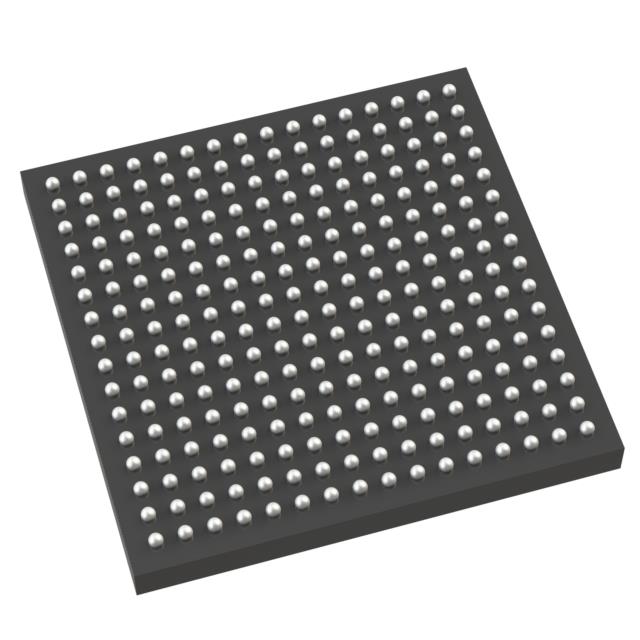
EPM7512BFC256-5 Overview
The EPM7512BFC256-5 is a high density CPLD from the MAX 7000B family, designed to handle complex control and interface logic in digital systems. It offers about 10,000 usable gates and 512 macrocells, arranged to support flexible decoding, state machines, and bus handling in one device. The CPLD uses EEPROM based configuration with a 2.5 V internal supply, so the logic is non volatile and powers up ready for use without external configuration memory. Housed in a 256 ball FBGA package, it supports a large number of user I O pins, making it suitable for dense boards that require many signal terminations within a compact footprint. Typical uses include glue logic, address decoding, peripheral interfacing, and board level customization in communication, industrial, and embedded applications. Looking for EPM7512BFC256-5? Contact us to check current stock, lead time, and pricing.
SameFrame Pin-Out Example of EPM7512BFC256-5
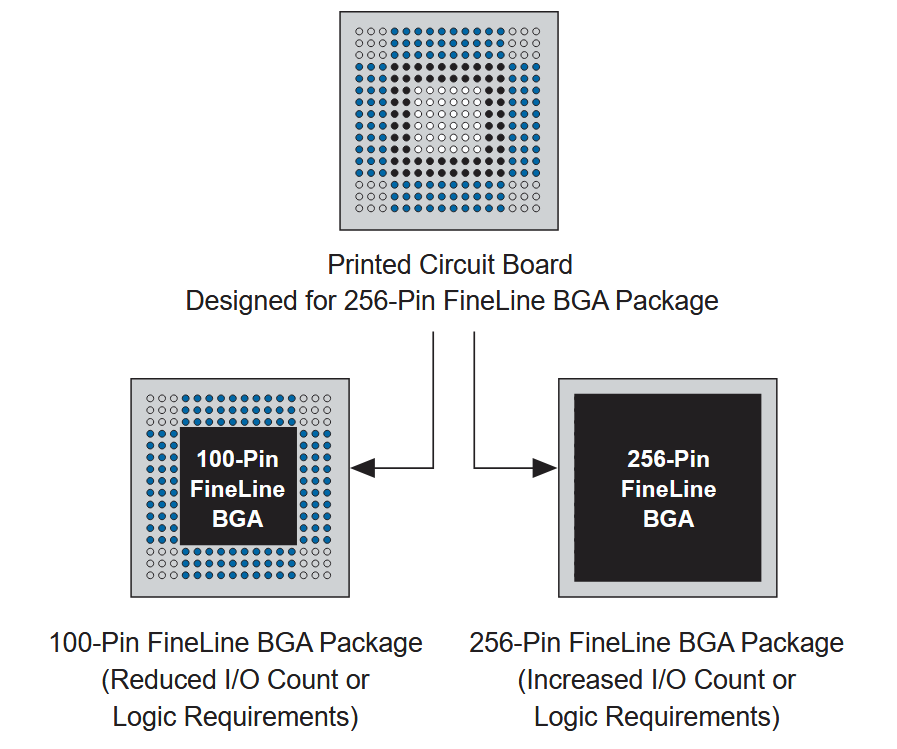
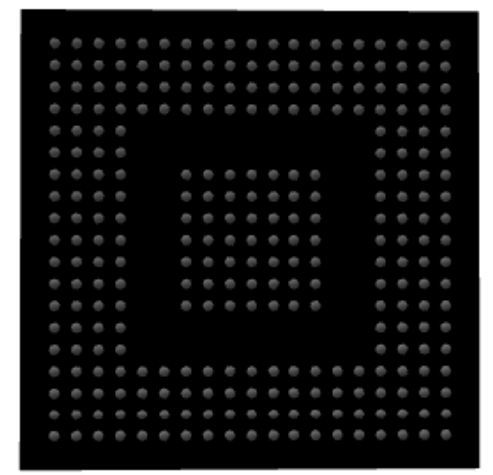
Printed circuit board layout is designed for a 256 pin FineLine BGA package, while the SameFrame pin out concept aligns a 100 pin FineLine BGA device to a subset of the same solder ball positions, allowing both packages to mount on the same board footprint. The central image represents the common land pattern on the board, and the lower images label the compatible 100 pin and 256 pin FineLine BGA options, described respectively as reduced and increased I O count or logic requirements. Arrows between the board and the two package drawings indicate that one layout can support devices with different pin counts, enabling migration across members of the MAX 7000B family such as EPM7512BFC256-5 without changing the underlying board design.
EPM7512BFC256-5 CAD Model
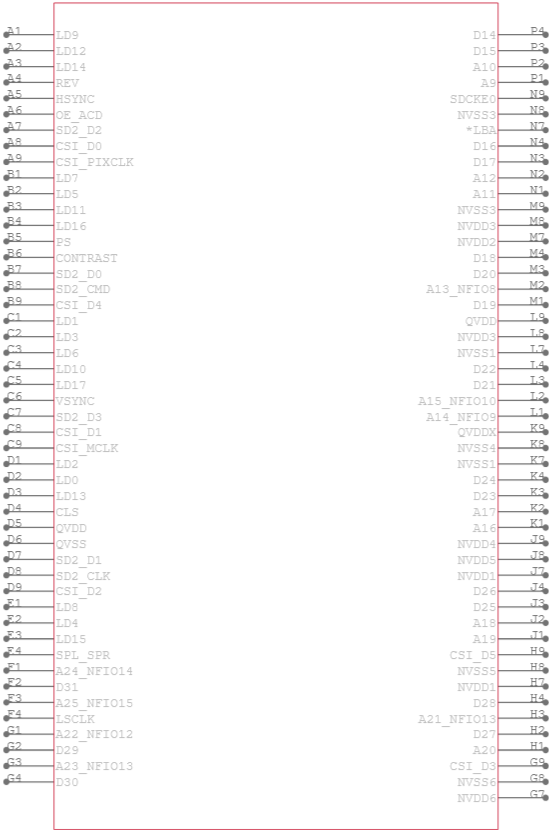
EPM7512BFC256-5 Symbol
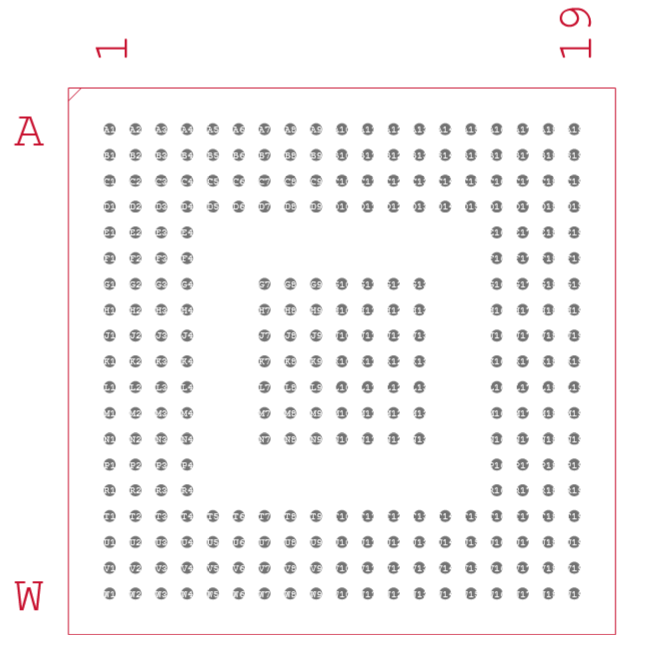
EPM7512BFC256-5 Footprint
EPM7512BFC256-5 3D Model
Features of EPM7512BFC256-5
EEPROM-Based Logic Architecture
The EPM7512BFC256-5 uses an EEPROM based logic structure that stores configuration data inside the device. This allows the CPLD to power up ready for use without relying on external memory, giving stable behavior across repeated on and off cycles. The architecture maintains its programmed functions even when the system is fully powered down.
Internal Core Voltage Operation
The device runs from an internal supply that stays within a range of about 2.375 V to 2.625 V, with 2.5 V as the typical level. This range supports steady operation across different board conditions and helps keep switching behavior predictable. It also allows the CPLD to work within systems that follow low voltage design practices.
In System Programmability Through JTAG
The EPM7512BFC256-5 supports updates through the IEEE 1149.1 JTAG interface, letting users program or adjust the device while it remains soldered to the board. This makes it practical to refine logic functions, check connectivity, or apply revisions during development and testing. The process works without removing the CPLD or interrupting surrounding components.
High Logic Density Using Macrocells and LABs
A total of 512 macrocells are arranged into 32 logic array blocks, giving the device a layout that handles many layers of control and decoding tasks. Each macrocell can be configured to support a range of logic functions, letting designers combine simple and wide expressions in one device. This structure helps the CPLD manage large sets of related signals.
Usable Gate Capacity for Complex Designs
The EPM7512BFC256-5 provides about 10,000 usable gates, offering enough room to replace multiple discrete logic components with one programmable device. This gate count is suitable for systems that need wide decoding, timing control, or custom state behavior in a compact area. It supports logic consolidation without adding extra board space.
Wide User I O Resources
With 212 user I O pins, the device supports designs that require many connection points for buses, control lines, or peripheral interfaces. The high pin count allows direct routing of multiple signals to and from the CPLD without additional buffers. This helps simplify board layout in dense systems.
Compact 256 FBGA Package
The 256 ball FBGA package uses a 17 by 17 layout that fits well in compact circuit boards. Its surface mount format helps reduce overall height while giving clear routing paths underneath the device. The footprint supports stable placement and allows tight component spacing in modern assemblies.
Fast Propagation Characteristics
The CPLD offers propagation delays near 5.5 ns, giving responsive behavior for logic paths that need quick transitions. This timing supports applications where signals must move through several stages without large delays. It helps maintain clean, predictable flow through control and interface circuits.
High Maximum Operating Frequency
The device reaches operating speeds around 160 MHz, with this grade supporting about 163.9 MHz in typical use. This frequency range allows the CPLD to handle rapid state changes and timing driven processes. It performs well in systems where control signals update at higher rates.
Commercial Temperature Compliance
The operating range of 0°C to 70°C supports stable use in typical indoor environments. The device maintains its programmed behavior and timing across this range, making it suitable for standard commercial equipment. This temperature window covers common room to warm conditions seen in enclosed systems.
EPM7512BFC256-5 Technical Specifications
| Product Attribute | Attribute Value |
| Manufacturer | Intel |
| Voltage Supply - Internal | 2.375V ~ 2.625V |
| Supplier Device Package | 256-FBGA (17x17) |
| Series | MAX® 7000B |
| Programmable Type | In System Programmable |
| Package / Case | 256-BGA |
| Package | Tray |
| Operating Temperature | 0°C ~ 70°C (TA) |
| Number of Macrocells | 512 |
| Number of Logic Elements/Blocks | 32 |
| Number of I/O | 212 |
| Number of Gates | 10000 |
| Mounting Type | Surface Mount |
| Delay Time tpd(1) Max | 5.5 ns |
| Base Product Number | EPM7512 |
MAX 7000B Device Block Diagram of EPM7512BFC256-5
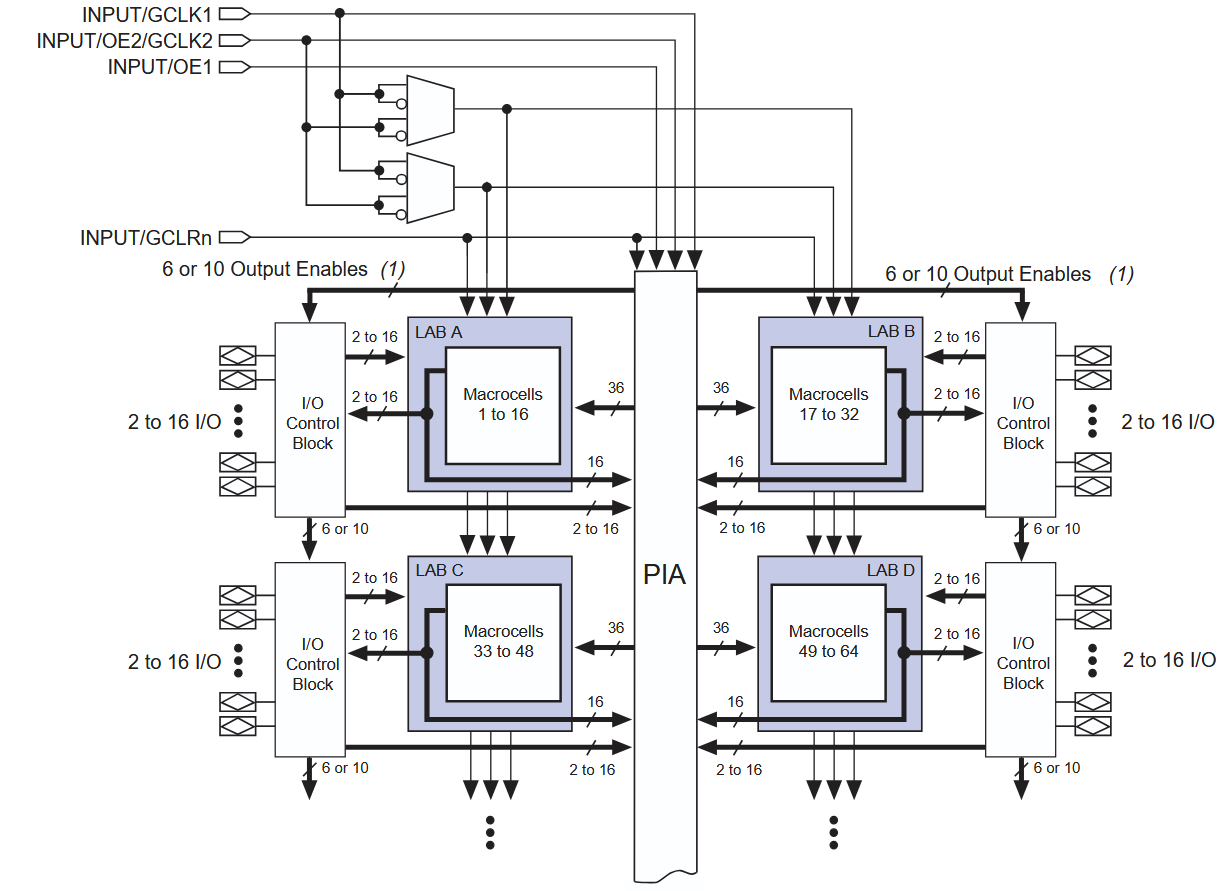
Internal architecture of the EPM7512BFC256-5 is arranged around multiple logic array blocks, each containing groups of macrocells linked by a central programmable interconnect array that routes signals between logic and I/O. Global inputs labeled as clock, clear, and output-enable feed a small control network at the top of the diagram, which distributes shared control signals to every logic block and I/O section. Each side of the device includes I/O control blocks connected to external pins, shown as ranges such as “2 to 16 I/O,” with local connections into nearby logic array blocks and wider access through the interconnect array. Output-enable lines indicated as “6 or 10 Output Enables” fan out toward the I/O structures, allowing groups of outputs to share enable control. Notes beneath the figure explain that device members in the same family may support different counts of these shared enable lines, confirming that the diagram represents the common internal organization used by MAX 7000B devices, including the EPM7512BFC256-5.
MAX 7000B Macrocell of EPM7512BFC256-5
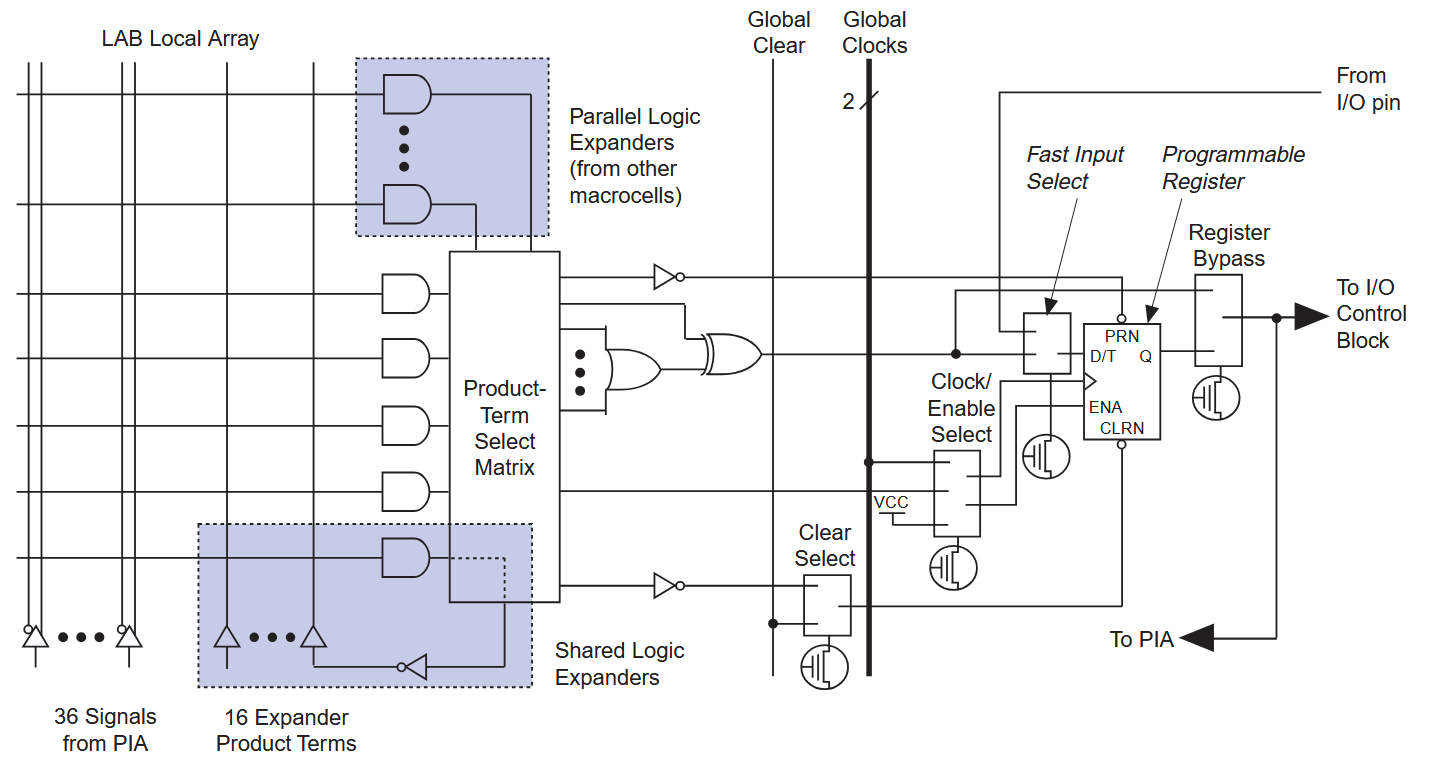
Macrocell structure for EPM7512BFC256-5 combines a LAB local array on the left, where 36 signals from the programmable interconnect array and 16 expander product terms feed a product term select matrix and shared logic expanders, with a control and register section on the right that manages clocking, clearing, and data routing. Parallel logic expanders from neighboring macrocells join the local signals to form the sum of products that drive the main logic gate, which then connects to a programmable register that can be bypassed for purely combinational operation. Global clear and two global clock lines enter dedicated select circuits, allowing independent selection of fast input, clock or enable source, and clear behavior for each macrocell. The registered or combinational output drives both the I/O control block and the programmable interconnect array, while an optional fast input path from the external I/O pin provides a direct connection into the register section for low latency signal handling.
Applications of EPM7512BFC256-5
Telecommunications and Networking Systems
The EPM7512BFC256-5 is widely used in networking switches, communication modules, and telecom platforms that rely on dense logic resources to manage multiple interfaces. It can handle bus coordination, timing control, and signal routing in systems where many data paths must operate together. Its non volatile configuration allows the device to retain custom logic for protocol handling and system management across power cycles.
Automotive Electronic Control Subsystems
Automotive subsystems that operate within commercial temperature limits can use this CPLD to manage control signals and support custom logic functions. It fits applications where compact logic consolidation helps reduce board complexity, such as small control units or signal conditioning blocks. The device maintains stable behavior across repeated starts, making it suitable for units that cycle frequently.
Industrial Automation and Factory Control
In industrial environments, the device supports tasks such as state machine control, I O mapping, and small protocol functions that help coordinate equipment behavior. Its predictable timing and ready at power up configuration work well in systems that run for long periods or restart in regular intervals. This makes it a practical choice for controllers, monitoring units, and automation modules.
Consumer and Embedded Electronics
The device is suited for embedded products that need programmable logic to manage internal coordination between subsystems. It can support interface adaptation, basic timing control, and custom signal organization in compact boards. Its ability to store logic internally helps keep system behavior consistent without adding external memory parts.
Legacy System Support and Design Maintenance
Many older designs use the MAX 7000B family, and the EPM7512BFC256-5 can serve as a direct replacement in these systems. It supports ongoing maintenance, repairs, and gradual updates without changing the overall architecture of the board. This allows continued use of established designs while keeping hardware aligned with available components.
Advantages and Disadvantages of EPM7512BFC256-5
Advantages
• High logic density with 512 macrocells and around 10k usable gates supports broad system integration
• EEPROM based configuration allows updates and adjustments while the device remains on the board
• Fast pin to pin response and stable timing support high speed digital paths
• Wide I O count and a 256 ball FBGA package allow flexible routing for dense designs
• Pin compatibility within the MAX 7000B family supports reuse of existing design layouts
• Non volatile configuration removes the need for an external memory device
• Well established device family with accessible technical resources
Disadvantages
• Not rated for lead free requirements, which can limit use in some regulated environments
• Commercial temperature range of 0°C to 70°C may not suit wider temperature applications
• Uses older 2.5 V and 3.3 V process levels, which can lead to higher power use than newer logic families
• Large BGA package may exceed the needs of designs that require fewer pins
EPM7512BFC256-5 Alternatives
| Part Number | Manufacturer | Key Features | Use Case/Notes |
| EPM7512BFC256-5N | Intel | MAX® 7000B CPLD with 512 macrocells and about 10k usable gates. In-system programmable EEPROM architecture, 256-ball FBGA package with high I/O count, and low-voltage core supply suited for modern 2.5 V designs. | Good for glue logic, simple state machines, and I/O expansion. Useful in legacy refresh projects where MAX 7000B tool flows and pin-compatible BGA footprints are preferred. |
| EPM7512BFC256-5GZ | Intel | Same MAX® 7000B logic capacity and ISP features with a lead-free, RoHS-compliant variant. High-density 256-BGA, wide I/O availability, and stable timing suited for control and interfacing tasks. | A drop-in choice for environmentally compliant builds. Fits dense digital control, communication backplanes, and board-space-constrained designs needing many I/O pins. |
| EPM7512BFC256-7 | Intel | MAX® 7000B CPLD with 512 macrocells and in-system programmability. Offers the same 256-BGA footprint and I/O resources, with a speed grade tuned for balanced timing and power. | Well-suited to cost-sensitive control logic, moderate-speed interfaces, and product variants where tighter speed is not required but board and tool compatibility must be maintained. |
About Intel
Intel is a large semiconductor company based in the United States, founded in 1968 and headquartered in Santa Clara, California. You work with a supplier whose core products include microprocessors, chipsets, programmable logic devices, and other integrated circuits used in computing and communication systems. Through its programmable logic lines, which include CPLDs and FPGAs, Intel supports designs ranging from embedded control to data and signal processing. Its long history in device design and high volume manufacturing provides a stable context for parts such as the EPM7512BFC256-5 within digital and mixed signal systems.
Conclusion
The EPM7512BFC256-5 brings together speed, flexibility, and a large amount of logic in one device. You get a CPLD that starts instantly, handles many signals, and stays easy to update through JTAG. Its architecture supports wide decoding, state machines, and interface logic without needing extra components. You can fit it into a range of systems, from communication hardware to embedded boards, and rely on its steady timing and clear behavior. With its compact BGA package and high I/O count, it gives you room to grow your design while keeping the layout manageable. Overall, it offers a dependable way to control and organize digital signals in many types of projects.
Datasheet PDF
EPM7512BFC256-5 Datasheet:
About us
ALLELCO LIMITED
Read more
Quick inquiry
Please send an inquiry, we will respond immediately.
Frequently Asked Questions [FAQ]
1. What does the EPM7512BFC256-5 mainly do?
It handles custom logic tasks inside a digital system. You can use it to manage state machines, decoding, timing control, and bus-related functions. It helps you replace many small logic parts with one programmable device.
2. Can the EPM7512BFC256-5 be updated while it is on the board?
Yes. It supports in-system programming through JTAG, so you can update or adjust its logic without removing it. This makes testing and fine-tuning much easier.
3. How many I/O pins does this CPLD offer?
It provides 212 user I/O pins, giving you plenty of room for buses, control lines, and interface connections. This makes it useful in designs that need many signal paths.
4. What supply voltages does it use?
The device uses an internal 2.5 V core supply and typically works with 3.3 V I/O. This matches many common digital systems and keeps the design straightforward.
5. Where is the EPM7512BFC256-5 commonly used?
You can find it in telecom equipment, industrial controllers, embedded products, and older systems that use the MAX 7000B family. Its non-volatile setup and wide I/O support make it helpful in many kinds of digital boards.
Why the EPF10K30EFC256-2 Works Well in Mid-Scale Digital Projects
on December 5th
Half Subtractor Explained: Logic Gates, Circuit, Truth Table and Applications
on December 4th
Popular Posts
-

Complex Instruction Set Computers: How They Changed Computing?
on April 18th 147754
-

USB-C Pinout and Features
on April 18th 111931
-
Using Xilinx Unified Simulation Primitives: A Comprehensive Guide to FPGA Design and Simulation
on April 18th 111349
-

Power Supply Voltages in Electronics: Meaning of VCC, VDD, VEE, VSS, and GND
on April 18th 83718
-

RJ45 Connector Guide: Pinout, Wiring, Cable Types, and Uses
on January 1th 79505
-

The Ultimate Guide to Wire Color Codes in Modern Electrical Systems
The way our electrical systems use colors isn’t just for looks. Each wire color now indicates a specific function, making it easier to identify and handle electrical components correctly during ins...on January 1th 66873
-

Quality (Q) Factor: Equations and Applications
The quality factor, or 'Q', is important when checking how well inductors and resonators work in electronic systems that use radio frequencies (RF). 'Q' measures how well a circuit minimizes energy...on January 1th 63010
-
Purge Valve Guide: Function, Symptoms, Testing, and Replacement for Optimal Engine Performance
The purge valve is a key part of a car’s system that helps keep the air clean by managing fuel vapors before they can escape into the atmosphere. This not only helps the environment by reducing pol...on January 1th 62960
-

Achieving Peak Performance with the Maximum Power Transfer Theorem
The Maximum Power Transfer Theorem explains how energy from a source, such as a battery or generator, flows to a connected load. It shows the exact condition where the load receives the most power....on January 1th 54080
-

A23 Battery Specifications and Compatibility
The A23 battery is a small, cylinder-shaped battery with high voltage. Also called 23A, 23AE, or MN21, it runs at 12 volts and much higher than AA or AAA batteries. Its special design make...on January 1th 52101
HOT Part Number
-

MB9AF316NAPMC-G-JNE2
Infineon Technologies
IC MM MCU
BD3539FVM-TR
Rohm Semiconductor
IC REG CONV DDR BUS 1OUT 8MSOP
SN74LV4046APWR
Texas Instruments
IC PHASE LOCK LOOP 16TSSOP
SRR1260-330M
Bourns Inc.
FIXED IND 33UH 3A 60 MOHM SMD
KDZVTR5.1B
Rohm Semiconductor
DIODE ZENER 5.4V 1W PMDU
LT1175CQ-5#TRPBF
Analog Devices Inc.
IC REG LINEAR -5V 500MA 5DDPAK
PIC16C57C-04/SP
Microchip Technology
IC MCU 8BIT 3KB OTP 28SPDIP
DS1706RESA+T&R
Analog Devices Inc./Maxim Integrated
IC SUPERVISOR 1 CHANNEL 8SOIC
2SB1132T100Q
Rohm Semiconductor
TRANS PNP 32V 1A MPT3
SP483EN-L/TR
MaxLinear, Inc.
IC TRANSCEIVER HALF 1/1 8SOIC
52745-1296
Affinity Medical Technologies - a Molex company
CONN FFC TOP 12POS 0.50MM R/A
MCP2562T-H/SN
Microchip Technology
IC TRANSCEIVER HALF 1/1 8SOIC
MIC5206-5.0BM5
Micrel Inc.
IC REG LINEAR LDO
XTR117AIDRBR
Texas Instruments
IC CURRENT TRANSMITTER 8SON
ADUM3200BRZ
Analog Devices Inc.
DGTL ISO 2500VRMS 2CH GP 8SOIC
CL05C2R2CB5NNND
Samsung Electro-Mechanics
CAP CER 2.2PF 50V NP0 0402
MAX6363PUT46+T
Analog Devices Inc./Maxim Integrated
IC SUPERVISOR 1 CHANNEL SOT23-6
CC1101RGPR
Texas Instruments
IC RF TXRX ISM<1GHZ 20VFQFN -
NTGS3443T2G
onsemi
MOSFET P-CH 20V 2.2A 6TSOP
LM2588S-12
Texas Instruments
IC REG MULT CONFG 12V 5A TO263-7
ISL80030AFRZ-T
Renesas Electronics America Inc
IC REG BUCK ADJUSTABLE 3A 8DFN
TPS65930A2ZCH
Texas Instruments
IC PWR MGMT 4LDO TXRX 139NFBGA
MC33375D-2.5R2G
onsemi
IC REG LINEAR 2.5V 300MA 8SOIC
A700V107M006ATE015
KEMET
CAP ALUM POLY 100UF 20% 6.3V SMD
ICS932S801AGLFT
Renesas Electronics America Inc
IC K8 CLOCK CHIP 48-TSSOP
INA234AIYBJR
Texas Instruments
IC CURR SENSE 1 CIRCUIT 8DSBGA
MAX9950DCCB+D
Analog Devices Inc./Maxim Integrated
IC PARAMETRIC MEAS UNIT 64TQFP
MAX9938FELT+T
Analog Devices Inc./Maxim Integrated
IC CURRENT SENSE 1 CIRCUIT 6UDFN
FTSH-108-01-LM-DH-C-TR
Samtec Inc.
CONN HEADER SMD R/A 16POS 1.27MM
ACS780LLSTR-100B-T
Allegro MicroSystems
SENSOR CUR HALL 100A 7POWERSMD
CS445AT
Infineon Technologies
IC SCREEN CNTRL TRUETOUCH
CY62157DV30L-70BVXI
Cypress Semiconductor Corp
IC SRAM 8MBIT PARALLEL 48VFBGA
MAX7033EUI+
Analog Devices Inc./Maxim Integrated
RF RX ASK 315MHZ/433MHZ 28TSSOP
HIP5010IS
Harris Corporation
HIP5010 - 7V, 17 AMP SYNCHROFET
PS2706-1-F3-A
CEL
OPTOISOLATOR 3.75KV DARL 4SMD
RT9078-25GJ5
Richtek USA Inc.
IC REG LIN 2.5V 300MA TSOT23-5 -
SM5S24A
Rectron USA
TVS DIODE 28.1VWM 38.9VC DO218
DZ23C6V8-7
Diodes Incorporated
DIODE ZENER ARRAY 6.8V SOT23-3
08052U1R5BAT2A
KYOCERA AVX
CAP CER 1.5PF 200V NP0 0805
ISL85410FRZ-T
Renesas Electronics America Inc
IC REG BUCK ADJUSTABLE 1A 12DFN
LE88266DLC
Microchip Technology
IC TELECOM INTERFACE 80LQFP
XC5VSX50T-2FFG665C
AMD
IC FPGA 360 I/O 665FCBGA
MC78LC28NTRG
onsemi
IC REG LINEAR 2.8V 80MA 5TSOP
LTC4364IS-2#TRPBF
Analog Devices Inc.
SURGE STOPPER W/DIODE SMD
XC6221B102MR-G
Torex Semiconductor Ltd
IC REG LINEAR 1V 200MA SOT25
74AHC1GU04W5-7
Diodes Incorporated
IC INVERTER 1CH 1-INP SOT25
PM8903
STMicroelectronics
IC REG BUCK ADJ 3A 16VFQFPN
NR4012T221M
Taiyo Yuden
FIXED IND 220UH SMD
DTA123ECAT116
Rohm Semiconductor
PNP -100MA -50V DIGITAL TRANSIST
MC34167THG
onsemi
IC REG BUCK BST ADJ 5.5A TO220-5
LMK107SD153KA-T
Taiyo Yuden
CAP CER 0.015UF 10V 0603
LX2208ILD-TR
Microsemi Corporation
IC BATT CHG LI-ION 1CELL 12MLPD
CLC4601ISO14X
MaxLinear, Inc.
IC OPAMP CFA 4 CIRCUIT 14SOIC
2SC0106T2A1-12
Power Integrations
IC GATE DRVR HALF-BRIDGE MODULE