Cold Cranking Amps (CCA) Explained: Types, Test, and Maintain the Right Car Battery
This guide explains what Cold Cranking Amps (CCA) are and why they matter when choosing a car battery, especially in cold weather. It shows how much CCA your car needs, how CCA compares to other ratings like CA and MCA, how to test your battery, how to take care of it, and how to choose the right one based on your climate and engine.Catalog
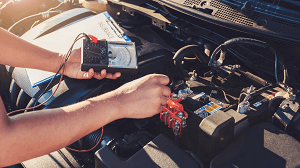
Figure 1. Battery CCA Measurement Setup Using a Multimeter
What are Cold Cranking Amps (CCA)?
Cold Cranking Amps, or CCA, is a standard measurement that shows how well a car battery can start an engine in very cold weather. It specifically measures the number of amps a 12-volt battery can deliver for 30 seconds at 0°F (-18°C), while still keeping the voltage above 7.2 volts.
Cold weather puts a strain on both the battery and the engine. Battery efficiency drops, and oil becomes thicker, making the engine harder to turn over. That’s why a reliable CCA rating is important, it reflects how much power the battery can provide under these difficult conditions.
How Many CCAs Does Your Vehicle Need?
The amount of CCA your vehicle needs depends on two main things: how cold it gets where you live, and what kind of engine your vehicle has.
As temperatures drop, starting your engine becomes harder. Cold air thickens engine oil and reduces the chemical reaction inside the battery. So, the colder the climate, the more CCA your battery should have to overcome this resistance.
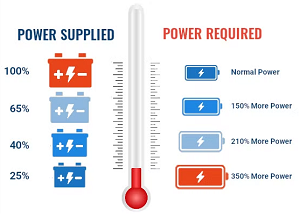
Figure 2. CCA Temperature Chart
Bigger engines need more power to start. Diesel engines, which operate under higher compression, demand more CCA than gasoline engines of the same size. Gasoline engines need about 1 CCA per cubic inch of engine displacement. Diesel engines need roughly 2 CCAs per cubic inch.
Here’s a quick reference table showing suggested CCA ranges by vehicle type and climate conditions:
|
Vehicle
Type / Engine |
Climate |
Suggested
CCA |
|
Small
car (4-cylinder) |
Warm |
300–400
CCA |
|
Small
car (4-cylinder) |
Cold |
400–500
CCA |
|
Mid-size
car (6-cylinder) |
Warm |
400–500
CCA |
|
Mid-size
car (6-cylinder) |
Cold |
500–600
CCA |
|
Full-size/SUV
(8-cylinder) |
Warm |
500–600
CCA |
|
Full-size/SUV
(8-cylinder) |
Cold |
600–800
CCA |
|
Diesel
(light truck) |
Warm |
700–800
CCA |
|
Diesel
(light truck) |
Cold |
800–1000+
CCA |
|
Heavy-duty/commercial |
Any |
1000+
CCA |
|
Motorcycle/ATV |
Any |
150–300
CCA |
Types of Cranking Power Ratings
Understanding the differences between cranking ratings helps ensure the battery you choose fits your vehicle and climate.
CCA (Cold Cranking Amps)
Cold Cranking Amps (CCA) measure how many amps a battery can supply for 30 seconds at 0°F while maintaining at least 7.2 volts. This rating is great for vehicles operating in cold climates, where starting an engine puts extra strain on the battery. The colder the temperature, the harder it is for the engine to turn over, making a high CCA rating important. Batteries with higher CCA values perform better in freezing conditions, ensuring reliable starts even on icy mornings.
CA (Cranking Amps) or MCA (Marine Cranking Amps)
Cranking Amps (CA), also called Marine Cranking Amps (MCA), are measured at a milder temperature of 32°F. Because of the warmer test condition compared to CCA, these ratings tend to be higher. This type of rating is commonly used in marine environments or in vehicles that operate primarily in moderate or warm weather. While helpful, CA is less relevant in extreme cold, so it's important to match the rating to your climate.
HCA (Hot Cranking Amps)
Hot Cranking Amps (HCA) represent a battery’s starting power at 80°F, a temperature typical in warm or hot climates. Batteries naturally perform better in heat, so this rating is usually higher than both CCA and CA. It’s a useful measure for vehicles in tropical or desert regions where extreme heat is the main concern. HCA helps ensure consistent starting performance when the engine compartment is already warm.
PHCA (Pulse Hot Cranking Amps)
Pulse Hot Cranking Amps (PHCA) measure the battery’s ability to deliver a quick burst of high current for a few seconds at around 77°F. This rating is important for high-performance applications like racing or vehicles equipped with advanced AGM or lithium batteries. PHCA focuses on peak power output rather than sustained starting power. It’s designed to reflect scenarios where engines demand an intense initial surge to start quickly and reliably.
RC (Reserve Capacity)
Reserve Capacity (RC) indicates how long a battery can deliver 25 amps at 80°F before its voltage drops below 10.5 volts. Unlike cranking ratings, RC isn’t about starting the engine but about how long a battery can keep important systems running if the alternator fails. A higher RC is valuable in vehicles with many electronic accessories or in marine situations. This rating reflects the battery’s endurance and backup power potential more than its starting strength.
How to Test Cold Cranking Amps?
To perform a CCA test accurately and safely, gather the following tools and equipment:
• Digital Battery Tester with CCA Function
• Manual Load Tester (Alternative Option)
• Wear Insulated Gloves and Eye Protection
• Multimeter
Step 1: Fully Charge the Battery
Before testing, ensure the battery is fully charged. A partially charged battery can give falsely low CCA readings. Use a battery charger if needed and allow the battery to rest for at least 30 minutes after charging.
Step 2: Clean the Battery Terminals
Dirty or corroded terminals can interfere with the accuracy of your test. Use a wire brush or terminal cleaner to remove any build-up. A clean connection ensures consistent current flow.
Step 3: Connect the Tester Properly
Attach the red (positive) clamp to the positive terminal and the black (negative) clamp to the negative terminal. Make sure the clamps are secure and have solid contact.
Step 4: Input Battery Information
Turn on the tester and select the correct battery type (AGM, flooded, gel, etc.). Enter the manufacturer’s listed CCA rating, typically found on a label on the battery case.
Step 5: Run the Test
Initiate the test. The tester will simulate a cold engine start by applying a load and measuring how much current the battery can deliver. The display will then show the actual measured CCA along with a pass/fail result, depending on your input.
Once the test is complete, interpret the results as follows:
If the measured CCA is equal to or higher than the rated value, the battery is in good shape. If it's slightly lower (within 10%), the battery still works but may be aging. If it's much lower, the battery should be replaced, as it may not start the car in cold weather.
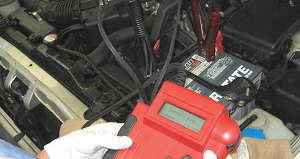
Figure 3. CCA Test Result
Manual Load Testing Option
If you don’t have a digital tester with CCA functionality, you can perform a manual load test using the following method:
Step 1: Apply a Load
Use a load tester to draw a current equal to half of the battery’s rated CCA for 15 seconds.
Step 2: Monitor Voltage
During the load, watch the battery voltage. If it remains above 9.6 volts at 70°F (21°C), the battery is still considered serviceable.
Step 3: Temperature Adjustment
Battery performance changes with temperature. If your tester doesn’t automatically compensate for this, use the following rule of thumb: subtract 0.1 volts from the 9.6V benchmark for every 10°F (6°C) below 70°F.
Step 4: Rest After Charging
Always allow the battery to rest for 30 minutes after charging before testing. This prevents surface charge from skewing results.
Comparing CCA, CA, and MCA
|
Feature |
CCA (Cold
Cranking Amps) |
CA (Cranking
Amps) |
MCA (Marine
Cranking Amps) |
|
Test Temperature |
0°F (-17.8°C) |
32°F (0°C) |
32°F (0°C) |
|
Minimum Voltage |
≥ 7.2V |
≥ 7.2V |
≥ 7.2V |
|
Typical Amp Range |
300 – 1000 |
400 – 1000 |
400 – 1000 |
|
Application Focus |
Cold climate automotive starting |
Moderate climate automotive use |
Marine engines and high-vibration uses |
|
Environment |
Sub-zero or winter conditions |
Mild weather or warm climates |
Wet, humid, or salty marine environments |
|
Battery Type |
Automotive lead-acid |
Automotive lead-acid |
Marine deep-cycle/starting hybrids |
|
Performance Duration |
30 seconds at low temp |
30 seconds at 32°F |
30 seconds at 32°F |
|
Labeling Standard |
SAE J537 |
Often JIS or SAE |
Often ABYC or SAE |
|
Vibration Resistance |
Moderate |
Low to moderate |
High |
|
Corrosion Resistance |
Standard |
Standard |
Enhanced (for marine exposure) |
|
Power Delivery |
Strongest under extreme cold |
Stronger under moderate cold |
Strong under wet start conditions |
|
Lifespan (Typical) |
Medium |
Medium |
Medium to high (depending on quality) |
|
Weight (Typical) |
Moderate |
Moderate |
Heavier due to thicker plates |
|
Cost |
Standard |
Slightly cheaper than CCA |
Higher due to marine-grade components |
How to Maintain Long-Term Battery Operation?
To keep your battery in good shape year-round:
• Clean terminals regularly to prevent corrosion.
• Turn off lights and electronics before shutting off the engine.
• Ensure battery cables are tight and secure.
• Park in the shade during summer to reduce heat damage.
• Use battery insulation in winter.
• If you drive infrequently, use a battery maintainer.
• Avoid short trips, longer drives help recharge the battery.
• Test voltage regularly with a multimeter.
• Replace aging batteries before they fail unexpectedly.
Following these habits extends battery life and helps ensure reliable cold-weather starts.
Figure 4. How to Maintain Long-Term Battery Operation
Conclusion
Cold Cranking Amps (CCA) shows how much power a battery can give to start your car in freezing temperatures. How much CCA you need depends on how cold it gets where you live and the size or type of engine you have. Ratings like CA, MCA, HCA, and PHCA are also helpful, but CCA is the most important for cold weather. Testing your battery, keeping it clean, and choosing the right size and type will help it last longer and work better. A good battery with the right CCA gives you reliable starts and fewer problems year-round.
About us
ALLELCO LIMITED
Read more
Quick inquiry
Please send an inquiry, we will respond immediately.
Frequently Asked Questions [FAQ]
1. Is a higher CCA battery better?
Yes, a higher CCA (Cold Cranking Amps) rating is generally better because it means the battery can provide more starting power in cold temperatures. However, it should match the vehicle manufacturer's specifications to ensure efficiency and avoid unnecessary costs.
2. Are AGM batteries better than standard lead-acid for cold weather?
Yes, AGM (Absorbent Glass Mat) batteries perform better in cold weather due to lower internal resistance, better cold cranking performance, and higher durability. They’re also maintenance-free, making them ideal for modern vehicles.
3. What is the difference between CCA and battery capacity in amp-hours (Ah)?
CCA measures how much current a battery can deliver in a short burst at cold temperatures, while amp-hours (Ah) represent how much energy it can supply over time. CCA affects starting power; Ah affects how long electronics can run.
4. Will a higher CCA battery drain my alternator or electrical system?
No, a battery with higher CCA won’t harm your alternator. Your alternator supplies power as needed. The CCA rating only indicates starting capability, not the actual power drawn under normal operation.
5. Does battery age affect its CCA rating?
Yes. As a battery ages, its internal chemistry degrades, reducing its ability to deliver high current. A battery that once met its CCA rating may no longer perform to spec after a few years of use or improper storage.

SR Flip-Flop Knowledge Guide—Working Principle, Advantages, Disadvantages, Truth Table, and Differences from RS Flip-Flop
on April 27th

T Trigger Knowledge Guide - Pros and Cons, How It Works, Types
on April 26th
Popular Posts
-

Complex Instruction Set Computers: How They Changed Computing?
on April 18th 147749
-

USB-C Pinout and Features
on April 18th 111910
-
Using Xilinx Unified Simulation Primitives: A Comprehensive Guide to FPGA Design and Simulation
on April 18th 111349
-

Power Supply Voltages in Electronics: Meaning of VCC, VDD, VEE, VSS, and GND
on April 18th 83714
-

RJ45 Connector Guide: Pinout, Wiring, Cable Types, and Uses
on January 1th 79502
-

The Ultimate Guide to Wire Color Codes in Modern Electrical Systems
The way our electrical systems use colors isn’t just for looks. Each wire color now indicates a specific function, making it easier to identify and handle electrical components correctly during ins...on January 1th 66871
-

Quality (Q) Factor: Equations and Applications
The quality factor, or 'Q', is important when checking how well inductors and resonators work in electronic systems that use radio frequencies (RF). 'Q' measures how well a circuit minimizes energy...on January 1th 63005
-
Purge Valve Guide: Function, Symptoms, Testing, and Replacement for Optimal Engine Performance
The purge valve is a key part of a car’s system that helps keep the air clean by managing fuel vapors before they can escape into the atmosphere. This not only helps the environment by reducing pol...on January 1th 62948
-

Achieving Peak Performance with the Maximum Power Transfer Theorem
The Maximum Power Transfer Theorem explains how energy from a source, such as a battery or generator, flows to a connected load. It shows the exact condition where the load receives the most power....on January 1th 54077
-

A23 Battery Specifications and Compatibility
The A23 battery is a small, cylinder-shaped battery with high voltage. Also called 23A, 23AE, or MN21, it runs at 12 volts and much higher than AA or AAA batteries. Its special design make...on January 1th 52091
HOT Part Number
-

BD9B100MUV-E2
Rohm Semiconductor
IC REG BUCK ADJ 1A 16VQFN
UPD70F3539AF5A9-PN7-Q-A
Renesas Electronics America Inc
IC MICROCONTROLLER
18081A621JAT2A
KYOCERA AVX
CAP CER 620PF 100V NP0 1808
FDN340P
onsemi
MOSFET P-CH 20V 2A SUPERSOT3
70231-101
Amphenol ICC (FCI)
CONN RCPT BLADE PWR 8POS EDGE MT
MPSW42RLRAG
onsemi
TRANS NPN 300V 0.5A TO92
MC7824BT
onsemi
IC REG LINEAR 24V 1A TO220AB
AD8009ARZ-REEL
Analog Devices Inc.
IC OPAMP CFA 1 CIRCUIT 8SOIC
LT1815CS5#TRPBF
Analog Devices Inc.
IC OPAMP VFB 1 CIRCUIT TSOT23-5
DG411DYZ
Renesas Electronics America Inc
IC SWITCH SPST-NCX4 35OHM 16SOIC
VFT2060C-M3/4W
Vishay General Semiconductor - Diodes Division
DIODE SCHOTTKY 20A 60V ITO-220AB
TSX562AIYST
STMicroelectronics
IC CMOS 2 CIRCUIT 8MINISO
MR256D08BMA45
Everspin Technologies Inc.
IC RAM 256KBIT PARALLEL 48FBGA
VSC3312YYP-01
Microchip Technology
IC SWITCH 16X16 6.5GBPS 196FCBGA
XC68HC908GP20CFB
Motorola
TSG 8BIT20K FLASH
CSR8811A08-ICXR-R
Qualcomm
IC RF TXRX+MCU BLUETOOTH
MPSW05
onsemi
TRANS NPN 60V 0.5A TO92
1N4055R
Solid State Inc.
DIODE GEN PURP REV 900V 275A DO9 -

ASX342ATSC00XPED0-DP
onsemi
IMAGE SENSOR VGA 1/4 CIS SOC
0433.125NR
Littelfuse Inc.
FUSE BOARD MNT 125MA 125VAC/VDC
1SMA5941BT3G
onsemi
DIODE ZENER 47V 1.5W SMA
DCP010512BP-U/700
Texas Instruments
DC DC CONVERTER 12V 1W
1-1734344-1
TE Connectivity AMP Connectors
CONN D-SUB HD RCPT 15P R/A SLDR
KSD1621STF
onsemi
TRANS NPN 25V 2A SOT89-3
BQ24161RGET
Texas Instruments
IC BATT CHG LI-ION 1CELL 24VQFN
BTA26-600BW
STMicroelectronics
TRIAC ALTERNISTOR 600V 25A TOP3
NCP1239DD65R2G
onsemi
IC OFFLINE SWITCH FLYBACK 7SOIC
TMS320TCI6482BZTZA
Texas Instruments
TMS320 - DIGITAL SIGNAL PROCESSO
BQ20Z90DBTR-V150
Texas Instruments
IC GAS GAUGE LI-ION 30TSSOP
PCMB104T-1R0MT
Susumu
FIXED IND 1UH 18A 3.3 MOHM SMD
CY29942AXCT
Infineon Technologies
IC CLK BUFFER 1:18 200MHZ 32TQFP
CC0402KRX7R9BB561
YAGEO
CAP CER 560PF 50V X7R 0402
STPS20M60SG-TR
STMicroelectronics
DIODE SCHOTTKY 60V 20A D2PAK
AT25010N-10SC-2.7
Microchip Technology
IC EEPROM 1KBIT SPI 3MHZ 8SOIC
04023A1R0CAT4A
KYOCERA AVX
CAP CER 1PF 25V C0G/NP0 0402
ISL6327IRZ
Intersil
SWITCHING CONTROLLER, VOLTAGE-MO -

LQW18AN75NG0ZD
Murata Electronics
FIXED IND
DFA100BA160
SanRex Corporation
DIODE MODULE 1600V 100A
BAR46AFILM
STMicroelectronics
DIODE ARRAY SCHOTTKY 100V SOT23
MAX825SEUK
Analog Devices Inc./Maxim Integrated
IC SUPERVISOR MPU
MMST2222A-7-F
Diodes Incorporated
TRANS NPN 40V 0.6A SOT323
FODM8801AR2
onsemi
OPTOISO 3.75KV TRANS 4-MINI-FLAT
FJV1845FMTF
Fairchild Semiconductor
SMALL SIGNAL BIPOLAR TRANSISTOR,
EVK105RH5R1JW-F
Taiyo Yuden
CAP CER 5.1PF 16V R2H 0402
6651170-3
TE Connectivity AMP Connectors
CONN EDGE DUAL FMALE 4POS 0.508
KSZ8893FQLI-FX
Microchip Technology
IC SWITCH ETH 3PORT 128QFP
170M6340
Eaton - Bussmann Electrical Division
FUSE SQUARE 400A 1.3KVAC RECT
BCM20741A2KFB1G
Broadcom Limited
SINGLE-CHIP BLUETOOTH
MAX3443EASA+
Analog Devices Inc./Maxim Integrated
IC TRANSCEIVER HALF 1/1 8SOIC
GRM0335C1H9R3DA01D
Murata Electronics
CAP CER 9.3PF 50V C0G/NP0 0201
TNY175PN
Power Integrations
11.5 W (85-265 VAC) 15 W (230 VA
742700726
Würth Elektronik
FERRITE CORE 278 OHM SOLID 4MM
DM74S20N
onsemi
IC GATE NAND 2CH 4-INP 14DIP
P4SMA56CA-E3/61
Vishay General Semiconductor - Diodes Division
TVS DIODE 47.8VWM 77VC DO214AC