The 74LS93 Binary Counter Explained
The 74LS93 is a compact and efficient 4-bit binary counter that supports a range of digital applications. This article explores its functionality, features, and uses, guiding you through its operation and practical benefits. From counting binary values to dividing frequencies, the 74LS93 offers simplicity and flexibility for projects requiring accurate counting and timing solutions.Catalog

Understanding the 74LS93 Binary Counter IC
The 74LS93 is a 4-bit binary counter designed with two built-in up-counters. It combines a mode-2 up-counter with a mod-8 up-counter, making it versatile for applications like mod-8 counting or dividing signals by 2 or 8. This IC includes four JK flip-flops that respond to input pulses, which can be provided by a microcontroller or a timer IC.
The design of the 74LS93 features two reset pins, two clock pins, and four output terminals, enabling it to count from 0 to 15 in binary. With its compatibility with various microcontrollers and TTL-based systems, this counter is a flexible choice for different digital projects. It is commonly available in formats like DIP and SMD, always containing 14 pins. Additionally, the IC is built to handle high-speed inputs, ensuring reliable operation in dynamic environments.
74LS93 Pinout

| Pin Number | Pin Name | Description |
| 1, 2, 3, 6 | NC | No Connection |
| 4, 5, 8, 9 | Q0, Q1, Q2, Q3 | Output pins |
| 7 | Ground | Connected to ground of the system |
| 10 | CP0 | Clock Input – divide by 2 |
| 11 | CP1 | Clock Input – divide by 8 |
| 12, 13 | MR | Master Reset – Clear Input |
| 14 | Vcc | Supply voltage – 4.5V to 5.5V |
74LS93 Counter IC Features
A 4-Bit Counter Integrated Circuit
The 74LS93 is a 4-bit binary counter designed for a wide range of applications. It offers reliable performance in systems that require counting or frequency division, thanks to its efficient 4-bit architecture.
Standard Operating Voltage
This IC operates seamlessly at a standard voltage of 5V, making it compatible with many digital systems. Its ability to perform consistently at this voltage ensures its reliability in various projects.
Voltage Range
The IC supports a voltage spectrum between 4.5V and 5.5V. This flexibility allows you to use it in systems with slight variations in power supply while maintaining stability.
High and Low Output Voltages
When the IC outputs a high state, it delivers 3.5V, and when it is in a low state, it outputs 0.25V. These levels make it compatible with other TTL devices, ensuring smooth integration into your circuits.
Output Current
The IC handles -0.4mA during high output and 8mA during low output. These current levels allow the IC to interact with other components effectively without causing overloads.
Clock Frequencies for Input Pins
The clock frequency for input pin CP0 can reach up to 32MHz, while CP1 supports up to 16MHz. This high-speed performance makes the IC suitable for tasks requiring rapid counting or frequency division.
Minimum Pulse Width
CP0 requires a pulse width of at least 15nS, while CP1 needs a minimum of 30nS. These specifications ensure accurate operation, preventing any missed signals during fast switching.
Pin Formats
The IC is available in formats like 14-pin PDIP, GDIP, and PDSO, making it versatile and easy to integrate into different designs. These formats allow you to choose the one that best fits your specific application.
Clock Impulse Sources
You can drive the IC’s clock inputs using devices such as 555 timers or microcontrollers. This flexibility makes it easy to use in various applications, from simple timers to more complex digital systems.
TTL-Compatible Output
The IC's output is in TTL format, which ensures compatibility with a wide range of ICs and microcontroller systems. This feature simplifies integration into your digital circuit designs.
Temperature Range
The IC performs well in temperatures ranging from 0 to 70 degrees Celsius, making it suitable for standard environments. It provides consistent results without being affected by moderate temperature changes.
Equivalents of 74LS93
• 74HC19
• 74LS192
• 4516
Other Counter ICs
• 74LS90
• CD4017
• 74LS02
• CD4020
• CD4060
• CD4022
• CD4026
• CD40102
How does 74LS93 Digital Counter Work?
To get the 74LS93 binary counter working, start by connecting the power supply. Attach the Vcc pin to the positive terminal and the GND pin to the ground of your system. Once this is done, connect the first clock input (Pin 1) to the last bit output (Pin 12). This connection is key to enabling the counting mechanism.

Next, set up the reset pins (Pins 2 and 3). Ground these pins to ensure the counter starts from zero. If you need the reset to function differently, you can connect these pins to external logic based on your application needs. This flexibility allows you to configure the counter according to your circuit requirements.
For the clock input, connect the second clock pin (Pin 2) to an external pulse generator, like a timer IC or any device capable of generating clock signals. This clock pulse controls the binary count output of the IC, which is displayed on Pins 8, 9, 11, and 12.
The internal circuit of the 74LS93 is divided into two main parts: the MOD 2 counter and the MOD 8 counter. The MOD 2 counter manages the first bit, toggling between 0 and 1 with each clock pulse as the signal transitions from HIGH to LOW. This output serves as the clock input for the MOD 8 counter, which uses three interconnected JK flip-flops to generate the remaining three bits.
Each JK flip-flop in the MOD 8 counter gets its clock signal from the output of the previous flip-flop. Together, the MOD 2 and MOD 8 counters produce a 4-bit binary count that ranges from 0000 to 1111. This binary output is displayed across the four output pins, providing a clear representation of the count.
74LS93 Counter Circuit
To understand the 74LS93 counter circuit, it helps to examine its internal design and functionality. The circuit is based on JK flip-flops, each capable of switching between two states: 1 and 0. These states represent binary values, and the counter progresses by changing these states in response to clock pulses.
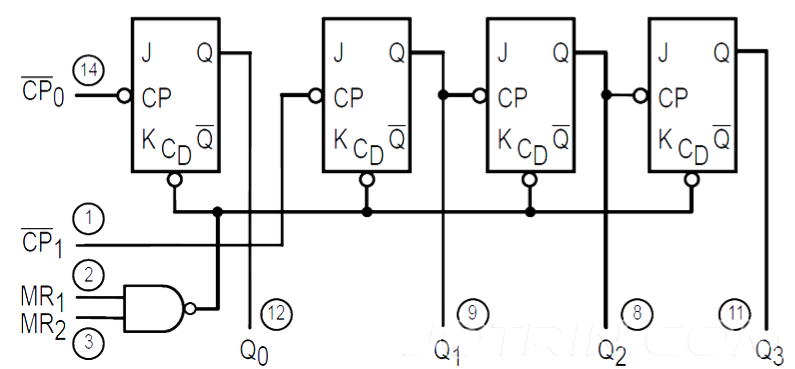
In the 74LS93, each flip-flop's state changes when the output of the preceding flip-flop transitions from HIGH to LOW. However, the first flip-flop is not directly connected to the second. To create a functional sequence, you link the first clock pin (CP1) to the output of the MOD 8 counter's first flip-flop. This ensures the sequence flows properly.
With four flip-flops connected in sequence, each receiving a clock pulse from the output of the previous flip-flop, the counter begins at 0000 and counts up to 1111 before resetting back to 0000. Each state represents a unique binary number, progressing in order.
The table below demonstrates how the binary output changes with each count:
| COUNTING | OUTPUT | Q3 | Q2 | Q1 | Q0 |
| 0 | 0 | 0 | 0 | 0 | |
| 1 | 0 | 0 | 0 | 1 | |
| 2 | 0 | 0 | 1 | 0 | |
| 3 | 0 | 0 | 1 | 1 | |
| 4 | 0 | 1 | 0 | 0 | |
| 5 | 0 | 1 | 0 | 1 | |
| 6 | 0 | 1 | 1 | 0 | |
| 7 | 0 | 1 | 1 | 1 | |
| 8 | 1 | 0 | 0 | 0 | |
| 9 | 1 | 0 | 0 | 1 | |
| 10 | 1 | 0 | 1 | 0 | |
| 11 | 1 | 0 | 1 | 1 | |
| 12 | 1 | 1 | 0 | 0 | |
| 13 | 1 | 1 | 0 | 1 | |
| 14 | 1 | 1 | 1 | 0 | |
| 15 | 1 | 1 | 1 | 1 |
Additionally, a timing diagram shows how the outputs from Q0 to Q3 behave in response to the input clock signal. This visualization makes it easier to see how the binary counter progresses step by step:

Applications of 74LS93
The 74LS93 is a versatile up-counter built using four JK flip-flops. By combining its mod-2 and mod-8 counters, it is commonly used to create a mod-16 counter. It is frequently utilized in circuits that require counting from 0 to 15 in binary or creating sequences for timing purposes, making it a straightforward and reliable choice for such applications.
This IC is also widely used in frequency division circuits, where it can divide frequencies by 2, 8, or 16 with precision. Its design allows it to handle controlled timing tasks effectively, making it suitable for use in digital timing systems such as digital clocks or sequential event management setups.
Additionally, the 74LS93 is employed in pulse counting applications, where it tallies incoming signals in binary. Its ability to combine mod-2 and mod-8 functionality makes it an efficient and dependable component in projects requiring accurate binary counting.
Steps to Operate the 74LS93 Binary Counter
Using the 74LS93 binary counter is straightforward and efficient. Begin by powering the IC through the Vcc and ground pins using a +5V power supply. This establishes the necessary operating conditions for the IC. The 74LS93 includes two MR (Master Reset) pins that allow you to configure the desired mode of operation. For standard counting functionality, connect both reset pins to ground (LOW), as shown in the mode selection table.

Next, supply clock pulses to the CP0 and CP1 input pins to initiate the counting process. Each pulse input to these pins increments the binary count by one. The CP1 pin controls the Q0 output, while CP0 governs the outputs of Q1, Q2, and Q3. To activate all four output bits, connect the clock pulse at CP1 to the Q0 output.
The IC supports a peak clock frequency of 32MHz for CP0 and 16MHz for CP1. Ensure the pulse width is at least 15nS for CP0 and 30nS for CP1 to maintain accurate operation. Typically, you can generate the clock signal using a 555 timer or a similar pulse-producing circuit.
|
COUNT |
OUTPUT |
|||
|
Q0 |
Q1 |
Q2 |
Q3 |
|
|
0 |
L |
L |
L |
L |
|
1 |
H |
L |
L |
L |
|
2 |
L |
H |
L |
L |
|
3 |
H |
H |
L |
L |
|
4 |
L |
L |
H |
L |
|
5 |
H |
L |
H |
L |
|
6 |
L |
H |
H |
L |
|
7 |
H |
H |
H |
L |
|
8 |
L |
L |
L |
H |
|
9 |
H |
L |
L |
H |
|
10 |
L |
H |
L |
H |
|
11 |
H |
H |
L |
H |
|
12 |
L |
L |
H |
H |
|
13 |
H |
L |
H |
H |
|
14 |
L |
H |
H |
H |
|
15 |
H |
H |
H |
H |
To better understand its functionality, consider simulating the IC's operation. For instance, in mode-0 (standard counting mode), grounding both MR pins and manually toggling the logic state generates clock pulses. With each transition from HIGH to LOW, the IC increments its count. Below is an example simulation illustrating this behavior.

For further clarity, you may refer to video tutorials or additional resources. The practical uses of the 74LS93 in various circuits, including timing and counting applications, demonstrate its adaptability and ease of use in digital designs.
Utilizing the 74LS93 in a Single-Digit Counter
To create a single-digit counter using the 74LS93, you will need components such as a 74LS20 (four-input NAND gate) and a 74LS04 (three NOT gates). These components work together with the IC to drive a BCD seven-segment display, allowing the counter to cycle through numbers from 0 to 9.
Although the 74LS93 is a 4-bit counter capable of handling up to 16 binary counts, it must reset after reaching 9 to ensure the display remains within the decimal range. If the counter is not reset at this point, the output may show incorrect or unexpected values. To manage this, a feedback reset circuit is used, combining signals from the NAND and NOT gates to reset the counter automatically.

In this circuit, two NOT gates are connected to the QA and QC outputs, while QB and QD are directly linked to the NAND gate inputs. The NAND gate produces a high output only when all its inputs are zero. At the binary value of 1010, the NOT gates reverse the signals from QA and QC, triggering a high output from the NAND gate. This output is inverted by the 74LS04, resetting the counter to zero. This design ensures the counter refreshes consistently and displays the correct decimal values.
Using 74LS93 for a 2-Digit Counter
The 2-digit counter configuration extends the concept of the single-digit counter, allowing it to display numbers from 00 to 99. The same basic logic applies, but in this case, the first seven-segment display progresses when the second display sends a clock reset signal. This design ensures seamless counting across two digits by using the reset signal of one display to drive the clock input of the other.

The logic behind the 2-digit counter remains consistent with the single-digit setup, offering an efficient way to showcase larger numeric values using two seven-segment displays. By linking the two counters through their reset and clock signals, the displays work in tandem to represent numbers from 00 to 99.
74LS93 Based 2-Digit Decimal Counter Example
74LS93 Based 2-Digit Decimal Counter
For a 2-digit counter, the 74LS93 can be configured to count and display numbers from 00 to 99. The logic for the two-digit counter builds upon the same principles as the single-digit counter but extends its functionality by cascading two BCD counters.
In this setup, the first BCD seven-segment display advances its count based on the reset signal from the second display. Essentially, the clock signal for the first display is derived from the reset of the second display. This cascading arrangement ensures the counter progresses logically through two digits, with the first display incrementing only when the second display completes its cycle from 0 to 9.

This two-digit counter circuit allows for counting up to 99 and provides a clear and readable display using two seven-segment displays. The underlying logic and feedback mechanisms ensure smooth operation, making it ideal for applications requiring a larger range of counting.
74LS93 Binary Counter Applications
Generation of Extended Timing Durations
The 74LS93 is well-suited for generating extended timing durations in digital circuits. By configuring its counters appropriately, you can achieve long and consistent delays that are useful in timing-related applications.
Stable Frequency Division
This IC acts as a reliable frequency divider. It can reduce input clock frequencies by factors of 2, 8, or 16, making it a dependable choice for systems where stable frequency division is needed for synchronized operations.
Precise Timing Tasks
When accurate timing is necessary, the 74LS93 provides a simple solution. Its predictable counting behavior ensures precision in tasks such as sequencing and time-based control in digital projects.
Microcontroller-Free Projects
The 74LS93 is ideal for projects where using a microcontroller might not be practical. It handles counting and timing functions efficiently, reducing the need for more complex and costly components.
Pulse Counting and Frequency Partitioning
This IC is effective in applications that involve pulse counting or frequency partitioning. Its binary counting mechanism makes it easy to track pulses or divide frequencies without additional circuitry.
Driving Seven-Segment Displays
The 74LS93 works seamlessly with seven-segment displays to show numerical outputs. Its compatibility with binary-to-decimal converters simplifies the process of creating digital counters and readouts.
Creating Long-Duration Intervals
By utilizing its counting capabilities, the 74LS93 helps in setting up circuits that require long-duration intervals. This makes it particularly useful for applications like digital clocks and timers.
Building Stable Counter Circuits
The IC is often used to design reliable counter circuits. Its robust performance and ease of configuration make it a common choice for building both standalone counters and frequency divider circuits.
Specialized Timing Applications
When timing needs are specific, the 74LS93 can be adapted to meet these requirements. Whether for industrial timing solutions or DIY projects, its flexibility ensures it fits a variety of timing-related tasks.
Conclusion
The 74LS93 is a versatile and reliable binary counter that simplifies digital counting and timing tasks. With its ability to divide frequencies, count pulses, and drive displays, it fits seamlessly into a variety of projects. Whether you’re building counters, managing timing, or creating frequency dividers, the 74LS93 offers an efficient and straightforward solution. Its flexibility and ease of use make it a practical choice for many applications.
About us
ALLELCO LIMITED
Read more
Quick inquiry
Please send an inquiry, we will respond immediately.
Frequently Asked Questions [FAQ]
1. Can the 74LS93 count down?
No, the 74LS93 is designed as an up-counter, which means it only counts upwards in binary format. It does not have the capability to count in reverse or decrement values.
2. What are the benefits and limitations of the 74LS93?
The 74LS93 is convenient to use and minimizes the need for external wiring, making it simple to integrate into projects. However, one limitation is that its flip-flops cannot be preset, so the counting always starts from zero, and you cannot begin counting from a different number.
3. How does a counter using the 74LS93 IC work?
The 74LS93 contains four JK flip-flops that respond to input pulses, whether they come from a microcontroller or a timer IC. It features two reset pins, two clock inputs, and four output pins, enabling it to count binary numbers effectively in response to clock pulses.
4. What is the role of the 74LS93 in a circuit?
The 74LS93 functions as a frequency divider and a counter. It is commonly used to create time delays or manage counting tasks in circuits. This IC is especially helpful in applications where dividing by 2, 8, or 16 is required.
5. What does the 74LS93N do?
The 74LS93N is a 4-bit binary counter that uses four master-slave JK flip-flops. It supports a divide-by-eight counting mechanism, which is triggered by a transition from HIGH to LOW on its clock input. Each clock pulse applied to its input pins advances the count by one step.

How IC 7493 Works as a Frequency Divider
on November 29th
Comprehensive Guide to VIPER22A
on November 29th
Popular Posts
-

Complex Instruction Set Computers: How They Changed Computing?
on April 18th 147749
-

USB-C Pinout and Features
on April 18th 111898
-
Using Xilinx Unified Simulation Primitives: A Comprehensive Guide to FPGA Design and Simulation
on April 18th 111349
-

Power Supply Voltages in Electronics: Meaning of VCC, VDD, VEE, VSS, and GND
on April 18th 83713
-

RJ45 Connector Guide: Pinout, Wiring, Cable Types, and Uses
on January 1th 79502
-

The Ultimate Guide to Wire Color Codes in Modern Electrical Systems
The way our electrical systems use colors isn’t just for looks. Each wire color now indicates a specific function, making it easier to identify and handle electrical components correctly during ins...on January 1th 66866
-

Quality (Q) Factor: Equations and Applications
The quality factor, or 'Q', is important when checking how well inductors and resonators work in electronic systems that use radio frequencies (RF). 'Q' measures how well a circuit minimizes energy...on January 1th 63003
-
Purge Valve Guide: Function, Symptoms, Testing, and Replacement for Optimal Engine Performance
The purge valve is a key part of a car’s system that helps keep the air clean by managing fuel vapors before they can escape into the atmosphere. This not only helps the environment by reducing pol...on January 1th 62934
-

Achieving Peak Performance with the Maximum Power Transfer Theorem
The Maximum Power Transfer Theorem explains how energy from a source, such as a battery or generator, flows to a connected load. It shows the exact condition where the load receives the most power....on January 1th 54073
-

A23 Battery Specifications and Compatibility
The A23 battery is a small, cylinder-shaped battery with high voltage. Also called 23A, 23AE, or MN21, it runs at 12 volts and much higher than AA or AAA batteries. Its special design make...on January 1th 52087
HOT Part Number
-
MAX208ECNG+
Analog Devices Inc./Maxim Integrated
IC TRANSCEIVER FULL 4/4 24DIP
ADP5022ACBZ-4-R7
Analog Devices Inc.
IC REG TRPL BCK/LNR SYNC 16WLCSP
DS1217A-64K-25
Analog Devices Inc./Maxim Integrated
MODULE NVRAM 8KB 250NS CARTRIDGE
AD5744RCSUZ
Analog Devices Inc.
IC DAC 14BIT V-OUT 32TQFP
TLC7528CNS
Texas Instruments
IC DAC 8BIT A-OUT 20SO
06035A910JAT2A
KYOCERA AVX
CAP CER 91PF 50V NP0 0603
FAN4800AUN
onsemi
IC PFC CTR AV CURR 268KHZ 16DIP
RR264MM-400TR
Rohm Semiconductor
DIODE GEN PURP 400V 1A PMDU
TMP106YZCT
Texas Instruments
SENSOR DIGITAL -40C-125C 6DSBGA
MCT06030C1002FP500
Electro-Films (EFI) / Vishay
RES SMD 10K OHM 1% 1/8W 0603
DMN6068LK3Q-13
Diodes Incorporated
MOSFET BVDSS: 41V 60V TO252
ADS7845E/2K5G4
Texas Instruments
IC SCREEN CNTRL 12BIT 16SSOP
XC4005E-3PQ100I
AMD
IC FPGA 77 I/O 100QFP
1812HC821KAT3A\SB
KYOCERA AVX
CAP CER 820PF 3KV X7R 1812
NRVTS12100PFST3G
onsemi
DIODE SCHOTTKY 100V 12A TO277-3
6N135-500E
Broadcom Limited
OPTOISO 3.75KV TRANS W/BASE 8SMD
MAX333AEUP+T
Analog Devices Inc./Maxim Integrated
IC SWITCH SPDT X 4 45OHM 20TSSOP
LFB212G45CG1C187
Murata Electronics
RF-D -

SC1565IST18TRT
Semtech Corporation
IC REG LINEAR 1.8V 1.5A SOT223-3
AD5220BN10
Analog Devices Inc.
IC POT DGTL 10K 128POS 8-DIP
LM2904AVQPWRG4
Texas Instruments
IC OPAMP GP 2 CIRCUIT 8TSSOP
BTF3125EJXUMA1
Infineon Technologies
IC PWR SWITCH N-CHAN 1:1 TDSO-8
744773115
Würth Elektronik
FIXED IND 15UH 1.2A 235 MOHM SMD
LP2981AIM5X-2.9
Texas Instruments
IC REG LINEAR FIXED LDO REG
1808SC102MAJ1A
KYOCERA AVX
CAP CER 1000PF 1.5KV X7R 1808
DS89C420-MNL
Analog Devices Inc./Maxim Integrated
IC MCU 8BIT 16KB FLASH 40DIP
STP16DPS05MTR
STMicroelectronics
IC LED DRIVER LINEAR 100MA 24SO
VC060305A150DP
KYOCERA AVX
VARISTOR 8.5V 30A 0603
CSD16410Q5A
Texas Instruments
MOSFET N-CH 25V 16A/59A 8VSON
HAL1000UT-K
TDK-Micronas GmbH
MAGNETIC SWITCH PROG TO92UT
SI1403BDL-T1-GE3
Vishay Siliconix
MOSFET P-CH 20V 1.5A SC70-6
AD7999YRJZ-1500RL7
Analog Devices Inc.
IC ADC 8BIT SAR SOT23-8
EP2A15B724C7
Intel
IC FPGA 492 I/O 724BGA
SN74AHC138RGYR
Texas Instruments
IC DECODER/DEMUX 1X3:8 16VQFN
PIC16F627A-I/SS
Microchip Technology
IC MCU 8BIT 1.75KB FLASH 20SSOP
MAX98307ETE+T
Analog Devices Inc./Maxim Integrated
IC AMP CLASS DG MONO 3.3W 16TQFN -

AOB290L
Alpha & Omega Semiconductor Inc.
MOSFET N-CH 100V 18A/140A TO263
MAX13433EETD+T
Analog Devices Inc./Maxim Integrated
IC TRANSCEIVER FULL 1/1 14TDFN
SN74LVC112ADR
Texas Instruments
IC FF JK TYPE DUAL 1BIT 16SOIC
ATSAM4SD32BA-MU
Microchip Technology
IC MCU 32BIT 2MB FLASH 64QFN
CL31A106KPHNNNF
Samsung Electro-Mechanics
CAP CER 10UF 10V X5R 1206
SOLC-120-02-F-Q-A
Samtec Inc.
CONN RCPT 80POS 0.05 GOLD SMD
UPW1J101MPD
Nichicon
CAP ALUM 100UF 20% 63V RADIAL
CS5532-BSZR
Cirrus Logic Inc.
IC ADC 24BIT SIGMA-DELTA 20SSOP
CC0603GRNPO9BN120
YAGEO
CAP CER 12PF 50V C0G/NPO 0603
S-812C50AMC-C3ET2G
ABLIC Inc.
IC REG LINEAR 5V 75MA SOT23-5
C3216X8R1H684M160AE
TDK Corporation
CAP CER 0.68UF 50V X8R 1206
CY2309NZSC-1HT
Cypress Semiconductor Corp
IC CLK BUF 1:9 133.3MHZ 16SOIC
FDD6632
Fairchild Semiconductor
MOSFET N-CH 30V 9A DPAK
GCM155R71E473KA55D
Murata Electronics
CAP CER 0.047UF 25V X7R 0402
LM2743MTCX
Texas Instruments
IC REG CTRLR BUCK 14TSSOP
7440650047
Würth Elektronik
FIXED IND 4.7UH 4.6A 23 MOHM SMD
SS2P4HM3/84A
Vishay General Semiconductor - Diodes Division
DIODE SCHOTTKY 40V 2A DO220AA
V24C12H100BS
Vicor Corporation
DC DC CONVERTER 12V 100W