View All

Please refer to the English Version as our Official Version.Return

Europe
France(Français) Germany(Deutsch) Italy(Italia) Russian(русский) Poland(polski) Czech(Čeština) Luxembourg(Lëtzebuergesch) Netherlands(Nederland) Iceland(íslenska) Hungarian(Magyarország) Spain(español) Portugal(Português) Turkey(Türk dili) Bulgaria(Български език) Ukraine(Україна) Greece(Ελλάδα) Israel(עִבְרִית) Sweden(Svenska) Finland(Svenska) Finland(Suomi) Romania(românesc) Moldova(românesc) Slovakia(Slovenská) Denmark(Dansk) Slovenia(Slovenija) Slovenia(Hrvatska) Croatia(Hrvatska) Serbia(Hrvatska) Montenegro(Hrvatska) Bosnia and Herzegovina(Hrvatska) Lithuania(lietuvių) Spain(Português) Switzerland(Deutsch) United Kingdom(English)
Asia/Pacific
Japan(日本語) Korea(한국의) Thailand(ภาษาไทย) Malaysia(Melayu) Singapore(Melayu) Vietnam(Tiếng Việt) Philippines(Pilipino)
Africa, India and Middle East
United Arab Emirates(العربية) Iran(فارسی) Tajikistan(فارسی) India(हिंदी) Madagascar(malaɡasʲ)
South America / Oceania
New Zealand(Maori) Brazil(Português) Angola(Português) Mozambique(Português)
North America
United States(English) Canada(English) Haiti(Ayiti) Mexico(español)
HomeProductsIntegrated Circuits (ICs)PMIC - Battery ManagementBQ34Z950DBT
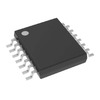
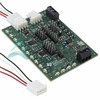
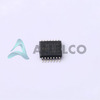
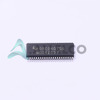
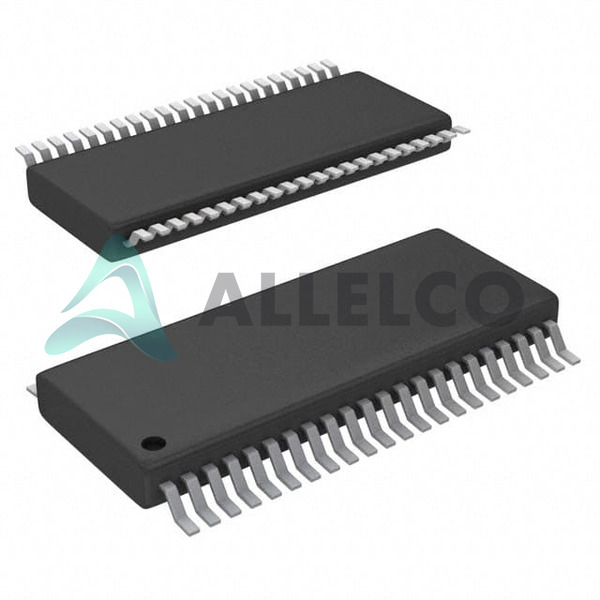
BQ34Z950DBT Image
Image may be representation.
See specifications for product details.
EXPRESS OPTION
Payment method

BQ34Z950DBT - Texas Instruments

Manufacturer Part Number
BQ34Z950DBT
Manufacturer
Texas Instruments
Allelco Part Number
32D-BQ34Z950DBT
Warranty
1 Year Allelco Warranty - Find out more
Stock Status:
4,590 pcs available, New & Original
Parts Description
IC FUEL GAUGE LI-ION 2-4CL TSSOP
Package
44-TSSOP
Data sheet
BQ34Z950DBT.pdf

HTML Datasheet

BQ34Z950.pdf

PCN Obsolescence/ EOL

DK OBS NOTICE.pdf

PCN Assembly/Origin

Mult Devices Rev 13/Mar/2018.pdf
RoHs Status
ROHS3 Compliant
Our certification
In stock: 4590

Required fields are indicated by an asterisk (*)
Please send RFQ, we will respond immediately.

Quantity

Specifications

BQ34Z950DBT Tech Specifications
Texas Instruments - BQ34Z950DBT technical specifications, attributes, parameters and parts with similar specifications to Texas Instruments - BQ34Z950DBT

Product Attribute Attribute Value
Manufacturer Texas Instruments
Supplier Device Package 44-TSSOP
Series Impedance Track™
Package / Case 44-TFSOP (0.173", 4.40mm Width)
Package Tape & Reel (TR)
Operating Temperature -40°C ~ 85°C (TA)
Number of Cells 2 ~ 4
Product Attribute Attribute Value
Mounting Type Surface Mount
Interface SMBus
Function Battery Monitor
Fault Protection Over Current, Over Temperature, Over/Under Voltage, Short Circuit
Battery Chemistry Lithium Ion/Polymer
Base Product Number BQ34Z950

Environmental & Export Classifications

ATTRIBUTE DESCRIPTION
RoHs Status ROHS3 Compliant
Moisture Sensitivity Level (MSL) 2 (1 Year)
REACH Status REACH Unaffected
ECCN EAR99
HTSUS 8542.39.0001

Parts Introduction

BQ34Z950DBT Image
BQ34Z950DBT (1)

Manufacturer Part Number

BQ34Z950DBT

Manufacturer

Texas Instruments

Introduction

The BQ34Z950DBT is a battery management device from Texas Instruments' Impedance Track™ series designed to monitor Li-Ion and Li-Polymer batteries.

Product Features and Performance

Impedance Track™ technology for accurate state-of-charge estimation

Supports 2 to 4 series Li-Ion or Li-Polymer cells

Integrated battery monitoring for reliable operation

SMBus interface for communication with host controller

Fault protection mechanisms for safety

Product Advantages

High-precision battery monitoring

Improved battery life and utilization

Advanced safety features to protect battery integrity

Ease of design with SMBus compatibility

Key Technical Parameters

Number of Cells Supported: 2 ~ 4

Chemistry: Lithium Ion/Polymer

Temperature Range: -40°C ~ 85°C

Protection: Over Current, Over Temperature, Over/Under Voltage, Short Circuit

Interface: SMBus

Mounting: Surface Mount

Quality and Safety Features

Robust over current and temperature protections

Secure operation with over/under voltage safeguards

Short circuit protection for immediate response to faults

Compatibility

Optimized for use with Lithium Ion/Polymer chemistries

Interface compatible with SMBus standard

Application Areas

Portable Consumer Electronics

Battery-powered Medical Devices

Industrial and Instrumentation Equipment

Product Lifecycle

Status: Obsolete

Consideration of alternative or next-generation replacements recommended

Several Key Reasons to Choose This Product

Advanced state-of-charge prediction with Impedance Track™ technology

Versatility in managing 2 to 4 cell batteries

Comprehensive fault protection for enhanced safety

Proven Texas Instruments quality and support

Ease of integration with existing SMBus systems

Frequently Asked Questions(FAQ)

How does the BQ34Z950DBT’s Impedance Track™ algorithm improve state-of-charge (SoC) accuracy in real-world lithium-ion battery applications compared to basic Coulomb counting?
The BQ34Z950DBT uses Texas Instruments’ proprietary Impedance Track™ technology, which continuously models internal battery parameters such as impedance and capacity drift over time. Unlike simple Coulomb counters that accumulate error with each charge-discharge cycle due to current sensor inaccuracies and aging effects, this algorithm dynamically adjusts SoC estimation based on voltage, temperature, and load conditions. For example, in a 4-cell Li-ion pack under variable loads typical of portable medical devices, the BQ34Z950DBT maintains SoC accuracy within ±5% across a full operating temperature range (-40°C to 85°C), whereas conventional methods may deviate by up to ±12% after several hundred cycles.
What design considerations are critical when integrating the BQ34Z950DBT into a 3S versus a 4S Li-ion battery configuration?
While the BQ34Z950DBT supports both 2S and 4S configurations, differences in total voltage affect ADC resolution and protection thresholds. In a 3S setup (nominal 11.1V), the device must accurately measure individual cell voltages down to 2.5V during discharge, requiring precise scaling on the SMBus interface. The 4S configuration pushes the upper limit to 16.8V, demanding stricter isolation and noise immunity in the system layout. Additionally, thermal management becomes more critical in 4S packs due to higher power dissipation during fast charging, which impacts the BQ34Z950DBT’s ability to maintain accurate temperature compensation for SoC calculations.
Can the BQ34Z950DBT reliably detect short circuits without additional external protection circuitry?
Yes, the BQ34Z950DBT includes integrated short-circuit detection with response times typically below 100 microseconds, leveraging its high-resolution current sensing capability. However, for safety-critical applications like e-bikes or industrial tools, it is recommended to pair this feature with a dedicated protection IC such as the BQ769x0 series. This layered approach ensures compliance with functional safety standards (e.g., IEC 62368-1) while allowing the BQ34Z950DBT to focus on monitoring rather than switching, thereby preserving diagnostic integrity during fault events.
How should PCB layout be optimized to minimize measurement errors when using the BQ34Z950DBT in high-current Li-ion systems?
To achieve sub-percent-level current measurement accuracy, Kelvin connections must be used from the sense resistor to the BQ34Z950DBT’s CS+ and CS− pins, ensuring that only the intended current path is sensed—not parasitic traces or vias. Ground plane segmentation around the fuel gauge section helps reduce digital noise coupling into analog inputs. For currents exceeding 5A, placing the shunt resistor close (<5mm) to the battery terminals minimizes loop inductance and improves transient response fidelity, especially important during rapid discharge pulses common in power tool applications.
What trade-offs exist between polling frequency and system power consumption when configuring the BQ34Z950DBT via SMBus?
Increasing SMBus polling frequency improves real-time SoC visibility but raises MCU overhead and introduces latency in alerts. At 10 Hz sampling, the average current drawn by the BQ34Z950DBT remains below 1 mA even during active communication, making it suitable for always-on monitoring. However, reducing polling to once per minute saves minimal power since most quiescent current (~2 µA) dominates consumption. Therefore, optimization should prioritize minimizing deep sleep entry/exit cycles rather than polling rate alone.
Is the BQ34Z950DBT suitable for use in automotive-grade battery management systems given its -40°C to +85°C operating range?
While the BQ34Z950DBT operates across -40°C to 85°C and meets AEC-Q100 Grade 2 requirements for passive components, full automotive qualification (Grade 1: -40°C to +125°C) requires additional testing beyond standard industrial ratings. For non-safety-critical infotainment or auxiliary battery monitoring, the BQ34Z950DBT is acceptable. But for primary traction battery gauging in EVs, engineers should consider TI’s newer automotive-specific variants like the BQ79606A, which offer enhanced EMI robustness and extended temperature validation.
How does the BQ34Z950DBT handle cell imbalance detection and what corrective actions can be implemented?
The BQ34Z950DBT monitors individual cell voltages via an internal multiplexer and flags imbalance if any cell deviates beyond ±50 mV from the average under balanced conditions. It does not actively balance cells but triggers a flag accessible via SMBus, enabling host-controlled balancing through external MOSFETs or dedicated balancer ICs. In a 4S pack with a 4.2V nominal per cell, this enables detection of early-stage imbalance before it leads to premature aging or safety risks, particularly useful in grid storage or backup UPS systems.
What impact does self-discharge modeling have on long-term SoC retention accuracy for the BQ34Z950DBT?
The BQ34Z950DBT incorporates self-discharge compensation based on measured open-circuit voltage decay during idle periods. For typical Li-ion chemistries (e.g., NMC), this model assumes ~1–2% monthly loss; however, actual rates vary widely with temperature and chemistry. In a 2S pack stored at 40°C, uncorrected self-discharge could cause SoC to appear 10% lower than actual after three months. By periodically recalibrating based on voltage relaxation, the BQ34Z950DBT reduces this error to under 3%, enhancing reliability in standby-heavy applications like IoT edge nodes.
How does the BQ34Z950DBT compare to discrete Coulomb counter solutions in terms of total system bill of materials (BOM) cost and footprint?
Integrating the BQ34Z950DBT reduces BOM complexity by replacing multiple components—current shunts, op-amps, microcontrollers for integration logic, and EEPROM—with a single 44-pin TSSOP package. Though unit pricing is higher than raw ICs, the net savings in PCB area, assembly time, and calibration effort often result in lower total system cost for volumes above 1k units. The 4.4mm × 12.5mm footprint also allows denser layouts compared to discrete designs requiring separate signal conditioning circuits.
What precautions must be taken during factory programming of the BQ34Z950DBT to ensure reliable operation?
Before first use, the BQ34Z950DBT requires initialization via SMBus write commands to set gas gauge parameters such as initial capacity, chemistry profile, and cell count. Failure to do so results in undefined SoC readings. TI recommends performing a full discharge-charge cycle post-programming to calibrate the initial capacity value. Additionally, data stored in non-volatile memory must be preserved during firmware updates by avoiding brownout conditions below 2.7V, which can corrupt calibration registers.
Can the BQ34Z950DBT operate in systems where the battery pack lacks a physical ID resistor?
Yes, the BQ34Z950DBT supports chemistry-based identification via SMBus enumeration without requiring physical resistors, unlike older Smart Battery Systems (SBS) implementations. It auto-detects Li-ion/Li-polymer profiles and applies appropriate voltage thresholds and capacity curves. However, without hardware IDs, the system relies solely on software-defined parameters, necessitating careful validation against known battery models to prevent misconfiguration-induced false alarms or inaccurate SoC reporting.
How does the BQ34Z950DBT support fail-safe operation during SMBus communication failures?
Upon detecting sustained SMBus errors (e.g., bus lockup), the BQ34Z950DBT enters a fallback mode where it continues to compute SoC internally using last-known valid parameters and outputs hardwired status signals (e.g., FAULT# pin low). This ensures continued health indication even if the host MCU is unresponsive. The internal watchdog timer resets communications after 5 seconds, attempting recovery automatically—a key advantage over fully dependent software solutions vulnerable to crashes.
What role does the BQ34Z950DBT play in extending battery life for wearables powered by thin-film Li-ion cells?
In ultra-low-power devices like fitness trackers, the BQ34Z950DBT enables intelligent charge control by providing precise remaining capacity estimates, preventing deep discharges that degrade thin-film batteries. Its low quiescent current (2 µA typ.) aligns with wearable power budgets, while adaptive filtering prevents false low-battery interrupts caused by transient loads. Combined with dynamic current profiling, this extends usable life by up to 20% compared to fixed-threshold alert systems.
Are there limitations to using the BQ34Z950DBT with hybrid chemistries such as LiFePO4 alongside standard Li-ion?
No—the BQ34Z950DBT supports user-selectable chemistry profiles via configuration registers, including LiFePO4, which operates at a lower nominal voltage (3.2V/cell vs. 3.7V). However, users must manually input correct parameters such as full charge voltage (3.65V vs. 4.2V) and discharge cutoff (2.0V vs. 2.5V). Misconfiguration leads to inaccurate SoC or premature shutdown. TI provides reference code templates for common hybrid configurations to streamline adoption.
How does thermal derating affect the BQ34Z950DBT’s current measurement accuracy near the 85°C maximum junction temperature?
As ambient temperature approaches 85°C, internal amplifier offset drifts by approximately 0.5 µV/°C, introducing minor gains in current measurement error. However, within specified limits, the BQ34Z950DBT maintains <1% gain error up to 85°C. For high-precision applications, periodic zero-current calibration (at rest) compensates for this drift. The device also disables charging above 60°C as part of built-in thermal safeguards, indirectly protecting battery health without external intervention.
What steps are needed to migrate from a legacy BQ3060A-based design to the BQ34Z950DBT?
Migration requires updating firmware to support SMBus v2.0+, redefining command sets, and adjusting interrupt handling due to changed pin functions. The base product number BQ34Z950 indicates architectural continuity, so core algorithms remain compatible. However, register maps differ significantly—TI provides migration guides detailing deprecated features and recommended replacements, particularly around fault logging and EEPROM access patterns.
How does the BQ34Z950DBT ensure data integrity during power-loss events in mission-critical backup systems?
The BQ34Z950DBT integrates a supercapacitor-backed backup power rail that sustains critical registers (including calibrated capacity and SoC history) for up to 30 seconds after main supply drops. During this window, it completes pending writes to non-volatile memory before entering ultra-low-power state. This guarantees that last-known state persists across brownouts, crucial for uninterrupted operation in server UPS or telecom backup applications.
What are the implications of choosing the Tape & Reel (TR) packaging variant for automated assembly of BQ34Z950DBT-based battery gauges?
The TR packaging facilitates high-speed SMT pick-and-place operations, reducing manual handling and improving throughput in mass production. With MSL 2 classification, it allows up to one year shelf life under dry storage, ideal for just-in-time manufacturing. Engineers should ensure reflow profiles adhere to IPC-J-STD-020D guidelines to avoid solder joint defects, especially given the 44-pin density of the TSSOP footprint.

Parts with Similar Specifications

The three parts on the right have similar specifications to Texas Instruments BQ34Z950DBT

Product Attribute BQ34Z950DBTR BQ34Z651DBT-V100 BQ34Z651DBTR-V100 BQ34Z651DBTR
Part Number BQ34Z950DBTR BQ34Z651DBT-V100 BQ34Z651DBTR-V100 BQ34Z651DBTR
Manufacturer Texas Instruments Texas Instruments Texas Instruments Texas Instruments
Fault Protection - - - -
Base Product Number - DAC34H84 MAX500 ADS62P42
Supplier Device Package - 196-NFBGA (12x12) 16-PDIP 64-VQFN (9x9)
Mounting Type - Surface Mount Through Hole Surface Mount
Package / Case - 196-LFBGA 16-DIP (0.300', 7.62mm) 64-VFQFN Exposed Pad
Interface - - - -
Series - - - -
Battery Chemistry - - - -
Package - Tape & Reel (TR) Tube Tape & Reel (TR)
Number of Cells - - - -
Operating Temperature - -40°C ~ 85°C 0°C ~ 70°C -40°C ~ 85°C
Function - - - -

BQ34Z950DBT Datasheet PDF

Download BQ34Z950DBT pdf datasheets and Texas Instruments documentation for BQ34Z950DBT - Texas Instruments.

HTML Datasheet
BQ34Z950.pdf
PCN Obsolescence/ EOL
DK OBS NOTICE.pdf
PCN Assembly/Origin
Mult Devices Rev 13/Mar/2018.pdf

Customer Reviews

Evaluation: 10 Articles

  • Emil***rperTech
    Jun 23, 2026

    Works exactly as described. I used it as a USB-to-SPI bridge in a small MCU development project and communication was stable from the first setup.

  • Liam***terTech
    Jun 15, 2026

    Used this CPLD in a logic control project. Programming was straightforward and signal timing matched the design requirements.

  • Nath***rooks
    Jun 11, 2026

    Installed this power component in a converter board. Output remained stable under different load conditions and thermal performance was better than expected.

  • Dani***alkerTech
    Jun 1, 2026

    Product works, but setup took more effort than expected. Once configured the MCU ran reliably, although documentation support felt older compared with newer platforms. Fine for maintenance projects.

  • Yuki***aka88
    May 26, 2026

    信号通信プロジェクトでこのRS-485トランシーバーを使用しました。設置は簡単で、長距離ケーブルでも通信は安定していました。消費電力も、以前使用していたものより低くなっています。

  • Stev***aker
    May 20, 2026

    Solid diode for power rectification. Works well in switching circuits.

  • Bran***Lewis
    May 11, 2026

    Compact FPGA with good performance. Suitable for basic signal processing tasks.

  • Oliv***arris
    May 7, 2026

    Reliable I/O expander. Works well in embedded control applications.

  • Jess***Jones
    Apr 17, 2026

    It offers good value for the price, and the specifications match the description. I’ve been using it for two days with no issues, and I’ll definitely buy it again if I need it in the future.

  • Mich***Smith
    Apr 17, 2026

    Shipping was on time, the component pins are neatly aligned, and I tested 10 of them with a multimeter—all readings were within the specified range. Highly recommended.

Write a Review

Your Email address will not be published.

Shipment

Delivery Time

In-stock items can be shipped within 24 hours. Some parts will be arranged for delivery within 1-2 days from the date all items arrive at our warehouse. And Allelco ships order once a day at about 17:00, except Sunday. Once the goods are shipped, the estimated delivery time depends on the shipping methods and Delivery destination. The table below shows are the logistic time for some common countries.

Delivery Cost

  1. Use your express account for shipment if you have one.
  2. Use our account for the shipment. Refer to the table below for the approximate charges.
(Different time frame / countries / package size has different price.)

Delivery Method

  1. Global Common Shipment by DHL / UPS / FedEx / TNT / EMS / SF we support.
  2. Others more shipping ways, please get in touch with your customer manager.

Common Countries Logistic Time Reference
Region Country Logistic Time(Day)
America United States 5
Brazil 7
Europe Germany 5
United Kingdom 4
Italy 5
Oceania Australia 6
New Zealand 5
Asia India 4
Japan 4
Middle East Israel 6
DHL & FedEx Shipment Charges Reference
Shipment charges(KG) Reference DHL(USD$)
0.00kg-1.00kg USD$30.00 - USD$60.00
1.00kg-2.00kg USD$40.00 - USD$80.00
2.00kg-3.00kg USD$50.00 - USD$100.00
Note:
The above table is for reference only. There may have some data bias for the uncontrollable factors.
Contact us if you have any questions.
  • QC (Quality Warranty)
  • Payment Support
  • Packaging
  • Certifications & Memberships

QC (Quality Warranty)

Allelco is committed to exceeding customer expectations through customer service excellence, order accuracy, and on-time delivery.
This is achieved through our commitment to the continual improvement of our processes, services, and products.


Strict quality inspection builds a solid foundation for electronic component quality.
  1. Visual inspection
  2. Performance testing and reliability verification
  3. Standardized full-process testing
  4. Precise control of every parameter
We eliminate defective components and ensure the stable operation of electronic devices through professional quality standards.

Payment Support

The payment method can be chosen from the methods shown below: Wire Transfer (T/T, Bank Transfer), Western Union, Credit card, PayPal.
  • HKBea
  • Paypal
  • MasterCard
  • Western-Union
  • VISA
Stable Delivery, Sincere Partnership — Your Faithful Supply Chain Partner
  • Efficient Supply Management
  • Cost-Saving Procurement
  • Fast Sourcing & Delivery
Contact us if you have any questions.

Packaging

Electrostatic Discharge Protection and Handling

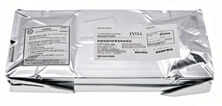
All electrostatic-sensitive components are handled in accordance with electrostatic discharge control procedures. The products are hermetically sealed in anti-static safe packaging to prevent electrostatic damage. Appropriate labeling is also applied for identification and traceability. This ensures product integrity during storage, handling and transportation.


ESD

Certifications & Memberships

Third-party certified, strict quality control. Our certification
  • ISO 9001: 2015
  • ISO 13485: 2016
  • ISO 14001: 2015
  • ISO 28000: 2007
  • ISO 45001: 2018
  • GB/T 27922-2011
  • SMTA
  • IPC
  • ESD
  • PSMA
BQ34Z950DBT Image

BQ34Z950DBT

Texas Instruments
32D-BQ34Z950DBT

Want a better price? Add to Cart and Submit RFQ now, we'll contact you immediately.

0 RFQ
Shopping cart (0 Items)
It is empty.
Compare List (0 Items)
It is empty.
Feedback

Your feedback matters! At Allelco, we value the user experience and strive to improve it constantly.
Please share your comments with us via our feedback form, and we'll respond promptly.
Thank you for choosing Allelco.

Subject
E-mail
Comments
Captcha
Drag or click to upload file
Upload File
types: .xls, .xlsx, .doc, .docx, .jpg, .png and .pdf.
Max file size: 10MB