View All

Please refer to the English Version as our Official Version.Return

Europe
France(Français) Germany(Deutsch) Italy(Italia) Russian(русский) Poland(polski) Czech(Čeština) Luxembourg(Lëtzebuergesch) Netherlands(Nederland) Iceland(íslenska) Hungarian(Magyarország) Spain(español) Portugal(Português) Turkey(Türk dili) Bulgaria(Български език) Ukraine(Україна) Greece(Ελλάδα) Israel(עִבְרִית) Sweden(Svenska) Finland(Svenska) Finland(Suomi) Romania(românesc) Moldova(românesc) Slovakia(Slovenská) Denmark(Dansk) Slovenia(Slovenija) Slovenia(Hrvatska) Croatia(Hrvatska) Serbia(Hrvatska) Montenegro(Hrvatska) Bosnia and Herzegovina(Hrvatska) Lithuania(lietuvių) Spain(Português) Switzerland(Deutsch) United Kingdom(English)
Asia/Pacific
Japan(日本語) Korea(한국의) Thailand(ภาษาไทย) Malaysia(Melayu) Singapore(Melayu) Vietnam(Tiếng Việt) Philippines(Pilipino)
Africa, India and Middle East
United Arab Emirates(العربية) Iran(فارسی) Tajikistan(فارسی) India(हिंदी) Madagascar(malaɡasʲ)
South America / Oceania
New Zealand(Maori) Brazil(Português) Angola(Português) Mozambique(Português)
North America
United States(English) Canada(English) Haiti(Ayiti) Mexico(español)
HomeProductsIntegrated Circuits (ICs)PMIC - LED DriversTPS92830QPWRQ1
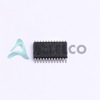
TPS92830QPWRQ1 Image
Image may be representation.
See specifications for product details.
EXPRESS OPTION
Payment method

TPS92830QPWRQ1 - Texas Instruments

Manufacturer Part Number
TPS92830QPWRQ1
Manufacturer
Texas Instruments
Allelco Part Number
32D-TPS92830QPWRQ1
Warranty
1 Year Allelco Warranty - Find out more
Stock Status:
27,346 pcs available, New & Original
Parts Description
IC LED DRIVER LINEAR PWM 28TSSOP
Package
28-TSSOP
Data sheet
TPS92830QPWRQ1.pdf

PCN Design/Specification

TPS92830-Q1 01/Feb/2018.pdf

HTML Datasheet

TPS92830-Q1 Datasheet.pdf
RoHs Status
ROHS3 Compliant
Our certification
In stock: 27346
  • Unit Price: $0.97
  • Subtotal: $0.00

Want a better price?
Add to Cart and Submit RFQ now, we'll contact you immediately.

Quantity Unit Price Ext. Price
1+ $0.97 $0.97
10+ $0.826 $8.26
30+ $0.747 $22.41
100+ $0.657 $65.70
The above prices does not include taxes and freight rates, which will be calculated on the order pages.

Specifications

TPS92830QPWRQ1 Tech Specifications
Texas Instruments - TPS92830QPWRQ1 technical specifications, attributes, parameters and parts with similar specifications to Texas Instruments - TPS92830QPWRQ1

Product Attribute Attribute Value
Manufacturer Texas Instruments
Voltage - Supply (Min) 4.5V
Voltage - Supply (Max) 40V
Voltage - Output -
Type Linear
Topology -
Supplier Device Package 28-TSSOP
Series Automotive, AEC-Q100
Package / Case 28-TSSOP (0.173", 4.40mm Width)
Package Tape & Reel (TR)
Product Attribute Attribute Value
Operating Temperature -40°C ~ 125°C
Number of Outputs 3
Mounting Type Surface Mount
Internal Switch(s) No
Frequency -
Dimming Analog, PWM
Current - Output / Channel -
Base Product Number TPS92830
Applications Automotive

Environmental & Export Classifications

ATTRIBUTE DESCRIPTION
RoHs Status ROHS3 Compliant
Moisture Sensitivity Level (MSL) 3 (168 Hours)
REACH Status REACH Unaffected
ECCN EAR99
HTSUS 8542.39.0001

Parts Introduction

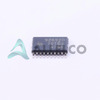
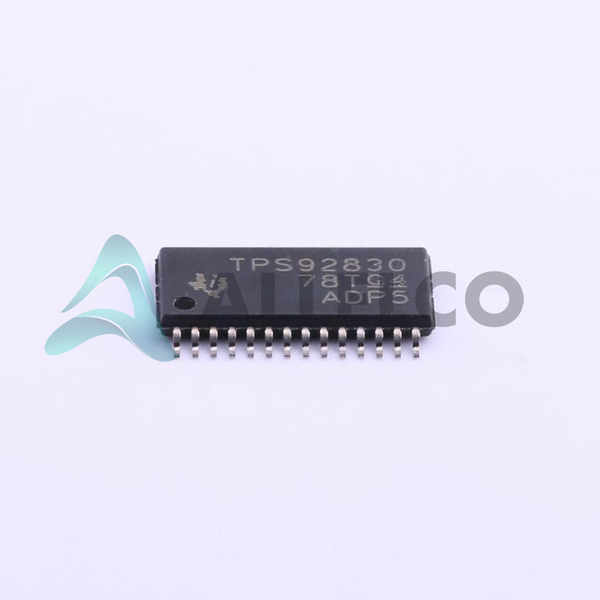
TPS92830QPWRQ1 Image
TPS92830QPWRQ1 (1)

Manufacturer Part Number

TPS92830QPWRQ1

Manufacturer

Texas Instruments

Introduction

The TPS92830QPWRQ1 is a versatile LED driver from Texas Instruments designed for power management applications, specifically targeting LED lighting systems.

Product Features and Performance

No internal switch, requiring external components for LED driving

Supports three output channels for multiple LED management

Operates on a wide supply voltage range from 4.5V to 40V, offering flexibility in various power environments

Analog and PWM dimming capabilities allow for precise control over LED brightness

Designed for automotive applications, ensuring high reliability and performance under harsh conditions

Qualifies for the AEC-Q100 automotive standard, ensuring rigorous quality and reliability

Surface mount technology for compact and efficient integration into various circuits

Product Advantages

High flexibility in voltage range accommodates different power systems

Supports precise brightness control through analog and PWM dimming

Designed specifically for automotive applications, ensuring high durability

AEC-Q100 qualification highlights reliability and suitability for quality-sensitive automotive uses
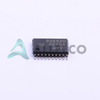
TPS92830QPWRQ1 Image
TPS92830QPWRQ1 (2)

Key Technical Parameters

Voltage Supply (Min): 4.5V

Voltage Supply (Max): 40V

Operating Temperature: -40°C to +125°C

Automotive Grade

Package / Case: 28-TSSOP

Quality and Safety Features

AEC-Q100 qualification ensures automotive-grade quality and reliability

Designed with automotive standards in mind for enhanced safety and performance

Compatibility

Suited for various automotive lighting applications due to its wide voltage range and temperature tolerance

Compatible with external components for flexible and customizable LED driving solutions

Application Areas

Automotive lighting systems, including headlights, taillights, and interior lighting

Electronic control units for LED management in vehicles

Product Lifecycle

The product status is active, indicating ongoing production and availability

No current information on discontinuation or replacements, suggesting stability in supply

Several Key Reasons to Choose This Product

Broad operational voltage range accommodates diverse automotive power systems

Analog and PWM dimming capabilities offer precise brightness control for LED lighting

Tailored for automotive applications, ensuring resilience and reliability in vehicle systems

AEC-Q100 qualification underscores the product’s quality and safety for automotive use

Surface mount technology facilitates easier integration into electronic systems
Frequently Asked Questions(FAQ)

How does the TPS92830QPWRQ1 support dimming control in automotive LED lighting systems, and what are the implications of using analog versus PWM dimming modes?
The TPS92830QPWRQ1 supports both analog and pulse-width modulation (PWM) dimming for precise control over LED output intensity. In analog dimming mode, brightness is adjusted by varying the current directly through the internal reference voltage, providing smooth, linear light transitions but potentially introducing flicker at low duty cycles. PWM dimming modulates the on/off timing of the LEDs while maintaining constant current, enabling higher dimming ratios and better compatibility with digital control systems. For automotive applications requiring compliance with stringent visibility and safety standards, PWM dimming is often preferred due to its immunity to thermal drift and consistent color temperature across the dimming range. The device’s ability to operate across a 4.5V to 40V supply range makes it suitable for direct connection to vehicle battery rails, where input voltage fluctuations can influence dimming performance if not properly managed.
What are the key electrical characteristics of the TPS92830QPWRQ1 that make it suitable for high-reliability automotive lighting applications, and how do these compare to general-purpose LED drivers?
The TPS92830QPWRQ1 is qualified under AEC-Q100, ensuring robustness against automotive environmental stresses such as temperature cycling, humidity, and mechanical vibration. Its operating temperature range spans from -40°C to 125°C, matching the demands of engine bay or exterior lighting modules. Unlike non-automotive ICs, this device integrates protection features like open-load detection and thermal shutdown, which are critical in fail-safe lighting designs. When compared to standard LED drivers, the TPS92830 offers superior stability under supply transients typical in vehicles—such as load dumps up to 65V—though it lacks an integrated switch, so external components must be selected to handle transient energy. This trade-off increases design flexibility but requires careful PCB layout and component derating.
Can the TPS92830QPWRQ1 drive multiple LED strings simultaneously, and what considerations apply when balancing current across its three outputs?
Yes, the TPS92830QPWRQ1 provides three independent linear current sinks, allowing simultaneous driving of up to three separate LED strings. Each channel can source up to 1.2A, making it suitable for high-power headlamp or daytime running light configurations. However, because the channels share a common reference and power dissipation profile, mismatched forward voltages between strings can lead to unequal current distribution unless compensated. To ensure balance, designers should match LED forward voltages closely and consider using ballast resistors or feedback loops per channel. Thermal coupling across the package also means that one heavily loaded string may elevate junction temperatures affecting adjacent channels, necessitating adequate heatsinking and spacing.
How does the lack of an internal switch in the TPS92830QPWRQ1 influence system efficiency and thermal management in high-current automotive applications?
The absence of an internal switch in the TPS92830QPWRQ1 means it operates as a linear regulator for each LED channel, dissipating excess voltage drop across the device as heat. At full current and maximum supply voltage (e.g., 40V), even a modest LED forward voltage (say 30V) results in significant power loss: (40V – 30V) × 1.2A = 12W per channel. In a three-channel configuration, this can exceed 30W total, requiring robust thermal design including large copper pours, vias, and possibly external heatsinks. Compared to switching regulators, efficiency suffers, especially in wide-input-voltage scenarios common in vehicles. However, linear operation eliminates switching noise and simplifies EMI filtering—benefits that may justify reduced efficiency in noise-sensitive lighting zones like cabin ambient lighting.
What role does the TPS92830QPWRQ1 play in meeting functional safety requirements for automotive LED systems, and how does its architecture support fault tolerance?
While the TPS92830QPWRQ1 itself is not a functional safety IC, its AEC-Q100 qualification and built-in diagnostics contribute indirectly to safer lighting operation. The device includes open-circuit detection on each output, signaling faults via status pins that can feed into a microcontroller-based safety monitor. In ASIL-B or ASIL-C rated systems, this data enables fail-operational strategies such as reducing brightness or isolating failed strings. Unlike fully isolated drivers, it relies on external isolation barriers for galvanic separation in high-side configurations, so system-level integration must account for creepage and clearance per ISO 26262. Its deterministic response to short circuits and overloads helps prevent cascading failures, aligning with automotive reliability expectations.
How does the supply voltage range of the TPS92830QPWRQ1 impact component selection for headlamp versus interior lighting applications?
With a supply range of 4.5V to 40V, the TPS92830QPWRQ1 accommodates both low-voltage subsystems (e.g., 12V or 24V vehicle buses) and high-voltage loads such as adaptive front-lighting systems that may experience brief surges beyond nominal rail voltage. For interior lighting, where voltage stability is higher and power budgets lower, efficiency losses are less critical, making the linear topology acceptable. In contrast, headlamps demand higher output currents and tighter regulation; thus, designers must derate performance near the upper end of the supply range to manage thermal limits. Additionally, in 48V mild-hybrid architectures, the wide input range allows single-driver deployment across multiple platforms without redesign, improving supply chain flexibility.
What are the advantages of using the TPS92830QPWRQ1 over discrete MOSFET-based LED driver solutions in space-constrained automotive designs?
The TPS92830QPWRQ1 integrates three matched current sources, reference circuitry, and protection logic into a single 28-pin TSSOP package, reducing BOM count and board real estate compared to discrete approaches. Discrete solutions require external op-amps, sense resistors, and gate drivers, increasing complexity and susceptibility to layout-induced errors. The integrated solution offers better channel-to-channel matching (<5% typical), simplifying calibration in multi-string applications like matrix beam headlights. Furthermore, the absence of high-side switches eliminates bootstrap capacitors and level-shifting circuitry needed in MOSFET-based designs, streamlining control signal routing and reducing electromagnetic interference risks. However, the linear nature still imposes thermal penalties that discrete buck converters avoid, creating a trade-off between integration density and efficiency.
How does the Moisture Sensitivity Level (MSL) rating of 3 for the TPS92830QPWRQ1 affect manufacturing handling procedures in automotive production environments?
The MSL rating of 3 indicates that the TPS92830QPWRQ1 can withstand up to 168 hours of exposure to ambient humidity before requiring baking to prevent popcorning during reflow soldering. This aligns with standard SMT production flows in automotive fabs, where controlled storage conditions and bake schedules are routine. Manufacturers must track lot dates and implement FIFO (first-in-first-out) practices for tape-and-reel inventory. Compared to MSL 1 parts, the TPS92830QPWRQ1 demands more disciplined handling protocols, particularly in high-volume assembly lines. Failure to adhere can result in latent defects manifesting post-assembly, compromising long-term reliability in harsh automotive environments—a critical concern given the long service life expected of lighting systems.
In what ways does the TPS92830QPWRQ1 facilitate compliance with global regulatory standards for automotive electronics, beyond basic electrical performance?
Beyond functional specs, the TPS92830QPWRQ1 supports compliance through several indirect pathways. Its RoHS3 compliance ensures adherence to EU substance restrictions, while REACH unaffected status simplifies supply chain documentation. The ECCN code EAR99 and HTSUS classification 8542.39.0001 indicate minimal export control complexity, aiding international sourcing. More importantly, its AEC-Q100 qualification demonstrates conformance to ISO 16750 and IEC 60068 environmental tests, which underpin automotive reliability mandates. Designers leveraging the TPS92830QPWRQ1 can leverage this pre-qualified status to accelerate certification cycles, particularly in regions requiring formal validation of component robustness. However, system-level compliance still depends on complete circuit design, including proper thermal management and fault handling, which the IC alone cannot guarantee.
What are the implications of choosing the TPS92830QPWRQ1 for a new-generation automotive lighting system targeting autonomous vehicle integration?
Autonomous vehicles rely on highly responsive, reliable lighting interfaces for communication, hazard indication, and sensor fusion. The TPS92830QPWRQ1’s support for PWM dimming up to high frequencies (typically >1kHz) enables dynamic pattern generation essential for vehicle-to-everything (V2X) signaling. Its fast response time (<1µs typical) allows microsecond-level adjustments crucial for emergency braking lights or directional cues. However, the linear architecture limits bandwidth compared to switching alternatives, potentially constraining complex animation sequences. Integration with domain controllers via I²C or GPIO enables centralized management of lighting behaviors aligned with ADAS logic. Still, designers must validate latency and jitter performance in the full system loop, as the IC’s deterministic behavior must meet stringent timing requirements defined in SAE J3061 for cyber-physical security.
How does the package size of the TPS92830QPWRQ1 influence placement decisions in compact automotive headlamp assemblies?
The 28-lead TSSOP measures just 6.1mm x 4.4mm, enabling placement in tight spaces within modular headlamp housings where traditional TO-220-style drivers would obstruct airflow or interfere with reflectors. This small footprint allows clustering multiple channels near individual LED arrays, minimizing trace lengths and reducing EMI radiation. However, the narrow pitch (0.65mm) demands high-precision pick-and-place equipment and careful stencil printing to avoid solder bridging. Thermal resistance from junction to ambient is relatively high (~50°C/W), so proximity to heat-generating components must be evaluated. In designs prioritizing compactness over thermal headroom, additional cooling strategies—such as forced airflow or thermal interface materials—may be necessary to maintain junction temperatures below 125°C under worst-case load.
What design trade-offs arise when selecting the TPS92830QPWRQ1 for a dual-headlight system requiring mirrored current matching versus a single-string application?
Mirroring two identical headlight strings using two TPS92830QPWRQ1 devices introduces challenges in maintaining channel-to-channel consistency across ICs due to process variations. Even with matched resistors and layout symmetry, skew in reference voltages can cause differential brightness. Alternatively, using one TPS92830QPWRQ1 to drive both left and right sides via mirrored outputs reduces mismatch but increases complexity in current sharing and heat distribution. Single-string applications benefit from simpler thermal modeling and easier calibration. The choice hinges on system redundancy needs versus cost constraints. In safety-critical setups, dual-device mirroring may offer diagnostic independence, whereas single-device designs reduce part count and simplify firmware control—at the expense of potential cross-talk during fault events.
How does the TPS92830QPWRQ1 interact with microcontroller units (MCUs) in advanced lighting systems requiring programmable dimming curves?
The TPS92830QPWRQ1 accepts control signals via analog voltage inputs for brightness setting and digital PWM inputs for dimming modulation. An MCU can generate smooth dimming profiles by writing to DACs or PWM generators that feed the analog input, enabling logarithmic or custom curves tailored to human perception. Alternatively, the PWM input allows direct digital control, bypassing analog quantization errors. Communication protocols like LIN or CAN can update setpoints dynamically based on driving conditions. However, the IC lacks onboard memory or flash, so all dimming algorithms reside externally. Designers must ensure timely updates and avoid glitches during mode transitions, which could cause visible flicker—especially problematic in cabin lighting where eye comfort is paramount.
What precautions should engineers take when evaluating the TPS92830QPWRQ1 for use in extreme ambient temperature environments outside typical automotive ranges?
Although the TPS92830QPWRQ1 is specified from -40°C to 125°C, real-world performance may degrade beyond these bounds due to packaging stress or semiconductor physics shifts. In desert climates exceeding 85°C ambient, junction temperatures may approach limits even at moderate loads, accelerating aging. Conversely, sub-zero operation affects solder joint integrity and carrier mobility, potentially increasing dropout voltage and shifting output current. Engineers should consult TI’s application notes for thermal derating curves and perform accelerated life testing if deploying in non-automotive extremes. Additionally, long-term reliability models (e.g., Arrhenius analysis) should incorporate observed field data to adjust MTBF estimates, ensuring warranty claims remain predictable.
How does the base product number TPS92830 relate to the variant TPS92830QPWRQ1, and what distinguishes the Q suffix in automotive qualification?
The base part TPS92830 represents the industrial-grade version of the IC, while TPS92830QPWRQ1 includes the “Q” suffix indicating AEC-Q100 qualification and automotive grade compliance. This distinction affects testing scope: the Q version undergoes extended temperature cycling, HAST tests, and electrical validation across military temperature grades. It also carries stricter incoming inspection criteria and traceability requirements. Suppliers offering only the non-Q variant may lack full automotive documentation, complicating audit trails in OEM supply chains. Designers must verify that procurement agreements include PPAP-level data when sourcing the Q version, especially for safety-related lighting functions.
What are the consequences of omitting external snubber circuits when using the TPS92830QPWRQ1 in systems exposed to inductive kickback from long LED harnesses?
Long cables connecting LEDs introduce parasitic inductance that, combined with rapid turn-off during PWM dimming, can generate voltage spikes exceeding the IC’s 40V absolute maximum rating. Without external TVS diodes or RC snubbers, these transients risk damaging the TPS92830QPWRQ1’s internal ESD structures. Even brief excursions above 40V may trigger latch-up or permanent failure. Automotive wiring often exceeds 1 meter in length, amplifying this effect. Mitigation strategies include placing transient suppressors close to the IC, using twisted-pair cables, and limiting PWM slew rates. System-level simulations using Spice models with realistic cable parasitics are recommended before finalizing layouts.
How does the cut tape and Digi-Reel packaging of the TPS92830QPWRQ1 affect inventory planning and Just-In-Time (JIT) manufacturing strategies?
Both CT (cut tape) and Digi-Reel formats support automated assembly but differ in scalability. Digi-Reel provides continuous reel-fed processing ideal for high-volume runs, reducing machine changeover time. Cut tape suits medium-quantity batches or prototyping, offering flexibility for engineering samples and low-volume builds. For JIT manufacturing, Digi-Reel minimizes stock variability and improves line efficiency. However, lead times and minimum order quantities (MOQs) vary by distributor, so planners must align procurement forecasts with production ramps. Storing either format requires climate-controlled environments due to MSL 3 sensitivity, impacting warehouse logistics in global supply chains.
In comparing the TPS92830QPWRQ1 to alternative linear LED drivers like the TPS92550 or TPS92630, what factors would justify selecting the TPS92830QPWRQ1 despite similar pinouts?
While the TPS92550 offers integrated switches and the TPS92630 targets lower-voltage applications, the TPS92830QPWRQ1 excels in high-supply-voltage scenarios above 24V due to its 40V rating and robust linear regulation. Its three-output architecture supports complex lighting topologies without needing multiple ICs, reducing component count. Additionally, its enhanced PWM dimming resolution (12-bit effective vs. 8-bit in some peers) enables finer granularity in adaptive lighting systems. If EMI suppression and simplicity outweigh efficiency concerns—as in interior or fog lighting—the TPS92830QPWRQ1 presents a compelling balance of performance, qualification status, and integration density for modern automotive platforms.

Parts with Similar Specifications

The three parts on the right have similar specifications to Texas Instruments TPS92830QPWRQ1

Product Attribute TPS929120AQPWPRQ1 TPS929120QPWPRQ1 TPS92692QPWPRQ1 TPS929121QPWPRQ1
Part Number TPS929120AQPWPRQ1 TPS929120QPWPRQ1 TPS92692QPWPRQ1 TPS929121QPWPRQ1
Manufacturer Texas Instruments Texas Instruments Texas Instruments Texas Instruments
Series - - - -
Current - Output / Channel - - - -
Number of Outputs - - - -
Voltage - Supply (Min) - - - -
Type - - - -
Internal Switch(s) - - - -
Topology - - - -
Frequency - - - -
Dimming - - - -
Base Product Number - DAC34H84 MAX500 ADS62P42
Operating Temperature - -40°C ~ 85°C 0°C ~ 70°C -40°C ~ 85°C
Mounting Type - Surface Mount Through Hole Surface Mount
Applications - - - -
Package / Case - 196-LFBGA 16-DIP (0.300', 7.62mm) 64-VFQFN Exposed Pad
Voltage - Supply (Max) - - - -
Supplier Device Package - 196-NFBGA (12x12) 16-PDIP 64-VQFN (9x9)
Voltage - Output - - - -
Package - Tape & Reel (TR) Tube Tape & Reel (TR)

TPS92830QPWRQ1 Datasheet PDF

Download TPS92830QPWRQ1 pdf datasheets and Texas Instruments documentation for TPS92830QPWRQ1 - Texas Instruments.

PCN Design/Specification
TPS92830-Q1 01/Feb/2018.pdf
HTML Datasheet
TPS92830-Q1 Datasheet.pdf

Customer Reviews

Evaluation: 10 Articles

  • Nath***rooks
    Jun 11, 2026

    Installed this power component in a converter board. Output remained stable under different load conditions and thermal performance was better than expected.

  • Dani***alkerTech
    Jun 1, 2026

    Product works, but setup took more effort than expected. Once configured the MCU ran reliably, although documentation support felt older compared with newer platforms. Fine for maintenance projects.

  • Yuki***aka88
    May 26, 2026

    信号通信プロジェクトでこのRS-485トランシーバーを使用しました。設置は簡単で、長距離ケーブルでも通信は安定していました。消費電力も、以前使用していたものより低くなっています。

  • Stev***aker
    May 20, 2026

    Solid diode for power rectification. Works well in switching circuits.

  • Bran***Lewis
    May 11, 2026

    Compact FPGA with good performance. Suitable for basic signal processing tasks.

  • Oliv***arris
    May 7, 2026

    Reliable I/O expander. Works well in embedded control applications.

  • Jess***Jones
    Apr 17, 2026

    It offers good value for the price, and the specifications match the description. I’ve been using it for two days with no issues, and I’ll definitely buy it again if I need it in the future.

  • Mich***Smith
    Apr 17, 2026

    Shipping was on time, the component pins are neatly aligned, and I tested 10 of them with a multimeter—all readings were within the specified range. Highly recommended.

  • Aman***arris
    Apr 3, 2026

    It was great—the entire process, from placing the order to receiving the package, went very smoothly. The components were consistent, the price was fair, and I had a very pleasant shopping experience.

  • Mike***nch
    Apr 3, 2026

    Better than expected! The resistance and capacitance readings were spot-on, and it passed the test on the first try. The service was reliable, and the packaging was thoughtful—I highly recommend it.

Write a Review

Your Email address will not be published.

Shipment

Delivery Time

In-stock items can be shipped within 24 hours. Some parts will be arranged for delivery within 1-2 days from the date all items arrive at our warehouse. And Allelco ships order once a day at about 17:00, except Sunday. Once the goods are shipped, the estimated delivery time depends on the shipping methods and Delivery destination. The table below shows are the logistic time for some common countries.

Delivery Cost

  1. Use your express account for shipment if you have one.
  2. Use our account for the shipment. Refer to the table below for the approximate charges.
(Different time frame / countries / package size has different price.)

Delivery Method

  1. Global Common Shipment by DHL / UPS / FedEx / TNT / EMS / SF we support.
  2. Others more shipping ways, please get in touch with your customer manager.

Common Countries Logistic Time Reference
Region Country Logistic Time(Day)
America United States 5
Brazil 7
Europe Germany 5
United Kingdom 4
Italy 5
Oceania Australia 6
New Zealand 5
Asia India 4
Japan 4
Middle East Israel 6
DHL & FedEx Shipment Charges Reference
Shipment charges(KG) Reference DHL(USD$)
0.00kg-1.00kg USD$30.00 - USD$60.00
1.00kg-2.00kg USD$40.00 - USD$80.00
2.00kg-3.00kg USD$50.00 - USD$100.00
Note:
The above table is for reference only. There may have some data bias for the uncontrollable factors.
Contact us if you have any questions.
  • QC (Quality Warranty)
  • Payment Support
  • Packaging
  • Certifications & Memberships

QC (Quality Warranty)

Allelco is committed to exceeding customer expectations through customer service excellence, order accuracy, and on-time delivery.
This is achieved through our commitment to the continual improvement of our processes, services, and products.


Strict quality inspection builds a solid foundation for electronic component quality.
  1. Visual inspection
  2. Performance testing and reliability verification
  3. Standardized full-process testing
  4. Precise control of every parameter
We eliminate defective components and ensure the stable operation of electronic devices through professional quality standards.

Payment Support

The payment method can be chosen from the methods shown below: Wire Transfer (T/T, Bank Transfer), Western Union, Credit card, PayPal.
  • HKBea
  • Paypal
  • MasterCard
  • Western-Union
  • VISA
Stable Delivery, Sincere Partnership — Your Faithful Supply Chain Partner
  • Efficient Supply Management
  • Cost-Saving Procurement
  • Fast Sourcing & Delivery
Contact us if you have any questions.

Packaging

Electrostatic Discharge Protection and Handling

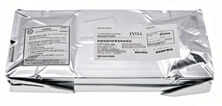
All electrostatic-sensitive components are handled in accordance with electrostatic discharge control procedures. The products are hermetically sealed in anti-static safe packaging to prevent electrostatic damage. Appropriate labeling is also applied for identification and traceability. This ensures product integrity during storage, handling and transportation.


ESD

Certifications & Memberships

Third-party certified, strict quality control. Our certification
  • ISO 9001: 2015
  • ISO 13485: 2016
  • ISO 14001: 2015
  • ISO 28000: 2007
  • ISO 45001: 2018
  • GB/T 27922-2011
  • SMTA
  • IPC
  • ESD
  • PSMA
TPS92830QPWRQ1 Image

TPS92830QPWRQ1

Texas Instruments
32D-TPS92830QPWRQ1

Want a better price? Add to Cart and Submit RFQ now, we'll contact you immediately.

0 RFQ
Shopping cart (0 Items)
It is empty.
Compare List (0 Items)
It is empty.
Feedback

Your feedback matters! At Allelco, we value the user experience and strive to improve it constantly.
Please share your comments with us via our feedback form, and we'll respond promptly.
Thank you for choosing Allelco.

Subject
E-mail
Comments
Captcha
Drag or click to upload file
Upload File
types: .xls, .xlsx, .doc, .docx, .jpg, .png and .pdf.
Max file size: 10MB