Infrared Heaters Explained: Types, Working Principle and Applications
Infrared heaters give you direct heat by warming objects and surfaces instead of the air. In this article, you will learn what an infrared heater is, how it works, and the main types available. You will also understand their advantages, disadvantages, and how they compare with traditional heaters. This helps you see where and how you can use infrared heaters effectively.Catalog
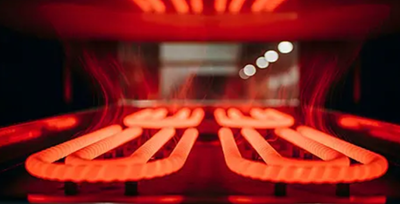
Figure 1. Infrared Heater Structure
What is an Infrared Heater?
An infrared heater is a device that produces heat by emitting infrared radiation directly toward objects and surfaces. Instead of heating the surrounding air, it focuses on transferring energy to solid materials that absorb and convert it into heat. This allows warmth to be delivered quickly and precisely to a specific area. The heating element inside the unit generates this radiant energy when powered. Infrared heaters are widely used where direct and efficient heating is needed.
Operating Principle of Infrared Heaters
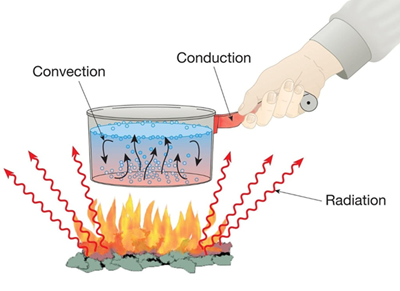
Figure 2. Infrared Radiation Heat Transfer Diagram
Infrared heaters operate by converting energy into infrared radiation that travels through space in the form of electromagnetic waves. These waves move outward from the heating element and do not rely on air to carry heat. When the radiation reaches an object, the surface absorbs the energy and its temperature increases. This process is based on radiant heat transfer, which differs from conduction and convection methods. Heat is delivered in straight lines and is most effective when there is a clear path between the heater and the object. As surfaces warm up, they may gradually release heat into the surrounding area. This creates a stable and localized heating effect.
Types of Infrared Heaters
Quartz Infrared Heaters
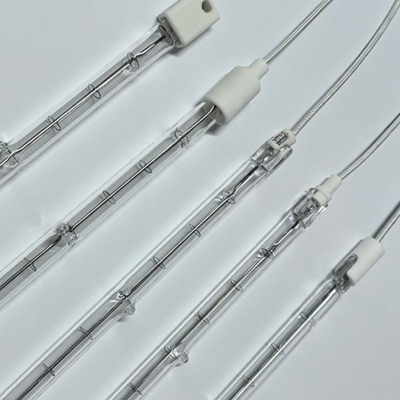
Figure 3. Quartz Infrared Heater
A quartz infrared heater is a heater that uses a quartz glass tube with a metal filament inside to generate radiant heat. When electricity flows through the filament, it heats up quickly and emits infrared radiation. The quartz tube protects the filament while allowing efficient heat transmission. This design enables rapid heating and visible glowing during operation. The internal coil structure shown in the figure highlights how heat is concentrated within the tube. These heaters typically operate at high temperatures and emit short-wave infrared energy. Their structure is compact and designed for fast heat output.
Ceramic Infrared Heaters
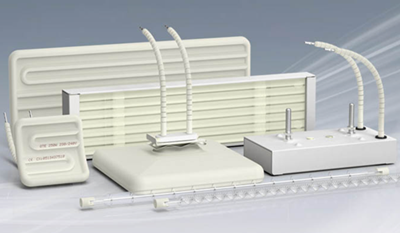
Figure 4. Ceramic Infrared Heater
A ceramic infrared heater is a device that uses a solid ceramic material to emit infrared heat. Inside the heater, an embedded resistance wire heats the ceramic surface, which then radiates energy outward. The ceramic material stores heat and releases it gradually over time. This results in steady and uniform heat emission. The flat and structured surface seen in the figure helps distribute heat evenly. These heaters operate at moderate temperatures and emit medium- to long-wave infrared radiation. Their design focuses on consistent thermal output and durability.
Halogen Infrared Heaters

Figure 5. Halogen Infrared Heater
A halogen infrared heater is a heating device that uses a tungsten filament enclosed in a halogen-filled tube to produce infrared radiation. When powered, the filament heats up rapidly and emits intense radiant energy. The halogen gas helps maintain filament performance and supports stable heat output. The bright glow visible in the figure indicates high operating temperature. These heaters emit short-wave infrared radiation that travels quickly through space. Their compact tube structure allows efficient heat emission. The design supports fast and powerful radiant heating.
Carbon Infrared Heaters
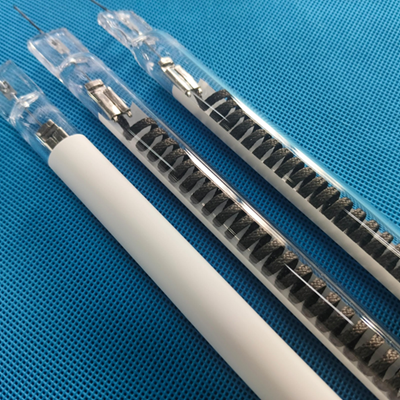
Figure 6. Carbon Infrared Heater
A carbon infrared heater is a heater that uses a carbon fiber element to generate infrared radiation. When electricity passes through the carbon material, it heats evenly and emits steady radiant heat. The carbon element typically appears as a dark coil or strip enclosed in a tube. This structure allows controlled and uniform heat output. The element shown in the figure highlights the stable heating surface. These heaters operate at moderate temperatures and emit medium- to long-wave infrared radiation. Their design supports long operational life and consistent performance.
Gas-Fired Infrared Heaters
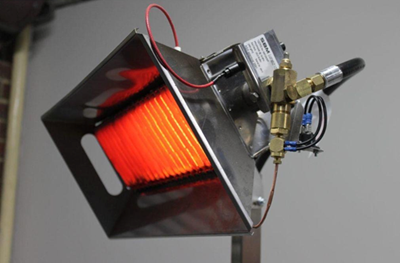
Figure 7. Gas-Fired Infrared Heater
A gas-fired infrared heater is a system that generates heat by burning fuel such as natural gas or propane. The combustion process heats a metal or ceramic emitter surface, which then radiates infrared energy. This heated surface acts as the main source of radiant heat. The structure shown in the figure includes a burner and emitter plate designed for efficient heat output. These heaters operate at high temperatures and produce strong infrared radiation. Their design allows continuous heat generation. The system is built for stable and consistent radiant emission.
Advantages of Infrared Heaters
• Provides instant heat directly to objects
• Reduces energy loss by avoiding air heating
• Delivers focused and targeted warmth
• Operates quietly without moving parts
• Requires minimal maintenance
• Produces consistent and stable heat output
Disadvantages of Infrared Heaters
• Limited heating range outside direct exposure
• Uneven warmth in enclosed spaces
• Higher initial setup cost
• Performance depends on placement
• Some units emit visible light
• Not ideal for full-room heating
Infrared Heaters vs Traditional Heaters
|
Feature |
Infrared Heaters |
Traditional
Heaters |
|
Heat Transfer
Method |
Radiant heat
using infrared waves (0.7–1000 µm) |
Convection
through heated air circulation |
|
Primary Heating
Target |
Directly heats
solid objects and people |
Heats the
surrounding air first |
|
Heating Speed |
Full heat output
within 1–3 seconds |
Typically
requires 5–15 minutes to warm a room |
|
Heat
Distribution |
Directional
heating within a 30–60° angle |
Even heat
distribution across the entire space |
|
Air Movement |
No air
circulation involved |
Uses natural or
forced airflow |
|
Heat Loss
Mechanism |
Low heat loss,
less affected by drafts |
Higher heat loss
due to air escaping |
|
Warm-Up Time |
Immediate
surface heating (under 5 seconds) |
Gradual increase
in air temperature |
|
Dust Circulation |
Minimal dust
disturbance |
Moderate to high
dust movement |
|
Noise Level |
Silent (0 dB, no
moving parts) |
May produce
20–60 dB depending on system |
|
Energy
Efficiency |
About 85–95%
efficient for targeted heating |
Around 60–80%
efficient due to air heat loss |
|
Installation |
Flexible
(wall-mounted, ceiling, or portable) |
Often fixed systems
(radiators, HVAC units) |
|
Temperature
Control |
Zoned or spot
heating for specific areas |
Whole-room or
central temperature control |
|
Heat Retention |
Heat stored in
surfaces like walls and floors |
Heat retained
temporarily in the air |
|
Energy
Consumption |
Lower for
targeted use (typically 500–1500W) |
Higher for
full-room heating (1000–3000W or more) |
|
Comfort Type |
Direct radiant
warmth similar to sunlight |
Ambient warmth
from heated air |
Applications of Infrared Heaters
1. Home Heating
Infrared heaters are used in living rooms, bedrooms, and bathrooms to provide direct warmth. They are often installed as wall panels or portable units. This allows users to heat specific areas without affecting the whole room. They are commonly used for personal comfort.
2. Outdoor Spaces
These heaters are used in patios, balconies, and outdoor dining areas. They provide warmth even in open environments where air heating is less effective. Restaurants and cafes use them for customer comfort. They are ideal for exposed spaces.
3. Industrial Heating
Infrared heaters are used in factories for drying, curing, and heating materials. They help maintain consistent temperatures during production. This improves process control and efficiency. They are widely used in manufacturing lines.
4. Commercial Buildings
Warehouses and large workspaces use infrared heaters for spot heating. They focus heat on specific zones instead of heating the entire space. This helps manage energy use efficiently. They are suitable for large indoor areas.
5. Agriculture Use
Infrared heaters are used in farms, greenhouses, and animal shelters. They help maintain proper temperature for plants and livestock. This supports growth and protection during cold conditions. They are commonly used in controlled environments.
6. Specialized Applications
Infrared heaters are used in saunas, therapy equipment, and wellness systems. They provide steady heat for relaxation and treatment. These systems require controlled and consistent heating. They are widely used in health-related applications.
Conclusion
Infrared heaters work by transferring radiant heat directly to nearby surfaces and come in several main types, including quartz, ceramic, halogen, carbon, and gas-fired models. Their structure, heating method, and heat distribution make them different from traditional heating systems. The article also covers their main strengths, limitations, and common applications in homes, commercial spaces, and industrial settings. Together, these points help explain how infrared heaters function and where they are most relevant.
About us
ALLELCO LIMITED
Read more
Quick inquiry
Please send an inquiry, we will respond immediately.
Frequently Asked Questions [FAQ]
1. Are infrared heaters safe to use indoors?
Yes, infrared heaters are safe for indoor use when properly installed and used according to safety guidelines. Most models include features like overheat protection and tip-over switches.
2. Do infrared heaters dry out the air?
No, infrared heaters do not dry out the air because they heat objects directly instead of reducing humidity levels in the room.
3. How much electricity does an infrared heater use?
Energy use depends on wattage, but most infrared heaters consume between 300W and 1500W. Actual usage varies based on how long and how often you use the heater.
4. Can infrared heaters heat large rooms?
Infrared heaters are best for spot heating or small to medium spaces. For large rooms, multiple units or higher power models are usually needed.
5. How long do infrared heaters last?
Most infrared heaters last between 5 to 10 years, depending on usage and the type of heating element used.

Heat Exchanger: Working Principles, Types and Applications
on March 30th
Complete Guide to Optocouplers for Beginners
on March 30th
Popular Posts
-

Complex Instruction Set Computers: How They Changed Computing?
on April 17th 147713
-

USB-C Pinout and Features
on April 17th 111742
-
Using Xilinx Unified Simulation Primitives: A Comprehensive Guide to FPGA Design and Simulation
on April 17th 111324
-

Power Supply Voltages in Electronics: Meaning of VCC, VDD, VEE, VSS, and GND
on April 17th 83636
-

RJ45 Connector Guide: Pinout, Wiring, Cable Types, and Uses
on January 1th 79285
-

The Ultimate Guide to Wire Color Codes in Modern Electrical Systems
The way our electrical systems use colors isn’t just for looks. Each wire color now indicates a specific function, making it easier to identify and handle electrical components correctly during ins...on January 1th 66789
-

Quality (Q) Factor: Equations and Applications
The quality factor, or 'Q', is important when checking how well inductors and resonators work in electronic systems that use radio frequencies (RF). 'Q' measures how well a circuit minimizes energy...on January 1th 62953
-
Purge Valve Guide: Function, Symptoms, Testing, and Replacement for Optimal Engine Performance
The purge valve is a key part of a car’s system that helps keep the air clean by managing fuel vapors before they can escape into the atmosphere. This not only helps the environment by reducing pol...on January 1th 62838
-

Achieving Peak Performance with the Maximum Power Transfer Theorem
The Maximum Power Transfer Theorem explains how energy from a source, such as a battery or generator, flows to a connected load. It shows the exact condition where the load receives the most power....on January 1th 54038
-

A23 Battery Specifications and Compatibility
The A23 battery is a small, cylinder-shaped battery with high voltage. Also called 23A, 23AE, or MN21, it runs at 12 volts and much higher than AA or AAA batteries. Its special design make...on January 1th 52007
HOT Part Number
-

FQPF9P25
onsemi
MOSFET P-CH 250V 6A TO220F-3
74ACT138SCX
onsemi
IC DECODER/DEMUX 1X3:8 16SOIC
TIP31C
Solid State Inc.
TRANS NPN 100V 3A TO220
MT29C1G12MAADYAMD-5 IT
Micron Technology Inc.
IC FLASH RAM 1GBIT PAR 130VFBGA
BR34E02FVT-WE2
Rohm Semiconductor
IC EEPROM 2KBIT I2C 8TSSOPB
M5M51008DFP-55H#BT
Renesas Electronics America Inc
IC SRAM 1MBIT PARALLEL 32SOP
S4006DRP
Littelfuse Inc.
SCR 400V 6A TO252
GRT31CC81A106ME01L
Murata Electronics
CAP CER 10UF 10V X6S 1206
GRM1885C1H6R1DZ01D
Murata Electronics
CAP CER 6.1PF 50V C0G/NP0 0603
SI6928DQ-T1-GE3
Vishay Siliconix
MOSFET 2N-CH 30V 4A 8-TSSOP
DCX69-16-13
Diodes Incorporated
TRANS PNP 20V 1A SOT89-3
RT0603DRD0756RL
YAGEO
RES SMD 56 OHM 0.5% 1/10W 0603
SMDJ22A-HR
Littelfuse Inc.
TVS DIODE 22VWM 35.5VC DO214AB
TPS65381AQDAPRQ1
Texas Instruments
IC REG AUTOMOTIVE 5OUT 32HTSSOP
C4532JB2E224K230KA
TDK Corporation
CAP CER 0.22UF 250V JB 1812
GRM32NC81C226ME15L
Murata Electronics
CAP CER 22UF 16V X6S 1210
MCIMX6L8DVN10AB
Freescale Semiconductor
I.MX 6 SERIES 32-BIT MPU, ARM CO
KMPC8245LVV350D
NXP USA Inc.
IC MPU MPC82XX 350MHZ 352TBGA -
L6911D
STMicroelectronics
IC REG CTRLR BUCK 20SOIC
MIC29150-3.3WT
Microchip Technology
IC REG LINEAR 3.3V 1.5A TO220-3
SN74LS03N
onsemi
SN74LS03 Quad 2-input positive-N
TX1470NL
Pulse Electronics
XFRMR OCTAL 1:1.41 1.2MH SMD
T627122054DN
Powerex Inc.
SCR 1.2KV 315A T62
MC908AP64CFAER
Freescale Semiconductor
IC MCU 8BIT 64KB FLASH 48LQFP
MAX4165EUK-T
Analog Devices Inc./Maxim Integrated
IC OPAMP GP 1 CIRCUIT SOT23-5
LTC3786IUD#PBF
Analog Devices Inc.
IC REG CTRLR MULT TOPOLOGY 16QFN
UDZ8V2B-7
Diodes Incorporated
DIODE ZENER 8.2V 200MW SOD323
MCP6494T-E/SL
Microchip Technology
IC OPAMP GP 4 CIRCUIT 14SOIC
74LVC1GX04GV,125
Nexperia USA Inc.
IC X-TAL DRIVER 6TSOP
SMCJ18CA
Littelfuse Inc.
TVS DIODE 18VWM 29.2VC DO214AB
TPSA225K035R1500
KYOCERA AVX
CAP TANT 2.2UF 10% 35V 1206
C3225X7T2W224M200AE
TDK Corporation
CAP CER 0.22UF 450V X7T 1210
PTCCL17H711FBE
Vishay Beyschlag/Draloric/BC Components
PTC RESET FUSE 145V 710MA RADIAL
AD9626BCPZ-250
Analog Devices Inc.
IC ADC 12BIT PIPELINED 56LFCSP
AT-64020
Broadcom Limited
RF TRANS NPN 20V 200SMD
LTC3708EUH
Analog Devices Inc.
IC REG CTRLR BUCK 32QFN -

TM-10
Ampleon USA Inc.
TM-10 - 10W BROADBAND RF POWER G
MCZ33198EFR2
NXP USA Inc.
IC GATE DRVR HIGH-SIDE 8SOIC
RFBPF1608070A0T
Walsin Technology Corporation
RF FILTER BAND PASS 2.45GHZ 0603
XMC1202T016X0032ABXUMA1
Infineon Technologies
IC MCU 32BIT 32KB FLASH 16TSSOP
TL074CDBR
Texas Instruments
IC OPAMP JFET 4 CIRCUIT 14SSOP
LT3970EMS-3.3#PBF
Analog Devices Inc.
IC REG BUCK 3.3V 535MA 10MSOP
TZMB22-GS08
Vishay General Semiconductor - Diodes Division
DIODE ZENER 22V 500MW SOD80
ISL60002DIH312Z-T7A
Renesas Electronics America Inc
IC VREF SERIES 0.4% SOT23-3
ICL3217ECAZ-T
Renesas Electronics America Inc
IC TRANSCEIVER FULL 5/3 24SSOP
STU5N60M2
STMicroelectronics
MOSFET N-CH 600V 3.7A IPAK
EFR32BG21A010F512IM32-BR
Silicon Labs
IC MCU 2.4G 10DB BLUETOOTH 5.1
TPSM63603V5RDHR
Texas Instruments
HIGH-DENSITY, 3-V TO 36-V INPUT,
1-1462051-1
TE Connectivity Potter & Brumfield Relays
RELAY RF SPDT 2A 3V
SMF33A
Yangjie Technology
SOD-123FL 200W 53.3V 3.75A TVS
2SB1201T-TL-E
onsemi
TRANS PNP 50V 2A TP-FA
MSD601-RT2
onsemi
SMALL SIGNAL BIPOLAR TRANSISTOR
RD3L140SPTL1
Rohm Semiconductor
MOSFET P-CH 60V 14A TO252
CC1206KKX7RABB223
YAGEO
CAP CER 0.022UF 200V X7R 1206