Learn About EPM7128SQI100-10 CPLD and How It Handles Digital Logic
You often want a single device that can handle several logic tasks without filling your board with extra parts. The EPM7128SQI100-10 gives you that flexibility by combining control logic, decoding, and signal routing in one programmable chip. You can shape its behavior to match your circuit needs and adjust it later if things change. With a balanced logic capacity and predictable timing, it fits well into systems that need steady digital control. Its surface-mount package also helps keep layouts clean while still giving you plenty of usable I/O connections.Catalog
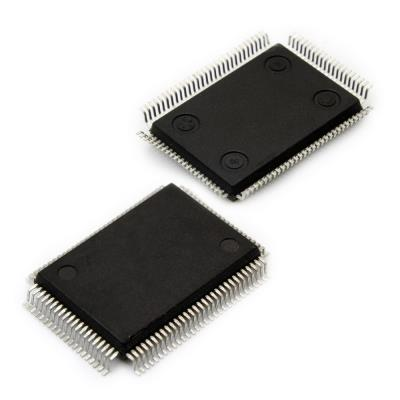
EPM7128SQI100-10 Overview
The EPM7128SQI100-10 is a programmable logic device designed to handle custom digital control and interface tasks within electronic systems. It contains 128 logic elements that allow multiple logic functions to be combined into a single component, helping simplify circuit layouts and reduce part count. The device supports fast logic response suitable for timing control, signal routing, and decision based operations. Its 100 pin surface mount package enables integration into compact board designs while maintaining stable electrical performance. Common uses include glue logic, state control, address decoding, and interface adaptation in industrial and embedded applications. Looking for EPM7128SQI100-10? Contact us to check current stock, lead time, and pricing.
Pin-Out Diagram of EPM7128SQI100-10
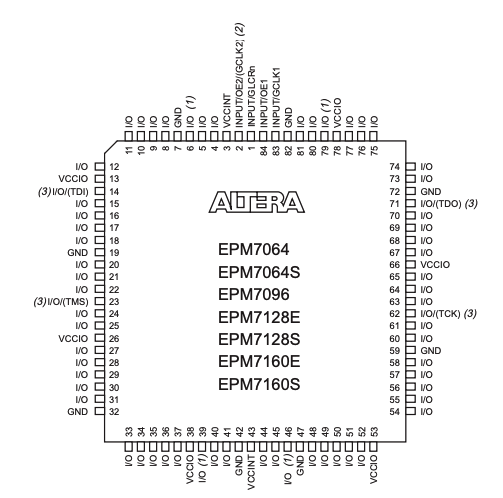
Pin arrangement is shown for the 84 pin PLCC package, with signal names and pin numbers distributed evenly around all four sides of the device. User I O pins occupy most positions and are interspersed with dedicated power, ground, and control pins to support stable operation. VCC and GND pins are placed at regular intervals to provide consistent power distribution across the package. Dedicated pins for global clock, output enable, and JTAG functions are clearly labeled to distinguish them from general purpose I O. The diagram reflects a standardized layout that supports predictable signal routing, simplified board design, and compatibility across related MAX 7000 series devices.
Features of EPM7128SQI100-10
In System Programmable Logic Architecture
The EPM7128SQI100-10 supports logic programming directly while mounted on the circuit board. This allows logic updates during development or after deployment without removing the device. It helps reduce downtime and simplifies revisions when system behavior needs adjustment.
Medium Density Logic Capacity
The device provides 128 macrocells that allow multiple logic functions to be implemented within a single component. This capacity supports control logic, decoding tasks, and interface handling while reducing the need for additional discrete logic devices.
Structured Logic Array Block Design
Eight internal logic array blocks organize the logic resources in a predictable way. This structure supports stable signal routing and consistent logic behavior across different operating conditions.
Usable Logic Gate Availability
With approximately 2500 usable logic gates, the device can support state machines, timing control, and custom digital functions. This level of integration helps simplify board layouts and lowers overall component count.
Flexible User Input and Output Support
The device supports up to 84 user configurable input and output pins. This flexibility allows it to interface with a wide range of external signals, buses, and peripheral devices in embedded systems.
Fast Propagation Delay Performance
A maximum propagation delay of 10 ns allows the device to respond quickly to input changes. This makes it suitable for applications that require predictable timing and responsive digital control.
Industrial Temperature Operating Range
The device is designed to operate reliably across an industrial temperature range. This allows stable performance in environments where temperature variation is expected, such as control systems and industrial electronics.
EPM7128SQI100-10 Technical Specifications
| Product Attribute | Attribute Value |
| Manufacturer | Intel |
| Voltage Supply - Internal | 4.5V ~ 5.5V |
| Supplier Device Package | 100-PQFP (20x14) |
| Series | MAX® 7000S |
| Programmable Type | In System Programmable |
| Package / Case | 100-BQFP |
| Package | Tray |
| Operating Temperature | -40°C ~ 85°C (TA) |
| Number of Macrocells | 128 |
| Number of Logic Elements/Blocks | 8 |
| Number of I/O | 84 |
| Number of Gates | 2500 |
| Mounting Type | Surface Mount |
| Delay Time tpd(1) Max | 10 ns |
| Base Product Number | EPM7128 |
Device Block Diagram of EPM7128SQI100-10
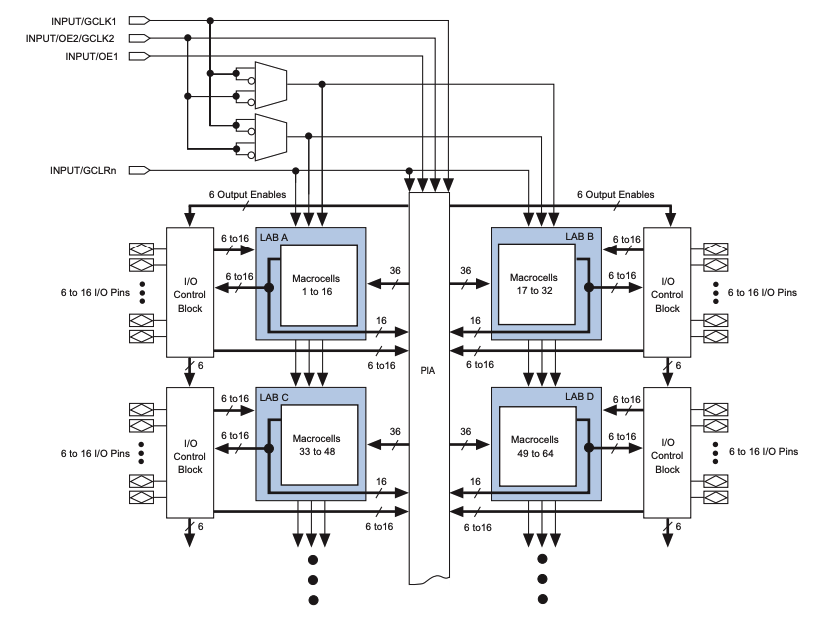
Internal architecture is arranged around multiple logic array blocks, each containing a defined group of macrocells used to implement combinational and registered logic functions. These logic array blocks are interconnected through a central programmable interconnect array that enables signal routing between blocks with predictable timing behavior. Dedicated I O control blocks surround the logic array blocks and manage input buffering, output driving, tri state control, and feedback paths between external pins and internal logic. Global resources, including clock inputs, output enable signals, and a global clear signal, are distributed across the device to support synchronous operation and coordinated control of outputs. This structure reflects the organization used by the EPM7128SQI100-10, which integrates multiple logic array blocks and macrocells to support medium density programmable logic with deterministic signal routing and centralized control paths.
Device Macrocell of EPM7128SQI100-10
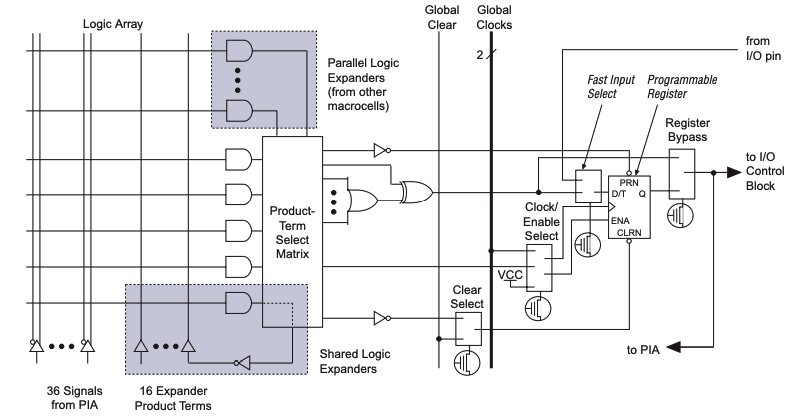
Logic within a single macrocell is organized around a product term select matrix that receives input signals from the programmable interconnect array and local logic expanders. Multiple product terms are combined to form sum of products logic, which can drive either a combinational output or a programmable register. The register includes clock enable, clear, preset, and bypass paths, allowing flexible selection between registered and unregistered operation. Global clock and global clear signals are routed directly into the macrocell to support synchronous control across the device. Output data is passed to the I O control block or fed back into the interconnect array, enabling reuse of logic results and efficient signal distribution within the EPM7128SQI100-10.
AC Test Conditions of EPM7128SQI100-10
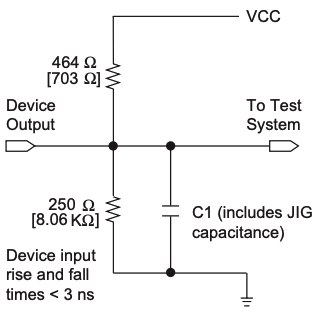
Test configuration defines the electrical conditions used for AC timing measurements by specifying resistive loads, capacitive loading, and signal paths between the device and the test system. The device output is connected to VCC through a pull up resistor and to ground through a defined load network that models output drive behavior during switching. A capacitor represents total load capacitance, including fixture effects, while the test system connection monitors signal transitions. Input rise and fall times are constrained to less than 3 ns to ensure consistent measurement conditions. The setup reflects how supply transients and ground current can influence observed AC performance and establishes standardized conditions for timing characterization of the EPM7128SQI100-10.
Applications of EPM7128SQI100-10
Industrial Control and Automation Systems
The EPM7128SQI100-10 is commonly used in industrial control environments to handle sequencing, interlock logic, and signal coordination. It helps manage input conditions from sensors and switches while generating stable control signals for actuators and control modules. Its programmable structure allows control behavior to be adapted as system requirements change.
Telecommunications Equipment Control Logic
In telecommunications equipment, the device supports control paths that manage timing, signal routing, and interface coordination. It is often used to organize control signals between processing units and communication interfaces, helping maintain orderly data flow within switching and transmission hardware.
Networking Hardware Glue Logic
The device is applied as glue logic in networking hardware to connect processors, memory devices, and peripheral components. It supports address decoding, bus arbitration, and signal alignment, allowing different digital blocks to operate together within compact network systems.
Embedded System Interface and Decoding Logic
Within embedded systems, the EPM7128SQI100-10 provides interface logic between controllers and external devices. It is used for address decoding, control signal generation, and basic protocol handling, helping simplify system design and reduce the number of discrete logic components.
Legacy Computing and Instrumentation Systems
The device is well suited for legacy computing platforms and instrumentation systems that require stable logic replacement. It can consolidate older discrete logic functions into a single programmable device while preserving compatibility with existing signal levels and timing behavior.
Protocol Bridging and State Machine Implementation
The EPM7128SQI100-10 is used to implement protocol bridging and state machines that manage structured digital processes. It supports defined state transitions and control sequencing, making it suitable for coordinating communication and control tasks across different system blocks.
Advantages and Disadvantages of EPM7128SQI100-10
Advantages
• Supports in system logic updates without removing the device from the board
• Provides 128 macrocells suitable for medium scale control and interface logic
• Offers predictable timing with a maximum propagation delay of 10 ns
• Operates across an industrial temperature range for stable field performance
• Includes a high number of user configurable input and output pins for flexible interfacing
Disadvantages
• Operates on a 5 V supply which limits compatibility with lower voltage systems
• Logic capacity is lower compared to more recent programmable logic devices
• Power usage is higher than modern low power programmable alternatives
• Package size may not suit highly compact or space constrained designs
EPM7128SQI100-10 Alternatives
| Part Number | Manufacturer | Key Features | Use Case/Notes |
| EPM7128SQI100-10N | Intel | 128 macrocells with in-system programmability, 5 V internal supply range, and fast 10 ns maximum propagation delay in a surface-mount package. | Used in digital glue logic, control logic, and interface applications requiring reliable timing and moderate logic density. |
| EPM7128SQI160-10 | Intel | Same 128 macrocell architecture with 10 ns speed grade, offered in a larger pin-count package for expanded routing flexibility. | Well suited for designs needing additional I/O access or compatibility with existing board layouts. |
| EPM7128SQI160-10N | Intel | 128 macrocells, in-system programmable CPLD with stable 5 V operation and extended temperature support. | Appropriate for industrial and embedded systems that require dependable logic control across wider temperature ranges. |
About Intel
Intel is a global technology company known for developing a wide range of digital computing and programmable logic solutions. The company has a long history of advancing semiconductor design for computing, communications, and embedded systems. Its programmable logic portfolio supports system control, signal management, and interface logic across industrial, networking, and embedded applications. Intel focuses on providing scalable logic platforms that balance performance, stability, and long term platform support. Its products are widely used in both established system architectures and evolving digital designs, reflecting a strong presence in the broader electronics ecosystem.
Conclusion
The EPM7128SQI100-10 brings together logic control, timing, and interface handling in a single programmable device. You get a clear structure with logic array blocks and macrocells that make behavior predictable. Its pin layout and I/O flexibility help simplify board routing. Fast response times support stable digital control in many systems. The device also works well when you need to update logic without hardware changes. Overall, it offers a practical way to manage medium-scale digital logic in one place.
Datasheet PDF
EPM7128SQI100-10 Datasheet:
About us
ALLELCO LIMITED
Read more
Quick inquiry
Please send an inquiry, we will respond immediately.
Frequently Asked Questions [FAQ]
1. What type of device is the EPM7128SQI100-10?
It is a CPLD that can be programmed to perform custom digital logic functions like control, decoding, and signal routing.
2. How many macrocells does the EPM7128SQI100-10 have?
The device includes 128 macrocells, allowing multiple logic functions to be combined in one chip.
3. Can the logic be updated after installation?
Yes, it supports in-system programming, so you can update the logic while the device is mounted on the board.
4. What kind of package does this device use?
It comes in a 100-pin surface-mount package that fits well into compact PCB designs.
5. Where is the EPM7128SQI100-10 commonly used?
It is often used for control logic, glue logic, state machines, and interface handling in embedded and industrial systems.

AD9883AKST-140 Analog Video ADC for High Resolution Displays
on January 6th
What Is a Trimpot and How It Works
on January 6th
Popular Posts
-

Complex Instruction Set Computers: How They Changed Computing?
on April 17th 147743
-

USB-C Pinout and Features
on April 17th 111822
-
Using Xilinx Unified Simulation Primitives: A Comprehensive Guide to FPGA Design and Simulation
on April 17th 111341
-

Power Supply Voltages in Electronics: Meaning of VCC, VDD, VEE, VSS, and GND
on April 17th 83674
-

RJ45 Connector Guide: Pinout, Wiring, Cable Types, and Uses
on January 1th 79412
-

The Ultimate Guide to Wire Color Codes in Modern Electrical Systems
The way our electrical systems use colors isn’t just for looks. Each wire color now indicates a specific function, making it easier to identify and handle electrical components correctly during ins...on January 1th 66822
-

Quality (Q) Factor: Equations and Applications
The quality factor, or 'Q', is important when checking how well inductors and resonators work in electronic systems that use radio frequencies (RF). 'Q' measures how well a circuit minimizes energy...on January 1th 62978
-
Purge Valve Guide: Function, Symptoms, Testing, and Replacement for Optimal Engine Performance
The purge valve is a key part of a car’s system that helps keep the air clean by managing fuel vapors before they can escape into the atmosphere. This not only helps the environment by reducing pol...on January 1th 62874
-

Achieving Peak Performance with the Maximum Power Transfer Theorem
The Maximum Power Transfer Theorem explains how energy from a source, such as a battery or generator, flows to a connected load. It shows the exact condition where the load receives the most power....on January 1th 54055
-

A23 Battery Specifications and Compatibility
The A23 battery is a small, cylinder-shaped battery with high voltage. Also called 23A, 23AE, or MN21, it runs at 12 volts and much higher than AA or AAA batteries. Its special design make...on January 1th 52042
HOT Part Number
-

CC1206KKX7RYBB223
YAGEO
CAP CER 0.022UF 250V X7R 1206
GRM0335C1H390JD01D
Murata Electronics
CAP CER 39PF 50V C0G/NP0 0201
LA6586FA-BH
onsemi
IC HALF BRIDGE DRV 600MA 10MICRO
5CEFA5M13C8N
Intel
IC FPGA 175 I/O 383MBGA
SN74LVC2G86YZPR
Texas Instruments
IC GATE XOR 2CH 2-INP 8DSBGA
TL431IDBVR
Texas Instruments
IC VREF SHUNT ADJ 2.2% SOT23-5
N80C152JD
Rochester Electronics, LLC
IC MCU 8BIT
FAN48632UC35X
onsemi
IC REG CONV GSM PA 1OUT 16WLCSP
EN6382QI
Intel
DC DC CONVERTER 0.6-5.9V
TC835CPI
Microchip Technology
IC DRVR 7 SEG 4 1/2 DIGIT 28DIP
1N914BWS
Fairchild Semiconductor
DIODE GEN PURP 75V 150MA SOD323F
78438335022
Würth Elektronik
FIXED IND 2.2UH 1.8A 108MOHM SMD
TLE4275S
Infineon Technologies
IC REG LIN 5V 450MA TO220-5-12
ADE7752ARZ
Analog Devices Inc.
IC ENERGY METERING DETEC 24-SOIC
5177984-1
TE Connectivity AMP Connectors
CONN PLUG 40POS SMD GOLD
KSZ8852HLEWA
Microchip Technology
IC ETHERNET CTLR 2PORT PCI 64LQF
1N5248B
Microchip Technology
DIODE ZENER
IS42S81600F-6TL
ISSI, Integrated Silicon Solution Inc
IC DRAM 128MBIT PAR 54TSOP II -
A3959SLPTR
Allegro MicroSystems
IC MOTOR DRVR 4.5V-5.5V 28TSSOP
USB3329C-GL-TR
Microchip Technology
IC TRANSCEIVER HALF 1/1 25WLCSP
LP8731QYZRRQ1
Texas Instruments
IC REG QD BUCK/LNR SYNC 25DSBGA
GP1UM281QKVF
SHARP/Socle Technology
SENSOR REMOTE REC 38.0KHZ 8.5M
TDA7498ETR
STMicroelectronics
IC AMP D MONO/STER 220W PWRSSO36
C1005CH1H120J050BA
TDK Corporation
CAP CER 12PF 50V CH 0402
TPS23754PWP
Texas Instruments
IC POE CNTRL 1 CHANNEL 20HTSSOP
DSEI12-12A
IXYS
DIODE GEN PURP 1.2KV 11A TO220AC
SN74AS138NSR
Texas Instruments
IC DECODER/DEMUX 1 X 3:8 16SO
AT86RF233-ZUR
Microchip Technology
IC RF TXRX+MCU 802.15.4 32VFQFN
8530-4500PL
3M
CONN RCPT 30POS 0.1 GOLD PCB
SN74LVC2G32DCURE4
Texas Instruments
IC GATE OR 2CH 2-INP 8VSSOP
12061C122KAT2A
KYOCERA AVX
CAP CER 1200PF 100V X7R 1206
MAX4657ESA
Analog Devices Inc./Maxim Integrated
IC SWITCH SPST-NCX1 10OHM 8SOIC
06031A131KAT2A
KYOCERA AVX
CAP CER 130PF 100V NP0 0603
HFBR-4597Z
Broadcom Limited
TOOL HAND CRIMPER FBR OPTIC SIDE
APT8014JLL
Microchip Technology
MOSFET N-CH 800V 42A ISOTOP
TLC549CDRG4
Texas Instruments
IC ADC 8BIT SAR 8SOIC -
06033C152JAT2A
KYOCERA AVX
CAP CER 1500PF 25V X7R 0603
ZTX749A
Fairchild Semiconductor
TRANS PNP 35V 2A TO226
AT87C58X2-SLSUM
Microchip Technology
IC MCU 8BIT 32KB OTP 44PLCC
MR25H40CDC
Everspin Technologies Inc.
IC RAM 4MBIT SPI 40MHZ 8DFN
C1608JB0J156M080AC
TDK Corporation
CAP CER 15UF 6.3V JB 0603
MAX499CWG
Analog Devices Inc./Maxim Integrated
IC BUFF/AMP RGB SPDT 24-SOIC
MMSZ5254BS-7-F
Diodes Incorporated
DIODE ZENER 27V 200MW SOD323
TLV62568DRLR
Texas Instruments
IC REG BUCK ADJ 1A SOT563-6
SN74HC257ANSR
Texas Instruments
IC MULTIPLEXER 4 X 2:1 16SO
P4KE30A
Taiwan Semiconductor Corporation
TVS DIODE 25.6VWM 41.4VC DO204AL
VE-230-CW
Vicor Corporation
DC DC CONVERTER 5V 100W
EP1S10F484C6N
Intel
IC FPGA 335 I/O 484FBGA
SN74AXC4T245BQBR
Texas Instruments
IC TRANSCEIVER HALF 4/4 16WQFN
SRR1260A-100M
Bourns Inc.
FIXED IND 10UH 5.5A 20 MOHM SMD
VI-230-IW
Vicor Corporation
DC DC CONVERTER 5V 100W
CY74FCT573CTSOC
Texas Instruments
IC OCT TRANS D LATCH 3ST 20SOIC
BMG250
Bosch Sensortec
GYROSCOPE 3-AXIS SPI/I2C SMD
ACPL-790B-300E
Broadcom Limited
IC OPAMP ISOLATION 1 CIRC 8DIPGW