TMS320C6421ZWT5 DSP Overview: Features, Alternatives, Specifications, and Applications
In this article, you’ll learn about the TMS320C6421ZWT5, a digital signal processor (DSP) made by Texas Instruments. We’ll walk through what it is, how it works, and the key features that make it useful in different systems. You’ll also see diagrams, specifications, applications, and simple steps for programming it. By the end, you’ll understand where and why this chip is used.Catalog
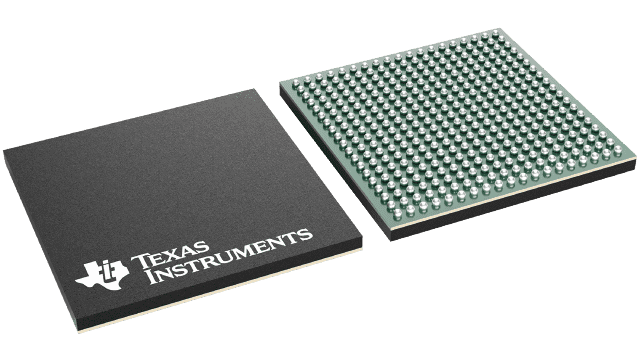
What is the TMS320C6421ZWT5?
The TMS320C6421ZWT5 is a high-performance digital signal processor (DSP) developed by Texas Instruments as part of its TMS320C64x+ family. Built on the VelociTI.2 VLIW architecture, this device delivers powerful fixed-point processing performance designed for intensive signal handling in modern embedded systems. With clock speeds reaching up to 500 MHz, it is capable of executing multiple instructions per cycle, making it suitable for a wide range of advanced processing tasks. Belonging to the broader TMS320C6000 DSP platform, the C6421 series carries forward Texas Instruments’ focus on scalable and code-compatible solutions. As part of a proven family of processors trusted worldwide, the TMS320C6421ZWT5 offers a reliable foundation for long-term designs.
Looking for TMS320C6421ZWT5? Contact us to check current stock, lead time, and pricing.
TMS320C6421ZWT5 CAD Models
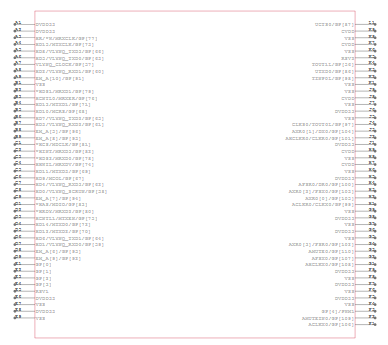
TMS320C6421ZWT5 Symbol
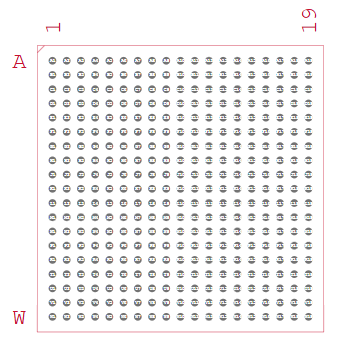
TMS320C6421ZWT5 Footprint
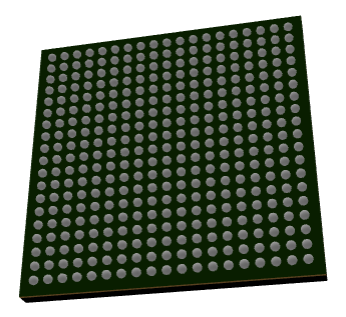
TMS320C6421ZWT5 3D Model
TMS320C6421ZWT5 Features
• High-Performance DSP Core
The device is powered by the VelociTI.2™ VLIW core, capable of executing up to eight instructions in a single cycle. This architecture enables very high throughput, making it ideal for complex signal processing tasks.
• Efficient Multipliers and ALUs
It integrates six arithmetic logic units (ALUs) and two powerful multipliers, which can handle multiple operations simultaneously. This design supports intensive math operations such as filtering, modulation, and encoding.
• Flexible On-Chip Memory
The processor includes 16 KB program cache, 48 KB data cache, and 64 KB of unified L2 memory. These internal resources reduce latency and support faster execution of applications.
• DDR2 and Flash Memory Interfaces
The chip features a 16-bit DDR2 SDRAM controller and an 8-bit asynchronous EMIF for external memory like NOR and NAND flash. This flexibility allows to expand memory for larger applications.
• Versatile Peripheral Support
It provides a wide range of interfaces including UART, I²C, McBSP, McASP with SPDIF, and a 16-bit Host Port Interface. These make the processor highly adaptable for telecom, audio, and industrial systems.
• Enhanced DMA Controller (EDMA)
A 64-channel enhanced DMA controller supports fast data transfer between memory and peripherals. This reduces CPU load and improves overall system performance.
• Networking and Connectivity
The chip integrates a 10/100 Ethernet MAC with MII/RMII support and a VLYNQ interface for external connectivity. These features make it suitable for network-enabled embedded applications.
• Rich General-Purpose I/O
With up to 111 multiplexed GPIO pins and three PWM outputs, the DSP offers excellent flexibility for system control and custom interfacing. This ensures easy integration into a wide range of hardware designs.
• Low Voltage Operation
It operates with a core voltage of 1.05 V or 1.2 V and I/O levels of 1.8 V or 3.3 V. This balance of power efficiency and flexibility makes it reliable for embedded designs.
TMS320C6421 Functional Block Diagram
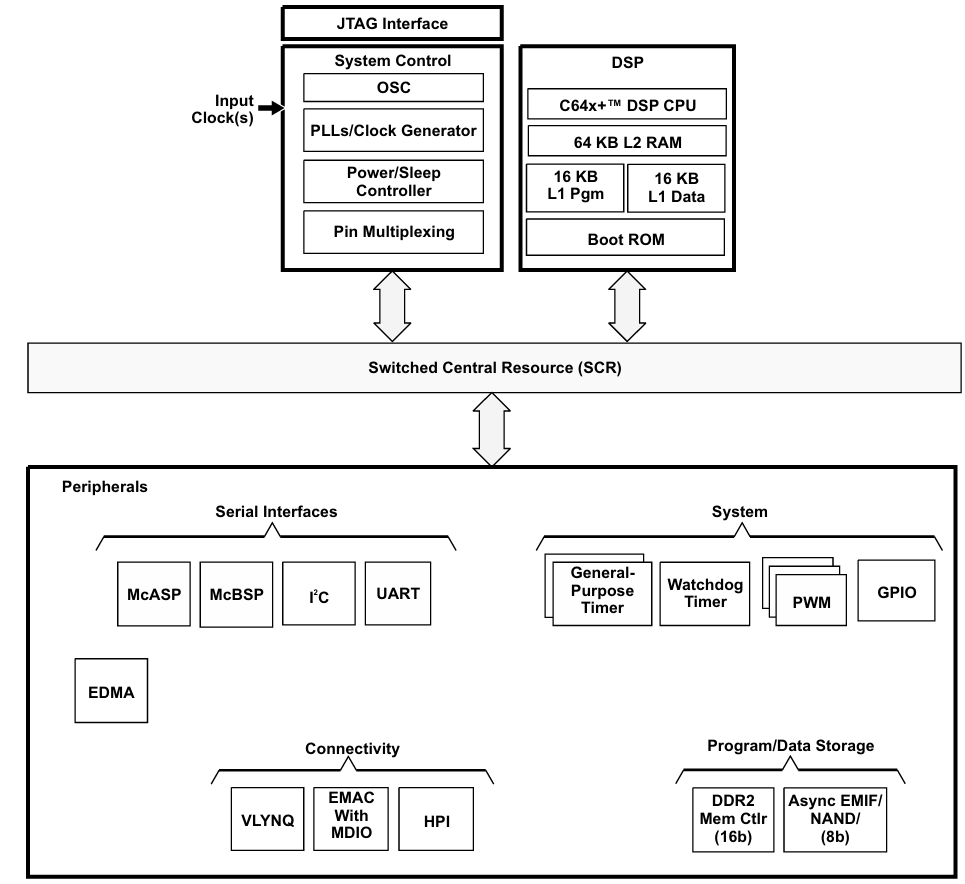
The TMS320C6421ZWT5 functional block diagram highlights how the processor combines its core, memory, and peripherals to work together. At the center is the C64x+ DSP CPU with L1 and L2 memory plus Boot ROM, which ensures fast data access and quick startup. System control blocks such as oscillators, PLLs, and power management handle clock generation, low-power modes, and signal routing.
All parts are linked through the Switched Central Resource (SCR), which acts like the main bus for data flow. The processor includes serial interfaces such as UART, I²C, McBSP, and McASP, supported by a powerful EDMA controller for high-speed data transfers. It also features timers, watchdog functions, PWM, and GPIO for general system control.
For connectivity, the device offers Ethernet MAC with MDIO, VLYNQ, and a Host Port Interface, making it flexible for networking and external communication. Memory expansion is supported through a DDR2 memory controller and an asynchronous EMIF for NAND or NOR flash. Together, these blocks show how the chip is built to handle intensive processing with efficient memory and wide connectivity options.
C64x+ Cache Memory Architecture

The C64x+ cache memory architecture in the TMS320C6421ZWT5 is built to give the CPU fast access to instructions and data. It starts with L1 memory, which is split into two parts: L1 Program (L1P) for instructions and L1 Data (L1D) for data. Both include SRAM and cache, connected to the CPU with wide 256-bit paths for high-speed transfers.
Behind this, the L2 memory works as a larger, unified space for both data and programs. It has SRAM and cache, and connects to external memory through a 64-bit bus. A write buffer helps speed up data storage by handling writes in the background. This layered design keeps frequently used data close to the CPU while still allowing access to larger external memory when needed.
I2C Module Block Diagram
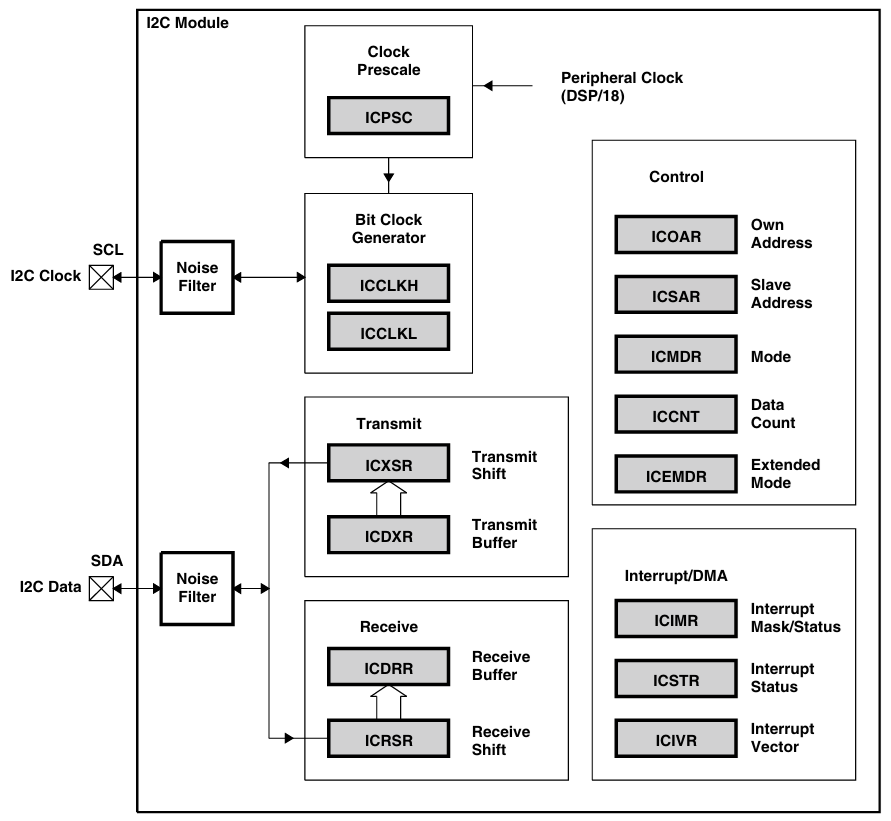
The I²C module in the TMS320C6421ZWT5 controls communication through the two I²C lines, SCL for clock and SDA for data. Both signals pass through noise filters to keep the transfer stable. A clock prescaler and bit clock generator set the correct speed for communication.
The module has separate paths for sending and receiving data. The transmit block holds data in a buffer before sending it out, while the receive block stores incoming data before passing it to the CPU. A control unit manages addresses, modes, and data counts so the device can work as either master or slave.
It also includes interrupt and DMA support, which help handle data transfers automatically without needing the CPU to check constantly. This makes the I²C interface reliable and efficient for connecting the DSP with external devices.
TMS320C6421ZWT5 Specifications
|
Type |
Parameter |
|
Manufacturer |
Texas Instruments |
|
Series |
TMS320C642x |
|
Packaging |
Tray |
|
Part Status |
Active |
|
Type |
Fixed Point |
|
Interface |
HPI, I2C, McASP, McBSP, UART, 10/100 Ethernet MAC |
|
Clock Rate |
500 MHz |
|
Non-Volatile Memory |
ROM (64 kB) |
|
On-Chip RAM |
96 kB |
|
Voltage - I/O |
1.8 V, 3.3 V |
|
Voltage - Core |
1.05 V, 1.20 V |
|
Operating Temperature |
0 °C ~ 90 °C (TJ) |
|
Mounting Type |
Surface Mount |
|
Package / Case |
361-LFBGA |
|
Supplier Device Package |
361-NFBGA (16×16) |
|
Base Product Number |
TMS320 |
TMS320C6421ZWT5 Applications
1. Telecom and Wireless Systems
The TMS320C6421ZWT5 is widely used in telecom infrastructure and wireless devices because of its high-speed signal processing power. It handles tasks like modulation, demodulation, and channel coding, which are good in base stations, gateways, and broadband equipment. With its integrated Ethernet MAC and DDR2 support, it provides both connectivity and the memory bandwidth required for communication.
2. Audio and Signal Processing
This DSP is well-suited for audio systems that require high-performance computation and low-latency processing. It can run multichannel voice codecs, perform noise cancellation, and handle audio effects in time. Interfaces like McBSP and McASP make it easy to connect with audio equipment, ensuring reliable and high-quality sound performance.
3. Imaging and Video Applications
The C6421 can also be applied to imaging and video tasks that demand rapid data processing. Its DSP core allows it to support compression, decompression, and enhancement functions for cameras, surveillance systems, and embedded vision devices. By leveraging its parallel execution capabilities, it enables efficient handling of image and video streams.
4. Industrial and Embedded Control
In industrial and office automation, the device is valued for its integration of timers, GPIOs, PWM, and DMA, which provide tight system control. It is used in applications such as printers, scanners, motor controllers, and embedded automation units. Its efficient power modes and high-speed processing help deliver reliable performance while keeping energy consumption low.
TMS320C6421ZWT5 Similar Parts
|
Specification |
TMS320C6421ZWT5 |
TMS320C6421ZDU5 |
TMS320C6421ZDU4 |
TMS320C6421ZWTQ5 |
TMS320C6424 |
|
Core Architecture |
C64x+ VelociTI.2 VLIW DSP |
C64x+ VelociTI.2 VLIW DSP |
C64x+ VelociTI.2 VLIW DSP |
C64x+ VelociTI.2 VLIW DSP |
C64x+ VelociTI.2 VLIW DSP |
|
Clock Speed |
500 MHz |
500 MHz |
600 MHz |
500 MHz |
Up to 720 MHz (higher tier) |
|
Performance (MIPS) |
~4,000 at 500 MHz |
~4,000 at 500 MHz |
~4,800 at 600 MHz |
~4,000 at 500 MHz |
Higher, up to ~8,000 MIPS |
|
On-Chip Memory |
L1P 16 KB, L1D 48 KB, L2 64 KB |
L1P 16 KB, L1D 48 KB, L2 64 KB |
L1P 16 KB, L1D 48 KB, L2 64 KB |
L1P 16 KB, L1D 48 KB, L2 64 KB |
Larger L2 options available |
|
ROM Size |
64 KB Boot ROM |
64 KB Boot ROM |
64 KB Boot ROM |
64 KB Boot ROM |
64 KB Boot ROM |
|
External Memory Support |
DDR2 (16-bit), EMIFA (8-bit) |
DDR2 (16-bit), EMIFA (8-bit) |
DDR2 (16-bit), EMIFA (8-bit) |
DDR2 (16-bit), EMIFA (8-bit) |
DDR2 (16-bit), EMIFA (8-bit) |
|
Ethernet MAC |
10/100 Mb/s with MDIO |
10/100 Mb/s with MDIO |
10/100 Mb/s with MDIO |
10/100 Mb/s with MDIO |
10/100 Mb/s with MDIO |
|
Operating Temperature |
0 °C to 90 °C (commercial) |
0 °C to 90 °C (commercial) |
0 °C to 90 °C (commercial) |
–40 °C to +125 °C (industrial) |
0 °C to 90 °C (commercial) |
|
Package |
361-pin NFBGA (16×16 mm) |
361-pin NFBGA (diff. marking) |
361-pin NFBGA |
361-pin NFBGA |
361-pin NFBGA |
|
Applications |
Telecom, audio, embedded |
Telecom, audio, embedded |
Performance-critical telecom |
Industrial/harsh environment |
Higher-end telecom & VoIP |
TMS320C6421ZWT5 Programming Steps
The process typically moves from setting up the environment to writing, debugging, and deploying optimized DSP code.
1. Install Development Tools
The first step is to set up Code Composer Studio (CCS), TI’s integrated development environment. This software provides the compiler, assembler, debugger, and project management tools specifically designed for the C6000 DSP family. Without this setup, programming and testing the DSP hardware would not be possible.
2. Create a New Project
In CCS, start by creating a new project configured for the TMS320C6421 device. This includes choosing the proper compiler options, linker command files, and startup code templates. Correct project setup ensures that the memory map and system resources are aligned with the hardware.
3. Write the Application Code
Applications can be written in C for general logic or in assembly for performance-critical routines. Many take advantage of the C64x+ VLIW architecture, which allows multiple instructions to execute in parallel. Optimizing loops and using DSP-specific intrinsics can greatly improve efficiency.
4. Compile and Optimize
After coding, the program is compiled and assembled into machine instructions. TI’s compiler includes optimization features such as software pipelining and loop unrolling to maximize throughput. At this stage, the programmer ensures that execution speed and memory usage meet application requirements.
5. Link and Load
The compiled object files are linked according to the device’s memory map, placing code and data in the correct internal and external memory areas. Once linked, the binary is loaded onto the DSP through the JTAG debugger. This prepares the system for execution on the hardware.
6. Debug on Hardware
Using CCS, you can set breakpoints, monitor registers, and step through instructions while the DSP runs. Debugging on hardware reveals behavior, such as cache usage, interrupts, and data transfers. This process ensures the application functions correctly under actual operating conditions.
7. Deploy and Monitor
Once testing is complete, the program is deployed for standalone execution on the target system. You may still use CCS to monitor performance, fine-tune memory allocation, or reduce power consumption. This final step confirms the DSP is running reliably and ready for practical applications.
TMS320C6421ZWT5 Advantages and Disadvantages
Advantages
• High fixed-point DSP performance with VLIW parallelism
• Upward code compatibility with older C6000 devices
• Rich set of integrated peripherals reduces external components
• Strong development ecosystem with CCS and optimization tools
• Flexible cache and memory architecture for faster data handling
Disadvantages
• No dynamic voltage or frequency scaling for power saving
• Higher power consumption compared to low-power DSPs
• Lacks built-in security features for secure boot or protection
• Less suited for portable or battery-powered applications
• Fixed performance profile with limited adaptability for mobile use
TMS320C6421ZWT5 Packaging Dimensions
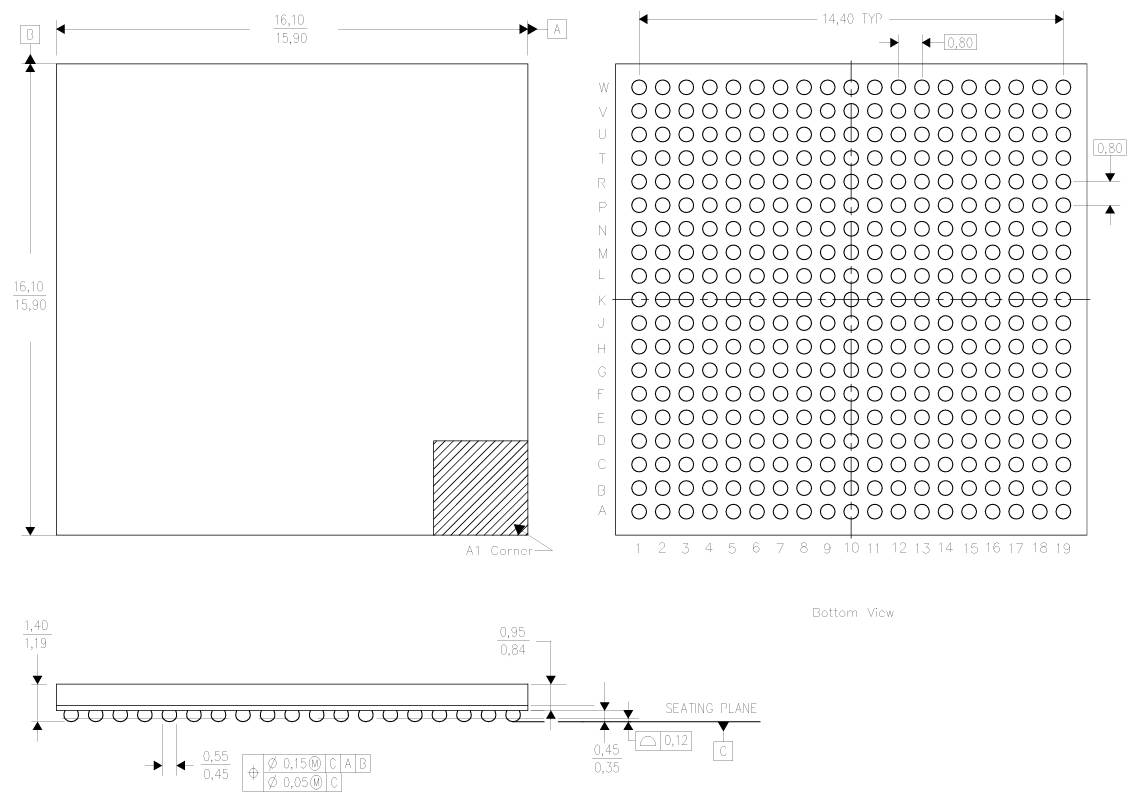
|
Type |
Parameter |
|
Package Type |
NFBGA (361-ball, ZWT) |
|
Ball Grid Array |
16 × 16 |
|
Pin Count |
361 |
|
Overall Length (L) |
17.5 mm |
|
Overall Width (W) |
15.45 mm |
|
Body Size Range |
15.90 mm – 16.10 mm |
|
Ball Pitch |
0.80 mm |
|
Ball Diameter |
0.45 mm – 0.55 mm |
|
Package Height (H) |
1.19 mm – 1.40 mm |
|
Ball Height (Stand-off) |
0.35 mm – 0.45 mm |
|
Seating Plane Tolerance |
±0.12 mm |
|
Corner Index (A1) |
Marked reference corner |
TMS320C6421ZWT5 Manufacturer
The TMS320C6421ZWT5 is manufactured by Texas Instruments (TI), a leading American semiconductor company headquartered in Dallas, Texas. TI is globally known for its innovations in analog and embedded processing technologies, providing solutions that power a wide range of industries including telecommunications, automotive, industrial automation, and consumer electronics. With decades of expertise in developing high-performance digital signal processors, TI has established the TMS320 family as a cornerstone for signal processing applications. The company also supports with comprehensive design tools, software environments, and documentation, ensuring reliable integration of its DSP products into advanced embedded systems.
Conclusion
The TMS320C6421ZWT5 stands out for its strong fixed-point performance, flexible memory system, and rich connectivity that suit demanding applications in communications, audio, video, and automation. Its design makes development efficient through Code Composer Studio, with tools for optimization and debugging on hardware. The processor provides good scalability, strong integration, and wide support, though it trades off some power-saving and security features. Overall, it offers a dependable balance of performance, memory, and interfaces, supported by TI’s ecosystem and proven C6000 platform, making it a practical choice for advanced embedded projects.
Datasheet PDF
TMS320C6421ZWT5 Datasheets:
About us
ALLELCO LIMITED
Read more
Quick inquiry
Please send an inquiry, we will respond immediately.
Frequently Asked Questions [FAQ]
1. Is the TMS320C6421ZWT5 compatible with older TI DSPs?
Yes. It maintains upward code compatibility with earlier C6000 devices, which helps reuse existing projects and shorten development cycles.
2. How does the TMS320C6421ZWT5 compare to low-power DSPs?
While it consumes more power than ultra-low-power DSPs, it offers far higher processing throughput, richer peripherals, and faster memory interfaces, making it better suited for performance-intensive designs.
3. Can the TMS320C6421ZWT5 be used in networked applications?
Yes. With an integrated 10/100 Ethernet MAC and VLYNQ interface, the processor supports network connectivity, enabling it to work well in communication and data-sharing environments.
4. Does this DSP support external memory expansion?
Yes. The TMS320C6421ZWT5 includes a DDR2 SDRAM controller and EMIF interface, allowing connection to NOR or NAND flash for larger storage requirements.
5. How does the TMS320C6421ZWT5 handle multitasking?
Its VLIW core executes up to eight instructions per cycle, supported by EDMA for fast data transfers, making it efficient at handling multiple tasks simultaneously.
EPM1270F256C4N MAX II CPLD Overview: Features, Specifications and Applications
on August 28th
MC9328MX21CVM Processor: Features, Specifications, Applications and Alternatives
on August 26th
Popular Posts
-

Complex Instruction Set Computers: How They Changed Computing?
on April 17th 147712
-

USB-C Pinout and Features
on April 17th 111697
-
Using Xilinx Unified Simulation Primitives: A Comprehensive Guide to FPGA Design and Simulation
on April 17th 111316
-

Power Supply Voltages in Electronics: Meaning of VCC, VDD, VEE, VSS, and GND
on April 17th 83590
-

RJ45 Connector Guide: Pinout, Wiring, Cable Types, and Uses
on January 1th 79246
-

The Ultimate Guide to Wire Color Codes in Modern Electrical Systems
The way our electrical systems use colors isn’t just for looks. Each wire color now indicates a specific function, making it easier to identify and handle electrical components correctly during ins...on January 1th 66762
-

Quality (Q) Factor: Equations and Applications
The quality factor, or 'Q', is important when checking how well inductors and resonators work in electronic systems that use radio frequencies (RF). 'Q' measures how well a circuit minimizes energy...on January 1th 62934
-
Purge Valve Guide: Function, Symptoms, Testing, and Replacement for Optimal Engine Performance
The purge valve is a key part of a car’s system that helps keep the air clean by managing fuel vapors before they can escape into the atmosphere. This not only helps the environment by reducing pol...on January 1th 62807
-

Achieving Peak Performance with the Maximum Power Transfer Theorem
The Maximum Power Transfer Theorem explains how energy from a source, such as a battery or generator, flows to a connected load. It shows the exact condition where the load receives the most power....on January 1th 54027
-

A23 Battery Specifications and Compatibility
The A23 battery is a small, cylinder-shaped battery with high voltage. Also called 23A, 23AE, or MN21, it runs at 12 volts and much higher than AA or AAA batteries. Its special design make...on January 1th 51959
HOT Part Number
-
ATSAM4S16BA-AU
Atmel
IC MCU 32BIT 1MB FLASH 64LQFP
TPS74650PQWDRBRQ1
Texas Instruments
IC POWER
AD7511DIKQ
Analog Devices Inc.
IC SW SPST-NCX4 100OHM 16CERDIP
HSMP-381F-TR1G
Broadcom Limited
RF DIODE PIN 100V SOT323
CAT5111LI-50-G
onsemi
IC POT DGTL 50K 100TAP 8DIP
MMA02040C1151FB300
Vishay Beyschlag/Draloric/BC Components
RES 1.15K OHM 1% 2/5W MELF 0204
P6SMB15A
Eaton - Electronics Division
TVS DIODE 12.8VWM 21.2VC SMB
LDL212PUR
STMicroelectronics
IC REG LINEAR POS ADJ 1.2A 6DFN
SMA6L16A
Littelfuse Inc.
TVS DIODE 16VWM 26VC DO221AC
MIC4451BM
Microchip Technology
IC GATE DRVR LOW-SIDE 8SOIC
UMK105CG680JVHF
Taiyo Yuden
CAP CER 68PF 50V C0G/NP0 0402
MCP4562T-503E/MF
Microchip Technology
IC DGT POT 50KOHM 257TAP 8DFN
PMV60ENEAR
Nexperia USA Inc.
MOSFET N-CH 40V 3A TO236AB
RFPIC12F675H-I/SS
Microchip Technology
IC MCU 1KX14 RF FSK/ASK 20SSOP
BRC2012T1R5MD
Taiyo Yuden
FIXED IND 1.5UH 1.1A 117MOHM SMD
SIP4282DVP3-T1GE3
Vishay Siliconix
IC PWR SWITCH P-CHAN 1:1 PWRPAK
VSC8641XKO-03
Microchip Technology
IC INTERFACE CONTROLLER
MX25L1633EM2I-10G
Macronix
IC FLASH 16MBIT SPI 104MHZ 8SOP -

MAX500BEJE
Analog Devices Inc./Maxim Integrated
IC DAC 8BIT V-OUT 16CDIP
TFZVTR6.8B
Rohm Semiconductor
DIODE ZENER 6.8V 500MW TUMD2M
ATF22LV10CZ-25JC
Microchip Technology
IC PLD 10MC 25NS 28PLCC
MAX6316LUK46BX
Analog Devices Inc./Maxim Integrated
IC SUPERVISOR 1 CHANNEL SOT23-5
IDT49FCT3805AQ8
Renesas Electronics America Inc
IC CLK BUFFER 1:5 20QSOP
BC846B
Diotec Semiconductor
BJT SOT-23 65V 100MA
T494C226K016AT
KEMET
CAP TANT 22UF 10% 16V 2312
S912XEQ512BCAA
NXP USA Inc.
IC MCU 16BIT 512KB FLASH 80QFP
5.0SMDJ33A
MDE Semiconductor Inc
TVS DIODE UP 33VRWM 53.3VC
MMBD1703A
Fairchild Semiconductor
RECTIFIER DIODE
S-1172B36-U5T1G
ABLIC Inc.
IC REG LINEAR 3.6V 1A SOT89-5
PIC16F616-I/ST
Microchip Technology
IC MCU 8BIT 3.5KB FLASH 14TSSOP
0454005.MR
Littelfuse Inc.
FUSE BRD MNT 5A 125VAC/VDC 2SMD
XCS40XL-4PQ240C
AMD
IC FPGA 192 I/O 240QFP
SNJ54HC151J
Texas Instruments
8-LINE TO 1-LINE DATA SELECTORS/
MT53E1G64D4SQ-046 WT:A
Micron Technology Inc.
IC DRAM 64GBIT 2.133GHZ WFBGA
MP2106DK-LF
Monolithic Power Systems Inc.
IC REG BUCK ADJ 800MA 10MSOP
293D226X9010C2TE3
Vishay Sprague
CAP TANT 22UF 10% 10V 2312 -

SD103AW-E3-18
Vishay General Semiconductor - Diodes Division
DIODE SCHOTTKY 40V SOD123
C8051F304-GM
Silicon Labs
IC MCU 8BIT 4KB FLASH 11QFN
LM2724M
Texas Instruments
IC GATE DRVR HALF-BRIDGE 8SOIC
XCZU27DR-1FFVE1156I
Xilinx
XCZU27DR-1FFVE1156I
PCA9535CD,112
NXP USA Inc.
IC XPNDR 400KHZ I2C SMBUS 24SO
NLV25T-101J-PF
TDK Corporation
FIXED IND 100UH 60MA 21 OHM SMD
MAX4008EUT+T
Analog Devices Inc./Maxim Integrated
IC CURRENT MONITOR 1% SOT6
1206CA181JAT1A
KYOCERA AVX
CAP CER 180PF 630V NP0 1206
BSC0902NSATMA1
Infineon Technologies
MOSFET N-CH 30V 24A/100A TDSON
NFM3DCC222R1H3L
Murata Electronics
CAP FEEDTHRU 2200PF 50V 1205
DG212BDY-T1-E3
Vishay Siliconix
IC SWITCH SPST-NOX4 85OHM 16SOIC
MBR130LSFT1
onsemi
DIODE SCHOTTKY 30V 1A SOD123FL
IS61LV12816L-10TLI-TR
ISSI, Integrated Silicon Solution Inc
IC SRAM 2MBIT PARALLEL 44TSOP II
UCC38502N
Texas Instruments
IC PFC CTR AV CURR 100KHZ 20DIP
DS1090U-16+T
Analog Devices Inc./Maxim Integrated
IC CLOCK GENERATOR 8UMAX
MAX17806ETI+T
Analog Devices Inc./Maxim Integrated
ADVANCED SMART BATTERY PACK CONT
IDT7208L35P
Renesas Electronics America Inc
IC FIFO 64KX9 35NS 28DIP
V300B5C150BG
Vicor Corporation
DC DC CONVERTER 5V 150W