Understanding the AD5328BRU 12-Bit Digital to Analog Converter
You work with systems that need more than one stable voltage, and the AD5328BRU fits naturally into that setup. You can control up to eight outputs from a single chip, keeping your layout clean and simple. Each channel gives you smooth, predictable voltage changes, making adjustments easy to manage. With a serial interface and buffered outputs, you spend less time adding extra parts and more time focusing on how everything works together. It’s a straightforward way to handle multi-channel voltage control without unnecessary complexity.Catalog
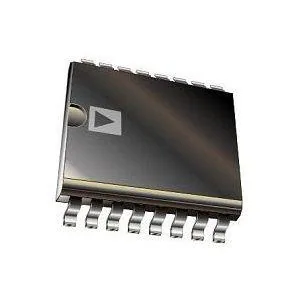
AD5328BRU Overview
The AD5328BRU is a 12 bit digital to analog converter that provides eight independent voltage output channels within a single surface mount device. It converts digital input data into stable analog levels suitable for systems that require coordinated multi channel control. Each output is internally buffered, which supports direct connection to external circuits without added components. The device communicates through a serial interface, allowing simple integration with digital control logic. Common uses include signal adjustment, voltage setting, and multi channel control in measurement and automation equipment. Looking for AD5328BRU? Contact us to check current stock, lead time, and pricing.
AD5328BRU Pinout Details
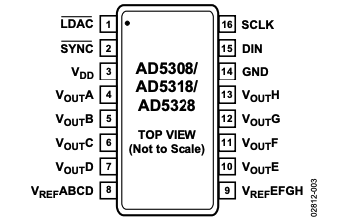
AD5328BRU Pin Description
| Pin Number | Pin Name | Description |
| 1 | LDAC | Active low control that transfers input register data to DAC registers |
| 2 | SYNC | Active low frame sync for serial data transfer |
| 3 | VDD | Power supply input, 2.5 V to 5.5 V |
| 4 | VOUTA | Buffered analog output from DAC A |
| 5 | VOUTB | Buffered analog output from DAC B |
| 6 | VOUTC | Buffered analog output from DAC C |
| 7 | VOUTD | Buffered analog output from DAC D |
| 8 | VREFABCD | Reference input for DAC channels A to D |
| 9 | VREFEFGH | Reference input for DAC channels E to H |
| 10 | VOUTE | Buffered analog output from DAC E |
| 11 | VOUTF | Buffered analog output from DAC F |
| 12 | VOUTG | Buffered analog output from DAC G |
| 13 | VOUTH | Buffered analog output from DAC H |
| 14 | GND | Ground reference for device |
| 15 | DIN | Serial data input |
| 16 | SCLK | Serial clock input |
AD5328BRU CAD Model
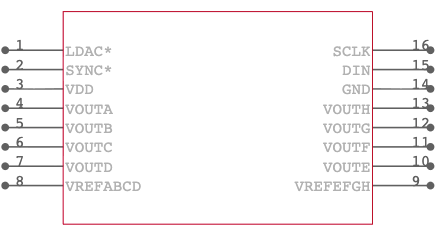
AD5328BRU Symbol
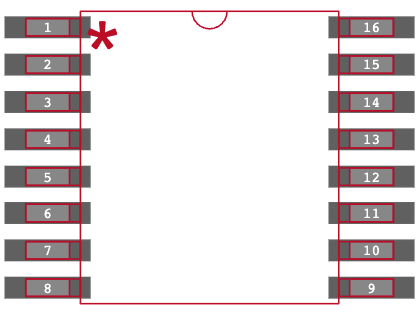
AD5328BRU Footprint
AD5328BRU 3D Model
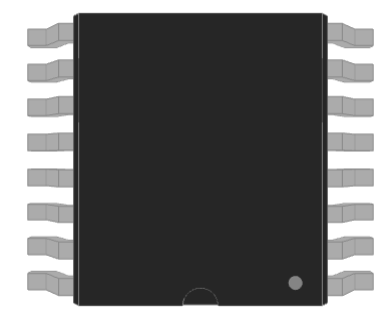
Features of AD5328BRU
High Resolution Digital to Analog Conversion
The device provides 12 bit resolution, producing 4096 distinct output levels. This resolution allows precise adjustment of output voltages, supporting applications that require smooth control and consistent signal steps across the full output range.
Eight Independent Output Channels
Eight separate DAC channels are integrated within a single device. Each channel operates independently, allowing multiple voltage outputs to be controlled at the same time without interaction, which simplifies multi channel system design.
Buffered Voltage Output Structure
Each output includes an internal buffer stage. This buffering allows the output to directly drive external circuits while maintaining stable voltage levels, reducing the need for additional external components.
Fast Output Settling Response
The output voltage settles to its final value in approximately 10 microseconds. This response time supports systems that require timely voltage updates without long delays between code changes.
Serial Digital Interface Support
The device uses a serial interface that aligns with common digital control protocols. This makes it suitable for connection to a wide range of digital control logic using minimal signal lines.
External Reference Voltage Control
An external reference input is provided to define the full scale output range. This allows the output span to be adjusted to match specific system voltage requirements.
Wide Supply Voltage Operating Range
Both the analog and digital sections operate from supply voltages between 2.5 volts and 5.5 volts. This flexibility supports use in low voltage systems and mixed supply environments.
String Based Conversion Architecture
The internal string based conversion structure supports monotonic output behavior and reduces output disturbances during code transitions, helping maintain smooth and predictable voltage changes.
AD5328BRU Technical Specifications
| Product Attribute | Attribute Value |
| Manufacturer | Analog Devices, Inc. |
| Voltage - Supply, Digital | 2.5V ~ 5.5V |
| Voltage - Supply, Analog | 2.5V ~ 5.5V |
| Supplier Device Package | 16-TSSOP |
| Settling Time | 10µs |
| Reference Type | External |
| Package / Case | 16-TSSOP (0.173", 4.40mm Width) |
| Package | Tube |
| Output Type | Voltage - Buffered |
| Operating Temperature | -40°C ~ 125°C |
| Number of D/A Converters | 8 |
| Number of Bits | 12 |
| Mounting Type | Surface Mount |
| INL/DNL (LSB) | ±2, ±0.2 |
| Differential Output | No |
| Data Interface | SPI, DSP |
| Architecture | String DAC |
| Base Product Number | AD5328 |
| Moisture Sensitivity Level (MSL) | 1 (Unlimited) |
| ECCN | EAR99 |
| HTSUS | 8542.39.0001 |
Functional Block Diagram of AD5328BRU
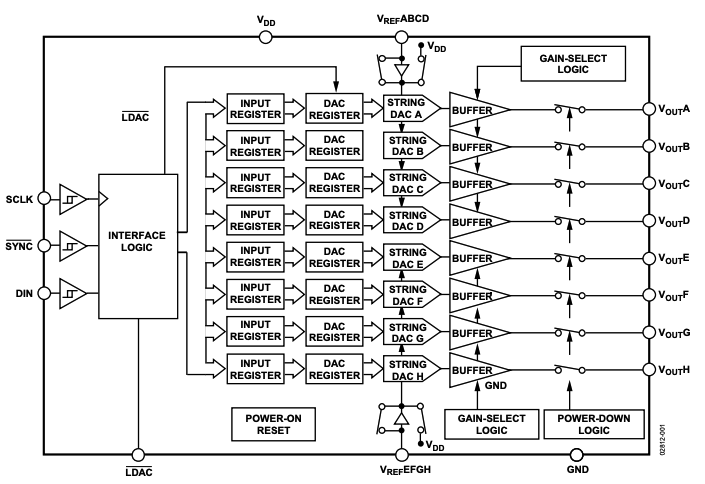
Internal structure is organized around eight identical DAC channels labeled A through H, each built from an input register, DAC register, resistor string core, and output buffer to generate independent analog voltages. Digital control enters through a serial interface using DIN, SCLK, SYNC, and LDAC signals, which manage data loading and register updates across all channels. Two reference inputs, VREFABCD and VREFEFGH, supply programmable full scale levels for separate channel groups, while gain select logic defines output scaling. Power on reset and power down logic manage startup behavior and channel disabling, and buffered outputs VOUTA through VOUTH provide low impedance voltage outputs referenced to VDD and GND.
Typical Application Circuit of AD5328BRU
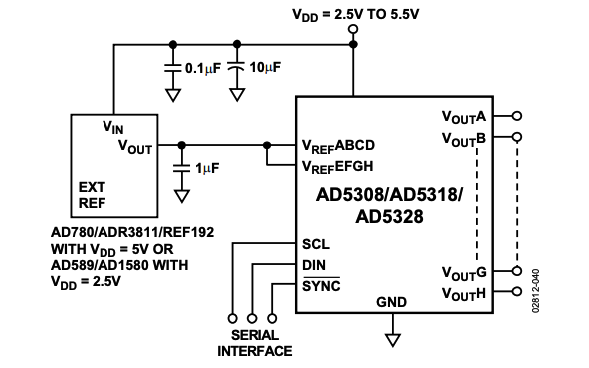
Circuit configuration presents the AD5328BRU operating with an external voltage reference and a single supply ranging from 2.5 V to 5.5 V. The reference source is connected to the VREFABCD and VREFEFGH pins and is decoupled with a local capacitor to ensure stable reference input for all DAC channels. Supply decoupling is implemented using parallel 0.1 µF and 10 µF capacitors connected between VDD and ground to reduce noise. The serial interface uses SCLK, DIN, and SYNC lines to load digital data, while buffered outputs VOUTA through VOUTH provide independent analog voltages referenced to the external source.
Applications of AD5328BRU
Industrial Automation and Process Control Systems
The AD5328BRU is used to generate control voltages for actuators, valves, and control loops in automated systems. Its multiple output channels allow several process variables to be adjusted from a single device, supporting coordinated and repeatable control in factory and plant environments.
Multi-Channel Data Acquisition Equipment
In data acquisition systems, the device provides programmable reference and calibration voltages across multiple channels. This supports signal conditioning tasks where consistent and adjustable analog levels are needed alongside digital measurement circuits.
Programmable Power Supplies and Bias Generation
The device is suitable for setting output levels in programmable power supplies and bias circuits. Its ability to produce stable voltages across several channels allows different bias points to be controlled independently within the same system.
Audio and Signal Level Control Systems
In audio and general signal control applications, the AD5328BRU adjusts gain levels, offsets, and reference voltages. Smooth output transitions help maintain controlled level changes without abrupt steps during adjustment.
Battery-Powered and Portable Instrumentation
Portable instruments use the device to manage reference voltages and adjustable output levels while operating from low supply voltages. Its integration helps reduce circuit size, which supports compact and power aware designs.
Communication and Test Measurement Systems
The device is applied in communication and test setups to generate programmable voltage levels for tuning, offset control, and signal simulation. Multiple outputs allow different test points to be driven under coordinated digital control.
Outline Dimensions of AD5328BRU
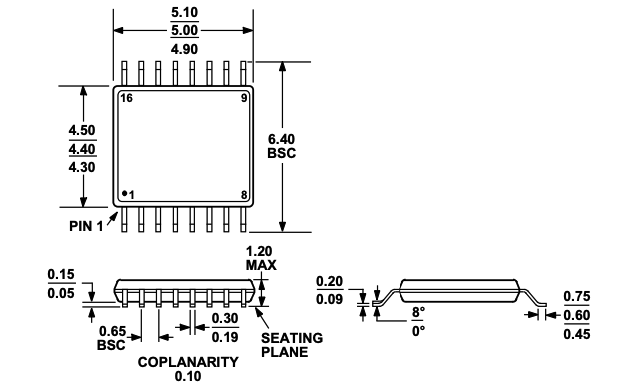
Mechanical drawing defines the physical size and layout of the 16 lead surface mount package, showing a nominal body width and length of approximately 5.00 mm with allowable tolerances. Pin numbering is indicated from pin 1 to pin 16 to establish correct orientation during assembly. Lead pitch is specified at 0.65 mm with controlled coplanarity to ensure proper solder contact on the seating plane. Maximum package height is limited to about 1.20 mm, and side profile views indicate lead bend angles and standoff dimensions that support reliable mounting on printed circuit boards.
Advantages and Disadvantages of AD5328BRU
Advantages
• Eight output channels support compact multi output designs
• Buffered outputs allow direct connection to external circuits
• Wide supply voltage range fits low voltage and standard systems
• Predictable output behavior supports stable voltage control
• Integrated design reduces overall part count
Disadvantages
• 12 bit resolution limits very fine voltage adjustment
• Output settling speed is moderate rather than fast
• External reference input adds an extra design step
• Serial interface limits update rate in some systems
AD5328BRU Alternatives
| Part Number | Manufacturer | Key Features | Use Case/Notes |
| AD5328BRUZ-REEL7 | Analog Devices Inc. | 12-bit octal DAC with buffered voltage outputs, SPI-compatible interface, low power operation, and support for external reference. Supplied in tape and reel for automated assembly. | Designed for high-volume production where multiple precise analog outputs are required in compact, surface-mount designs. |
| AD5328BRUZ | Analog Devices Inc. | Same 12-bit resolution and eight buffered voltage outputs, SPI/DSP interface support, and wide supply voltage range in tube packaging. | Suitable for prototyping, testing, or low-volume production where manual handling is preferred. |
| AD5328BRUZ-REEL | Analog Devices Inc. | Identical electrical performance to the tube version, featuring eight-channel 12-bit DAC architecture with buffered outputs and serial control. | Ideal for automated PCB assembly processes in industrial, instrumentation, and embedded control applications. |
About Analog Devices, Inc.
Analog Devices, Inc. is a global technology company known for developing analog, mixed signal, and digital signal processing solutions. The company serves a wide range of markets, including industrial systems, communications, healthcare, automotive, and instrumentation. Its product portfolio includes data converters, amplifiers, power management devices, sensors, and signal processing components that support accurate measurement and control. Analog Devices places strong emphasis on long product lifecycles, system level performance, and consistency across product families, which helps designers build reliable platforms that can be maintained and scaled over time.
Conclusion
The AD5328BRU gives you a simple way to manage multiple voltage outputs from one compact device. Its 12-bit resolution offers smooth control, while eight buffered channels help reduce extra circuitry. The serial interface keeps connections minimal and easy to handle. With flexible supply and reference options, it fits comfortably into many systems. You also benefit from predictable output behavior that supports stable operation. Overall, it’s a practical choice when you want clean, multi-channel analog control without added complexity.
Datasheet PDF
AD5328BRU Datasheet:
About us
ALLELCO LIMITED
Read more
Quick inquiry
Please send an inquiry, we will respond immediately.
Frequently Asked Questions [FAQ]
1. What does the AD5328BRU do?
It converts digital data into analog voltages across eight separate output channels.
2. How many output channels does the AD5328BRU have?
It provides eight independent buffered voltage outputs labeled A through H.
3. What resolution does the AD5328BRU support?
The device offers 12-bit resolution, giving 4096 possible output levels.
4. Does the AD5328BRU need an external reference?
Yes, it uses external reference inputs to define the full-scale output range.
5. What types of systems commonly use the AD5328BRU?
It’s often used in automation, measurement, signal control, and programmable voltage applications.
XC2V500-5FGG456C Programmable Logic Device Specs and Uses
on December 23th
What Makes the AD7846JP 16-Bit DAC a Reliable Choice
on December 23th
Popular Posts
-

Complex Instruction Set Computers: How They Changed Computing?
on April 19th 147782
-

USB-C Pinout and Features
on April 19th 112066
-
Using Xilinx Unified Simulation Primitives: A Comprehensive Guide to FPGA Design and Simulation
on April 19th 111352
-

Power Supply Voltages in Electronics: Meaning of VCC, VDD, VEE, VSS, and GND
on April 19th 83824
-

RJ45 Connector Guide: Pinout, Wiring, Cable Types, and Uses
on January 1th 79640
-

The Ultimate Guide to Wire Color Codes in Modern Electrical Systems
The way our electrical systems use colors isn’t just for looks. Each wire color now indicates a specific function, making it easier to identify and handle electrical components correctly during ins...on January 1th 67004
-
Purge Valve Guide: Function, Symptoms, Testing, and Replacement for Optimal Engine Performance
The purge valve is a key part of a car’s system that helps keep the air clean by managing fuel vapors before they can escape into the atmosphere. This not only helps the environment by reducing pol...on January 1th 63128
-

Quality (Q) Factor: Equations and Applications
The quality factor, or 'Q', is important when checking how well inductors and resonators work in electronic systems that use radio frequencies (RF). 'Q' measures how well a circuit minimizes energy...on January 1th 63067
-

Achieving Peak Performance with the Maximum Power Transfer Theorem
The Maximum Power Transfer Theorem explains how energy from a source, such as a battery or generator, flows to a connected load. It shows the exact condition where the load receives the most power....on January 1th 54097
-

A23 Battery Specifications and Compatibility
The A23 battery is a small, cylinder-shaped battery with high voltage. Also called 23A, 23AE, or MN21, it runs at 12 volts and much higher than AA or AAA batteries. Its special design make...on January 1th 52218
HOT Part Number
-

LM78M24CT
Fairchild Semiconductor
IC REG LINEAR 24V 500MA TO220-3
TLE2024CDWR
Texas Instruments
IC OPAMP GP 4 CIRCUIT 16SOIC
SPX3940M3-L-1-8/TR
Sipex
IC REG LINEAR 1.737V 100MA
PIC18LF4520-I/PT
Microchip Technology
IC MCU 8BIT 32KB FLASH 44TQFP
LCMXO2-256ZE-3SG32I
Lattice Semiconductor Corporation
IC FPGA 21 I/O 32QFNS
DRV5053EAQDBZTQ1
Texas Instruments
SENSOR HALL ANALOG SOT23-3
NJM317DL1-TE1
Nisshinbo Micro Devices Inc.
IC REG LIN POS ADJ 1.5A TO252-3
AD7572AJRZ10
Analog Devices Inc.
IC ADC 12BIT SAR 24SOIC
LTC1418ACG#PBF
Analog Devices Inc.
IC ADC 14BIT SAR 28SSOP
VF40100C-E3/45
Vishay General Semiconductor - Diodes Division
DIODE ARRAY SCHOTTKY 100V ITO220
AD7777AR-REEL
Analog Devices Inc.
IC ADC 10BIT 4CH HS 28-SOIC T/R
PI3A288ZMEX
Diodes Incorporated
IC SWITCH SPDTX2 350MOHM 10UQFN
AF0603FR-0710KL
Yageo
RES SMD 10K OHM 1% 1/10W 0603
WSL2512R0650FEA
Vishay Dale
RES 0.065 OHM 1% 1W 2512
T810-800G-TR
STMicroelectronics
TRIAC SENS GATE 800V 8A D2PAK
SI8430AB-D-ISR
Skyworks Solutions Inc.
DGTL ISO 2500VRMS 3CH GP 16SOIC
1N4753A
NTE Electronics, Inc
DIODE ZENER 36V 1W AXIAL
IS62C1024AL-35QLI-TR
ISSI, Integrated Silicon Solution Inc
IC SRAM 1MBIT PARALLEL 32SOP -
TLV2444CPWR
Texas Instruments
IC CMOS 4 CIRCUIT 14TSSOP
MC10H646FN
onsemi
IC CLK BUFFER 2:8 80MHZ 28PLCC
LQM18PN2R2MDHD
Murata Electronics
FIXED IND 2.2UH 650MA 475MOHM SM
2225GC153KAT1A
KYOCERA AVX
CAP CER 0.015UF 2KV X7R 2225
LTM4653IY
Analog Devices Inc.
DC DC CONVERTER 0.5-54.5V
MBR20S100CTTU
onsemi
DIODE ARRAY SCHOTTKY 100V TO220
MMBT489LT1G
onsemi
TRANS NPN 30V 1A SOT23-3
C1206C301J5GAC7800
KEMET
CAP CER 300PF 50V C0G/NP0 1206
EP1C4F324C7N
Intel
IC FPGA 249 I/O 324FBGA
STA2064N2
STMicroelectronics
IC AUDIO INFOTAINMENT
LT1720IDD#PBF
Analog Devices Inc.
IC COMPARATOR 2 GEN PUR 8DFN
HZM4.7NB3TR-E
Renesas Electronics America Inc
DIODE ZENER
TMPM380FWFG
Toshiba Semiconductor and Storage
IC MCU 32BIT 128KB FLASH 100LQFP
GRM0335C1E680FA01J
Murata Electronics
CAP CER 68PF 25V C0G/NP0 0201
CL32B334KBFNNNE
Samsung Electro-Mechanics
CAP CER 0.33UF 50V X7R 1210
LH28F016SCT-L95
Sharp Microelectronics
IC FLASH 16MBIT PARALLEL 40TSOP
AD5721BRUZ
Analog Devices Inc.
IC DAC 12BIT V-OUT 16TSSOP
06031C331KA14A
KYOCERA AVX
CAP CER 330PF 100V X7R 0603 -

PEX8747-CA80FBCG
Broadcom Limited
PEX8747-CA80FBC G
NZ9F12VT5G
onsemi
DIODE ZENER 12V 250MW SOD923
2SAR544RTL
Rohm Semiconductor
TRANS PNP 80V 2.5A TSMT3
CBS504803
Cosel USA, Inc.
DC DC CONVERTER 3.3V 39W
ADRF5020BCCZN-R7
Analog Devices Inc.
IC RF SWITCH SPDT 30GHZ 20LGA
DS92LV0411SQE
Texas Instruments
LINE DRIVER
TLV320AIC23GQE
Texas Instruments
IC AUDIO CODEC 32BIT SER 80-BGA
CSTCW60M0X51-R0
Murata Electronics
CER RESONATOR
INA240A3DR
Texas Instruments
IC CURRENT SENSE 1 CIRCUIT 8SOIC
FDS4141
onsemi
MOSFET P-CH 40V 10.8A 8SOIC
MAX11615EEE+T
Analog Devices Inc./Maxim Integrated
IC ADC 12BIT SAR 16QSOP
A5940GLNTR-T
Allegro MicroSystems
IC MOTOR DRIVER 10SSOP
NSVB143ZPDXV6T1G
onsemi
TRANS PREBIAS NPN/PNP 50V SOT563
NSR0340P2T5G
onsemi
DIODE SCHOTTKY 40V 200MA SOD923
SN74CB3Q3305PWR
Texas Instruments
IC BUS SWITCH 1 X 1:1 8TSSOP
SS0540_R1_00001
Panjit International Inc.
DIODE SCHOTTKY 40V 500MA SOD123
FDME1023PZT
Fairchild Semiconductor
SMALL SIGNAL FIELD-EFFECT TRANSI
SN74LVTH374DWR
Texas Instruments
IC FF D-TYPE SNGL 8BIT 20SOIC